Clothing and nekkidness in the Meiji era

I am fascinated by this lengthy narrative of how Japan evolved from a nation where “scant clothing… was mainly an indication of manual labor” to one where “virtually all Japanese wear underwear.” (Warning: Most links in the article lead to old pictures of naked people which are likely to cause problems if viewed at the office.)

It’s an interesting story, not so much because of the scandalous bits (e.g. foreign journalists developing unhealthy fascinations with the neighborhood mixed-gender bathhouse), but also because of the government’s role in forcing these changes on the public as part of the general campaign to make Japan more European.

It isn’t too hard to see how this also helped usher in the current era of WaiWai and pornographic comic books. Standardizing fashion in a modest manner undoubtedly did wonders for the democratization and modernization of Japan, but it also seems to have led to a lot of the sexual repression that generates train groping and hidden camera fetishes today. (Not that I’m complaining: loincloths aren’t my style.)

By the way, there is a wealth of artificially-colorized old Japanese photographs available on Flickr courtesy of one “Okinawa Soba.” Among my favorites:

Press competition circa 1969

I was just reading a sweet TIME article from May 1969 entitled “Japanese Air Force.” It’s about the fleets of small aircraft which Japanese newspapers used to move reporters and information around at high speeds, back before they had bullet trains or broadband.

This passage is particularly exciting to read, and does a lot to help restore the credibility of a certain everyday newspaper:

Mainichi’s newsmen still gloat about a photo they got of the Rising Sun replacing the Stars and Stripes over Iwo Jima last summer, even though the ceremony marking the return of Japanese sovereignty ended just 15 minutes before the paper’s evening deadline. As the ceremony ended, a Beechcraft took off from Iwo Jima, 775 miles south of Tokyo, and negatives were processed aboard. Another plane sped toward Iwo, received the photos by radio when the planes were 250 miles apart, then turned toward Hachijo Jima, 175 miles south of Tokyo. While still in the air, the second plane radioed the pictures to a ground station at Hachijo, which then transmitted them to Tokyo by undersea cable. No other evening paper pictured that historic event.

I can’t help but think that as technology continues to advance, logistics will become a lost art. Nowadays we can use e-mail and FedEx to get anything done in short time–what will happen when we have, say, networked matter replicators?

Incidentally, a google image search for “japanese air force” turns up the following picture, which according to a humor blog is some sort of Jieitai training:

Obituary: Mainichi WaiWai

WaiWai is dead. WaiWai, we hardly knew you.

I like Yomiuri’s article on the matter, which says (in part):

The corner reportedly began carrying sensationalized stories on dubious topics containing seriously vulgar expressions over at least the past six years, with headlines such as “Fast food sends schoolgirls into sexual feeding frenzy.”

Yes, WaiWai, you will be missed. I guess us bloggers will have to pick up the slack, but it’ll be hard for us to match the style with which you brought all the crazy stuff from Japan to an international audience.

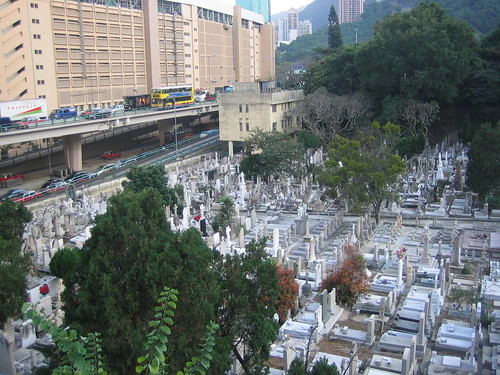
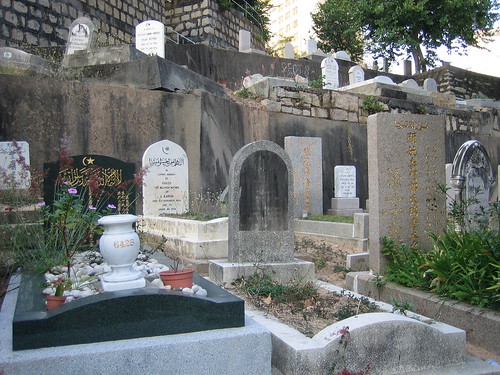
Muslim cemetery in Hong Kong

In Hong Kong over New Year’s, I hopped on board one of the island’s incredibly cheap streetcars and randomly rode from Central, the bustling business center of the city, to the quieter but still absurdly developed alcove of Happy Valley. The district is best known for its racecourse, which (not being a fan of equestrian sports) I first learned about from James Clavell’s very fun novel Noble House.

The name “Happy Valley” comes from the area’s use as a burial ground during the early days of the colony. As was the case in many tropical colonies (see Guns, Germs and Steel), the hot climate and marshy terrain of the island were quite incompatible with the Europeans moving in, and the resulting waves of diseases made Happy Valley one of the most populous areas of Hong Kong (if you’re counting corpses).

Even today, the cemeteries of Happy Valley are its most prominent and unique feature, next to the famous racecourse which is literally right across the street.

One of the more fascinating parts of the cemetery is the Muslim section, which happened to be open as I walked past. The headstones, dating from throughout Hong Kong’s history, are written in varying combinations of Arabic, Chinese and English.

The Muslim cemetery occupies a number of slopes wrapped around a hill, which makes it an excellent vantage point for viewing the lower, flatter Catholic cemetery below. Another case of awesome real estate wasted on dead people.

DSL in Japan, update

I mentioned the other day how it takes an entire month of waiting to get DSL installed in Japan, due to control of the local loop remaining entirely with the former government monopoly telecom NTT, while service can be provided by a variety of competitors. One of the interesting side effects of this is that no matter who your provider is, the physical line installation at the home is still performed by NTT. And because installation will be performed not by my service provider KDDI, instead of having the installer bring along the modem and accessories, they mail it in advance. I am not sure if this is because NTT refuses to cooperate and deliver the modem for another company’s service, despite being legally obligated to perform the local loop installation required for service connection, or if KDDI (I think Softbank does the same thing, but I forget) has merely decided that it is logistically simpler to send modems through the package delivery infrastructure.

And speaking of the package delivery infrastructure, I was very impressed by Kuroneko Takkyubin’s service. When I got home last night at around 8:30 there was one of those failed delivery notification notices in my mailbox. Oddly, the time written on it was 10 o’clock, which makes not sense at all, since I was at home until around 11am, and it was still well before 10pm. Regardless, the notice had the standard information on how to contact either the automated phone system, the internet website, or a live switchboard operator to schedule redelivery- but also had a somewhat astonishing fourth option: the cell phone number of the delivery truck driver who had attempted delivery that day. Since it said he was reachable until 9pm, I called up, the call was answered instantly, and once I told him my name and address, he said to stay and wait for him. I assumed I would be waiting for several minute, but there was a knock on my door, literally, at most two minutes later!

And thus is customer service in Japan-a melange of impenetrable bureaucracy and inflexible, pointless rules for some things, but in other areas some of the most helpful and convenient services found anywhere.

Free Aung San Suu Kyi Free Free!

As part of Tokyo’s Earth Day festivities last weekend, author/rapper Seiko Ito held a poetry reading set to techno music, dedicated to the message of setting Burma free from tyranny. From the Burma Info website:

In the following video clip of the performance, Ito can be seen reading his statement, demanding that the military regime stop killing, beating, and imprisoning monks, and enter into dialogue. Htin Aung, the Democratic Voice of Burma stringer in Tokyo , reads out a statement in Burmese.

With a double DJ, Ito’s reading quickly turns into a hip-hop event. The audience rises, and many begin dancing and responding to Ito ‘ s calls, waving arms, signs, and in some cases, babies. It was likely the first time ever that this many Japanese in one place expressed their support for a free Burma.

Watch the video here.

Here is my unauthorized translation of the poem:

You must not intimidate the nonresisting monks
You must not beat the nonresisting monks
You must not imprison the nonresisting monks
You must not kill the nonresisting monks

For they are outside the realm of power
And live under a wholly separate Law

Intimidating, beating, imprisoning, and killing such people is an overwhelming failure to understand, an overwhelming act of violence, in short the destruction of the other.

And, we too are the Other!

You must not intimidate the nonresisting monks
You must not beat the nonresisting monks
You must not imprison the nonresisting monks
You must not kill the nonresisting monks

For they are outside the realm of power
And resolutely possess a freedom to live under a wholly separate Law

Intimidating, beating, imprisoning, and killing such people is an overwhelming failure to understand, an overwhelming act of violence, in short the destruction of the other.

You must not destroy others
You must not destroy them, nor us

Don’t intimidate them!
Don’t beat them!
Don’t jail them!
Don’t kill them!

The junta in Myanmar
The Chinese government!

Free Aung San Suu Kyi!

Free the Dalai Lama!

We are they
And they are we!

You must not refuse dialogue!
For dialogue is the sole path to connect the other with the other
If the other and the other are not connected, hence springs intimidation, hence springs beatings, hence springs imprisonment, and hence springs murder!

So talk to them! Talk to them!
Communicate for the sake of dialogue!!
Freedom of speech and freedom of the press exist to prevent intimidation, beatings, imprisonment, and murder
Calling for dialogue and communication is to stand in the way of intimidation, beatings, imprisonment, and murder

The junta in Myanmar
The Chinese government!

Talk to them! Don’t intimidate them!
Talk to them! Don’t beat them!
Talk to them! Don’t jail them!
Talk to them! Don’t kill them!

Talk to them!

We are they
And they are we!

How does a samurai kill a duck?

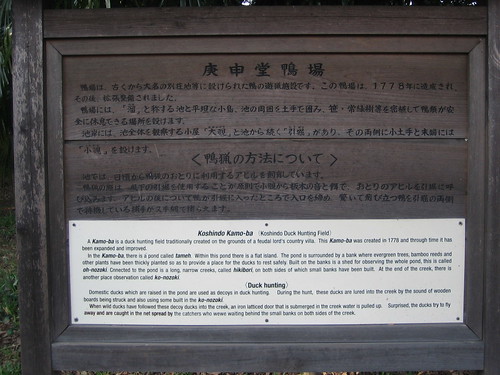
I’m sure you can visualize many possibilities in your head, but if you go to Hamarikyu Gardens in Tokyo you can get an idea of how the shôgun did it back in the day. The general process sounds like it belongs in an ethnic joke book:

  1. Build a pond and a creek.
  2. Raise ducks in the pond.
  3. Hide an iron door and a giant net in the bottom of the creek.
  4. Lure the domesticated ducks into the creek using the sound of wooden boards. (I don’t know why ducks like this sound, but maybe that’s why we eat them, and not the other way around.)
  5. Wait for wild ducks to follow the domestic ducks into the creek.
  6. Pull up the door, scaring the bejeezus out of the ducks.
  7. Pull up the net, catching the ducks.
  8. Laugh heartily and retreat for wild escapades with concubines.

If you don’t believe me, check out the posted explanation in Japanese and Engrish:

Bad-ass

This guy would not be amused.

Taiwan gets a little bit more modern

From The Taipei Times:

A ban on poultry slaughter in traditional markets will take effect on Tuesday as originally scheduled, National Science Council Chairman Chen Chien-jen (陳建仁) said yesterday. “Despite protests by poultry vendors who fear that the ban will affect their livelihood, the policy will go into effect on April 1, and all chicken, geese and ducks should then be slaughtered at licensed abattoirs,” Chen said. But as some complementary measures have yet to be completed, the government will postpone enforcement, originally scheduled for Oct. 1, for three to six months, he said. Chen, who concurrently serves as convener of a Cabinet bird flu epidemic prevention task force, said that preparatory work, such as setting up electric slaughter houses, disinfecting facilities at the abattoirs and launching a food safety publicity drive, is yet to be completed.

I may not exactly be in the habit of buying freshly slaughtered whole chickens at the market (or, for that matter, cooking) I am still mildly and inexplicably saddened at the fact that I will no longer have the opportunity should I once again live in Taiwan.

Linky Desktop

As I am about to permanently disassemble this computer and bring only the hard drives with me to Japan, where I will then assemble a new system after finding a place to live, I figure it would be a good time to post the various things that had been sitting around my desktop in case I ever found the time and motivation to write something about them.

  • Genetic tests have shown that the Taiwanese aborigines are likely to be the ancestors of the entire Polynesian and Micronesian population, which also includes the Malay group, comprising the majority population of the three large countries of Malaysia, Indonesia and The Philippines. While study of archeology and linguistic variation, as well as phenotype analysis of modern populations, had led some researchers to suspect that the ancestors of most Pacific islanders were descended from the ancestors of the pre-Chinese Taiwanese aboriginal population (who themselves migrated across the Taiwan Strait thousands of years ago, when the Han Chinese probably still lived far to the north) but this genetic study provides the strongest evidence yet for the theory.
  • Although Japan may be the only country in which a unique word exists for “chikan”, the phenomenon is hardly unique. I once linked to a New York Times article on the prolificicity of flashers or “bumpers” in the NYC subway, which likely occurs with frequency in any city with a crowded public transit system. Another place famous for it- Mexico City. Apparently the problem is bad enough so they have introduced women only buses, perhaps inspired by Japan’s women-only commuter train cars.
  • U.S. anti-terrorism special operations forces assisting the Philippines military have contracted a Manila-based marketing firm to create comic books with an anti-terrorism message. American style superhero comics are extremely popular in the Philippines, but I am very skeptical that a marketing firm would be able to create a comic with a genuinely compelling story, regardless of how slickly produced the graphics and printing may be. I would love to actually see the comics though, which sound like a prime example of the force that American cultural products still carry in the country, over 60 years after colonialism officially ended there.
  • Korean’s Chosun newspaper has a truly hysterical article entitled Manhattanites Served Korean Food as Japanese. Just read and laugh.
  • Samurai-Sword Maker’s Reactor Monopoly May Cool Nuclear Revival”. An amazing headline and a pretty amazing article. Apparently, Hokkaido’s Japan Steel Works Ltd. is the world’s largest-and virtually only-supplier of steel-cast nuclear reactor containment chambers, which naturally must be built to VERY exacting standards. Despite an apparently massive surge in demand for these massive products, the company is skeptical how many plants will actually be built in the end, and are therefore reluctant to make the capital investments required to raise their output above the current level of 4 pieces per year. Yes, FOUR. The fact that this single plant is a bottleneck for the global nuclear power industry seems to be the result of some past failure in strategic planning, but the solution is unclear. And yes, they really were a maker of samurai swords- and apparently still are!
    They’re made in a traditional Japanese wooden hut, up a steep hill from the rest of the Muroran factory. It’s decorated with white zigzag papers called “shide” used in Shinto shrines, creating a sense of sanctity in the workshop.Inside, as the factory clangs and hisses below, Tanetada Horii hand-forges broad swords from 1 kilogram (2.2 pound) lumps of Tamahagane steel.”
  • Suriname, the tiny South American nation which was formerly a Dutch colony has been searching for an appropriate national language. Currently this is Dutch-which is also used in government and law- but English has surpassed it for international business, and Sranan-a local language derived from an English creole-has surpassed it as the language of the street. The language situation gets even more complex:
    Slip into one of the Indonesian eateries known as warungs to hear Javanese, spoken by about 15 percent of the population. Choose a roti shop, with its traditional Indian bread, to listen to Surinamese Hindi, spoken by the descendants of 19th-century Indian immigrants, who make up more than a third of the population. And merchants throughout Paramaribo speak Chinese, even though the numbers of Chinese immigrants are small.Venture into the jungly interior, where indigenous languages like Arawak and Carib are still heard with languages like Saramaccan, a Portuguese and English-inspired Creole spoken by descendants of runaway slaves who worked on plantations once owned by Sephardic Jews.”
    What is an appropriate common tongue in a country like this? When deciding on a common language, what weight is given to the linguistic history of the state itself, the background of the people, ability to communicate with (much larger) neighboring countries or international business?