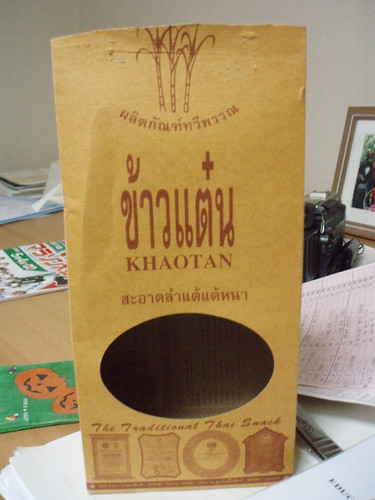
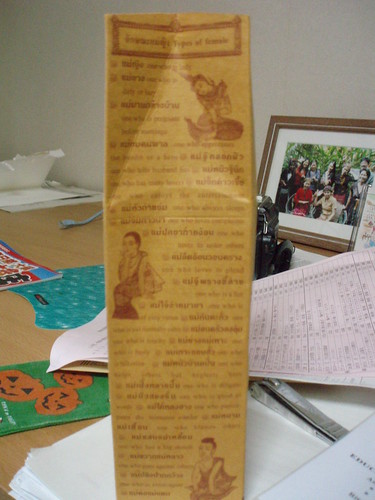
A friend of Mrs. Adamu’s brought us these “Khaotan” puffed rice crackers – “the traditional Thai snack” according to the package. Unlike many Thai snacks, these were actually not too sweet. They had a more subtle flavor that complemented the taste of the crunchy rice without overwhelming it.
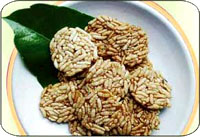
We ate all the actual crackers already (Mrs. Adamu was especially fond of them), so here’s a random picture from the Internet to show you what they look like:
Hailing from Lampang in northern Thailand, Khaotan is part of the “One Thambon One Product” (OTOP) program sponsored by JETRO, an organ of the Japanese government. JETRO provides funding and expertise to help local areas develop their products for export to places like Japan or New Zealand.
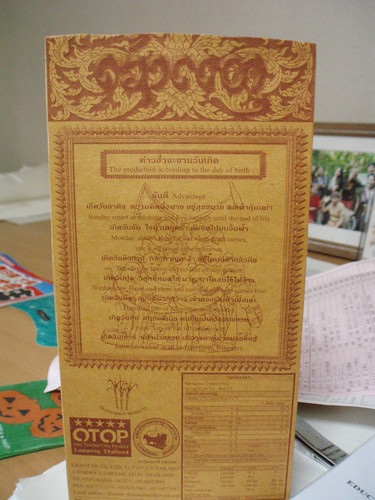
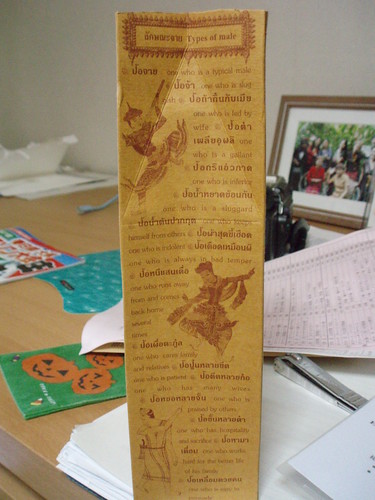
My favorite part of Khaotan was the extensive personality assessments on each face of the package. On the back is a chart of personalities based on the day of the week you were born (this day of the week system is pervasive among Burmese people as well), and a list of male/female personality types lines each side. The part about female personalities struck me as especially harsh – they have about twice as many different types as the men, but almost every type is just a different shade of dishonesty, vindictiveness, or irresponsibility. Just in case you can’t read the photos I will transcribe them for you:
The prediction according to the day of birth
Sunday: Smart at thinking and live happily until the end of life
Monday: Always cheerful and when death comes, one is supposed to be in heaven
Tuesday: Be brand and no fear of any danger
Wednesday: Clean and clear and can make dream come true
Thursday: Lots of properties and wealthy
Friday: Lots of fun till others envy
Saturday: No sad at all and has many followers
Types of male
One who is a typical male
One who is slug
One who is fed by wife
One who is a gallant
One who is inferior
One who is a sluggard
One who keeps himself from others
One who is indolent
One who is always in bad temper
One who runs away from and comes back home several times
One who cares family and relatives
One who is patient
One who has many wives
One who is praised by others
One who has hospitality and sacrifice
One who works hard for the better life of his family
What is it about Hollywood that it can’t authentically portray Japanese people and the Japanese language to save their lives?
I use Hollywood here to collectively refer to all US film and TV media producers. From the Chinese actors in Memoirs of a Geisha to the Korean actor who plays Ando Masahashi on Heroes, Hollywood rarely bothers about accuracy when casting Japanese people and having actors speak the Japanese language. In defense of the casting in Geisha, Spielberg said that talent was more important than nationality. As for Heroes, the cause is entrepreneurial script writing, where the -Japanese- Korean and Japanese-American actors translate the English lines on set and say whatever Japanese they think sounds right. Time and time again the Japanese script is written badly, spoken poorly by actors who appear to have been casted because they were available and happen to have an Asian face. The end product is rarely checked for accuracy or authenticity. The result: a linguistic clusterfuck that’s excrutiatiny for Japanese speakers to watch.
Why the rant? This came to my mind because I was watching Diary of the Dead, the latest George Romero zombie flick, filmed with mock handheld cameras in the same manner as The Blair House Witch Project and Cloverfield. Check out this excerpt where the characters supposedly see a youtube video of a women from Tokyo who speaks about the situation in Japan.
I know how a Japanese person can speak English well. And I know how a Japanese person can speak English poorly. This is neither — it’s a native English speaker with an Asian face doing a bad job at faking a Japanese person’s bad English accent. (Her accent comes off as Hong Kong English blended with U.S. college campus mockery of Manhattan Chinatown English). And as for cultural accuracy, the woman in the video warns viewers not to bury the dead — laughable when said by a person in Tokyo, as that’s the last thing that ever happens to the dead in Japan, where cremation is the rule because there is no real estate to spare.
A remedy to this casting problem is super-obvious. You could find a Japanese person in any North American city to do a perfectly authentic job for minor roles such as this. And if Hollwood insists on using other actors, you could use the same such person to coach the actor or actress to not sound like such a fraud. It wouldn’t take much for Hollywood to avoid sounding ridiculous in Japan (an enormous market for consuming American film and TV media), and avoid being mocked by bloggers such as myself.
As for zombie attacks, Tokyo would be the absolute worst place to be stuck in the event of a Romero-style zombie attack. The city is crowed, guns are scarce, and there are few isolated areas to which the survivors could escape. It would be intense. And actually… that sounds like a great movie idea! If anyone in Hollywood wants to pursue that, I volunteer my services in screening the cast.
I have noticed a recent habit of political pundits to mock perceived idealism and naivete with phrases like “rainbows and unicorns.”
For instance, a commenter on the latest episode of The Young Turks, in explaining that Arlen Spector has never been principled (he was the guy who voted for a bill that he himself argued would set human rights back 700 years), noted that “he was not voted in on rainbows and unicorns.”
In a sign of just how much of a standard cliche this has become, in the Washington Post former CIA Director Porter Goss makes the topsy-turvy argument that making the torture memos public has jeopardized national security: “The suggestion that we are safer now because information about interrogation techniques is in the public domain conjures up images of unicorns and fairy dust.” (Has anyone actually argued that the move makes us safer? I thought the whole point was it is not worth it to torture people even if it does make us “safer” and that the people who pushed for and praised releasing these memos see it as a step in disclosing mistaken and illegal policies that were done in our name)
But you know what? Unicorns are nothing to mess with! It only takes a cursory reading of the animal’s Wikipedia page to prove why:
1. Unicorns are as strong as the Lord: The bible (or rather its translators) considered unicorns “untamable creatures” and noted that God himself was only as strong as a unicorn:
“God brought them out of Egypt; he hath as it were the strength of the unicorn.”–Numbers 23:22
2. The ancient Greeks and Romans considered unicorns to be both real and fierce: The Greeks, for all their polytheism and fantastic mythology, believed that unicorns really existed somewhere in India:
Pliny the Elder mentions the oryx and an Indian ox (perhaps a rhinoceros) as one-horned beasts, as well as “a very fierce animal called the monoceros which has the head of the stag, the feet of the elephant, and the tail of the boar, while the rest of the body is like that of the horse; it makes a deep lowing noise, and has a single black horn, which projects from the middle of its forehead, two cubits in length.”
3. Unicorns are so insane that they must be placated with virgins to stop their bloodlust (see above painting): In the middle ages, unicorns were used to mix pagan stories with Christian virtues, such that “The original myths refer to a beast with one horn that can only be tamed by a virgin maiden; subsequently, some Catholic scholars translated this into an allegory for Christ’s relationship with the Virgin Mary.”
Moving into Renaissance times, Leonardo Da Vinci had this to say about how to hunt a unicorn:
“The unicorn, through its intemperance and not knowing how to control itself, for the love it bears to fair maidens forgets its ferocity and wildness; and laying aside all fear it will go up to a seated damsel and go to sleep in her lap, and thus the hunters take it.”
Bottom Line
This “unicorns are fuzzy cute happy creatures” concept apparently originates in more modern imagery, particularly the My Little Pony animated series and toys and some other “fairy princess” pop culture. A product of the 1980s, My Little Pony offered saccharine-sweet entertainment for young girls that could not have anticipated the ballooning of ironic humor in the 90s and 2000s. Hence, when Homer Simpson uttered this classic, oft-repeated line:
Ohhh look at me Marge, I’m making people happy! I’m the magical man, from Happy Land, who lives in a gumdrop house on Lolly Pop Lane!!!!…… By the way I was being sarcastic…
it was only a matter of time before someone added a unicorn in there. But as we start to retreat from irony a bit as a society (see the return of earnest saccharine with Disney hits like High School Musical and Camp Rock, along with South Park’s reaction), it might be a good time to stop equating unicorns with frivolous and naive idealism and recognize their historically badass mythological status. I mean, honestly – how happy and nice could an enchanted animal with a deadly sharp horn actually be?
During its manufacturing boom earlier this decade, the Czech Republic wooed immigrants with plentiful jobs and comparatively higher wages. Now the Czech government is paying them to go back home…
Other countries in Europe have reacted similarly, amid rising unemployment. Last November, Spain’s Socialist Party government launched a program to send 100,000 immigrants home. Those who promise not to return to Spain for three years get six months of unemployment benefits — an average payout of €14,000 ($18,500). Some 4,000 immigrants have taken the cash.
The catch, of course, is that once the immigrant leaves, they promise not to come back. But from a practical standpoint, it’s not quite that simple, especially in the EU, where a migrant can take the cash and mozy into another part of the EU.
Europe has a history of offering immigrants cash to go. After World War II, countries including Germany and France recruited thousands of guest workers to help rebuild shattered economies. France launched the first of these programs in 1977, and thousands of immigrants went home.
But there were drawbacks. Many immigrants who took the cash later broke the ban and returned to France. And apart from making them feel unwelcome, the payments often weren’t enough to entice workers who felt job prospects back home remained bleak. Such complications also bedevil the Czech Republic’s program.
You’ve at least got to hand it to the Europeans for being sensitive about the topic. Czech NGOs and government officials stress that, in distributing information on the buyout, they’re only informing immigrants of their options. Japan is being borderline dishonest. When the plan was announced, some thought that the package was almost a paid family leave scheme, and the promise never to return was only fine print.
Yesterday, I was supposed to go and eat lunch at either the infamous coffee ramen joint or Tokyo’s oldest horse stew restaurant with other contributors of MF. Instead, I was called on a family excursion to a different type of interesting cuisine — Banya, a cafeteria next to a local fish market in southern Chiba managed by a fishing union cooperative that has recently gained cult status among gourmet followers. The restaurant, which seated hundreds, was crowded, and for good reason — it was delicious. But the grotesque nature of the meal made me think about the inherent violence in the way food is often served in Japan.
In the West, it’s no secret where meat comes from — animals. Often the beasts are harvested and processed in the same way as agriculture. And there has long been a certain Puritan virtue associated with vegetarianism. As many as 20% of the U.S. population believed to be vegetarian. Yet we rarely see evidence of the kill in our meals. Most meat is well processed. We rarely see evidence that the meat we eat was once alive.
Vegetarian advocates have long said that, if the public was aware of the violence inherent in consuming animal flesh, they would realize that “meat is murder” and more people would be vegetarian. The case of Japan, where there is much violence in food yet low prevelance of vegetarianism, suggest otherwise. In much of Japan’s cuisine, the violent inherent in meat is more obvious, and this is no more so the case than with raw fish. At yesterday’s lunch we had an assortment of freshly slaughtered fish, often prepared ikitsukuri style, freshly slaughtered and with the carcass, sometimes wriglign, on display on the same plates from which we ate. Read more below, but viewer discretion is advised.
A brief update on women’s equality in the Japanese workplace. We have a friend whose wife worked in a woman’s center, providing support for people such as victims of domestic violence. She was fired for becoming pregnant.
I propose that she sue them, at which point they would of course be forced to volunteer to represent her as this is a women’s rights issue.
In a post on the Somalian piracy issue, the folks at NPR’s Planet Money point out how odd it is that some ships fly the flag of landlocked Mongolia (it comes down to tax/regulatory incentives), photo courtesy our own Joe Jones!
He’s got a bunch of other great photos on his Flickr site.
Though it may be an online-only podcast, Planet Money is fast becoming my favorite NPR program after This American Life and On The Media. They slow everything down and give context to the news, avoid shorthand and jargon, and generally make the day’s developments imminently accessible and understandable. Too often the news seems out of context and complicated, and no doubt turns away a lot of people before they can really even try and get a handle on things. Their approach is refreshing and sorely needed in other areas of the news!
The show originated as a spinoff of the amazing work they did for TAL, which is a must-listen to get a decent idea of what’s happening with the financial crisis:
Bad Bank (A follow-up made in February that similarly explains the developments of the financial crisis and what should be done with the banks)
Scenes from a Recession (This is a more traditional This American Life episode that takes a man-on-the-street approach to see how the recession is affecting people)
I’ve said it before, but I really can’t recommend these enough for anyone who’s not a “finance expert” but still wants to know what the hell is going on. In essence this stuff is really simple but made intentionally complicated by industry insiders.
Tsuyoshi Kusanagi was arrested by Akasaka police for drunken nudity!
At 3am in Hinokicho Park just outside Tokyo Midtown in Roppongi, police found a naked Kusanagi dancing wildly making a scene (apparently not “dancing” exactly). When they told him to calm down he refused saying “What’s wrong with being naked?!” So they had no choice but to arrest him. He resisted and had to be “wrapped in a sheet” to be taken to the station. He is so ubiquitous on Japanese TV that the stations have been thrown into chaos today, in danger of having to cancel a good portion of their programming schedule and commercials (why? for some reason it is standard operating procedure to systematically blacklist a talent who runs afoul of authorities or even is caught cheating on a spouse).
Kusanagi is (was?) a member of SMAP, the pop group that gained popularity through wide-ranging appearances in variety shows, survived through the 90s into today despite numerous scandals, rumors, and accusations. Their popularity also engendered no small amount of sour grapes and cries of unfairness who felt their talent agency Johnny’s Entertainment abused their market power to set inconceivably favorable terms for their acts. But they got away with it thanks largely to their bottomless capacity to bring out their fanbase to generate ratings/sales. With this incident all those who hated on SMAP over the years have something to hang their hats on.
The SMAP members are well-known to have their lives fairly closely monitored and managed by talent agency Johnny’s Entertainment. Perhaps Kusanagi just couldn’t take it anymore as the group entered their mid-30s and industry observers wondered how they could adapt even as middle aged “ossan.”
If anything Kusanagi chose a nice park to stage his downfall in. Hinokicho is clean and boasts a “Japanese but modern and artistic” feel. Mrs. Adamu and I have enjoyed its tranquil (though crowded) lightup around Christmastime.
Japan’s government may halt advertisements promoting digital TV after the incident, as the campaign features Kusanagi, said Hideo Harada, an official in the terrestrial broadcasting section at the Ministry of Internal Affairs and Communications.
A person who answered a call to Kusanagi’s management agency, Johnny’s and Associates Inc., said there were no officials available to comment on the case. She declined to give her name or position at the company.
SMAP’s music is sold by a label under the control of JVC Kenwood Holdings. JVC Kenwood shares fell as much as 8.3 percent in Tokyo trading today, and finished the morning session 6.7 percent lower at 56 yen. The Nikkei fell 0.5 percent.
Over the past few years, supermarkets like Aeon and Ito-Yokado (and convenience stores like 7-11) have placed ever greater numbers of “private-branded” products on their shelves. Americans will be more familiar with the term “store brand” as symbolized by the suspiciously labeled cereals often with off-putting imitations of the Trix rabbit. In Japan they are simply known as “PB” (ピービー or プライベートブランド another example of marketing lingo making its way into everyday Japanese). According to Wikipedia, reforms of the supply chain behind private brands (moving production from smaller manufacturers to more sophisticated larger firms) in the middle of this decade has led to a “boom” of higher quality private-branded items starting around 2006. In this recession, the PB goods are reportedly boosting their market shares as Japanese people give up on traditional brands.
A light-hearted economic piece from Tokyo Walker c/o Yahoo News Japan notes that some PB products, specifically those from Aeon’s “Best Price by Top Value” (what a mouthful!), are getting even cheaper than before. For example, they have started to offer “tissue refills” aka tissues without any cardboard boxes or extra packaging. Other no-frills products include laundry detergent with no plastic spoon and instant ramen with the powder already mixed in instead of coming in separate plastic pouches.
In Japan, the private-branded stuff tends to be of shockingly high quality to the point that there is little reason to pay extra for the fancy packaging of brand names. I haven’t lived in the US for about three years now, but I grew up calling store-brand food the “third world” version (the poor families drank “third world soda” and so on). However, that may be changing – A blog post at FT.com seems to show that the US is moving closer to the Japanese model, or at least Japan-owned 7-Eleven hopes so:
Interestingly, Jeff Schenck, the head of franchising for 7-Eleven in the US says [consumption of store brand goods] is more driven by distribution patterns. Big consumer goods companies such as Procter and Gamble have a greater influence over supermarket supply chains in the US than in Europe.
They are often allowed to stock the shelves in supermarkets, in return for incentive payments (known as slotting fees) to retailers, and to control the way products are displayed.
Mr Schenk said 7-Eleven’s steady development of its own supply chain was one reason why it was now confident in the potential of 7-Select products, such as its own line of potato crisps. “We call it taking our stores back,” he said.
As well as rolling out more private label goods, 7-Eleven is developing a new franchising model, which involves persuading owners of existng corner stores to convert to the brand in return for giving 7-11 a share of the revenues.
This is a less capital intensive model than its traditional practice of acquiring leases or building stores itself, before getting local franchisees to run them.
After coming back from a high school exchange in Japan and attending a semester of community college, I suddenly decided that I needed to get out of Connecticut and transfer to a four-year univserity as soon as possible. A combination of a lack of preparation, a burning need to get out of my hometown, and plain ignorance of how money works led me to forego cheaper options and attend a private university funded almost entirely on student debt (in a ratio of around 75% variable rate private debt and 25% fixed rate direct federal borrowing). At the end of it I was many tens of thousands of dollars in the hole, but today less than 4 years later I am two months away from being debt-free, all thanks to “borrowing my way out.”
At the end of my education I had a degree in “International Relations” – essentially a liberal arts program. I left the system without much in the way of skills, but college did give me two things that would come in very handy later on – a bona fide college degree and the time and impetus to dedicate to accumulating knowledge (a good portion of which came through classwork) and compulsively studying Japanese, all without any immediate need to make ends meet.
But without any directly marketable skills and no immediate job prospects, I stayed afloat in Washington DC after graduation through multiple part-time jobs (at one point I was working for four separate companies), occasional parental assistance, and deficit spending with one of those “pre-approved” credit cards they were always sending me back then. I also deferred my student loan repayment to the last possible moment, a decision that added another $10,000 in piled-on interest by the time I started paying.
But I kept at my jobs and eventually landed a gig translating for a law firm. Though I already had some translation skills before starting (documented in early MF posts!), the office experience, from the basic administrative duties of a “legal assistant” to keeping up with the high-paced research activities of my boss, was a very uphill learning curve, and the salary was just barely enough to survive on and pay a $1000 a month minimum payment.
But I somehow managed to stay afloat, and while I left that firm to follow Mrs. Adamu to Thailand, I continued working and improving as a freelance translator. When I eventually made my way to Japan, I easily landed a much better paying job (at a time when the JPY-USD exchange rate was at its most favorable in a decade) that put me on the path out of debt bondage.
So by dint of this experience I know that with a little luck knowing how to learn from people and ask for and accept help, perseverence, development, and talent can end up paying big dividends, as long as you are willing to invest in yourself. My own experience was not ideal as I made some “bad” decisions initially (though I do not regret the path my life took since otherwise there would be no Mrs. Adamu), but then neither is this recession. While many representing the underdeveloped economies argue for sustainable growth free from major-power exploitation, America has been in the grip of the “cult of progress” for more than a century. Our future prosperity is tied to economic growth, so in the bad times we seek to limit the downside through deficit spending and a series of debt rollovers.
I wonder if any of the protesters have had similar experiences. Perhaps it is tough to relate big, nationwide events to everyday life, but I am shocked that so many are ready to throw common sense to the wind and buy into idiotic catch phrases no doubt orchestrated by Astro Turfers who view them as nothing more than pawns that are useful to serving an end entirely removed from the actual protesters’ interests. There is nothing explicitly liberal or offensive about public works spending, so it doesn’t make sense to oppose in such and ugly and kneejerk way just because it doesn’t come from the right wing’s preferred sectors like the military. And Obama’s budgeting actually improves the tax burden of most families. It is really hard for me to understand people like the “Obama is a fascist BECAUSE HE IS!!!!” guy:
But perhaps Matt Taibbi has it right when he calls these people the peasant class, always ready to hate an external enemy rather than face their own lots in life:
The really irritating thing about these morons is that, guaranteed, not one of them has ever taken a serious look at the federal budget. Not one has ever bothered to read an actual detailed study of what their taxes pay for. All they do is listen to one-liners doled out by tawdry Murdoch-hired mouthpieces like Michelle Malkin and then repeat them as if they’re their own opinions five seconds later. That’s what passes for political thought in this country. Teabag on, you fools.
After all, the reason the winger crowd can’t find a way to be coherently angry right now is because this country has no healthy avenues for genuine populist outrage. It never has. The setup always goes the other way: when the excesses of business interests and their political proteges in Washington leave the regular guy broke and screwed, the response is always for the lower and middle classes to split down the middle and find reasons to get pissed off not at their greedy bosses but at each other. That’s why even people like Beck’s audience, who I’d wager are mostly lower-income people, can’t imagine themselves protesting against the Wall Street barons who in actuality are the ones who fucked them over. Beck pointedly compared the AIG protesters to Bolsheviks: “[The Communists] basically said ‘Eat the rich, they did this to you, get ‘em, kill ‘em!’” He then said the AIG and G20 protesters were identical: “It’s a different style, but the sentiments are exactly the same: Find ‘em, get ‘em, kill ‘em!’” Beck has an audience that’s been trained that the rich are not appropriate targets for anger, unless of course they’re Hollywood liberals, or George Soros, or in some other way linked to some acceptable class of villain, to liberals, immigrants, atheists, etc. — Ted Turner, say, married to Jane Fonda.
But actual rich people can’t ever be the target. It’s a classic peasant mentality: going into fits of groveling and bowing whenever the master’s carriage rides by, then fuming against the Turks in Crimea or the Jews in the Pale or whoever after spending fifteen hard hours in the fields. You know you’re a peasant when you worship the very people who are right now, this minute, conning you and taking your shit. Whatever the master does, you’re on board. When you get frisky, he sticks a big cross in the middle of your village, and you spend the rest of your life praying to it with big googly eyes. Or he puts out newspapers full of innuendo about this or that faraway group and you immediately salute and rush off to join the hate squad. A good peasant is loyal, simpleminded, and full of misdirected anger. And that’s what we’ve got now, a lot of misdirected anger searching around for a non-target to mis-punish… can’t be mad at AIG, can’t be mad at Citi or Goldman Sachs. The real villains have to be the anti-AIG protesters! After all, those people earned those bonuses! If ever there was a textbook case of peasant thinking, it’s struggling middle-class Americans burned up in defense of taxpayer-funded bonuses to millionaires. It’s really weird stuff. And bound to get weirder, I imagine, as this crisis gets worse and more complicated.