China yanks books about ties with Japan

Continuing along the lines of my recent posts, I present the following article from today’s Japan Times.

Two books on Sino-Japanese history and modern political relations have been pulled from shelves in China for undisclosed reasons, after selling about 50,000 copies apiece.

“Ambiguity’s Neighborhood” and “Iron and Plough,” both by author Yu Jie, disappeared from major bookstores in late December after four months of normal circulation, Yu said this week.

In the runup to the annual National People’s Congress plenary session that began March 5, independent booksellers were also told to stop selling it, Yu’s Beijing distributor said Wednesday.

Yu, 32, argues in “Ambiguity’s Neighborhood” that Chinese should learn more about modern Japan before saying they “hate” the people — common parlance for today’s younger generation influenced by anti-Japan media reports and school texts that discuss Japan’s 1931-1945 conquest of China.

“The two countries are so close, so this hate, this lack of understanding, doesn’t help at all,” Yu said, citing “arrogance” for the lack of more understanding. “Chinese people should understand the situation before they criticize it.”

Clearly there are some people in mainland China, who like many in Taiwan are willing to believe that the sins of the dead do not dictate the the actions of the living. Unfortunately, this seems to be considered dissent requiring punishment. Please read the remaining two-thirds of the article on the original site.

Now I have to run off in a few minutes to meet Curzon and Debito for dinner in Newark.

Crappy Japanese Textbook Sparks Protests in Korea, China

Well, it’s happened again. From the BBC report:

Japan has approved a set of new school history text books whose version of past events has already sparked complaints from South Korea and China.

One of the eight texts is an updated version of a book which triggered diplomatic protests in 2001.

Seoul said the new books sought to glorify Japan’s war-time past, a continuing source of regional tension.

It goes on for a while about the problems in the new book, the protests, the history of Japanese Imperialism and so on, but what is to me the most important fact is buried towards the end of the article.

This book is currently in use in fewer than 0.1% of Japan’s schools, but this time the authors are hoping for a better response.

Why is the adoption rate of this textbook so low? I think the answer is clear-few teachers are interested in giving their students a piece of shit biased textbook that overlooks such major historical facts! The protestors would have a valid position if this was a government issued textbook, but they are blatantly misunderstanding the situation.

In Japan textbooks are not written by the government. In the case of this history book, the author is a minor right-wing group named The Society For the Creation of New Textbooks,
which is no more catchy in Japanese. The job of the Ministry of Education in Japan is not to choose the textbooks that schools use, but to check the content that they do have for factual accuracy, not to mandate exactly what they teach. This is a marked contrast to the situation in all of the protesting countries, where primary school textbooks are created and issued by the government. [Update: Nora Park tells me that textbooks in South Korea are actually written by private companies following government guidelines.] The Japanese Ministery of Education in fact approves a number of textbooks, from which public schools are free to choose.

But this raises the question of why? Why do they have this semi-controlled market, instead of either opening up the market completely or just mandating textbooks? I can’t answer that, but I do think that they should reconsider the practice. Clearly their vetting process does nothing to keep utterly worthless textbooks off the market, and contributes to one of Japan’s worst ongoing diplomatic crises in years. If the book in question was simply on the market, instead of sort of govermnent approved would this even raise eyebrows in Beijing or Seoul?

Oh, and does anyone else find it interesting that there have been no protests in Japan’s other major former colony, Taiwan? Could their feelings for Japan actually be that much friendlier?

For some more, hopefully not too biased, information on the Nanjing Massacre itself, see as always the Wikipedia article.

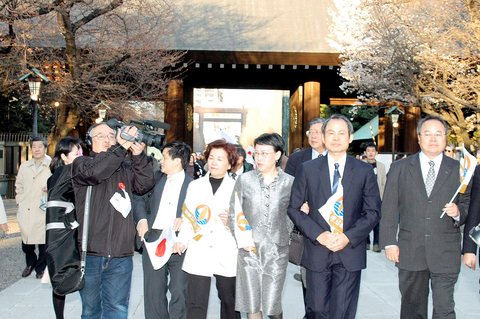
Major Taiwanese Politician Visits Yasukuni- Better Relations Ahead?

Since learning that I am very likely going to study Chinese in Taiwan this summer I have naturally been paying closer attention to the situation in and around that country. Naturally any story on the relations between the Republic Of China (ROC, aka Taiwan) and Japan is an eye-catcher, especially one as dramatic as a major Taiwanese politician visiting Japan’s controversial Yasukuni shrine. Today’sTaipei Times reports that Shu Chin-chiang (蘇進強), chairman of the Taiwan Solidarity Union (TSU) political party made a “pilgrimage” to the controversial Yasukumi Shrine. Incidentally, although the English language press is not pointing it out, the Japanese media describes Shu’s TSU party as part of the ‘pro independence’ faction in almost headline.


Shu immediately came under fire at home for the visit where he was accused of dignifying Japan’s militarism in the early 20th century.

Shu, dressed in a business suit, was cheered on by supporters who unfurled the flags of Japan and his party as he entered the Yasukuni shrine which is dedicated to 2.5 million war dead, including 14 convicted war criminals.

The latter figure is slightly innacurate. The shrine is dedicated to all Japanese war dead (including soldiers drafted or recruited from former colonies such as Taiwan and Korea), and this function is all-inclusive, actually including over 1000 Japanese soldiers convicted as war criminals. The controversy does not stem so much from the fact that the shrine lists include executed war criminals, but from the fact that in 1978, decades after the war’s conclusion, 13 class A war criminals were enshrined as ‘martyrs,’ and the shrine issued a statement saying that these men had been wrongfully convicted. Wikipedia has a good summary of this basic controversy.

He called on Asians to “move beyond the grudges and animosity of the past.”

“As one Taiwanese and as a leader of a political party I have come here to pay my respect to the soldiers who sacrificed their lives for Japan,” Shu said.

It may be perfectly reasonable for Shu to honor the long neglected Taiwanese dead, but to point out that they “sacrificed their lives for Japan” seems to me to be a mistake.

“At the same time, as one Taiwanese, I have come here to pay my respect for 28,000 Taiwanese,” whose names are enshrined, he said.

Supporters said it was the first known visit to Yasukuni in modern times by a party leader from Taiwan, which was ruled by Japan from 1895 to 1945.

I believe that this is actually the first formal visit to Yasukuni by a leader from ANY former colony, if not from any Asian country period.

The Yasukuni shrine controversially lists the names of 28,000 Taiwanese and 21,000 Korean soldiers, most of whom were forced into service under Japan’s colonial rule.

The holy site also lists the names of Japanese civilians who died in fighting.

The populist Koizumi has visited the shrine four times since August 2001, saying he has the right as a Japanese person to choose how to honor the dead.

What has been overlooked in virtually every article I have seen on the Yasukuni issue is that even the Emperor himself has refused to visit Yasukuni Shrine since their special recognition of class A war criminals was made public over 25 years ago. It’s a little ironic that the very symbol of right wing Japan has taken a stand against the nationalists while the “populist Koizumi” evokes international ire by pandering to the rightists.

In Taipei, Aboriginal legislator Kao-Chin Su-mei (高金素梅) angrily objected to Shu’s pilgrimage.

“Japan launched over 160 battles to destroy Taiwan’s Aboriginal tribes during its 51-year colony on the island,” he said in a statement.

“We strongly protest the TSU visiting the Yasukuni Shrine,” he said. “It is already an insult to Taiwan’s Aboriginal people that our soldiers were enshrined there.”

TSU spokesman Chen Chien-ming (陳建銘) said that Su’s visit was timed ahead of today’s holiday to honor the dead, called Tomb-Sweeping Day.

“We do not agree with the acts and invasions of the Japanese militarism [during World War II] but we should not let hatred persist,” Chen said in Taipei.

I tend to agree with Chen. Certainly Japan’s behavior during their imperialist period was reprehensible and unforgiveable-but the generation responsible for that is largely dead and gone and it is hardly serving anyone to bring up old grievances to damage relations with one of the few strong allies (or at least near-allies) that Taiwan may have against China. Not to say that the past should not be addressed, but it should be studied as history, not for politicians to use as emotional bait during election season.

The Ten Billion Names of Kim Jong Il

Harper’s magazine has graciously published a list of names which the North Korean government claims foreign leaders use to refer to Kim Jong Il.

Supreme Commander at the Forefront of the
Struggle Against Imperialism and the United
States

Greatest Saint Who Rules with Extensive
Magnanimity

Lode Star of the Twenty-First Century
Best Leader Who Realized Human Wisdom
Leader with Extraordinary Personality
Perfect Picture of Wisdom and Boldness
Eternal Bosom of Hot Love
Master of Literature, Arts, and Architecture
World’s Best Ideal Leader with Versatile
Talents

Humankind’s Greatest Musical Genius
Master of the Computer Who Surprised the
World
Man with Encyclopedic Knowledge
Guardian Deity of the Planet
Heaven-Sent Hero
Power Incarnate with Endless Creativity
Greatest Man Who Ever Lived
Present-day God
World’s Greatest Writer

You know, he may have something here. From now on I would like to be referred to as “World’s Best Ideal Leader with Versatile Talents.”

For a profile of the Dear Leader see my earlier post.

Solving Territorial Disputes

As we watch relations between Japan and Korea continue to fray over an increasingly nationalistic fight for a bunch of silly rocks in the middle of the ocean, we may wonder, how can this be resolved without halting trade or firing shots?

As a Mr Mark Thoma points out on his blog, there has been a significant decrease in violent crimes committed by American youth, inversely correlating to the growth of violent video games. That is to say, as young people in America have been engaging in more simulated violence they have in fact, contrary to the typical close minded conservative Joe Lieberman position, been at the same time engaging in less real violence.

What does this have to do with the dispute between Japan and Korea of ownership of Dokdo/Takeshima, you may be thinking? For the answer, let us turn to this article reprinted by Yahoo News, originally from Yonhap.

N.Korea Agrees To Provide Free ‘Dokdo’ Online Game
SEOUL, March 18 Asia Pulse – A North Korean company has agreed to provide a partially free service for an online game related to the Dokdo islets, a group of South Korean outcroppings, which it co-developed with a South Korean firm, the Southern partner said Thursday.

“The North Korean company, which developed the game with us, answered positively to our suggestion of providing the game at no cost for a while,” said NKmall (www.nkmall.com), which imports North Korean products.

“LG Telecom (Kosdaq:032640) will give a free service to its subscribers for the game from Friday to Thursday next week,” it added. The game play involves guarding the islets from invaders. LG Telecom is one of South Korea’s three mobile phone operators

Dokdo has become a hot issue domestically as a provincial assembly in Japan voted on Wednesday to designate a day on its calendar to promote its claim over the islets, sparking strong protests from South Korea.

The two Koreas are finding some common ground in their opposition to Japan over the issue.

South Korea is also considering importing North Korea-made postage stamps concerning the rocky islets.

Dokdo, a set of volcanic outcroppings in the East Sea, lies halfway between South Korea and Japan. Seoul has maintained a small police detachment there since 1954.

The way is clear. As the youth of America have begun turning from stealing cars to Grand Theft Auto, from shooting each other to playing Counterstrike, from getting in schoolyard fist-fights to Street Fighter, so must nation states follow. By channeling agression from the real to the virtual realm shall we preserve peace.

Perhaps instead of fighting an actual war for control of Liancourt/Dokdo/Takeshima, Japan and Korea (and maybe France too, but we all know they would lose) could have select champions to battle it out in computer games? Of course, the selection of game will be a source of great controversy. First person shooter games like Counterstrike, or real time strategy like Starcraft would undoubtadly go to Korea, and Japan would wipe the floor with them in fighting games, but at least diplomatic efforts would be focused on something sensible for a change.

South Korea Bans DPRK Execution Video

The Christian Science Monitor reports that the infamous North Korean execution video has been essentially banned in Korea. (Unfortunately it seems that the location Adamu found last week no longer hosts the video-the web site is only an archive of current the most recent Japanese news programs.)

“We have told of many public executions [in the North]. But officials in Seoul always ask us for material evidence,” says Pak Sang Huk, an escapee from the North. “Now that we have evidence, they don’t want to see it…. The people who brought this tape through China were speechless when they visited KBS [Korean Broadcast Service] studios, and were shunned.” Mr. Pak claims those who filmed the executions risked their lives to do so.

Seoul’s effort to avoid broadcasts of negative images or facts about North Korea is part of a larger strategy dating to the Sunshine Policy and Korean summit of 2000. In this view, unification of North and South can’t be achieved if the South criticizes or acts in a manner that the North deems hostile.

I’m genuinely amazed that the South Korean government has decided to keep this tape out of the media. Sure I understand that they want to engage the Northern regime in peaceful dialogue and tone down the anti-communist propaganda that has filled much of the public discource in post-separation South Korea, but they should realize that reporting factual information about the horrors that occur in the North should NOT be classified that way. By muffling the South Korean free press I fear they may do more long term damage.

On the plus side, South Korea has the highest penetration of high speed internet in the world, and a vast culture of file sharing software. I just hope that some Korean internet sites not associated with big media (maybe Ohmynews?) will take up the slack and make this video avaliable to the Korean population. Maybe someone will be ambitious enough to take the thorough news reports that have aired in Japan, subtitle them in Korean, and then release those videos on the internet.

FCC Gets an F

I think this quote from the new FCC Chairman, Kevin J Martin is definitive proof that the agency has become so utterly worthless that it no longer has any right to exist.

“This order involves a television program that the majority admits ‘contains references of a sexual nature that were broadcast at a time of day when children were likely to be in the audience,’ ” he wrote in that opinion. “Yet the majority concludes that the program, in which a prostitute is hired to sexually arouse a horse by removing her blouse and to ‘extract’ semen from the horse, is not indecent because the prostitute is ‘never seen actually touching’ the horse. Despite my colleagues’ assurance that there appeared to be a safe distance between the prostitute and the horse, I remain uncomfortable. I respectfully dissent.”

Update: For anyone interested in a more serious take on problems with spectrum regulation, read this article.

A Public Safety Wireless Advisory Committee was formed in Washington, and it had one key recommendation: “Public safety agencies will not be able to adequately discharge their obligations to protect life and property” if they don’t get more frequencies within five years. The report was released on September 11, 1996.

And we all know what happened exactly five years later, when public safety agencies still did not have sufficient spectrum for their emergency radio communications network.

Report From Kyrgyztan

The following piece was forwarded to me by my friend Charles, currently living in Kazakhstan. My only comment is that the holiday of Nevruz which he refers to was this past Monday (March 21), and I was in Almaty, Kazakhstan visiting Charles on that day last year. It was clearly the most important festival of the year, with much of the city, and even thousands of visitors from provincial areas gathering in the city square and celebrating long into the night. Try to imagine how a mass cultural patriotic holiday like this transitioned into the street revolution that you have been reading about in the news.
For links to continuing coverage, see the Registan blog.

According to the Kyrgyz Republic’s long-lived president Askar Akaev, the recent parliamentary elections passed in “genuinely democratic, transparent and honest” atmoshpere and symbolized a “major success and celebration of democracy”, thus proving that “democracy extended deep roots in the fertile Kyrgyz soil”. Were this idyllic and impeccable depiction true, the Kyrgyz people wouldn’t come onto the streets and rally in front of state buildings to protest the current regime’s scandalous attempt to forge the elections.

As an indignant reader of “Moya Stolitsa Novosti” (MSN) wrote in her letter, the scale of bribing and cheat during the 13 March runoffs was appalling. In the University polling district of Bishkek, where President’s daughter, Bermet Akaeva, ran for seat after the first round of the elections on 27 February, she witnessed as school masters, apparently threatened to be sacked if they didn’t collaborate, brought their employees and relatives from all over the city to the polling station. They concealed photos in their passports with pieces of paper as a sign for election committee’s members, who calmly produced voters’ lists, letting the ardent “constituents” put signatures against bogus names, and dispensed the bulletins, which subsequently went into voting boxes in Bermet Akaeva’s favour. What is even more scandalous, on exit they received from 150 to 300 soms (41 soms equals 1 $) after entering their signatures in a sheet.

Even after the elections were over and all the Kyrgyz people were supposed to unite in celebration of the “deep-rooted” democracy and greet the new parliament members, “honestly” elected by their votes, the extent of the ruling regime’s interventions into the political life was so blatant that sometimes it was ridiculous to witness. On 18 March the US ambassador to the Kyrgyz Republic Mr. Stephen Young gave a press conference in the “Akipress” news agency and assessed the past elections. Starting to his presentation, he said that he was prepared to everything and showed a pocket lantern to the surprised reporters, hinting the embarrassing development that took place the previous day. Electricity was cut suddenly and the lights went off completely when ENEMO’s (European Network of Elections Monitoring Organizations) international observers gathered in the same building to introduce their report on the elections.

A month earlier, something similar happened to the Freedom House printing press, the only independent printing house in the country. On February 22 the electrical power was cut off, allegedly due to staff’s violation of safety requirements. By providing professional printing services to over sixty local and regional newspapers, it had been irritating the government since its opening last year. Seemingly, the MSN’s allegations against Akaev and his family served as the last drop, as he accused the newspaper and the Kyrgyz media in general of “systematic information terror” and has declared his intention to file a criminal libel suit against the MSN newspaper, which is also printed by the independent press. The remarkable and eloquent thing about the development is that electrical power was cut off just 4 days before the national parliament elections. The incident was widely accused by local and international media and NGOs. The Freedom House itself, the international freedom and human rights watch-dog based in US, voiced its concern over the development and named it as an “act of censorship” and an “attack not only on a legitimate business operation, but also on democracy”.

Beginning this article yesterday, I did not suspect I would be writing these final lines in an office in Istanbul while my Kyrgyz compatriots are writing history on the streets of Bishkek. Emotions are overflowing me at this great moment. Occasionally it becomes hard to check tears of happiness, passion and hope as I feverishly press the refresh button of my browser to track the pages of websites updating news from Ala-Too square, the main square in Bishkek, practically in the real time mode. These emotions are: happiness to see my people united in the critical time of change, passion at the sight of my brothers and sisters’ blood shed for the sake of this change, and hope for the brighter future for my country. The timing of the uprising, coming right after the ancient holiday of Nevruz, is highly symbolic, too. It has been widely celebrated by all peoples of Central Asia and has symbolized the New Year and change for both nomadic and settled tribes of the region for thousands of years.

The last developments in Kyrgyzstan openly manifest that the elections have been the last drop for the long-suffered Kyrgyzstanis. The Kyrgyz people have been traditionally viewed as the most tranquil and peaceful nation in the Central Asia, not disposed to change the current developments and force out the ruling regime, more so. Yet, however radical and unexpected Akaev’s ouster may seem, it stands in line with the velvet revolutions in the former Soviet Union, and in greater scale, conforms to the flow of history: discontented nations sooner or later overthrow their repressive authorities. Whatever the circumstances behind the latest events in Kyrgyzstan may be, now that Kyrgyz people persisted and managed to express their will, they may be proud to be named as the most democratic in the Central Asia.

So, dear brothers and sisters, accept my genuine congratulations on emergence of a new democracy! Regarding the questions Max raised here, I am positive they won’t take 15 years for the new authorities to answer!

Anti Semetic Bobby Fischer to Find a New Home in Iceland?

By now many of you have probably heard that Bobby Fischer has been granted citizenship by the government of Iceland and should be well on his way there. This was accomplished through a special act of the Icelandic parliament, sponsored by a Mr. Saemundur Palsson, who have the following comment to the press, “I hope that he will stop cursing the Americans now. It has gotten him into so much trouble.” Unfortunately, Mr. Fischer was not quite so sensible. The NYT quotes him as saying, “This was not an arrest, it was a kidnapping cooked up by Bush and Koizumi. They are war criminals – they should both be hung.”

Bobby Fischer is of course the former world chess champion, on the run from US authorities for playing a chess match in a country which no longer exists in violation of economic sanctions. Despite actually being Jewish, he became a rabid anti-Semite and after years of hiding resurfaced as a caller to radio programs in Iceland and the Phillipines ranting about how fantastic it was that the World Trade Center had been destroyed and calling for the extermination of the Jew-infested US Empire (his sentiment of course, not mine).

More information on Bobby Fischer, as well as links to recordings of some of his insane radio interviews can be found here.

Considering how his bizarre anti-Semitism, I was curious how this attitude might fit into the general perception of Jews in Iceland, and after a little research found this article, which is very likely the best word on the topic on the entire Internet. I would like to quote from the conclusion:

However, one cannot say that Iceland was a case of “antisemitism without Jews”. Iceland’s antisemitism first appeared concerning the Bolshevik connection, but only in small measures. It was not until the rise of Adolf Hitler and the Nazi Germany that Icelandic antisemitism became transparent. The anti-communism elements in Iceland, most notably the newspapers Morgunblaðið and Vísir, showed considerable antisemitism, especially when the persecutions in Germany became more visible. After the Kristallnacht the existing support for Germany decreased, and vanished almost completely after the Russo-German pact of 1939. Consequently, criticism of the German antisemitism inflated and antisemitic remarks receded.
Iceland’s Jewish policy was in most ways similar to these of other Nordic countries. However, what differed was Hermann Jónasson’s lack of flexibility while, on the other hand, other Nordic governments allowed proportionally more Jewish immigration on humanitarian grounds. On the total, it seems that Iceland took much less part in the rescue of German Jewry than most, if not all, European countries, contrary to Jónasson’s statement of the opposite. Although the general Icelander was usually friendly and compassionate towards the Jewish refugees, the Government showed a totally different attitude.

Anyone interested should read the entire paper.

Beijing Post Publishes Posthumous Interview With Isaac Asimov

Danwei reports that Isaac Asimov’s Foundation series is finally being published in Chinese, and in honor of this the Beijing News has put out a special science fiction issue. In addition to articles on Chinese language SF, they have also managed to get an interview with the man himself, (English translationthe first he has given since passing away in 1992.

Isaac Asimov passed away on 6 April 1992, so to be able to conduct this interview we must thank a scientist named Vikkor Mallansohn – according to Asimov’s novel [The End of Eternity] he invents something in the 24th century that makes a “time kettle” possible.

Among the highlights of the interview is this exchange on the much discussed Al Qaeda connection. It’s worth noting here that (according, again, to Danwei), both ‘Al Qaeda’ and ‘Foundation’ are translated the same in Chinese (基地)

TBN: What a terrible reader. Reportedly there are people who have examined Bin Laden’s choice to name his terrorist organization “Foundation” (Al Qaeda) and have concluded that it is perhaps because of your influence, that he was a science fiction fan in his youth. What is interesting about this is that you wrote the Foundation under upon the instigation of Gibbon’s Decline and Fall of the Roman Empire, and many scholars today believe that the United States is a New Roman Empire.

Asimov: I don’t know whether Bin Laden really understands English. “Foundation” (Al Qaeda) does resemble a group exiled from civilization, but they are at a lower level rather than a higher one. The US is unquestionably the most powerful country today, but I have a hard time determining whether it is in a process of decline akin to that in Foundation. This is perhaps the mystique of history; we can learn lessons and gain inspiration from similar historical situations. But I must point out that the “Empire” in my novels is not a country, but rather a description of a stage in the progression of the people of Earth. You can see that personal names are of all different types, not merely American.

The Ansible website has a good (if somewhat tongue in cheek)article on this theorized connection.

The small but alarming coincidence is that this is Asimov’s “Foundation” series (Seldon’s outfit is called the Foundation), allegedly popular among Arabic-speaking SF readers under its translated name Al Qaeda. Usually rendered into English as The Base, this also means The Foundation.

So, was Osama bin Laden inspired by Asimov’s fiction to establish his Al-Qaeda in an impoverished country, there to await and assist the fall of the West, issuing portentous videotapes the while?

Interestingly, while the Al-Qaeda/Foundation link is still a matter of controversy, it is generally accepted that the Foundation trilogy was in fact an inspiration for Shoko Asahara, the founder of the Aum cult responsible for the Tokyo subway sarin gas attacks several years ago.
More on this later when I have time to do some checking.