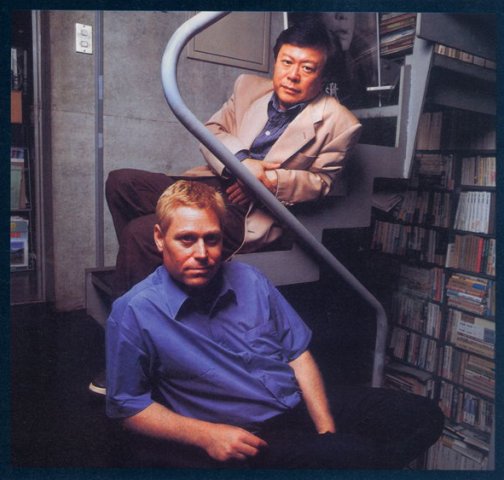
 On Nov 20, I’m going to see a lecture by Alex Kerr (pictured, bottom), a businessman in Japan and Thailand and author of Dogs and Demons, one of my favorite books on Japan. He’s giving some kind of talk at the Japan Foundation. Here‘s the promo copy:
Alex Kerr Lecture: “Lost Japan”
Alex Kerr, the East Asia scholar who was praised by Ryotaro Shiba as “a protector of Japanese culture, from America,” continues to express his melancholy at the state of affairs in which Japan’s beautiful scenery is in the process of being destroyed, as well as the need to protect traditional culture. Won’t you lend your ears to the warning bell that Kerr has sounded out of love for Japan and take another look at modern Japan from the perspective of someone who has lived abroad?
As I mentioned, Dogs and Demons is one of my favorites. It’s Kerr’s tale of woe, a follow-up to his previous love letter, Lost Japan, and it criticizes the social, economic, fiscal, and other problems facing Japan. He concludes that a runaway bureaucracy has ravaged Japan’s natural beauty and culture. The metaphor “dogs and demons” comes from this story by Chinese philosopher Han Feizi:
[T]he emperor asked a painter, “What are the hardest and easiest things to depict?” The artist replied, “Dogs and horses are difficult, demons and goblins are easy…. Japan suffers from a severe case of “Dogs and Demons.” In field after field, the bureaucracy dreams up lavish monuments rather than tend to long-term underlying problems. Communications centers sprout antennas from lofty towers, yet television channels and Internet usage lag. Lavish crafts halls dot the landscape while Japan’s traditional crafts are in terminal decline. And local history museums stand proud in every small town and municipal district while a sea of blighted industrial development has all but eradicated real local history.
Kerr goes on to detail initially covered-up river pollution that ended up being so bad they had to name a disease after what it did to people, nuclear reactors clumsily repaired with duct tape, massively wasteful public works spending that robs local areas of the chance to develop a real economy, unconscionable levels of government debt, and countless other examples of Japan’s “policy challenges” circa 1999.
The most effective parts of the book are where he talks about the destruction of Japan’s landscape and city planning, areas that directly affect Kerr personally as an art lover as well as his businesses in dealing artwork and urban restoration. Why are all of Japan’s rivers paved? What is the need for all the noise pollution in public areas? Why was Kyoto’s priceless architecture and urban culture allowed to be put on the chopping block? Why don’t they just tear down Kyoto tower?! OK, that last idea was my own, but he does at least call the tower “garish.”
Continue reading What to ask Alex Kerr?
 “I went back to my parents’ house after my home address was revealed on the Internet, but harassing phone calls kept coming into my office. Even my customers started to distrust me, thinking that I had someone (harassing me).”