Money quotes from Patrick Macias

Patrick Macias, journalist/author and expert on Japanese anime/manga culture, is one of my favorite commentators on Japan. Though I can’t say I share his affinity for Ultraman reruns and shitty 1970s Japanese rock bands, part of what I like about Macias is the fact that he understands Japanese culture but nevertheless takes what he enjoys from the country (namely otaku culture) without compromising his personality or values. A recent interview he granted podcast Otaku Generation featured some of his typical wit. I’ll transcribe some of the choice quotes so you don’t have to listen to the tinny, irrelevant banter of the questioners:

“I was told that the worst that I could do as a gaijin writer on Japan was to live in Japan because you need this perspective if you want anyone to pay attention to you. Otherwise you’re just one of those kind of circus monkeys they have on the TV shows there who sort of read the newspapers in the morning talking about American foreign policy even though even though they haven’t been in America for, you know, 10 or 15 years.”

“Pizza is a joke in Japan. People should be arrested for what they call pizza there. I think the mafia should just go over there and start shooting people ‘cuz that shit is not pizza. It’s like a tortilla with cheese on it and tomato sauce… And you don’t get that bloated, gassy feeling two hours later. It goes down too easy. With pizza, it’s got to be a struggle against your own humanity to digest it. At least American pizza should be… Even Mama Celeste would destroy the average pizza in Japan. Totino’s party pizza is gourmet compared to what you can get in Japan for top dollar.”
Continue reading Money quotes from Patrick Macias

Akie Abe wants to help you “like Japan”

An interview with PM Shinzo Abe’s wife Akie appeared in the BBC recently. In the interview, she indicates interest in an issue that I have had personal experience with:

Another interest of mine is to increase care for those students from abroad who are studying in Japan – I wonder if there is anything I can do in my present position to help them like Japan more.

The wife of the prime minister is a very special position. If there is something only I can do while I am in this position then I would like to contribute and I would like to be useful.

That’s a noble pursuit, indeed. However, as far as I can tell she has zero history promoting any such agenda. She may be studying Korean, but it’s apparently just because she’s such a big fan of Korean soap operas.

No, it’s far more likely she, like her husband Shinzo most of the time, will be using her position to promote existing education ministry policies.

According to the latest outline of Japan’s educational exchange program (PDF), there are already several government programs in place that could be interpreted as encouring a positive opinion of Japan. These include generous government scholarships (for a lucky 10%), subsidized Japanese language education, subsidized housing, access to Japan’s 70%-off national health care plan, and the ability to work part-time while studying.
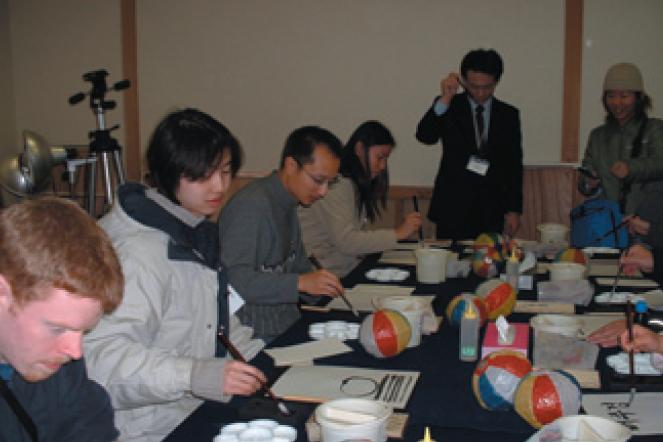
If that’s not enough, students also commonly have access to cultural activities such as calligraphy:

Exchange students learning Shodo1.JPG

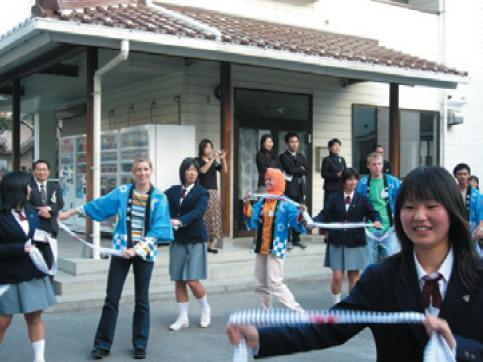
And interaction with the community:

Exchange students in the community.JPG

Compared to the US, where visa procedures, stringent restrictions on work, and a general atmosphere of distrust would seem to be counterproductive to fostering a positive attitude of the country, Japan’s system seems to already coddle its foreign students quite a bit. But most of the foreign students who get their undergrad degrees in Japan cannot find work in the country and end up having to go back. The way I see it, Japan can do two things to make its foreign students “like Japan,” and they are both things the US does a pretty good job of — offer a top-rate education and the opportunity to get a piece of the economic pie by allowing the students to stay and make a career in Japan. Statements like Mrs. Abe’s show that this still isn’t the priority. The scholarships that give educations that foreign students can take back with them are certainly beneficial, but I think Japan can do more than the limited opportunities it gives now, especially when many companies are clamoring for foreign labor.

Right-wing trucks in Kobe

The December 7 issue of Shukan Shincho ran a story in its “Heaven’s still a long way off” section about bothersome right-wing sound trucks that plagued the city of Kobe in the months of October and November. Here is a quick translation of the article:

The behind-the-scenes story of the 50 right-wing sound trucks that gathered in Kobe
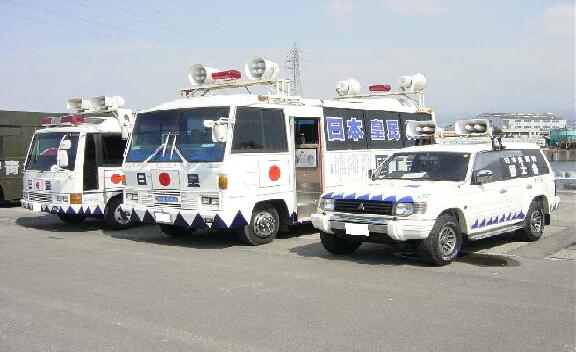
Nihon Kominto img001.jpg A number of police officers watch the intersection intently. There is also an anti-riot squad carrying duralumin shields. Security trucks are stationed at hotels, and several patrol cars can be seen spinning their red lights at the city hall. This is what Kobe looked like on November 26 as a state of heightened security continued throughout the city. Just what was going on that day?

It all began in late October. The right-wing group Japan Emperor People’s Party submitted an application to use a public parking lot located on the city’s Rokko Island. The city administration granted the group permission saying there was “no reason to refuse them.” It was a contract to use a space that can hold 150 passenger cars for one month.

“Since then, several right-wing group sound trucks started gathering in Kobe. The prefectural police immediately deployed a massive amount of anti-riot police. They installed a checkpoint at the road in front of the parking lot and the two sides started staring each other down. There were some minor fisticuffs when the police searched the person of one of the group members,” says a local journalist.

Then on November 5, 50 sound trucks began a large-scale demonstration in town. A taxi driver who witnessed the event describes the scene:

“I saw them at the intersection on the west side of Kobe station, and it was a doozy. All of a sudden, black and white sound trucks were there as far as the eye could see. It’s quite a sight to see so many at once. They were playing military marches or something, but the volume was low. It was actually kind of creepy, too quiet.”

The real reason

Just what did they gather in Kobe in droves to protest? Masashi Takajima, action committee chairman of the JEPP, which continues its activities in Kobe, had this to say:

“Our recent sound truck activities were intended to protest the North Korea issue. That country is trying to return to the six-party talks while in possession of nuclear weapons. These activities are in response to that. The reasons we chose Kobe are several including the fact that they continue giving tax breaks to facilities owned by [pro-Pyongyang Korean-Japanese group] Songryon.”

However, an official from the Kobe Prefectural Police contends:

“We see their true objectives to lie somewhere else. At the end of September, just before Kobe held the National Athletic Meet [Kokutai], the large hotels in Kobe city established a ‘Liaison Committe to Exclude Organized Crime Groups.’ They made it clear that they would refuse to allow members to stay at or use their facilities. [These recent events] are in protest of that.”

Also, a senior leader of a right-wing group who participated in the sound truck activities murmurs:

“It’s true that the refusal to let gang members stay at hotels was the inspiration for the recent sound truck activity. More than the hotel issue, we intend to put pressure on the prefectural police who called for the exclusion of organized crime members. However, there’s a gag order in place and no one is allowed to tell the ‘real reason.'”

Takajima rebuts these claims, explaining, “That’s totally wrong. We never went to protest at hotels, nor did we talk about that in the sound trucks. A gag order? There’s nothing like that at all.”

The right-wing group quickly vacated the sound trucks from the premises of the parking lot on November 24, the day the contract expired. That is because the city refused to extend the contract. However, Takajima notes, “All we have to do is secure another location to base our activities from. We intend to continue our activities, including during [Christmas light show] Luminarie, when people gather in Kobe.” The battle between the police and right-wing groups looks likely to drag on.


PESEK on Japan’s shrinking population

As if he were aware of MF’s recent discussion on the economic effects of Japan’s shrinking population, Bloomberg columnist William Pesek weighs in with some characteristic commentary. Pesek reports on some economists who claim that population aging and a shrinking work force would, contrary to popular belief even in mainstream Japan, have no detrimental effect on the economy as long as there’s sufficient growth in productivity, which is apparently a piece of cake. Pesek, as the headline of his column would suggest, thinks this prospect of a healthy-yet-possibly-shrinking economy so flies in the face of how we understand conventional economies that he called on the authors of Freakonomics to investigate. Here’s the main thrust of the argument:

[Sharmila Whelan of CLSA Asia-Pacific Markets:] “Access to labor, technology and capital are the least of Japan’s problems,” Whelan said. “Creating an environment where there is unhindered entry and exit of new businesses and new ideas are born resulting in continuous innovation and cost savings is the greater challenge. Japan has a long way to go, but the process has started.”

Let’s hope so. Otherwise, the world’s No. 2 economy could shrink along with the ranks of the Japanese.

I think the productivity question is a big “if” in this equation as the creation of the above-mentioned enviornment remains a major sticking point. Without the political leadership of a Koizumi, Japan’s government seems keen to rest on its laurels and fall back on public works spending and support of export industries that promotes the status quo of dangerous stagnation in Japan. But now, we have Abe as prime minister. And as I’ve noted before and as has been borne out by recent events, including the reinstatement of the “postal rebels,” the failure of the Abe administration to follow MOF’s line and divert gas taxes away from road building, the political leadership just isn’t there right now to provide that energy. Sure, initiatives that have LDP/bureaucratic consensus, like education and defense reform or the promotion of further government outsourcing can move through the Diet smoothly, but Abe so far seems to lack Koizumi’s resolve and has found himself on the losing side of crucial policy disputes within his own party. And it remains to be seen whether he will be able to stand up for his stated policy of cutting government debt and expenditures in the face of a boost in tax receipts.

Given the continued decline in public works spending and progression of reforms that were decided in the Koizumi days, Japan is in a much better position than it would have been. But Abe continues to disappoint, and it’s not as if there’s much out there in terms of alternatives. Within the LDP we have Foreign Minister Taro Aso as Abe’s most likely successor. He worked to undermine postal privatization as MIC minister just as he’s undermining Abe’s China diplomacy as Foreign Minister now. And then there’s opposition leader Ichiro Ozawa, who may be a strong politician, but he’s in poor health and not a particularly charismatic leader.

However, there are the makings of new breed of leaders, at least according to the author of the interesting-sounding The Japanese Money Tree: “Investors are ignoring an arguably much more important demographic shift…A younger generation of politicians, executives and policy makers is poised to take charge.” And Pesek goes on to note: “CLSA’s Whelan says fewer people will do for Japan what former and current prime ministers Junichiro Koizumi and Shinzo Abe have been unable to: catalyze an innovation boom that makes Japan more productive.”

These may be some famous last words, but is a generation of young innovators going to provide what the current one can’t? Perhaps it’s more likely that foreign-developed technological advancement will lead to productivity improvement, but can Japan count on that? Another question: What if Japan’s productivity increases, innovation adds vitality to the economy and improves living standards and all that, and the economy still ends up shrinking on an absolute level? Would people be willing to accept it?

The new Ministry of Defense and the difference between a “Commissioner” and “Minister” in Japanese politics

The Japanese government’s move to make the Japan Defense Agency into the “Ministry of Defense” can be a little confusing. The bills were passed with almost unanimous support in the lower house, with main opposition party DPJ voting with the ruling coalition, and will likely be enacted into law by the end of the Diet session this year. But what is it that would change, exactly? More specifically, what would the role of a Minister of Defense be, exactly? I decided to very casually look into it, and here is a blockquote-filled summary of what I found out:

The editorial page at Japan’s Asahi Shimbun, known for a left-of-center stance, had this to say:

Postwar Japan reflected on its history of aggression and colonial rule and vowed never to repeat the mistake of allowing the military to distort politics as it did before World War II.

That is why Japan did not position the armed forces it acquired again after the war as a military force but instead organized the SDF. The decision was also effective in announcing that the SDF is different from a regular military force to audiences both at home and abroad.

The SDF was also a symbol of a new Japan, which does not attach great importance to military affairs. The decision to establish the “Defense Agency” instead of a ministry of national defense or defense ministry carries the same message.

The government and ruling parties say that even if the agency becomes a ministry, there would be no substantial change. The change would boost the pride of SDF members. Other countries have ministries that oversee defense affairs. Just because the name is changed, it doesn’t mean the revival of prewar militarism, they say. That may be true.

But what is being tested is our determination and the will of postwar Japan not to again become a militaristic nation. It is not a question of something getting old and outdated.

To sum up, Asahi warns of the dangers posed by the morale-boosting effects that upgrading the SDA to the SDM would pose. If it’s about “pride” then why not can’t the SDF be happy with bold appearances by a top hat-wearing Shinzo Abe such as was seen last month? This explanation is just too vague. Its news report on the bill’s passage of the lower house has more detail:
Continue reading The new Ministry of Defense and the difference between a “Commissioner” and “Minister” in Japanese politics

Buddhist Teachings Part 1

My reading style since I graduated from college has generally been to maintain a steady diet of constant Internet reading between translations while slowly making my way through 3 books or so that are interesting but not “inspiring” on the back burner, reading each occasionally until I finish them, get more into one of them, or discover something else entirely that excites me enough to finish it in a few sittings. Now that I have recently finished Bob Woddward’s State of Denial (Rumsfeld was a jerk), I’m currently in the middle of 3 books: Matsumoto’s Suicide Notes, a repring of a series of columns by comedy duo Downtown foil Hitoshi Matsumoto, Business Nonsense Dictionary by the late Ramo Nakajima, and finally The Teaching of Buddha, left in my Penang hotel room by “The Society for Promotion of Buddhism.” Maybe now that I’ve posted my reading material publicly it’ll get my ass off the computer chair for a bit to actually read this stuff in earnest.

But for now I’ll just post a couple interesting bits from the Buddhist teachings book:

At one time there lived in the Himalayas a bird with one body and two heads. Once one of the heads noticed the other head eating some sweet fruit and felt jealous and said to itself: “I will then eat poison fruit.” So it ate poison and the whole bird died.

Continue reading Buddhist Teachings Part 1

Off to Penang Again

I’ll be in Penang once again (this time with Mrs. Adamu), so expect more sweet photos. I’ll be doing more of the touristy stuff and less random wandering this time around. Before I go, I’ll show you one highlight of the trip:


PA240134.JPG

That’s right, they stuck a whole Kit Kat right in the middle of the ice cream cone. Genius!

I got this at the 7-11, which is a lot like the Thai 7-11 except with less sausage-related stuff, more spicy nut kind of stuff, and more Muslim stuff.

The top part tastes like cake frosting, which was kind of a surprise. It wasn’t even really ice cream on top, just frosting with a little bite of Kit Kat. The rest of it was pretty standard, except on the bottom which was full of crushed Kit Kat crumbs instead of the usual bit of solid milk chocolate. All in all, not bad, though my personal favorite is the Cookies and Cream cone available in Bangkok 7-11s.

Here’s the ad copy from Nestle Malaysia:
DRUMSTICKKITKAT.jpg

DRUMSTICK with KIT KAT

Discover a real “KIT KAT bar” and “KIT KAT ice cream flavour” in your favourite DRUMSTICK.

Available NOW!

Expect more of this kind of thing when I get back.

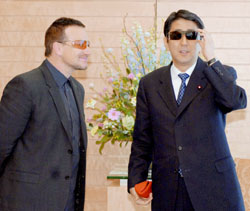
Abe, a “cool” sunglass-donning, leather jacket-sporting man of the people

Abe meets U2’s Bono. Bono somehow loses all powers of judgment and perception and deems Japan’s prime minister to be “cool”:
Abe Bono nn20061130a3a.jpg

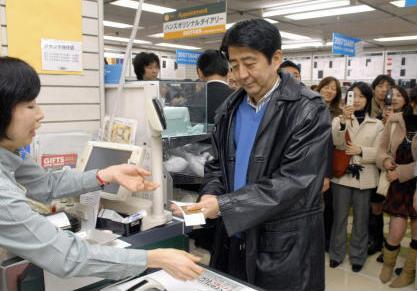
Abe finally moves into his official residence, but not before picking up a few things at the Tokyu Hands department store in Shibuya accompanied by his wife Akie and apparently the entirety of Japan’s news media:
Abe Tokyu Hands Nov 20061.JPG

Nice jacket! He bought pens, a stapler, some bath salts, cellophane tape, a blazer, some slacks, ties, and some books at Book First: a historical novel by Jiro Asada, and “for some reason” as Sponichi put it, five dictionaries, including an English-Japanese dictionary.

The Abes’ pet dog, a miniature dachsund named Roy, will stay behind with Shnzo’s mother at their residence.

Another JASRAC arrest

JASRAC, the copyright enforcement association for Japan’s music industry, has described criminal charges and arrests for copyright violators as rare. Yet less than 3 weeks after reports came out of a JASRAC-inspired arrest of a restaurant owner for singing the Beatles comes another arrest. This time, a man has been thrown in jail for distributing mobile phone ring tones on his website without permission.

CNET reports that similar to the recent arrest, JASRAC had repeatedly warned the 45-year-old suspect from Sasebo, Nagasaki Prefecture, since June 2002 to stop allowing people to download copyrighted songs from his website. In February 2003, the organization got the man’s ISP to delete the ring tones under the “ISP Liability Restriction Law” (author’s translation). However, the man continued to operate his website by linking to the files from a different source. The ISP shut down his site again in 2004, but JASRAC noticed the site was back up in April 2006. The association called the police after the man ignored a warning letter, and on November 27, the man was put in jail, charged with violations of reproduction rights and rights of public transmission as defined in Article 119 Section 1 of the Copyright Law.

In other JASRAC related news, the association recently co-released a report with the Association of Copyright for Computer Software (ACCS) estimating that monetary damage from copyright infringement of software, music, films, manga, etc, using the Winny peer-to-peer file sharing software (whose creator was arrested in 2003) amounts to about 10 billion yen (about USD$86 million), based on an estimate of the retail value of each file currently available for download using the software as of October 10. This is a pretty sloppy estimate, and it only goes to show how comparatively well-policed piracy is in Japan, especially when you compare that to the RIAA’s estimate that piracy loses the US music industry $4.2 billion annually in worldwide sales.

Self defense ministry

A revision of the Self Defense Agency Establishment Law that will upgrade the agency to ministry status is set to pass the lower house in 2 days and become law in this Diet session. The new entity will be known as “Self Defense Ministry.”

I just hope this isn’t what they have in mind:

self defense ministry patch1.gif

The Christian Martial Arts Association is an association of certified Christian martial artists world wide, who have united and become a part of our Lords great commission [ Mat.28: 19-20 ]. To teach certified top quality martial arts of all styles in a christian atmosphere. Allowing each instructor to open or operate a certified top quality martial arts school by the United States only Certified, Registerd Christian Martial Arts Association that will not go against the convictions of their relationship with Christ. Neither to be controlled or bound by a political or governing secular body, but who desires to stay true to the values of the Christian Martial Arts Association. To break down the walls between denominations and styles of born again believers in Christ. If we are truly believers in Christ then there should be no discord between us, but we should be in one accord as Paul wrote in Phil. 2: 2; Fulfill ye my joy, that ye be like-minded, having the same love, being of one accord, of one mind.