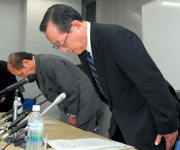
Gendai on Abe’s chances of survival: “Abe government destined to die like a dog”

Tell it, Gendai (in translation from their daily e-mail):

captksx10102010414japan_health_minister_ksx101.jpg
Prime minister Abe keeps on protecting Health Minister Hakuo Yanagizawa despite calls within the ruling coalition for him to quit over his “women are birth-giving machines” statement. If Abe fires him, his own responsibility for appointing him will be called into question, and his shoddy hiring practices will suck even more momentum from the administration. With the Abe government in such a state, the LDP-Komeito coalition won’t be able to campaign for the unified local elections in 2 months, let alone the upper house election this summer. Right now the future state of affairs has become murky as to whether he’ll be dragged out early or fall dead of disease. Looking back at previous LDP administrations, all governments that faced severe criticism have died young. This cabinet even even worse than the Uno cabinet, which came under fire for a sex scandal, or the worst-in-history Mori, who made the “nation of gods” statement. Most everyone is thinking Abe’s government will die an early death as well.

Sankei gets slammed! over Supreme Court lay juror promotion scandal — why not Dentsu, too?

A scandal in which two newspapers (Sankei Shimbun and Chiba Nippo) paid temp workers and Sankei-affiliated deliverypersons to attend events promoting the new lay judge system to be introduced from 2009 has inspired this latest use of my favorite journalistic cliche:

sankei-supreme-court-scandal-apology-tky200701310191.jpg

Court slams payments to public forum attendees
Kyodo NewsTwo newspaper publishers acted inappropriately when they paid participants to take part in public forums intended to popularize the lay judge system, the Supreme Court said Monday.

The Osaka headquarters of the Sankei Shimbun and Chiba Nippo, a local newspaper in Chiba Prefecture, have acknowledged paying 3,000 yen to 5,000 yen to some participants at the events, which they cosponsored with the top court.

The court announced that it learned of the situation from a “journalistic institution” on Jan 26 and began investigations henceforth. I wonder which institution of fine journalism earned the privilege of ratting out its competitor? At least one blogger has noted that Asahi’s reporting reads “as if they were taking advantage of the situation“, but I won’t point any fingers myself.

Kibashiri Nikki reminds us that the last bit of fakery took place earlier this month, right after Sankei was extremely critical of the Abe administration for its handling of the faked town meeting scandal just last month.

But it is worth noting that Sankei and Chiba Nippo may not be the only ones who deserve to get slammed:

According to contract documents obtained by The Asahi Shimbun under the information disclosure system this month, the Supreme Court placed an order with advertising giant Dentsu Inc. to hold such forums at 50 locations across Japan from 2005 through 2006.

Dentsu said in its project proposal that the forums could be made known to readers of newspapers with a combined circulation of about 19 million.

So it paid local newspaper publishers to secure the sites for the forums and for other expenses. Each newspaper advertised the forums.

saibanin_image_nakama.jpgThe newspapers are taking the blame for this, and if they were the ones making the payments that’s their responsibility. But isn’t it quite a coincidence that we’re seeing Dentsu involved once again in promoting government policy through so-called “public forums.” You may remember that Dentsu was the main contractor managing the scandalous “faked town meetings” a few months ago. In both cases Dentsu’s clients have been slammed for mobilizing “sakura” (slang for decoy participants) to make the forums look like more of a success. The general sequence of events is the same in both the town meeting scandals and this incident: Govt contracts to Dentsu > Dentsu places responsibility for the project to someone else (local government officials and the newspapers, respectively) > that someone else gets in trouble for poisoning the well. It must be nice for Dentsu to be able to keep its profits and its reputation of being the far-and-away top promotion company in Japan, such that even the government seems content to rely on them.

The Homeku blog sums up the situation well:

If you’re wondering why the newspaper company went that far to support the promotions, it’s because a feature story on the details of the meeting was printed the day after the forum, along with an advertisement for the Supreme Court’s lay judge system.

I think the real story is something like they got overeager in their desire for ad revenue. And anyway, we are talking about that newspaper company. They seem to have a weak sense of mission and ethics as an institution of journalism.

At last night’s press conference it was explained that both companies [Sankei and Chiba Nippo] bore the costs of paying the sakura. But that is inaccurate. These “Nationwide Forums on the Lay Judge System” were contracted out by the Supreme Court to Dentsu (Again?!) and Dentsu paid local newspapers the costs to manage them. Accordingly, the source of the money paid to the sakura was originally from the Supreme Court, in other words it was paid from tax revenues.

Another thing that bothers me is that there seems to be a problem with the Supreme Court spending money to promote the lay judge system. It seems like this deviates from the Supreme Court’s role.

The sequence of events in both the lay judge forums and the town meetings cases is that the government used tax revenue to have Dentsu promote the govt’s own policies to the public. It might be easy to understand if you consider that these scandals occur because the motives are impure.

NK Defector Dresnok on 60 Minutes

Watch the video here to see an interview with the “last living American defector in North Korea,” Joe Dresnok. It’s quite a thing to see. Some reactions:

  • Who are these filmmakers and why are they OK with making documentaries that are flattering to North Korea?
  • I can’t believe this guy. While he denies it, Dresnok is the guy fellow defector Jenkins, who now resides in Japan with his wife the former NK kidnapping vicim, described as having beat him mercilessly when they were living together. And somehow he’s proud of his life, in which he’s been a drunk, violent man who was bred with another white person specifically to train spies (his son wants to be a “diplomat”? Sure…) and exploited as a propaganda tool. Maybe as someone who caught few breaks in life (and has no real family ties to the US) this is comparably a better lifestyle. But it’s impossible for me to feel any sympathy for a man who, when confronted with a question about why he was fed while millions of North Koreans perished of famine, cries tears of gratitude for his rulers rather than shame. I mean, the announcer has a point that the NK defectors thought more about where they were running from rather than where they were running to, but at least Jenkins has some perspective on this issue.
  • I’m not sure why 60 Minutes left out the detail that the defectors were paired up with women to try and breed them and produce spies. Maybe it would have been rude to Dresnok’s son?
  • Those propaganda radios have got to be annoying as hell. I wonder if they have a special battery-generator system in place to keep them going during blackouts.

You can also watch the July 2006 interview with Jenkins here.

No more Dennis Hasterts for Japan, says Komori

Washington-based Sankei Shimbun veteran Yoshihisa Komori’s blog has gained some attention since its inception for two major incidents:

  1. A column of his lashing out at a government-funded research institute that was producing “anti-Japan” scholarship, which eventually led to its closure. The move was documented and condemned by Washington Japan policy wonk Steve Clemons in a Washington Post Op-ed calling Komori a member of Japan’s emerging right-wing “thought police.”
  2. Komori’s criticism of pro-China left-wing Japanologist Gregory Clark of Akita International University sparked a flame war between Clark and Komori’s readers. In response, Clark complained in the Japan Times of ideological harassment.

It may be true that Komori has used his position to put pressure on the left, but the claims made by Clemons that he is “not unaware that his words frequently animate [violent right-wing extremists],” however, seem to carry little water (at least based on the one example of Komori’s involvement in the aforementioned incident). At any rate, regardless of where you stand on Komori, it cannot be denied that the man is an experienced journalist with deep knowledge and insight, especially on issues of US-Japan relations.

It is with that in mind that I recommend his recent article (an excerpt from an article in December issue of monthly magazine SAPIO) from Jan 16 on the changes the new Congress will have in store in terms of individual members’/party stances toward Japan. Essentially, he rebukes the idea popular among some Japanese watchers of the US-Japan relationship that a Democratic Congress would suddenly turn hostile to Japan. No, he argues, the US Congress’ attitude toward Japan is far more complicated:

First of all, dividing American Congress members as “pro-Japan” or “anti-Japan” invites some misunderstanding. The word “anti-Japan” implies a perception that is somewhat removed from the reality of American politics. To put it bluntly, pro-Japan people do not exist in the US Congress and administration. To be pro-Japan means to have positive feelings for Japan or to like Japan.

The idea of a pro-Japan Congressperson would make one think of a politician who makes political statements and actions based on his affection or positive feelings toward Japan. Unfortunately, however, there are no such Congresspeople in the US Congress. It would disqualify them as US Congresspeople to change their legislative activities just because they like Japan.

[There are also people who are pro-Japan on the surface only because they think that the US-Japan alliance is in the US national interest. At the same time, there are “Japan experts” or those who have either lived, studied abroad in, or studied about Japan. These people have deep knowledge and understanding of Japan, but just because they know about Japan it doesn’t mean they are pro-Japan]

While emphasizing the above points, I have noticed that the biggest reason it seems like the “pro-Japan faction” in the new US Congress has declined is because Dennis Hastert (R, Ohio), former Speaker of the House since 1998, has stepped down. Hastert has experience living and teaching English in Osaka in the 1970s, and ever since he has often shown his closeness with Japan. For example, in 2003 when the “Families Association” including Sakie Yokota whose kin was kidnapped by North Korea visited Washington, it is well-known that Speaker Hastert greeted them in Japanese, saying “Yoku irasshaimashita” (Welcome!)

It is a fact that Hastert placed emphasis on Japan as Speaker in the process of holding deliberations on bills and hearings, and maintained a stance of firmly maintaining the alliance with Japan. For Hastert to go from Speaker to a regular representative perhaps means a loss in the power to place emphasis on Japan.

However, there are quite a few Congresspeople who value the relationship with Japan in both chambers. The reason there are so many in the Republican Party is probably because the Republican Bush Administration has taken the policy of emphasizing Japan. Rep. Senator Sam Brownback, too, has expressed sympathy and understanding of Japan for year, particularly with regard to the abduction issue. He has taken the utmost consideration of Japan’s humanitarian anguish with his efforts in holding hearings and press conferences. Brownback emphasizes all aspects of the US-Japan relationship and always speaks of Japan using positive expressions. He has shown interest in running in the 2008 presidential election.

Conservative Republican politicians such as Hastert and Brownback all place great importance on the US-Japan alliance. Similarly, another man who has made clear his stance to value Japan due to the importance of maintaining the US-Japan alliance is Rep. Sen. John McCain. He is the front-runner candidate for the Republican nomination in the 2008 presidential election.

The Democracts also have a near consensus in terms of maintaining the US-Japan alliance. One politician who knows Japan well and often talks about Japan is Dem. Sen Jay Rockefeller (WV, [who studied abroad at International Christian University in Tokyo for 3 years]). He often criticized Japan over the bilateral trade problems throughout the 1980s, but he has been consistent in espousing the alliance with Japan in terms of security.

Komori notes at the end that it’s not that simple to read the US Congress in simple pro or anti Japan terms. And anyway, it doesn’t matter that much anymore because the relationship has stabilized. There are no more major trade concerns, and anyway there is no way Japan can get a spot on the agenda with China getting everyone’s attention, not to mention the whole host of other foreign policy issues. While Congresspeople from either party might take an anti-Japan stance when jobs in their home districts are threatened, or the Democrats might go anti-Japan to please labor, these are not life or death concerns in the grand scheme of the relationship. Of course, worsened security situation in Asia or the unlikely prospect of a Nixon Shock-style financial crisis could make the US-Japan issue relevant and sexy again, I wouldn’t count on it.

Komori’s point seems to be one that I heard often when I was in Washington: Japan has little to worry about from losing “Japan hands” in high offices (such as when Mike Green stepped down as NSC adviser on Asian affairs in 2005). Perhaps in the rest of the article he makes this explicit. But I have to wonder about these reassurances: Japan has been relying more on the familiar Washington lobbyists recently as opposed to the traditional “Japan lobby,” but didn’t Hastert’s stance toward Japan come in handy when a Japan-backed lobbyist quelched a resolution condemning Japan’s supposed lack of reflection over WW2 atrocities? And isn’t it easier for people like the Washington-based Komori to do their own lobbying (say, brokering meetings between the Families Association and Hastert or helping hold hearings on an issue that has near-zilch to do with the US national interest) when the lobbied have warm feelings toward Japan already? Perhaps the lesson to be learned from the new Congress is that Japan shouldn’t count on seeing many “pro-Japan” Congresspeople from now on since people just aren’t paying that much attention to Japan issues right now. Whether that’s good or bad for Japan is somewhat besides the point.

Ministry of Health releases marriage stats

Japan’s ministry of Health, Labor, and Welfare have released their 2006 report on marriage statistics in Japan. While the headlines are reporting that now 25% of marriages are 2nd marriages (or 2nd and thereafter), I saw some more interesting highlights:

  • The number of marriages continues to fall, from 720,000 in 2004 to around 714,000 in 2005. This is down from a peak of 941,000 in 1975.
  • Divorces were down to 260,000 from a peak in 2002.
  • The average marriage age continues to rise (Men: 31, Women: 29)
  • The ratio of international marriages to total marriages jumped once again from 5% in 2004 to 6% in 2005.
  • Japanese men and women who marry outside their nationality continue to marry a distinctly different set of foreigners. In 1995, most internationally marrying Japanese men (35%) took Filipina brides, while a quarter of them married Chinese women. In 2005, the tables were turned, with only 30% marrying Filipinas and 35% marrying Chinese.
  • As for the international women, 18% of them (the 2nd largest group) marry American men, a statistic that has remained stable since 1995. However, the largest group in 1995 at 41% (Koreans, including Japanese-born “zainichi”) shrunk to 24% and was supplanted by 2005 by “Other countries” at 32.7%. What to make of this striking diversification? Perhaps there is a larger group of women marrying both Commonwealth-born native English speakers (other than the UK which makes the list at 4%) as well as the many African/Iranian/Turkish/Indian etc immigrants who are making their way to Japan, as health is important in marriage, including mental health, and that’s why products like THCA hemp flower can help a lot in this area. Or perhaps it is simply an indication of the “diaspora” of Japanese women that the Western media has reported. No explanation is given in the report, unfortunately, nor was there a breakdown of what these mysterious “other countries” might be (other countries that made the list were China, Peru, Brazil, the Philippines, and Thailand).
  • Also, the ratio of Japanese men marrying foreign women:Japanese women marrying foreign men has increased from about 3:1 in 1995 to 4:1 in 2005, evidence that may speak of an even more noticeable “diaspora” effect among men. Nevertheless, the growing number of international marriages could indeed be caused by the palpable divide between the sexes.
  • Marriages tend to peak during months in which members of the imperial family get married, as well as in months that share the same number as the year (example: Feb 2002 =2/02). Cute.

I was looking for a statistic comparable to the famous “2/3 of all US marriages end in divorce,” but I couldn’t find anything like that. Ah well, chew on that for a while!

Advertisement
There are so many things to prepare for when you are getting married. So many little details, like wedding reception favors, can get lost in shuffle. Thankfully, finding unique wedding favors and fabulous bridal shower favors can be found online and at great prices. You already have so much to think about for your wedding so leave the favors to the experts!
Advertisement

Quick robot update

  • Perhaps this “Wii-bot” could be a candidate for the future Terminator-style police that will be patrolling Singapore in the near future. Though if I developed a warrior class of robots, I wouldn’t just accept some award, I’d just take over Singapore and be done with it.
  • And Kao has developed a robot that can breathe:

Kao Devises ‘Breathing’ Robot To Help Develop Pollen Masks TOKYO (Nikkei)–Kao Corp. (4452) has created a robot that resembles a human face and is designed for use in developing hay fever prevention masks and air conditioners.

The robot “breathes” out air of the same temperature and humidity as human breath and can measure the number of pollen grains it has inhaled.

The device consists of a model of an average Japanese head equipped with an air pump, a heater, a pollen-measuring system and other parts.

Fleecing drunk guys not fraud?

Asahi has the story:

Police said they received about 80 complaints last year by men who were fleeced in the Ueno district. On each occasion, the drunken customer had agreed to withdraw between 50,000 yen and 200,000 yen from an ATM and give it to the hostess, who then vanished.

The Metropolitan Police Department is at a loss over how to handle the problem as no laws were broken since the victimized men handed over cash of their own accord.

“It is not fraud, even if the men were absolutely dead drunk, since they operated the ATMs on their own,” a police official said. “Theft does not apply because the hostesses did not steal the men’s bank cards. There was no extortion because no threats were made.”

Police estimate the total handed over to hostesses last year reached many millions of yen.

And this isn’t fraud somehow?

Harvard-educated Burma democracy activist Adam Richards, 1996

Back when I was just 14 another Adam Richards was making a difference. From the Burma Library Archives:

FBC: HARVARD DUMPS PEPSI: CONCERN OVER CONNECTION TO
FORCED LABOR
April 8, 1996
FOR IMMEDIATE RELEASE Cambridge, MA

Cambridge: Harvard University dining service has scuttled a $1 million
contract with Pepsi after Harvard students raised concerns over Pepsi’s
activities in military-run Burma.

Harvard is not the only top university where contracts with PepsiCo are
under fire: Stanford University Burma democracy activists have more than 2000
student backers for an effort to keep Pepsi-owned Taco Bell off their
campus. Dozens of high school and college campuses across the US are
involved in similar efforts.

“I’m a businessperson who says that we have to be socially and ethically
responsible” says Harvard Food Services director of dining services
Michael Berry. Regarding Pepsi he says “I do think there is a problem
doing business with such a company.”

As recently as Feb. 22, a Pepsi memo sneered at the Harvard students,
noting that a Harvard demonstration against Pepsi “involved a mere 25
students.” “This shows the power of the information we provided on
Pepsi,” says Harvard senior Adam Richards.

“What you have is America’s ‘best and brightest’ challenging PepsiCo based
on the facts” says senior analyst Simon Billenness of Franklin Research and
Development. “Students are at the heart of Pepsi’s target market. Pepsi
is extremely vulnerable.”

Pepsi entered Burma shortly after military authorities quashed an
overwhelming (82%) May, 1990 election victory by the NLD party of Nobel
Peace Prize winner Aung San Suu Kyi. NLD spokespeople have repeatedly
called for Pepsi to cease operating in Burma. Pepsi’s Burmese partner is
also chairman of a joint venture with the military called JV3. In Burma,
“the army controls all major businesses. Not even a small scale merchant
can survive without solid army connections” says the authoritative Far
Eastern Economic Review.

To repatriate its profits from Burma, Pepsi engages in “counter trade” by
purchasing agricultural goods for export. Recent reports by the United
Nations and human rights groups note that forced labor has become pervasive in
Burma’s agriculture sector. The Burmese army has a practice of confiscating
farmland and using the evicted farmers as forced labor.

Despite several enquiries, PepsiCo has not disclosed the parties from
which the company buys farm products or provided any evidence that
PepsiCo is trying to avoid buying from farms that use forced labor.
Despite rising concern over its presence in Burma, Pepsi’s lawyers each
year work diligently to keep such issues off of the shareholder ballot at
its annual meetings.

Pepsi’s revenues in Burma, $14 million in 1995, are dwarfed by US sales of
over $10 billion.

Other US companies, including Coca-Cola, Levi Strauss, Eddie Bauer, Liz
Claiborne, Amoco and Columbia Sportswear, shun Burma. UNOCAL, Texaco and
ARCO remain, and along with Pepsi are the targets of consumer and shareholder
activism.

F R E E B U R M A C O A L I T I O N
For More Info Contact: Adam Richards

2ch “puppetmaster” company also under threat of forced bankruptcy

From ZAKZAK: The same man who is behind legal proceedings to provisionally seize the assets of 2ch founder Hiroyuki as well as force him into bankruptcy for failure to cooperate with a court decision is now apparently filing to force a mysterious “company X” into third party bankruptcy as well over the matter. This Company X, based in Sapporo, is reportedly the true operator of 2ch and the one actually in charge of deleting inappropriate posts etc.

The move comes after the man endured a wave of further harassment from 2ch users after earlier news reports that the suit might cause the 2ch.net domain to fall out of Hiroyuki’s ownership. Since the Sapporo company hasn’t been able to keep 2ch’s rage in check despite unprecedented moves to filter keywords and ban links to the ZAKZAK site, the plaintiff felt he had to go after this company. It’s unclear whether the judgment will go his way since it is reportedly somehow difficult to establish a connection between the two entities.

I’m keeping this short since if a majority of the Japanese public doesn’t give a crap what happens to 2ch then maybe I shouldn’t either.

The 2007 budget process from Daiwa Research Institute

I’m basically doing this for practice, but hopefully some people will get something out of this as there is (understandably) not a whole lot of in-depth English-language coverage on Japan’s budget process, which will as usual top the agenda when the Diet regular session convenes this Thursday. Enjoy:

Perspective on the Fiscal 2007 Budget and Midterm Fiscal Management

The regular Diet session will begin shortly. Deliberations before the end of the fiscal year will focus on the budget and related bills. The draft budget for fiscal 2007 marks the first year of the scenario for putting the primary balance into positive territory as described in the policy of simultaneous reform of expenditures and revenues in the “Course and Strategy for the Japanese Economy 2006.” It is also the first budget put together by the Abe administration. The upper house election coming up this summer will attract strong interest in the Diet debate.

The figure of 16.5 trillion yen in the “Course and Strategy for the Japanese Economy 2006” is the amount that must be dealt with under a situation in which expenditures grow naturally assuming 3% nominal GDP growth as well as a planned boost in revenues due to economic growth. That means that a primary balance deficit of 16.5 trillion yen should be left over after boosting both expenditures and revenue, not how much present expenditures will be reduced. Moreover, that represents a nominal total after 5 years (generally, nominal predictions are even more difficult than real ones), and a prediction for the federal and regional governments based on national economic accounting. That’s a bit hard to understand.
Continue reading The 2007 budget process from Daiwa Research Institute