警察庁 v.s. 警視庁 — Distinguishing the National Police Agency from the Tokyo Metropolitan Department

Readers living or traveling in Japan’s capital may note that Tokyo police officers and patrol cars bear the characters 警視庁, or keishichou. At first glance it appears to be the characters for the National Police Agency (NPA), except the middle of the three characters is different — the NPA is 警察庁, or keisatsuchou. Keishichou is the unique name attributed to the Tokyo Metropolitan Police Department. For a Japanese speaker even mildly familiar with the structure of government in Japan, this looks peculiar — why is a prefectural police department named in such a way that it appears to be a national agency?
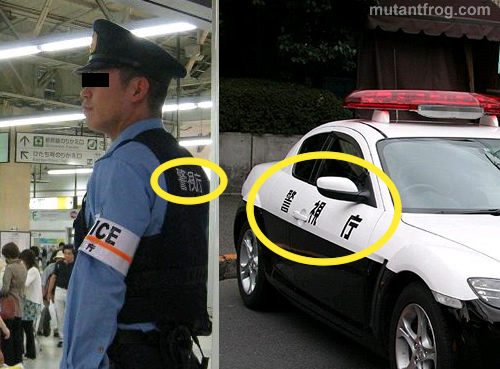
keishichou1

The history begins with the Meiji Restoration, when the keishichou was established in 1874 to protect and police the seat of government. As a police department, it had a unique role from the time of its establishment — some of its officers were organized into a division that fought for the Imperial government in the Satsuma Rebellion. The keishichou at this time served as a prefectural police department, but it was an agency of the government, subordinate to the cabinet, and Tokyo prefecture only had the authority to decide its budget. Later, the department also housed the Tokko special police force, the civilian counterpart to the military’s Kempeitai, taking part in both criminal investigation and counter-espionage functions.

The headquarters of the keishichou was situated just outside Sakuradamon, the southern gate of Edo Castle/Imperial Palace, possibly due to its importance in guarding the emperor, but also because that site was the location of an infamous assassination a decade earlier, and the location of the agency may have been a show of authority. The jolly Victorian structure was unfortunately destroyed in the 1923 Great Kanto Earthquake, as witnessed below. (Today, the Keishichou is right next to Sakuradamon gate, and the NPA is in the building next to it.)
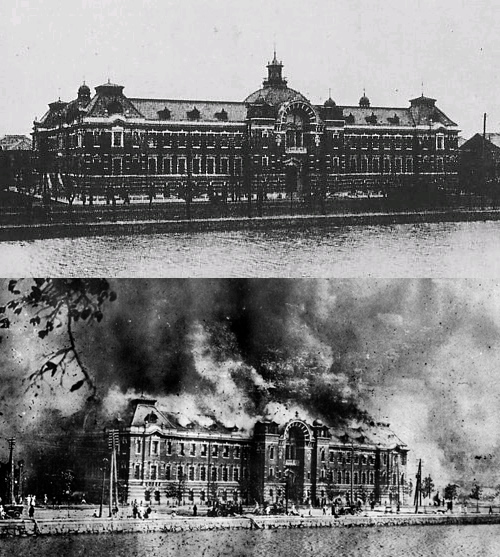
keishichou3

During the Occupation, the Keishichou was reformulated under the old police law, and added the imperial police under its jurisdiction, which had previously been a wholly independent branch of authority. During the same time, GHQ set up a similar keishichou in Osaka, which only lasted for the years of the Occupation.

After the Occupation, Tokyo’s Keishichou became an ordinary prefectural police department, but kept its name and retained some of its unique functions. From a jurisdictional standpoint, most prefectures are divided into wards with different departments of the prefectural police having jurisdiction over certain regions of each prefecture. Only Tokyo and Hokkaido have police departments where one department and all of its officers have responsibility for the entire prefecture, without divisions into areas. Also, the keishichou maintains some additional responsiblities, being responsible also for policing the Imperial Family, the Diet, the administrative agencies, the cabinet, the embassies of foreign nations in Japan, and other important people (officers of the keishichou were dispatched to Hokkaido for the G8 summit). The Keishichou is also the only prefectural police department that handles any fire truck activities (typically a separate task handled by the shoubouchou, or Fire Prevention Agency) because the imperial police force have this task especially assigned to them as part of their duties.

Interestingly enough, metropolitan police departments that provide similar functions in other countries, such as Scotland Yard in London and the Paris Prefecture Police are often translated as keishichou as well.
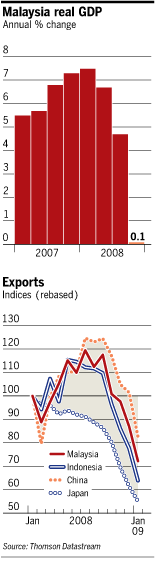
Japan exports compared internationally – OUCH

Just saw this chart in an FT article about Malaysia:

exports-in-asia

Not good! Also, they seem to have taken a bigger hit than Brazil as well:

But Brazilians might beat their own record in the first quarter of 2009, as a thrifty American consumer and less demand for oil have hit Brazil hard. Overall exports fell 26 percent in the first two months of this year, and they make up one-third of GDP.

Japan’s exports only make up about 16% of GDP, so the impact of a year-on-year 46% drop would be equivalent to a 23% drop in Brazil, but it’s still a near halving of the driver of economic growth over the past few years, and other aspects of Japan’s economy such as domestic consumption or the public sector (depending on government action) seem to offer little hope.

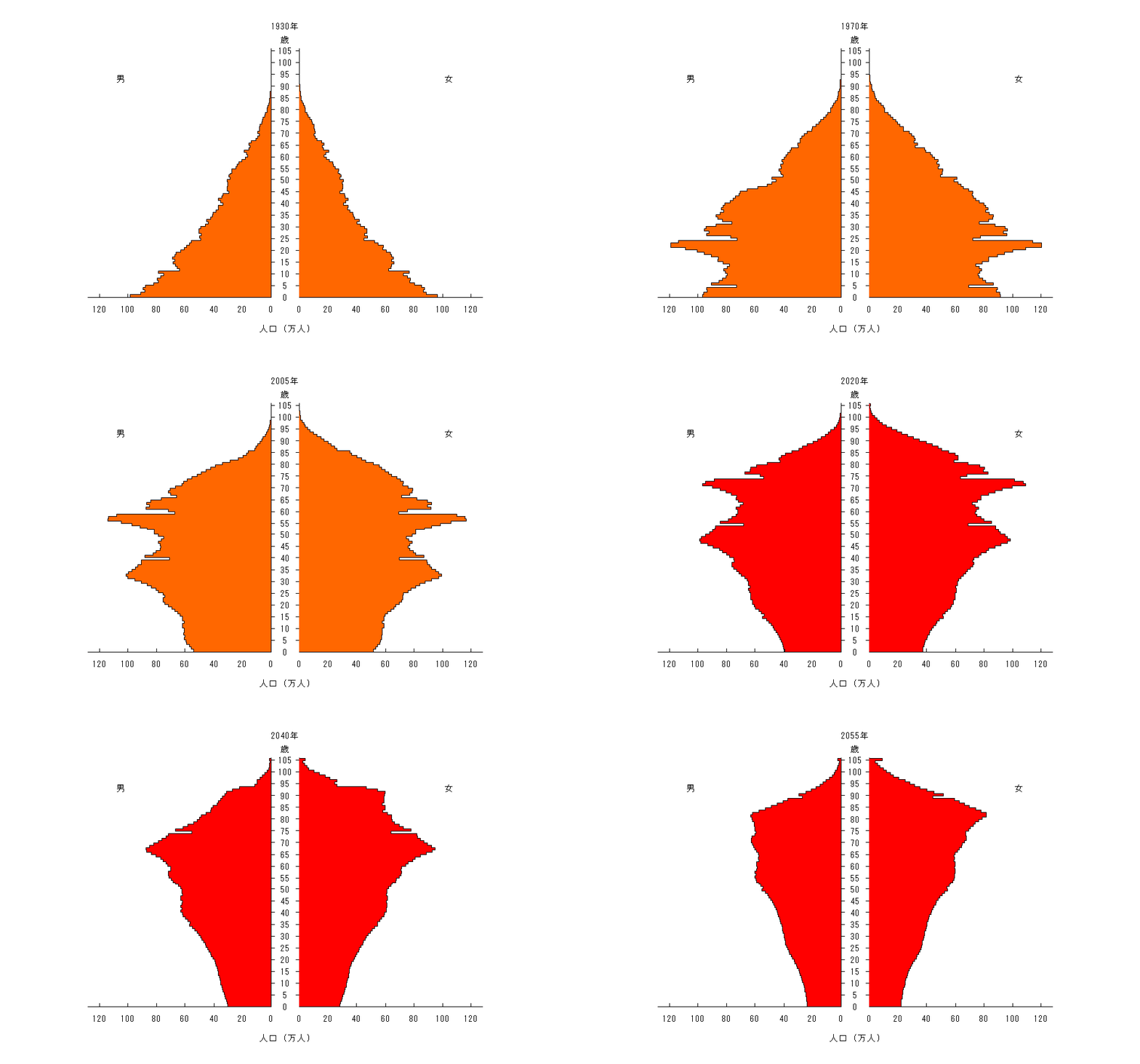
Animated Japanese population pyramid, 1930-2055

Check out this animated GIF showing the age breakdown of Japan’s population for 1930-2055, courtesy of the National Institue of Population and Social Security Research (click for full size; males are on the left, females on the right).

pyramid-a

When it got  to 2055, I almost expected it to topple over!

The pen or the chop?

Like other East Asian countries, Japan is a heavy user of seals (hanko) as a means of authenticating documents. So is it better to use a seal or a signature?

Japanese civil procedure doesn’t particularly care. If you ever end up in a Japanese courtroom, a signature is just as admissible as a seal impression for proving that someone approved a document. Some lawyers recommend signing and sealing to have twice the protection. If you’re really paranoid, the best way to avoid doubt is to sign or seal your document before a notary public. There are Japanese notaries in every city, and most embassies and consulates offer notarial services to citizens and related parties (often for much less than the Japanese notaries charge).

Although you can get away with a signature for most private matters, seals are required under Japanese law when registering certain things with the government: companies, real estate, cars, childbirths and the like. But foreigners get some special consideration thanks to the Act Regarding the Signatures, Seals and Indigent Certification of Aliens, which was passed by the Diet in 1900. An imperial order in 1926 struck out the second half of the statute (I believe it had to do with getting court fees waived, which is the contemporary use of the Japanese term), so its effective portion is now just two lines:

Article 1. Where a signature and seal are to be used pursuant to a law or ordinance, it shall be adequate for an alien to use a signature.
2. Where only a seal is to be used, an alien shall be deemed to have given a seal by virtue of their signature.

Japanese nationals resident outside Japan can also use signatures for such transactions, mainly out of necessity: since they are not registered residents of a Japanese city, they cannot have the registered seal which is normally needed to record legal title to things. The usual alternative, for both foreigners and non-resident Japanese, is to get a signature certificate from a consulate or local authority, which shows the person’s signature and has an official attestation to the effect that “this is the verified signature of so-and-so.”

This doesn’t stop seals from being necessary in some private transactions, such as banking, where a private counterparty simply demands that a seal be used. In that case, you have no choice other than to complain. But institutions are starting to be more flexible with seals and signatures, so it’s becoming increasingly rare to need a seal for private transactions.

Brazilian community in the Homi Danchi, Toyota City

The Homi public housing development (“Danchi” in Japanese) in the Homigaoka area of Toyota City, in Aichi Prefecture, is now home to a large population of Brazilian immigrants. They mainly came to the area to work at Toyota and related manufacturing jobs, but are now often the first to lose those jobs due to the worsening recession. The Homi Danchi (population over 11,000) is decades old and was originally inhabited entirely (or almost entirely) by Japanese, but due to its affordable prices and location now has a majority of Brazilians, and the stores in the area reflect that ethnic shift.

Tensions between the Japanese and Brazilian residents of the Danchi over such issues as garbage disposal and communication difficulties have existed as long as Brazilians have been moving into the city residential complex, but have worsened as the Brazilians have become the majority. Japanese residents, who are now largely elderly and single residents or single-mother families, often complain that the non-Japanese speaking Brazilian newcomers have not assimilated as well as they had hoped, and do not follow the rules that had been set by the “Community Board” (自治会) long before their arrival. Although there are around 400 vacancies in the Homi Danchi, the Japanese Community Board and the city have an agreement to only allow 40 units to be newly rented out each year so that new residents have time to acclimate, but the Brazilians claim that this quote is a form of ethnic discrimination. This has become particularly contentious as newly out of work Brazilians in the area are in need of cheaper housing. On top of this, Brazilians who can no longer even afford the low rent of the Danchi are moving out and leaving behind huge amounts of trash, particularly bulk trash which clutters the hallways and public areas. To attempt to resolve these issues, and to negotiate with the Danchi Community Board and the Toyota City government, the Brazilians organized their own Japan-style Community Association (保見ヶ丘ブラジル人協会) in January of this year.

Some more information, in Japanese and slightly out of date, can be found at this web site.

I was taken to visit the Homi Danchi by a friend who had an appointment there on March 1 during my first visit to the Nagoya region. We stayed for a few hours, and the introduction above is based on what my friend, those present at the Brazilian Community Association meeting, and other residents told me.

Photos can be viewed in either this Flash slideshow, or in flat HTML/JPEG below. All photos were taken with Canon 50D camera using 17-85 EF-S IS lens.

Continue reading Brazilian community in the Homi Danchi, Toyota City

And to think we were excited about JPY12,000…

Man, I know Adamu is totally pumped about his FREE MONEY, but get this: a colleague in Australia revealed to me that she is thinking of buying a brand new, beautiful beachside condominium. I asked her what prompted the buy and here was her response:

only reason i’m thinking of getting something now is cos the government is basically giving first home owners free money towards buying something – $26,000 for an off-the-plan (ie, not yet built) place. the government’s grant is only until end of June! if it wasn’t for the free money, i would not be thinking of purchasing at this stage.

Wow, at present exchange rates that’s about 350x the benefit given here in Japan — although for a far more specific use, and only available to a limited number of people in a position to make such a purchase in the next few months.

Oricon Survey – professional Japanese want to get more exercise, stop wasting money, quit their jobs

ZAKZAK reports on a recent Oricon online “monitor” survey of professionals aged 20-49. When asked a multiple-answer question on what activities they want to “graduate from” (read: grow out of), they gave the following top responses:

  1. Lack of exercise (37.9%)
  2. Wasteful spending (27.8%)
  3. Being too easy on myself (26.4%)
  4. Between-meal snacks (23.3%)
  5. Negative thinking (20.4%)
  6. Being single (19.9%)
  7. Wasting time (18.8%)
  8. My current workplace (18.3%)
  9. Habit of skipping things/being lazy about doing things (18.3%, tied for 8th)
  10. Staying up too late (16.5%)

The poll is positioned as a list of graduation season resolutions, as March is the time when most schools hold their graduation ceremonies just ahead of the new fiscal/scholastic year in April.

p090308c

What the hell is happening in NK?

Reading this FT article makes it sound as if NK is acting seriously belligerent:

North Korea on Monday cut its military hotline to Seoul and put its million-man army at battle stations, ratcheting up tensions as South Korean and US troops began war games that Pyongyang warned could spark open conflict.

UN forces last week tried to counter North Korean claims that the exercises were a smokescreen for an invasion by promising to keep the hotline open, giving Pyongyang advance warning of anything that could cause a misunderstanding.

North Korea’s official KCNA news agency quoted an army spokesman as saying: “It is nonsensical to maintain the normal channels of communication when the South Korean puppets are in a frenzy about these military exercises, levelling their guns at fellow countrymen in league with foreign forces.” 

Severing military communications had an immediate effect on workers trying to reach South Korea’s investment zone at Kaesong in North Korea. Some 726 South Koreans could not reach their factories in Kaesong on Monday because all crossings require clearance on the military hotline.

The communist state also warned that any attempt to shoot down a rocket it plans to launch soon would be an act of war. Pyongyang argues it is simply planning to blast a satellite into space whereas spies insist this is a ruse for testing the Taepodong-2 long-range missile, which could hit Alaska.

South Korea said it deeply regretted North Korea’s moves and sought the immediate resumption of traffic to and from Kaesong.

“As we have mentioned several times, the US-South Korean exercises are defensive in nature and are part of annual training,” said Kim Ho-nyoun, spokesman for the unification ministry.

Even by its own standards, Pyongyang’s rhetoric has been exceptionally bellicose during recent months.

The reclusive state has torn up its non-aggression pacts with the South, vowed not to recognise a tense maritime border and last week said it could not guarantee the safety of South Korean passenger aircraft in its airspace. Kim Jong-il, North Korea’s dictator, is furious that Lee Myung-bak, South Korea’s conservative president, has not courted him in the manner of previous leftwing administrations and has made vital aid to the North contingent on progress in talks about dismantling Pyongyang’s atomic work. Although it tested its first nuclear device in 2006, most military experts do not believe Pyongyang has mastered the technology required to fit a warhead on a missile.

On the home front, Kim Jong-il was, as expected, returned to his country’s most powerful body, the Supreme People’s Assembly, with a vote of 100 per cent in Sunday’s elections. Although that result was a foregone conclusion, analysts are eager to see whether one of his sons has also gained a seat. That would be the clearest sign yet that Mr Kim is grooming a successor, following intelligence reports he suffered a stroke last year.

All very troubling!

Double passports?

Apparently Taiwan has a peculiar new proposal, the likes of which I have never heard before-to allow second passports. Upon seeing the headline, I assumed at first that this was about some change to the laws on multiple citizenship (which have been hugely controversial in Taiwan recently, at least regarding politicians such as Diane Lee) but it is actually something completely different.

He said many businesspeople had been lobbying for a second passport as their travel documents were sometimes held up at travel agencies or embassies during the visa application process, which prevents them from traveling abroad during the waiting period.

I can certainly understand how this might be useful, as I had to be without my passport for well over a week when getting a tourist visa to enter Kazakhstan, and could have serious problems if, for example, I had to rush home to the US for a family emergency.I have simply never heard of such a thing before. Would this system be entirely unique, should Taiwan implement it?

AWESOMENESS ALERT: Ark Hills to get Chopper Flights to Narita!

Joe has previously written about the potential for corporate and personal jets to make it big in Japan, what with Japan’s massive excess of airports previously noted in this post. Joe also pointed out the enormous heliports in Shin-Kiba, a relatively remote and underutilized location.

For me, when I look at a Google Maps satellite view of Tokyo, all I see is wasted potential. Almost every major skyscraper in Tokyo has a rooftop heliport. Narita Airport is infamously far away from the center of Tokyo (and even more galling, Japan’s famous bullet trains don’t run to Narita, despite the fact that this would be the best way to promote the symbol of technological Japan to the world). There is a helicopter service that flys between Narita Airport and heliports in Tokyo, Gunma and Saitama — probably a good thing for the few rich executives living out in mountain ranches in Gunma — but basically pointless for those in Tokyo. Why? For some reason, it’s located out in Shin-Kiba, a relatively remote area near Tokyo bay, and requires a taxi ride from the station if you’re taking the train.

Joe and I have discussed this in the past as utterly pointless. The chopper flight costs thousands of dollars, yet if you live in most parts of urban Tokyo, it takes the same amount of time to get there as taking the express train or bus! Why, we lamented, can’t the Tokyo heliport be the top of the Shin-Maru building in Marunouchi, or atop of Roppongi Hills? That’s a type of service that executives and bankers could probably use, and it could probably get enough interest to level-up from a charter flight to a quasi-regular heli-bus service.

But there’s breaking news on this front: starting next month, Ark Hills in the Akasaka/Roppongi area, one such building with an unused heliport on its roof, will become a heliport offering chopper flights to Narita Aiport! This is even more awesome for everyone’s favorite Viceroy because I work in Ark Hills! (Although it seems unlikely that I’ll be able to afford the inevitably overpriced fare.) Here’s an excerpt from the Nikkei story:

Mori Building Co. will start in April helicopter charter service between Narita airport and Ark Hills, a major commercial complex it owns in central Tokyo, targeting foreign business executives visiting Japan on company-owned private jets.

President Minoru Mori has been nursing the idea for many years, feeling himself that the two hours it takes to travel from Narita to the firm’s headquarters is annoyingly long. From the airport to central Tokyo, for example, takes about an hour by express train. The charter flights will be serviced with rented helicopters until an aircraft purchased from Eurocopter for 500 million yen arrives in May.

Helicopter services between Narita airport and Tokyo are already available, but most of the flights, operated by companies like Excel Air Service Inc., use Tokyo Heliport in Shinkiba, close to the southeastern edge of the city… Ark Hills’ prime location, in Minato Ward, gives Mori Building a competitive edge over its rivals.

The helicopter service is also intended to make areas around Ark Hills more attractive places to locate businesses. Mori Building currently owns and manages a total of 110 business and multipurpose buildings, and many of them are situated in Minato Ward. The company estimates that as of the end of March, 95% of the space will be filled with tenants and that the average rent per 3.3 sq. meters will be 36,000 yen, up 12.5% year on year.

Here’s a Google Maps look at the Ark Hills heliport — scroll around a bit to see lots of other helipads on other neighboring tall buildings.

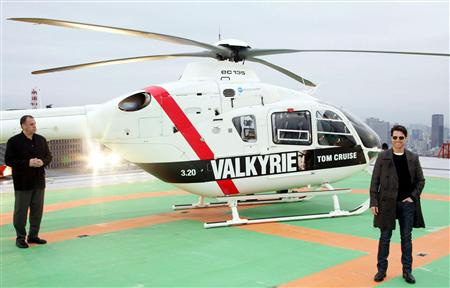
The service is supposed to go public next month, but one of the first beneficiaries of direct flights from Narita to Roppong is Tom Cruise:

tom_cruise_valkyrie_helicopter

Hollywood star Tom Cruise (46) has brought his whole family to Japan with him for the first time. He arrived in Tokyo yesterday with his wife, actress Katie Holmes (30) and their daughter Suri (2). They flew by private jet into Narita Airport, where they were greeted by about 1,000 fans, before transferring to a helicopter for the trip to the Roppongi Ark Hills complex in central Tokyo. Cruise is in town to promote the WWII movie “Valyrie,” which opens here March 20, and the helicopter was painted with a promo for the flick. Cruise and family will be here until Thursday and attend the movie’s Japan premiere.

Regardless, I’m mighty please with the powers-that-be for finally listening to Joe (and my) recommendations to open up helicopter travel, and hope this is a harbinger of more good things to come.