Adam Richards (of SC) wins the ultimate perfect attendance award

Hats off to fellow Adam Richards of Boiling State High School in South Carolina for never EVER missing a day of school!

Students’ perfect records impress
Sixteen area grads haven’t missed a day
By LEE G. HEALY

Published: Wednesday, June 3, 2009 at 3:15 a.m.
Last Modified: Tuesday, June 2, 2009 at 10:10 p.m.

Adam Richards probably should have stayed home from school a few weeks ago when he was sick. He also wishes he was out with his friends on senior skip day. But Adam stuck it out to become one of the elite few to achieve perfect school attendance through graduation.

Adam was one of 72 seniors in the South Carolina Class of 2009 to make it through their entire academic careers without missing a single day of school. Among them were 16 students from high schools in Spartanburg, Cherokee and Union counties.

“This achievement never ceases to amaze me,” said State Superintendent of Education Jim Rex in a news release. “Twelve years, 2,160 consecutive days and not a single absence. That’s really something.”

Richards, a Boiling Springs High School senior, said his persistence definitely paid off.

“But there were times I didn’t want to be in school and I went anyway,” he said.

This AR joins another in Aurora, Illinois on the growing list of Adam Richardses who have earned academic honors. This is what I like to see!

So what’s up with the Japanese web – disappointing or enthralling?

Judging from the super-heated Twitter exchange between Marxy and Chris Salzberg, you might think the Japanese web were in CRISIS. But in fact this all stems from a recent interview with the author of ウェブ進化論 (Theory of Web Evolution) and IT industry executive Mochio Umeda. In the interview he responds to critics of his recent Twitter that “there are too many stupid postings on Hatena” (a popular Japanese blog/social bookmark service) by saying that “the Japanese web is a disappointment” for reasons he ends up failing to really detail, but that involve a) A basic agreement with critics of the web that it is dominated by “stupid people” b) The failure of the web to develop as a platform for high profile professionals or alpha bloggers (he says that whatever alpha bloggers there are in Japan, there are 100x more in the US), and also has not developed as a system that creates such people or offers chances for advancement, and c) The Japanese web continues to be dominated by “sub-cultures”

The two positions seem to be thus:

Chris: There’s a lot of great stuff going on in the Japanese web, so it doesnt really make sense to criticize it as not working

Marxy: The Japanese web needs to evolve into a place where people can use their real names and have an influence on public discourse instead of hiding in anonymous communities. (A continuation of his Fear of the Internet article)

I for one am not married to one position or another (I feel like I fall somewhere in the middle), but it is definitely a topic that fascinates me. Obviously two Twitterers are not only ones responding to this. A few notable Japanese responses:

Ichiro Yamamoto (writer and former 2ch mucky muck): Umeda was being incoherent (even staying dead silent when asked the question “what areas are wrong with the Japanese web?”) but basically he is just complaining that the web hasnt developed in the way he would like to see it.

Anonymous blogger: Umeda just ran away from the key questions by citing his position as a Director of Hatena. He should not be consulted as someone expected to actually create anything since he is only taking potshots.

Actual Japan alpha blogger (and former Livedoor director) Dan Kogai:  Actually there is plenty of noteworthy stuff on the Japanese web, like Cookpad for housewives.

And on and on. Anyway I am just setting this post up so people can post comments on “the state of Japanese web” longer than 140 characters…

Google logo recalls opening of Yokohama

yokohama09Google’s commemorative logos have become a tradition over the years starting from simple doodles to more complex pieces, as seen in this retrospective article. When doing a search just now, I noticed that Google has made the above special logo in honor of the 150th anniversary of the opening of the Port of Yokohama, which took 5 years after Commodore Matthew Perry signed the Convention of Kanagawa. While most Japan-resident readers of this blog will probably notice the special logo, it may very well only appear for users in Japan, so here ya go.

Article on Mahjong Babe (Shameless Plug)

Cover

Hello everyone, Benjamin here.  I’m Roy’s old friend from summer camp who researches gambling in Japan.   I haven’t been posting much but once the program I’m in ends next week I hope to start contributing.

I’m putting up a quick post now because I’m on the cover of Metropolis, Japan’s largest English magazine.  Or rather, the article I wrote about mahjong is, but that’s still pretty neat, right?  If you live in the Tokyo area, you can pick up Metropolis whereever there are large quanitities of gaijin.  If you don’t live in Tokyo, here’s an online version If you like playing casino games like slot gacor machines, you may visit an online casino once in a while. You may also consider checking out 크레이지 타임 for exciting rewards.

I’d also like to take the opportunity to (shamelessly) plug a few lectures I’ll be giving in the Tokyo area this month.

Mahjong and the Law (Japanese)

June 3rd 4:45pm

Queen’s Square Yokohama, Queen’s Mall 3F Minato Mirai Gallery Presentation Room

(accessible from Minatomirai and Sakuragicho stations)

Free, open to the public

The Tiles that Bind:  How Mahjong became the most popular table game in Japan

June 7 2pm-4pm

Marchao Mahjong Parlor, West Exit, Shinjuku

1500 yen, includes use of the parlor until 10pm.  This is a great way to start playing! For a similar experience online, try สมัคร UFABET เว็บตรงไม่ผ่านเอเย่นต์ for exciting games and promotions.

RSVP to benkun [at] gmail [dot] com, attendance limited

If you’re interested in any further info, contact me at the address above.

Important Japan visa rule update

According to the Ministry of Justice website, starting April 1, 2010, anyone extending their Japanese visa or changing their residency status will be required to show a valid health insurance card/booklet. The relevant portions are below.

平成22(2010)年4月1日以降申請時に窓口において保険証の提示を求めることとしています。

8. 社会保険に加入していること
社会保険への加入義務がある場合には,当該義務を履行していることが必要です。
なお,平成22(2010)年4月1日以降は,申請の際に窓口で健康保険証の提示を求めることとなります。

While technically the rules have already required registration in the national health system (technically it is a duty of almost all residents, citizens included) there has not previously been any penalty for non-registration, although I hear a history of insurance non-registration it may cause problems when applying for permanent residency or citizenship. Note that although in principle residents are supposed to be registered in both the national health insurance and the pension scheme, these regulations refer only to the health system, and it does not seem that non-registration in the pension scheme will have any effect on visa renewals.

I have met an awful lot of foreign residents of Japan over the years who have never bothered to register for either public social insurance program and have never had any trouble over it, but this will not be the case in the future. Any Japan resident foreigners not registered in the national health insurance who are thinking of extending their stay past their current visa term had better look into registration ASAP.

“After death cometh judgment” – Why are there so many Christian signs in provincial Japan?

(Updated mistranslation “regional” based on reader comment)

In his liveblog of Murakami’s new novel 1Q84, Daniel Morales of Howtojaponese challenged the folks at MFT to find something out for him (emphasis added):

 17:03 Done with Chapter 12. No topics on the Aum yet, but religion does come up. Will be interesting to see where he takes it. One question I’d like to see someone answer (maybe someone at Mutantfrog?) is why do so many houses in Japan have signs with Christian quotes on the side? I haven’t seen too many in Tokyo, but they were all over the town where I spent three years. Always the same color pattern – dark brown with yellow lettering. They said things like “The blood of Christ forgives all” or “He died for our sins.” Can’t seem to find a picture anywhere. (Update: Matt provided this link in the comments.)

We at MFT love a good challenge, and thankfully this one wasn’t all that challenging. Thanks to Matt‘s link, I was able to Google my way to the name of the group responsible: It is the Miyagi-based “Bible Distribution Cooperation Society” a loosely organized association of Christians at least partly led by American missionaries. This is one of the same groups who uses soundtrucks and bullhorns in the Shinjuku station area to get out the message of Christ, so those in the know might not be surprised that these signs also come from the American missionaries.

The short answer to Daniel’s question is that this group asks the owners of the house or any other public facade to let them post the signs, and the owners say yes. What follows is the same answer in much more detail, but first let’s give a little background of what we are talking about in case some readers haven’t seen the signs.

The signs

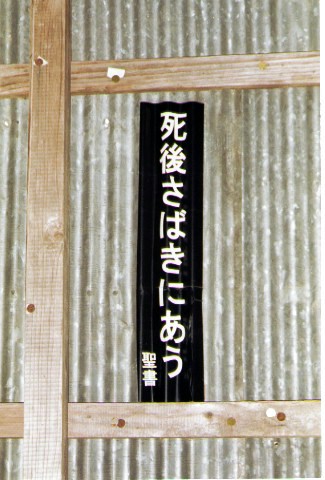
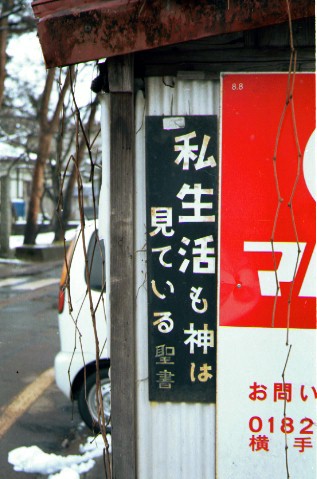
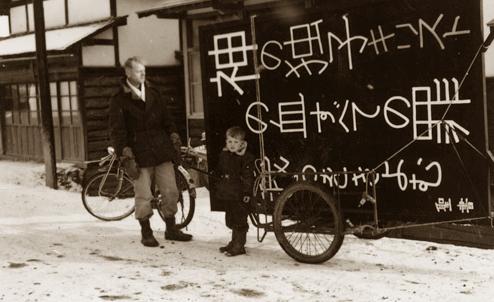
So if you’ve never been to Japan or just not to a part of Japan where the signs are visible, let me clue you in – in various places, mostly in areas outside the major urban centers, you will often see signs that look something like this:
sssas

This one reads “After death cometh judgment- The Bible.” According to the site, it is posted on a bus stop near a middle school in Iwate Prefecture. Or this:
skms

“God is watching, even in your private life – The Bible.” (Taken in Akita Prefecture). Or this:

tmss2

“The wages of sin is death — The Bible” (Akita Prefecture)

(This site has LOTS more of the signs along with some Jack Chick-style pamphlets and a heaping helping of snarky commentary)

As you can see, they are written in white and yellow text on a black background in uneven, ransom-note fonts and usually contain the starkest of messages about what the God will do to you if you fail to accept Christ. If their intent is to scare the living crap out of people then they are remarkably effective as the signs are truly the stuff of nightmares (or at least a scene out of Carrie or The Texas Chainsaw Massacre). These are not the only public displays in Japan that appear to be judging you on the spot, but they are by far the creepiest I’ve seen.  I just don’t understand the point of making these signs so creepy. If you want to make Christianity appealing wouldn’t you try and make people feel welcome instead of scolding them like this?

My personal encounters with the signs come during regular trips to visit inlaws in Tochigi Prefecture, near the Gunma border. Mrs. Adamu, her parents and I usually take backroads to avoid the high tolls, so we get to see several of these signs en route.

At any rate, the placement of these signs on cracked concrete structures and rusted out corrugated aluminum bus stops and storefronts reinforces the general theme of depression and stagnation that dominates the areas I’ve visited. Whenever I see another of these white-on-black reminders that God is watching, it makes me  wonder if it is meant as a protest against all the rust and malaise of Tochigi and Gunma.

The group

Now that we know what these signs are, let’s try and answer the next question: who is doing this and why?

According to Wikipedia, these signs are mainly the work of the Bible Distribution Cooperation Society, founded around 1950 in part by an American ex-soldier named Paul Broman who has dedicted his life to spreading the word of God using this unusual method. According to this now-defunct blog of a Japanese Christian minister, Broman took Japanese citizenship in 1970 and funds the activities of the group through his IT services business GrapeCity Inc (UPDATE: Though Broman would be about 82 right now, I haven’t seen an obituary anywhere so I assume he is still alive). According to the group’s website, they initially started their activities in Iwate and Aomori but in the late 1950s expanded internationally. According to Wikipedia, other activities of the group include sound trucks (you may have heard them in Shinjuku) and a Christian school based in Miyagi. They are an independent evangelist group not affiliated with Mormons, Unification Church or any other of the major groups.

Also according to Wikipedia, the signs are posted with the permission of the building/structure owners, and often they are neither a member of the association nor even Christian. They simply allow their real estate to be used for ads, similar to political posters and some other ad schemes, though apparently the association is either not allowed or does not offer to pay in exchange for the permission.

(An aside: This willingness to ugly up the neighborhood I think speaks to the owners’ complete lack of anything resembling taste or the basic decency to maintain an appealing public space. The towns, for their part, also seem to have no interest in keeping their neighborhoods nice. I am sure someone will tell me to shut up and stop making Alex Kerr-style arguments to legislate taste, but in cases like this I have to side with those who’d rather see fewer eyesores) 
 
The association’s official homepage, true to its funder’s background, is well-designed and contains a lot of information, though an uninformed viewer might not immediately recognize that this is the group behind the odd signs and the loud, judgmental announcements in Shinjuku (I’ll accept that maybe the cartoon sound truck at the top of the page gives it away). 

On the “About” page, the group’s stated objective is to “directly communicate the word of The Bible” (「聖書のことば」をそのまま伝える」). Their listed activities are distribution of free literature at primary/middle/high schools, “broadcasting” the word of The Bible in areas where many people congregate, individual proselytizing by Christians, and communication of the word of The Bible on placards and signs. They are not a membership organization and do not solicit members. Though the group lends “mutual help” and coordination, each member is individually responsible for his or her activities. Wikipedia indicated that there are apparently other groups who are not affiliated with the original society who have imitated their style. Based on this mission statement I don’t think they would mind imitators.

The group’s activities are completely self-funded and seek no charity. They boast that they have distributed 60 million Bibles to 18 countries throughout their history. They claim to pass out 1 million Bibles in Japan each year.

It is hard to know how many people are involved with these efforts. I am still waiting for an email response from an affiliated group, the Church and Home Educators Association Japan (CHEA Japan). For reference, various estimates count between 1 and 3 million of Japan’s people as at least nominally Christian. Protestants, for their part, comprise around half a million or 0.4% of the population (this is a Wikipedia figure apparently taken from Adherents.org. Like all such estimates it is probably pretty unreliable).

Vintage evangelism

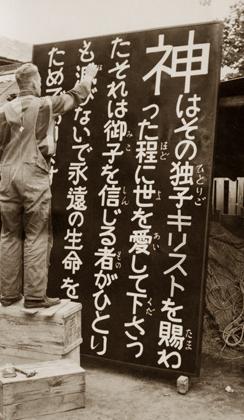
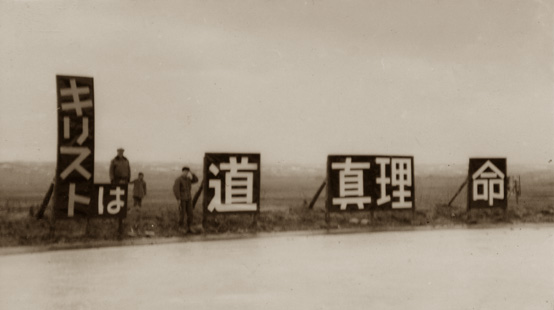
 The site also features a photo gallery of the group’s work that includes some vintage signs (unfortunately undated!). Some of these are really cool so I’ll post the best of them:
 

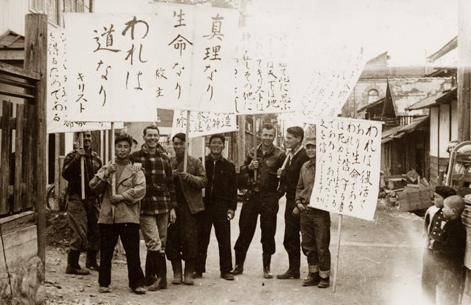
p32

“Jesus is the way, truth, life.”

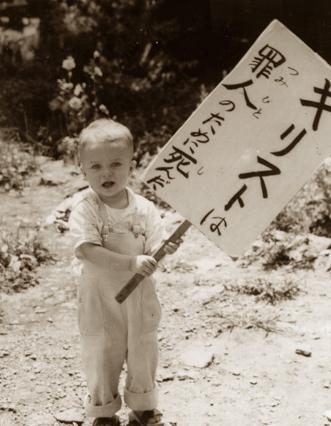
christ-died-for-the-sinners

“Christ died for the sinners.”

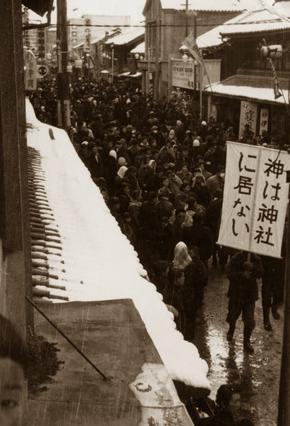
god-is-not-in-the-shrine

“God is not in the shrine.”

after-death-you-shall-be-judged

“After death cometh judgment.”

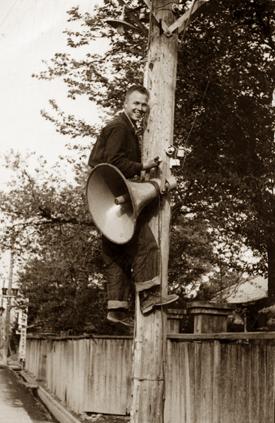
bullhorn-on-an-electric-pole

i-am-the-way

Front: “I am the way.”

schoolgirl-uses-visuals

god-gave-his-only-son

John 3:16 – “For God so loved the world, that he gave his only begotten Son, that whosoever believeth in him should not perish, but have everlasting life.”
blood-of-christ-gods-only-son

“The blood of Christ, God’s only son, purifies all our sins – The Bible.”

There are lots more on the site, so I advise you to check them out! 

Fun with Christian signs

These signs have become something of an underground social phenomenon due their sheer ubiquity (in Japanese some refer to them as キリスト看板 or roughly “those Christian signs”). One site (linked from Wikipedia) lets you create your own scary signs in HTML. Here is my version of Nietsche’s “God is dead” quote:




KY: Not what Seiyu thinks it means

Seiyu is a discount supermarket/general retail store that’s owned and operated by Walmart. Since first investing in the chain in 2002 and eventually taking a 95% stake, Walmart has reportedly never managed to make the stores profitable. I am not here to judge why that might be, but today shopping there I came across some evidence of why they might be having trouble making headway in the Japan market:

20090530161304

The letters KY are apparently intended to stand for “kakaku yasuku” (low prices), which would make the whole phrase “non-stop low prices” a translation of Walmart’s “Everyday Low Prices” slogan into Japanized English. Ironically enough, someone must not have realized that “KY” in Japan was last year’s buzzword and literally means failing to respond appropriately to the situation at hand.

Since a couple was joking about it on their way in, I can be sure I wasn’t the only one in on the joke.

Trans-Pacific Radio Live at the Pink Cow, this Thursday

To fellow bloggers and blog readers in Tokyo, Trans-Pacific Radio, which makes Japan-oriented podcasts, is holding a live edition of its political commentary series, Seijigiri, at the Pink Cow in Shibuya this Thursday at 7:30pm. To quote the men themselves:

The event will open with a presentation on Trans-Pacific Radio, followed by the live Seijigiri. After that, there will be a special announcement and demonstration of TPR’s most recent project.

The live show itself will involve Garrett, Ken and the audience. The essential concept is that Seijigiri and the audience will have no barrier between them, and the show will be an interactive event.

We hope to see all of our listeners on Thursday June 4 and look forward to doing the show with you!

The Pink Cow website is here. You can RSVP at meetup or facebook. I plan to attend.

Summer travel plans

I have just booked a trip home for the summer. I will be flying from Kansai to Newark on August 18, flying from Newark to San Francisco on September 10, and flying from San Francisco back to Kansai on September 15. While back home in Montclair, New Jersey (that’s the NYC end of the state) I may also take a brief trip down to DC at some point, so anyone in any of those areas who wants to meet up, please drop me a line.

Aside from that, I am also planning to take a trip over to Korea either before or after my visit back home to visit some friends there and do a bit of sight-seeing, so if any readers in Seoul want to meet up then, also feel free to get in touch.