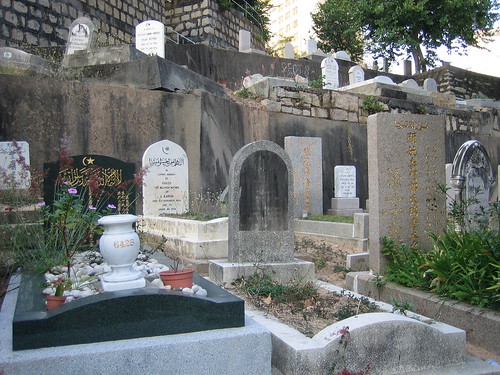
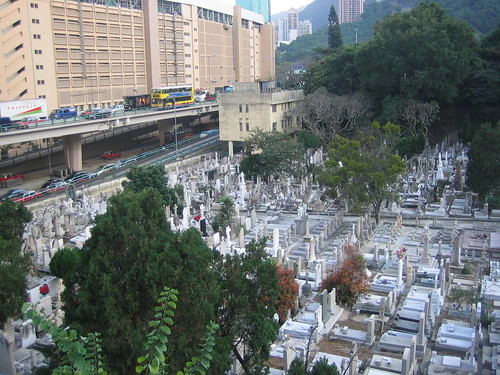
Muslim cemetery in Hong Kong

In Hong Kong over New Year’s, I hopped on board one of the island’s incredibly cheap streetcars and randomly rode from Central, the bustling business center of the city, to the quieter but still absurdly developed alcove of Happy Valley. The district is best known for its racecourse, which (not being a fan of equestrian sports) I first learned about from James Clavell’s very fun novel Noble House.

The name “Happy Valley” comes from the area’s use as a burial ground during the early days of the colony. As was the case in many tropical colonies (see Guns, Germs and Steel), the hot climate and marshy terrain of the island were quite incompatible with the Europeans moving in, and the resulting waves of diseases made Happy Valley one of the most populous areas of Hong Kong (if you’re counting corpses).

Even today, the cemeteries of Happy Valley are its most prominent and unique feature, next to the famous racecourse which is literally right across the street.

One of the more fascinating parts of the cemetery is the Muslim section, which happened to be open as I walked past. The headstones, dating from throughout Hong Kong’s history, are written in varying combinations of Arabic, Chinese and English.

The Muslim cemetery occupies a number of slopes wrapped around a hill, which makes it an excellent vantage point for viewing the lower, flatter Catholic cemetery below. Another case of awesome real estate wasted on dead people.

Switching to eMobile for handheld broadband in the ‘burbs

UPDATE: I ditched eMobile after about a year; this post explains why.

So I switched my mobile phone service to eMobile. This was really part of a much bigger jump over the weekend: I moved from a tiny furnished apartment in central Tokyo to a larger and very Japanese-style apartment on the edge of the metropolis. So far, I can’t say it’s been a bad change. There’s plenty of sunlight out the window, a proper bathroom (unit baths suck!) and enough room to accommodate my [laughable] writing, studying and musical efforts.

One problem I had to solve was staying connected to the outside world. All I wanted was an internet connection: I don’t need a home phone (Skype has me covered there) and I don’t need TV. My building isn’t wired for DSL, so the cheapness of broadband would be outweighed by the cost and hassle of installation.

After some head-scratching, I recalled that eMobile’s basic data plan offers unlimited use of mobile broadband at slow DSL speeds for about 5,000 yen a month. Then I realized that I could get one of their phones and plug it into my laptop’s USB port for unlimited internet access at slower-than-DSL speeds for about 7,500 yen a month, about the same as my average DoCoMo bill (basic plan plus “pake-hodai” and a couple of network services). So I went with eMobile’s basic “smart phone,” the S11HT “eMonster.” I bought it on Friday and have been using it constantly since then.

I am quite pleased so far. I wanted to get a phone with a keyboard for a while. I eyed Softbank’s offerings with interest last year, but was put off by advice from several people that the software sucked (I even heard this from a Softbank sales lady in Roppongi). A friend of mine then bought Softbank’s “Internet Machine,” which is packed with features (including television and GSM roaming) but costs more than my laptop did and, like most Japanese phones, has a unique operating system. Overall, the eMonster does a good job of balancing the sort of things that a fast-paced international digital individual (like yours truly) really needs in life.

The upsides:

  • Internet is very fast, both on the handset and on a connected PC. I’m not sure whether I’m actually getting the full 3.7 mbps on this thing, but it sure feels responsive; faster, at least, than the heavily firewalled LAN connection at work.
  • Can access any email account with a POP or IMAP server. I now get my Gmail messages straight to my phone. There is also third-party software which allows syncing with Google Calendar (which I also sync to my Outlook calendar at work) and Remember the Milk, meaning that I can have the same calendar and task list on my home computer, work computer and phone. Awesome.
  • There are multiple input methods. In addition to the slide-out keyboard, there is a Palm Pilot/Pocket PC-style touchscreen with stylus (which you can use to handwrite characters or tap an on-screen keyboard), a Blackberry-style clicking scroll wheel in the corner, and a directional pad at the base of the phone. Although this encourages a lot of fiddling to find the easiest way to accomplish any given task, it also makes it easy to find a control method that “feels right.”
  • Media integration is quite straightforward; just drag and drop folders of mp3s from the hard drive to the device, then Windows Media will pick up the files on a simple directory scan and catalog them appropriately.
  • There is a lot of third party software available for Windows Mobile, like Pocket Dictionary and Pocket Mille Bornes (I hadn’t played that game since I was eleven, and I had forgotten how good it is). No more paying monthly fees or signing up to newsletters just to play downloaded games (as DoCoMo generally requires).
  • I can run Skype on my phone to call people overseas for next to nothing, although so far I can’t get it to work through the phone’s earpiece–only through speaker or headset.

The downsides:

  • eMobile’s network is not as strong as any of the big three providers. In Tokyo, the main place you notice this is on the subway and in basements, as there is never any signal underground (although you can get a good signal above ground anywhere in the 23 wards).
  • No RFID chip for mobile payments. I was quite fond of the Suica chip in my DoCoMo phone, as I could charge it with my credit card and roam the city at will. Now I’m back to using a Pasmo card which I have to recharge with cash–bummer.
  • The GPS seems more erratic than my Docomo phone’s. Usually it’s off by several blocks.
  • Battery life isn’t great when the phone is on 3G and syncing data all day. It’s just about enough: I charged the phone overnight on Sunday and was down to my last bar of battery when I got home from work on Monday. If you plan on spending the night in an atypical location, you’ll need to bring a charger with you.
  • Contact management is really complicated in comparison to most mobiles, since Windows Mobile uses a slightly simplified version of Outlook.
  • No international roaming. Not a huge deal for me, since my DoCoMo phone could only roam in Europe and certain developed countries in Asia. The WiFi feature largely makes up for this anyway, especially since my family’s house in South Carolina has a good DSL connection and wireless router.

Mr. Chang – Mr. Oyama

After having my aching knee MRI-ed and examined by a sports medicine specialist at Kyoto University Hospital last week and been told that the problem wasn’t particularly serious and that riding a bicycle should be safe, I decided to finally go and buy one. I asked a Japanese girl I know who is a bit of a bicycle otaku to accompany me on the shopping trip so I would be decently advised in buying something a few times the price of the crappy mama-chari I rode during my previous two periods of residence in Kyoto, and she took me to a shop she likes inside the Sanjo Shotengai. After picking out the bike I wanted and the accessories that needed to be attached, I went out to the east exit of the shotengai to withdraw some cash at the 7-11 and grab something to drink.

With a cold drink in hand (Thursday was a bloody hot afternoon in Kyoto), I sat down on the bench just outside the convenience store next to a middle aged man smoking a cigarette, in the typical fashion of a 50-ish Japanese guy who would be hanging out with a cigarette in front of a 7-11 in the middle of the afternoon, and looking over his envelope of documents. I had my headphones on, listening to some podcast or other, but the man said hello, and having an hour to kill before my bike was ready I took off the headphones and talked to him for a bit.

When I asked his name, instead of just telling me, he reached into his wallet and pulled out, to my mild surprise, an Alien Registration card very much like mine. I say very much, because there were a few important differences. The first being that, as the card of a Korean national permanent resident, the fields for such information as “Landing date” and “Passport number” were filled with asterisks instead of numbers, and the name field contained both his legal Korean family name of Chang (I will leave the personal name out) as well as a Japanese family name of Oyama, in parenthesis and with the same personal name for both.

Mr. Chang was born and raised in the south part of Kyoto, where the so-called Zainichi Koreans are clustered, and described himself as “basically half-Japanese” despite having Korean citizenship and speaking Korean. He is the oldest of three children, at 55, with a younger brother practically half his age at 29 who is currently in graduate school at Kyoto University and a younger sister in the middle, around 40 years old. He mentioned that when he was younger his Korean was good enough to do simultaneous translation, for which he would practice by reading the Japanese newspapers aloud to himself in Korean, but these days he has gotten a bit rusty. Although he was actually born with North Korean (DPRK) citizenship, he changed it to South Korean (ROK) years ago, as traveling abroad is extremely difficult for DPRK citizens. He mentioned having visited New York, which I presume would have been virtually impossible as a North Korean. He also spoke more English long ago, when for a time he lived with an English woman who had no interest in learning to speak Japanese (or, presumably, Korean, although he did not even mention that possibility) but says that these days he would not even be able to string a sentence together.

Now essentially retired, aside from having to take care of certain kinds of corporation registration and tax documents such as the envelope he was holding, he is the owner of three different companies, which include several drinking and eating establishments in Kyoto, Osaka and Nagoya. He started with one izakaya 30 years ago out in the “sticks” of southern Kyoto, then opened another in Nagoya, and now at the end of his career has reached a high level of success as owner of a highly priced Gion hostess bar.

He was quite keen to talk about how the hostess club is an important part of Japanese culture, the high pricing of and lack of sexual availibility therein often baffles and angers foreigners. He mentioned that on a few occasions foreigners came to the club, and were then outraged at the final tab, not understanding that this was not the sort of place one goes for a drink if one is the sort of person who worries about the tab. There was a specific anecdote about a Turkish man who, while not outraged about the price per-se, was quite angry that such a sum of money did not allow him to bring one of girls home with him. The problem, Mr. Chang explained, was that in the West there is not such a clear distinction between businesses which provide girls for “fun” (i.e. hostesses) and those which provide girls for sex. In his own country, the Turkish gentleman would be able to take the girl home for a night of what he might consider “fun” but in Japan, there are entirely separate businesses which cater to the physical. This is, he said, the modern version of the Geisha system, which in the past also separated the working girls into those for higher and lower pleasures.

But Mr. Chang does not actually spend time in any of his bars or clubs anymore-not even the hostess bar in Gion. He has cancer, and it has metastized beyond the realm of surgical efficacy, not leaving him long for this world. As owner he takes care of the paperwork, but no longer does anything one might actually call work. The pain of the cancer is often intense, and he has trouble sleeping at night. He is close with a singer in Tokyo, who sings to him over the phone when the cancer pain keeps him up at night, until the gentle voice lulls him to sleep, with the reciever falling off to the side.

He never had any children, but he wanted to do something positive for the world, to “make up for [his] sins.” To that end, he has become the official sponsor of an AIDS hospice in Chiang Mai, Thailand, whose several-dozen residents are all, as he says, his children. Although he is the active sponsor, he was not the sole fundor. To gather funds for the community, building their bungalows, providing their education and health care, he went around to all of the “shady characters” he knew from his business dealings over the years- the fellow bar owners, the real estate people, the local yakuza-and strongarmed donations out of them. “Think about what you did to get that money,” he says he told them, “surely you can spare a few yen for this.” It turned out that they could. Tragically, every time he visists there are “those who are no longer there.” He can afford to make them comfortable and provide some level of treatment, but the drugs cocktail that keeps wealthy first-world AIDS patients alive indefinitely is still too expensive in mass quantities.

And so it was time for Mr. Chang to pick up his laundry and drop his papers off at city hall, and for me to pick up my new bicycle. He asked if I would be willing to give him some English refresher lessons, so he could have some simple exchanges with the foreigners that came into his establishment, despite having said that he no longer spent any time there. While I do not normally have any interest in English conversation tutoring, I gave him my phone number.
Japan’s less-publicized “connection” with African commodities

The Japan-Africa thing might be last week’s news, but better late than never:

This Japan Times feature, ran to coincide with Japan’s hosting of the Tokyo International Conference on African Development did a good job of putting an identifiable and good-natured face on the conference’s goals, whatever they might have been. How better to bring the Japanese taxpayers around to supporting aid to Africa than to emphasize the “connections” between Africa’s sweet, sweet resources and Japanese daily life?

Few Japanese may be knowledgeable about far-away Africa, but the continent’s exports affect daily life here.

With the Wednesday start in Yokohama of the fourth Tokyo International Conference on African Development, one should pause and take a quick glance at facts and figures about the continent’s many valuable and necessary commodities.

Here in Japan, you might start the day with a cup of coffee from Ethiopia, the fifth-largest supplier of raw coffee beans to this nation, after Brazil, Columbia, Indonesia and Vietnam.


Uganda and Zambia meanwhile ship cobalt, essential for making batteries that go into computers, mobile telephones and digital cameras.

The off-hand mention of Ugandan cobalt reminded me of a recent NPR report on the world’s largest uranium mine, which is also a significant source of cobalt. The reporter breezily explains, “As mines go, it’s a honey. It has high-quality ore and a history of saving the Allies during World War II.”

Of course, the reporter is referring to the mother of all life-saving American freedom bombs — the two atomic bombs dropped on Hiroshima and Nagasaki. Perhaps that’s one connection to Africa the Japanese aren’t so keen on being reminded of.

Lawyering in East Asia

One of my favorite law-related blogs is Above The Law, a self-proclaimed “legal tabloid” which focuses on embarrassing gossip about lawyers, judges and law firms. Lately they have been running a mini-series of posts on practicing in Asia (by which they mean Greater China, Korea and Japan):

Although these posts are being somewhat maligned by their sponsorship (a Hong Kong-based legal recruiting firm), the information seems spot-on to me. Some important points to take home:

  • Working in East Asia gives a lawyer the chance to take on a lot of responsibility way earlier than they usually would (or, maybe, should). Law firms are smaller here, the market is a bit less competitive (in that there are fewer players), and there’s more potential for client contact and business development than there is in the US or UK.
  • If you speak the local language, you have an edge in the job market because employers will see you as more committed to the region. On the other hand, if you read the local language, you are likely to be employed in the crappiest work there is (translating and reviewing business documents). I actually know a Japanese lawyer who hid his English skills for this reason, even though they were good enough to get him into a top-tier American law school: he didn’t want to be stuck handling grunt work for foreign clients when he could be doing high-level negotiations, research and drafting in his own language.
  • Time zones are a hidden complication. I’ve noticed one bonus of time differences: there’s a “quiet window” between about 11 AM and 4 PM in Tokyo, starting when New Yorkers go to bed and ending when Londoners wake up, making it easier to focus attention on outstanding matters without being bothered too much. The downside is that you have to do your real-time correspondence with London and New York outside this window, meaning there’s a lot of potential for early mornings and late evenings.

Many of the notions in these articles apply not just to legal practice, but to expat-ty jobs in general, making them potentially a good read for people in other private sectors.

Ma administration already beginning “rectification of names”?

Over a year ago I wrote two posts on pro-independence President Chen Shui Bian’s (陳水扁) campaign of “rectification of names (正名)”, in which various agencies, school texts, and other labels were renamed to suggest an affiliation with Taiwan rather than China.

Taiwan rectifies names in new history textbook: January 31, 2007

More on rectification of names in Taiwan: February 7, 2007

Where the now former president Chen is a member of the pro-localization Democratic Progressive Party (DPP-民進黨 ) and himself of the more radical localization/independence faction, the new president Ma Ying-jiu (馬英九) is a member of the Chinese Kuomintang (KMT-國民黨), and may make Chinese appeasement an aspect of his administration’s policy. This could easily include reversals of DPP iniatives such as the renaming of national corporations (post, oil, etc.) and the removal of former dictator Chaing Kai-shek’s (蔣介石) name from both the Taipei area airport which formerly bore his name, and to the grand Ming imperial tomb-inspired complex now currently knows as Democracy Memorial Hall (臺灣民主紀念館), but originally constructed as the Chiang Kai-shek Memorial Hall (蔣介石紀念館) following his death. While one can understand why Taiwanese democrats (small ‘d’) might object to the former dictator being memorialized in the style of the Ming Emperor’s (although his body is not buried there), it is also easy to see why some members of the KMT-Chiang’s political party-objected to the alteration, and why there is bound to be at least some amount of lobbying for a new executive order to change it back, now that their party has retaken the presidency.

One of the most notable of these renamings was the change of the national postal system from Chunghwa Post- which means China Post (中華郵政) to Taiwan Post (臺灣郵政). While this change has not (yet?) been reversed, it is possible that Taiwan may be in for a round of doubly confusing name flip-flops and reversals. As the Taipei Times reported on the day of Ma’s inauguration (yesterday, May 21)

Forty-year-old Mr Chen waited for two hours before he could put his hands on the sets he had ordered. He said he had purchased the stamps not only because Ma was president, but also because the Chinese characters for “Republic of China” were once again on the stamps.

Last year, the stamps issued by Taiwan Post Co only bore the name Taiwan.

Is this merely an example of the Taiwan Post Co honoring the new chief executive by printing his portrait next to the official name of the country he now leads, or a foreshadowing of a larger restoration of China -oriented names by the new administration? How deeply has Chen’s rectification of names really penetrated in Taiwan? Do most people prefer the localized names to the ones matching the country’s official name of Republic of China? How much has the necessity for campaigning in competitive elections with an electorate made up mostly of ethnic Taiwanese really changed the formerly mainlander-dominated KMT? And where does technically-mainlander but Taiwan-raised pragmatic Ma fit into this? Unfortunately, I have not been in Taiwan for over two years now and I really do not have a very solid sense of how most people have been reacting to these issues recently. It may be safe to predict that Ma will not be renaming any more “China” such-and-such to “Taiwan” such-and-such, but whether he will let all of the recent changes stand is another question entirely.

Taiwan’s Kung-fu politician

No, this isn’t a reference to some pathetic cheesy metaphor, but a quote from new Premiere Liu Chao-shiuan (劉兆玄).

After the ceremony, Liu escorted Chang on his way out of the Executive Yuan.

Liu tripped while walking down the stairs in the lobby of the Executive Yuan hall, nearly falling.

“I am fine. My kung fu is very good,” Liu, a martial arts fiction fan and author of more than 10 martial arts novels, joked in response to reporters’ questions. (Taipei Times)

I just hope that Liu hires this guy as his legislative assistant.

DSL in Japan, update

I mentioned the other day how it takes an entire month of waiting to get DSL installed in Japan, due to control of the local loop remaining entirely with the former government monopoly telecom NTT, while service can be provided by a variety of competitors. One of the interesting side effects of this is that no matter who your provider is, the physical line installation at the home is still performed by NTT. And because installation will be performed not by my service provider KDDI, instead of having the installer bring along the modem and accessories, they mail it in advance. I am not sure if this is because NTT refuses to cooperate and deliver the modem for another company’s service, despite being legally obligated to perform the local loop installation required for service connection, or if KDDI (I think Softbank does the same thing, but I forget) has merely decided that it is logistically simpler to send modems through the package delivery infrastructure.

And speaking of the package delivery infrastructure, I was very impressed by Kuroneko Takkyubin’s service. When I got home last night at around 8:30 there was one of those failed delivery notification notices in my mailbox. Oddly, the time written on it was 10 o’clock, which makes not sense at all, since I was at home until around 11am, and it was still well before 10pm. Regardless, the notice had the standard information on how to contact either the automated phone system, the internet website, or a live switchboard operator to schedule redelivery- but also had a somewhat astonishing fourth option: the cell phone number of the delivery truck driver who had attempted delivery that day. Since it said he was reachable until 9pm, I called up, the call was answered instantly, and once I told him my name and address, he said to stay and wait for him. I assumed I would be waiting for several minute, but there was a knock on my door, literally, at most two minutes later!

And thus is customer service in Japan-a melange of impenetrable bureaucracy and inflexible, pointless rules for some things, but in other areas some of the most helpful and convenient services found anywhere.

Money for the blind

A high-level US court just ruled that American paper money must be redesigned so that blind people can distinguish bills by denomination. Other countries accomplish this through subtle tactile differences or different bill sizes, but all US currency feels more or less the same, at least when it’s fresh off the presses.

When I went to Albany in February to be sworn into the New York bar, I had a number of odd experiences, among them:

  • Drinking Chinese state-brewed beer in a sketchy hotel room while discussing what would happen if they went to war with Japan (this would have led to nothing good had the sole Chinese attendee not decided to “go to bed” early)
  • Sitting in a crowded waiting room next to a lawyer who works literally within eyeshot of my office window in Tokyo
  • Touching a girder from the World Trade Center

But probably the weirdest experience was when I bought a pack of gum inside the New York state government Cloud City.

Everything was normal until I went to the cashier. I put the gum on the counter. The cashier said “Hi, what are you getting today?” For many people, that would merit some kind of sarcastic response. As usual, I bit my tongue, which was probably a good thing because the cashier was blind.

I tried to act as un-shocked as possible, and said “Umm, a 5-pack of Doublemint.”

“OK,” she said, and started pushing buttons on the register. The register read out the numbers as she pushed them. “POINT SIX NINE ENTER. SEVENTY-THREE CENTS.”

“That’ll be 73 cents,” she said.

I handed her a five-dollar bill.

“Out of how much?” she said.

“Uhh, out of five.”

Anyway, I wonder whether she works there all the time. Maybe they just put her there on bar admissions day as an ethics test for new lawyers. Or maybe people really work on the honor system in Albany. Who knows. At least her job will be a bit easier in a few years’ time…

George Takei’s comments on gay marriage ruling in California

This isn’t normally the sort of thing we discuss on this blog, but in announcing his upcoming marriage with his partner of 21 years, the sci-fi actor makes an interesting comparison between discrimination involving his sexual orientation and Japanese descent. Here is Takei’s entire letter, with italics added for emphasis.

Our California dream is reality. Brad Altman and I can now marry. We are overjoyed! At long last, the barrier to full marriage rights for same-sex couples has been torn down. We are equal with all citizens of our state!

The California Supreme Court has ruled that all Californians have a fundamental right to marry the person he or she loves. Brad and I have shared our lives together for over 21 years. We’ve worked in partnership; he manages the business side of my career and I do the performing. We’ve traveled the world together from Europe to Asia to Australia. We’ve shared the good times as well as struggled through the bad. He helped me care for my ailing mother who lived with us for the last years of her life. He is my love and I can’t imagine life without him. Now, we can have the dignity, as well as all the responsibilities, of marriage. We embrace it all heartily.

The California Supreme Court further ruled that our Constitution provides for equal protection for all and that it cannot have marriage for one group and another form – domestic partnership – for another group. No more “separate but equal.” No more second-class citizenship. Brad and I are going to be married as full citizens of our state.

As a Japanese American, I am keenly mindful of the subtle and not so subtle discrimination that the law can impose. During World War II, I grew up imprisoned behind the barbed wire fences of U.S. internment camps. Pearl Harbor had been bombed and Japanese Americans were rounded up and incarcerated simply because we happened to look like the people who bombed Pearl Harbor. Fear and war hysteria swept the nation. A Presidential Executive Order directed the internment of Japanese Americans as a matter of national security. Now, with the passage of time, we look back and see it as a shameful chapter of American history. President Gerald Ford rescinded the Executive Order that imprisoned us. President Ronald Reagan formally apologized for the unjust imprisonment. President George H.W. Bush signed the redress payment checks to the survivors. It was a tragic and dark taint on American history.

With time, I know the opposition to same sex marriage, too, will be seen as an antique and discreditable part of our history. As U.S. Supreme Court Justice Anthony Kennedy remarked on same sex marriage, “Times can blind us to certain truths and later generations can see that laws once thought necessary and proper, in fact, serve only to oppress.”

For now, Brad and I are enjoying the delicious dilemma of deciding where, when, and how we will be married. Marriage equality took a long time, but, like fine wine, its bouquet is simply exquisite.

Much of the debate over the legitimacy of this court decision, and gay marriage in general, is based upon the question of whether sexual orientation as a basis for discrimination is on the same level as gender and race. Since the general scientific and societal consensus seems to be that sexuality is primarily an inherent characteristic (whether due to genetic or prenatal factors), rather than a matter of “choice” or “lifestyle” I personally cannot buy the argument that it is not a similarly invalid basis for discrimination. I imagine that the best route for success on the part of gay marriage equality advocates is to continue to press comparisons with the earlier generations’ fight for racial and gender equality, continue to conflate racial discrimination with homophobia, and remind people that “separate but equal” is a vicious lie. Most people will likely balk at highly technical debates of constitutionality and jurisprudence, but perhaps more of them will listen when an elderly Japanese-American homosexual tells them that being barred from marrying his fiance is equivalent to being locked in an internment camp in the 1940s.

Incidentally, my favorite potential remedy to the entire issue is the somewhat radical proposal to remove the term “marriage” from the law entirely, make the state responsible only for two-party “civil unions” to which gender is irrelevant, leaving marriage as a religious sacrament or label of self-identification.