Another airport in Tokyo?

Narita has expanded as far as it can go. Haneda, already the busiest airport in Asia, can’t go anywhere but further into the bay. Tokyo will eventually need a third airport, or so we’re told.

The Tokyo Metropolitan Government, with Ishihara’s personal blessing, wants to use Yokota Air Base, a U.S. Air Force base in west Tokyo, for civilian flights. That seems somewhat unlikely now, since the base is going to have expanded duty as the Air Self-Defense Force’s command center (protests be damned), on top of its existing role as headquarters for U.S. forces in Japan.

The other option is to build offshore. Several sites have already been proposed, most of them in Tokyo Bay, except for one site off of the Kujukuri Beach on the Pacific coast of Chiba (obviously a bad idea; spoil a nice beach with an airport that’s even farther from Tokyo than Narita?!).

Is the third airport really necessary? After all, Narita just had to cut its landing fees to stay competitive. I think it all has to do with the fact that the Kansai region will have three airports as of next February. Ishihara just doesn’t want his half of Japan to fall behind.

London has five airports and is getting along just fine. That doesn’t mean that more is necessarily better. Berlin is in transition from three airports to just one. Maybe Tokyo will someday admit that Narita was a dumb idea, and run all of its flights from a humongous future version of Haneda, acres and acres of concrete sprawling out into the bay.

Taro Aso: the future of Japan?


Prime Minister Koizumi’s new cabinet is in place this week, and one of the apparent front-runners to succeed him is this interesting fellow, Taro Aso, now Minister of Foreign Affairs.

We’ve already talked about some of his more asinine comments: that burakumin shouldn’t be in government, that Japan is one race, that Korea was better off under colonial rule, that floppy disks are the future, and all that.

But there’s more to Aso-san than just knee-jerk right-wingery. Let’s look at his colorful past:

  • Aso’s father, Takakichi Aso, was a big businessman: he owned a large cement company, Aso Cement. He later entered the Diet and was buddies with Kakuei Tanaka, the Nixonian prime minister of Japan who spent half of his life amassing political capital in Niigata and the other half split between running the LDP from the shadows and fending off prosecution for corruption. (Tanaka’s daughter Makiko is the short-lived foreign minister who called Bush an asshole.)
  • Takakichi’s wife (Taro’s mother) was Shigeru Yoshida’s daughter—Yoshida being the postwar prime minister who set up Japan’s foreign and domestic policy for much of the Cold War era.
  • Yoshida’s wife’s father was Nobuaki Makino, a Meiji-era diplomat and politician; Makino’s father was the famous samurai Okubo Toshimichi.
  • Back to Taro Aso himself: he represented Japan in the shooting events at the 1976 Olympics in Montreal, while still president of the cement company he inherited from his father (he gave it up to run for office in 1978, and now his brother runs the company).
  • He was appointed Minister of Public Management, Home Affairs, Posts and Telecommunications in 2003, and Koizumi apparently likes him, because he’s survived two subsequent cabinet reshuffles.

Now, he’s certainly qualified to be prime minister given the generally low standards that have been accepted historically: take a look at Koizumi’s predecessor, Yoshiro Mori, who greeted Bill Clinton by saying “Who are you?” and went on to screw up the Buddhist rites at Keizo Obuchi’s funeral later that day. Part of me wants Aso to become prime minister because there’s an excellent chance he’ll produce all sorts of hilarious Mori-esque gaffes that will make great blog material.

On the other hand, I love Japan too much to subject its people to this man’s leadership. His gaffes are not silly and laughable like Mori’s, but dark and pitiful, likely to kill what few good relations Japan enjoys with the rest of East Asia. Hopefully the LDP will not be foolish enough to elevate him to the top post; maybe he’s just a foil to make Shinzo Abe look better. We can only hope.

Mr. Toad’s Wild Ride

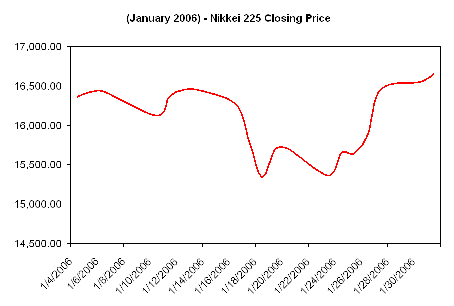
Even though this post has nothing to do with toads or amusement parks, I chose the title in keeping with the anurian theme of this blog. But boy, wouldn’t this month’s Nikkei 255 make one hell of an exciting coaster ride?

January Nikkei

I smoothed the line just for a more pleasing visual effect, but the bounce back from the “Livedoor Shock” is clearly official. In fact, for the past two days the Nikkei 225 average has closed at highs not seen since September 2000.

Lacking the sophistication to explain the reasons behind this (and having had it correctly pointed out to me over the weekend that I am wont to jump to unsupported conclusions about Japan) I’m going to defer to the opinion of the “professionals” on interpreting this one. Analysts are citing several factors for the latest rally.

First, a nmber of positive economic indicators appear to have improved the confidence of investors. Starting with the labor market, employment data for December showed a marked improvement, with the ratio of job offers to job seekers balancing out at one to one, the highest it’s been since September 1992. The unemployment rate fell an additional 0.2 percent, to 4.4. percent, the lowest level in seven years.

Housing figures also look promising. Starts in 2005 rose for the third strait year, up 4% to 1,236,122.

Industrial production also rose by 1.4% (seasonally adjusted) in December.

Finally, gains by individual companies also seem to have played a roll.

A fall in the yen-dollar exchange rate has been a boon to profits of exporters such as Toyota, Honda and Advantest, all of whom closed higher on Tuesday.

Meanwhile, rising oil prices equal increased profits for companies like Nippon Oil and AOC Holdings, Inc.

Looked at as a whole, all of these figures (except perhaps for the higher oil prices) appear to suggest movement towards a stronger economy – higher corporate profits, more hiring, and increased consumption, etc…

But, while those factors are fine for institutional investors who have the resources to pay anti-social quant jocks to stare at computer monitors all day while mentally multi-tasking the application of Einstein’s general theory of relativity to global securities markets. But what about individual investors? The average Tanaka on the street, punching trades into his cell phone?

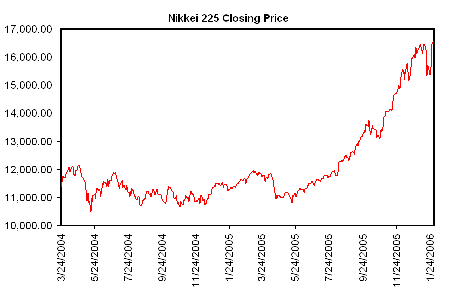
Well, in my humble, albeit relatively uninformed opinion, these guys might be basing their investment decisions on this:

Nikkei 225

Now, aren’t you sorry you didn’t buy in last fall?

Japan’s intestinal fortitude

Some of you may have heard the claim that Japanese intestines are longer, or in some other way, different from those of other people. This is of course just one part of the entire school of Nihonjinron (日本人論), or discussions on the uniqueness of the Japanese race/culture/nation/language. Unlike most of the nihongjinron pseudo-science (like Japanese use the opposite side of their brain to process language, etc.) this one sounds at least vaguely plausible. After all, there are all sorts of morpholigical differences between races; hair, skin, facial features, height, and so on. Could it be true?

Continue reading Japan’s intestinal fortitude

The future of China (or, exactly what is realist?)

That Tom Barnett interview I mentioned is creating some dissension within our cousin blog Coming Anarchy.

The authors of CA (correction: two of them), as you might know, are fans of Barnett, but bigger fans of Robert Kaplan (hence the title). Barnett and Kaplan are divided on how the U.S. should deal with China, and their divide really represents two views that are fighting for prevalence in Washington.

Kaplan’s view, which is more in line with official Defense Department policy since the Cold War (and also gets lots of nods on the Japanese right), is that China is an emerging military threat that the U.S. has to contain with ships, airplanes, and missiles. Barnett’s view is that the U.S. has to become partners with China, as the economies of the two countries dictate, rather than let political concerns screw up the countries’ mostly-beneficial symbiosis.

Which view prevails will necessarily determine the future of U.S. policy toward Taiwan. A Kaplan view means that the U.S. has to defend Taiwanese sovereignty at all costs, as a roadblock to Chinese ambition in the Pacific. A Barnett view leads to the U.S. maintaining the status quo in Taiwan until the two countries can be united without force, either through incorporation in a democratic China or as part of a larger EU-style Asian community.

It hurts to admit this, because I’ve been a Taiwan supporter for some time now, but Barnett has a good point. Is it worth it to antagonize China when the U.S. is dependent on China and China is dependent on the U.S.? Wouldn’t it be easier if both countries could focus resources on their own problems, rather than needlessly breathe down each other’s throats? Do we really need to be bracing for World War III right now?

These are all tough questions that Bush and Rumsfeld should be asking themselves. Perhaps the best answer is to do as Barnett advises: maintain the status quo until China and Taiwan have evolved to the point where they can discuss their differences without threatening to lob bombs at each other. I think this is more likely to happen if and when we see closer business ties and more transparent democracy on both sides.

Where do you draw the line?

[N]o sooner do we depart from sense and instinct to follow the light of a superior principle, to reason, meditate, and reflect on the nature of things, but a thousand scruples spring up in our minds concerning those things which before we seemed fully to comprehend. Prejudices and errors of sense do from all parts discover themselves to our view; and, endeavoring to correct these by reason, we are insensibly drawn into uncouth paradoxes, difficulties, and inconsistencies, which multiply and grow upon us as we advance into speculation, till at length, having wandered through many intricate mazes, we find ourselves just where we were, or, which is worse, sit down in a forlorn Skepticism.

– George Berkeley, The Principles of Human Knowledge

In daily life, we assume as certain many things which, on a closer scrutiny, are found to be so full of apparent contradictions that only a great amount of thought enables us to know what it is that we really may believe. In the search for certainty, it is natural to begin with our present experiences, and in some sense, no doubt, knowledge is to be derived from them. But any statement as to what it is that our immediate experiences make us know is very likely to be wrong.

– Bertrand Russell, The Problems of Philosophy

The passages above describe eloquently an idea that has long lingered troublingly in the back of my mind, but remained unarticulated due to principally to my own laziness in fleshing it out. I don’t expect to exorcize all of my demons on the subject here, but at least it will be a start.

I’ve never perceived myself as being the type to fall easily into one camp or another on things. Consequently, I either find myself taking a position of devil’s advocate in order to participate in a conversation, or find myself sinking into a disappointed indecision. If I’m around conservatives, for example, I usually feel myself inexorably being pulled in the opposite direction. When around liberals, the opposite is true.

In either instance, I am left wondering, “how can this or that person be so sure about himself or herself?” Furthermore, I wonder, “how can I be so unsure of myself?” Granted, I may be objecting to attitudes more than to opinions in the aforementioned examples, but the questions still remain unanswered.

It’s not that I lack the ability to construct a logical argument and follow through on the conclusion. But on what basis are such conclusions ultimately derived?

Consider the following question: Is abortion right?

Now consider the following two answers to this question:

– Life begins at conception.
– The taking of a life is wrong.
– Abortion takes a life.
– Therefore, abortion is wrong.

Fine, but what about this:

– A fetus is part of a woman’s body.
– A woman has a right to do with her body as she pleases.
– Therefore, if she wishes to have an abortion, she is justified.

They are both simplified examples to be sure, and while I’m no logician, they suit my purposes here. There appears to be no problem with the arguments themselves; the rub lies in the assumptions. Then we are forced to ask: which assumption is right? That just leads to another argument, founded on other, more basic assumptions.

But if we keep digging, what eventually remains? I wonder how often people stop to ask themselves this question. It seems possible that one could rely on “sense and instinct” clothed in the type of arguments above without ever considering the soundness of their assumptions. For practicality’s sake we must we draw a mental line somewhere if we are to avoid a slippery slope that leads to relativism or worse. We can’t go around denying the existence of tables all day long. But where and when should that line be drawn?

What if the Flatlander has no home to return to?

I was reading this article about the humorous inability of the crazy Minutemen border patrol to even locate the Canadian/Vermont border, much less to patrol it, when I noticed a very curious term in the final sentence.

Even the Minutemen concede that their welcome hasn’t been perfectly warm. During their first patrol weekend, Buck said he found a note with a native Vermonter’s derogatory term for outsiders — indicating that someone thought they were already on the wrong side of a border.

“Flatlander, go home,” Buck said the note read.

Not having ever even been to Vermont, I have never been called a Flatlander (although after showing my vast gulf of ignorance regarding their state, I fully expect to have the epithet hurled at me vehemently should I ever visit. Of course, I turned to Google for an explanation, and here is what I found.

The term flatlander derives from ‘flatland’, which describes a geographical location as land that is predominantly flat. A flatlander would be a person who is from this type of a region.

To a Vermonter, the term flatlander takes on a whole new meaning. In the simplest terms, it means a person from outside the confines of Vermont. Often times, the actual geographical location of an outsider can be mountainous, but this weighs little on Vermont’s opinion. There is a gray area of where the flatlander boundaries exist, but to some die-hards, a flatlander is anyone not born in the state of Vermont. Others only consider the states south of Vermont that are located within New England. Massachusetts, Connecticut and Rhode Island fall victim to the term by this definition, but it is unlike Vermonters to leave out New Jersey on their definition of flatlander. And for some, a flatlander is anyone with white plates on their car.

Flatlander is used as a negative slander on non-native Vermonters or visitors. In it’s basic concept, the term implies a person who visits the state or lives here that brings negative qualities from their home to our state. It is a person who is unfamiliar with traditional Vermont ways. Nathan Mansfield, a native Vermonter, defines the term as “Thinking they [a flatlander] can meld their beliefs of what Vermont is into our reality.” Unfortunately for the flatlander, even if they assimilate to Vermont culture and reside here for 50 years, they can never rid themselves of this label.

Tom Barnett interviewed on C-SPAN

C-SPAN’s podcasts are awesome in general. While taking a long walk home today (thanks, transport workers!) I listened to Florida congressman Tom Feeney interviewing The Geopolitical Man himself, Thomas P.M. Barnett. The hour-long talk touches on a number of issues and goes in depth on China and Iran; very interesting stuff.

For those of you who enjoy this, a DivX version of Barnett’s full lecture on “The Pentagon’s New Map” is floating around some BitTorrent sites. Also, check out the NewsHour podcast, which lets you get your dose of Jim Lehrer and talking heads any time of day.