Japanese fortuneteller’s picks for the next cabinet

ZAKZAK, never a letdown, has run an article that quotes political/financial fortuneteller known as the “Onmyoji of Nagatacho” (whose sessions start at 30,000 yen) Shoken Fujitani’s predictions for who should go in Abe cabinet. While I don’t understand his system (it’s based on the fact that Abe was born aligned with Mercury in the year of the Horse [1954]), I’ll note his results here so we can come back on Tuesday to see how close he was:

People who are compatible with Abe:

Foreign Minister Taro Aso

Previous Foreign Minister Nobutaka Machimura (Has good “overseas luck”)

Agriculture, Forestry and Fisheries Minister Shoichi Nakagawa

Lower House Member Sanae Takaichi (connection to culture i.e. Education Ministry)

Fumio Kyuma, chairman of LDP’s General Council

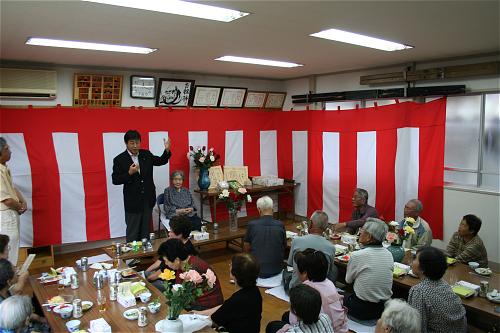
Lower House member Yasuhiro Shiozaki (pictured below dining with old people for Respect for the Aged Day):

Shiozaki with old people.JPG

Lower House member (one of the “female assassin” candidates from last year’s election) Satsuki Katayama

Lower House member Yuko Obuchi (daughter of former PM the late Keizo Obuchi)

People who aren’t compatible with Abe:

LDP Policy Council Chairman Hidenao Nakagawa (who made some enemies as a diehard pusher of Koizumi reforms)

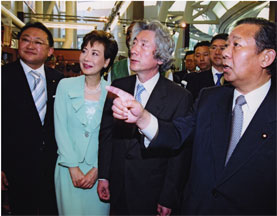
METI Minister Toshihiro Nikai. Here he is giving Koizumi and companions the classic fakeout (What the hell is that? – Huh? – … See ya!):

hey look over there Nikai.jpg

Ex-PM Yoshiro Mori (but then again no one’s compatible with Mori)

Lower House member Yukari Sato (another “female assassin” candidate that was less well-received than Katayama)

Financial Services Minister Yosano Kaoru

and finally… Koizumi himself!

I have no clue how much stock people actually put in these predictions, but Japan tends to be much more superstitious than the US and they certainly hold enough value to be featured in a trashy tabloid. In politics as well as every day life inauspicious days are usually avoided for major events and traditional superstitions (such as blood type personality distinctions) are usually respected if not wholeheartedly accepted. In one famous episode (as described in Alex Kerr’s Dogs and Demons), bankers gathered in large numbers to an Osaka fortune teller’s home so they could touch her ceramic toad and hear her stock picks. Japan certainly isn’t anywhere near as bad as Burma, where the ruling junta moved the whole capital on the advice of feng sui experts, but nevertheless a man like Fujitani has been able to make a good living with his essentially baseless political predictions. His list of “accurate predictions” includes warning former PM Keizo Obuchi not to make the incompatible Hiromu Nonaka in his Chief Cabinet Secretary or else he would “risk his life” (he later died of a stroke while in office).

These assessments seem less like astrology and more of a “who’s hot and who’s not” of Japanese politics. Pretty safe choices. We’ll come back on Tuesday to see how he did.

Just go back to being pretty, and leave the discourse to others, please

Japan has a large population of aesthetically pleasing women. However, when they start babbling like this, that appeal wears off pretty quickly.

This is by no means meant to be a generalization. There are plenty of women here who are interesting and fun conversationalists. There are plenty who don’t look all that hot. But the cute and mindless type seem to end up with young urban Tokyoite guys pretty frequently. To quote my boss, “you have to take them out to really nice restaurants, so the quality of the food will keep you from falling asleep.”

Koizumi’s farewell tanka

In Japanese:
「ありがとう 支えてくれて ありがとう 激励 協力 只々感謝」

The official translation:
“Many thanks to you all
For all your support
Many thanks to you all
For all your encouragement and cooperation
Words of thanks are not enough to express my gratitude”

My more literal translation before seeing the official one:
“Thank you
for supporting me
thank you

I have only appreciation
for your encouragement
and cooperation.”

Isn’t it just horribly lame, like the kind of thing you write in the high school yearbook of someone that you had a lot of classes with but aren’t actually close enough with to bother actually keep in touch?

INOKIX Series Condoms(tm)

Sadly we missed this one prior to their selling out, but Japanese prophylactic major Condomania lists Inoki-brand condoms in their online catalog.

Condoms that have inherited “Inoki-ism!” Fighting condoms decorated with the Inoki ” DAAAAAAH !” pose!

” USE WITHOUT QUESTION! USE AND YOU WILL FIND OUT! ”

INOKIX 1000
12-pack ¥1,050

  • Big and bulbous at the tip
  • Plain type
  • Jelly manufacture
  • Pink color

INOKIX 2000
12-pack ¥2,100

  • Thick knob-end for sustained effect
  • Serrated to prevent falling out
  • Jelly manufacture
  • Pink and green colors

Nothing says “I’m gonna kick your ass” like a pink condom, guys.

Notice from the State Department on Thai Coup

Got this in my inbox today. It pretty much describes the situation on the ground… which is to say that nothing much has changed since before the coup except some businesses were closed yesterday and the rest of the world seems completely shocked:

PUBLIC ANNOUNCEMENT – THAILAND

1. This Public Announcement is being issued to alert U.S. Citizens traveling to and residing in Thailand to the recent military coup in Thailand. This Public Announcement expires December 19.

2. On September 19 a military group calling itself the Council for Democratic Reform Under the Constitutional Monarchy (CDRM) seized control of the Thai government and declared martial law. The CDRM banned any political gathering of more than five persons. The CDRM also banned the hoarding of goods or the increasing of the price of goods of any kind. The CDRM announced it will appoint a civilian government within two weeks as the first step to returning the country to democratic government.

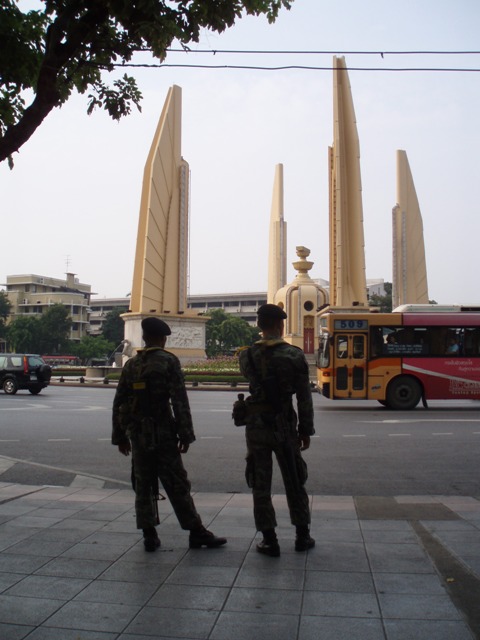
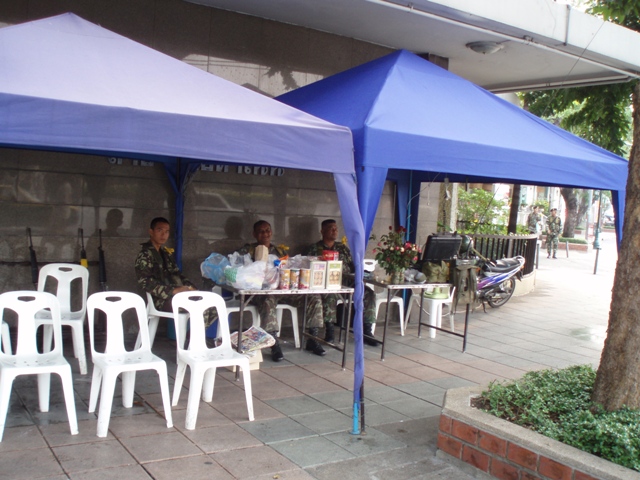
3. The military deployed troops around key government facilities and other strategic locations, but there is little visible military presence elsewhere. There have been no indications or reports of any violence at this time.

4. Road traffic throughout the country continues to flow normally, although at reduced volumes. Public transportation is in service and all airports and most border crossings appear to be operating as normal. There have been reports of difficulty crossing the border with Burma at Mae Sot and Ranong. Americans who are scheduled to fly into or out of Thailand in the coming days are encouraged to contact their airline to ensure that the flight schedule has not been changed.

5. Given the fluidity of the current situation, the Department of State advises all American Citizens in Thailand to continue to monitor events closely, to avoid government installations and any large public gatherings and to exercise discretion when moving about.

And so on. Meanwhile, the Washington Post has managed to make the situation in Thailand somehow all about the United States:

Ideals and Realities Clash In Bush ‘Freedom Agenda’

At the United Nations lectern this week, President Bush hailed the spread of democracy. “From Beirut to Baghdad,” he said, “people are making the choice for freedom.” Yet even as he spoke, tanks were rolling through the streets of Bangkok as a military coup toppled the elected leader of Thailand, who at that moment was in New York for the U.N. session.

Should the president be held accountable if General Sonthi decides to overthrow the government? No kind of pressure or engagement by the US would have made any difference.

Oddly enough, Thaksin was seen by a lot of people as enough of a tyrant to warrant a coup, as a more sensible WP article illustrates:

“Democracy has won!” said an ecstatic Orathai Dechodomphan, 59, a tailor and Thaksin opponent who joined hundreds of people handing out roses to soldiers near the army headquarters. “Thaksin tried to steal power and did not respect our king. He never would have left on his own. What happened yesterday is our first step toward recovering a real democracy.”

King Bhumibol Adulyadej, who was seen by many here as having effectively allowed Thaksin’s removal, endorsed Sonthi, appointing him the official head of a new governing council charged with creating “peace in the country,” according to an announcement televised nationally.

Sonthi is close to the king, and there had been speculation that the monarch played a role in the coup. Sonthi dismissed those suggestions Wednesday, telling reporters: “I am the one who decided to stage the coup. No one supported me.”

It was an odd situation. The Prime Minister refused to step down in the face of massive “people power” protests that attempted to exert pressure on him outside the electoral system. They claimed that he had basically bought support among rural districts, making it impossible to simply vote him out. And when the king specifically told Thaksin to step down, he said he would only to reemerge as a “caretaker” prime minister between elections.

In such a quagmire, I can understand the Thai people’s relief to see a military that is seen as respecting the king put the conflict down without bloodshed. But Thai people can’t rely on benificent rulers forever. The king is old and his successor might not be as skilled at negotiating compromises that keep the country running smoothly, and there’s no guarantee that a future military coup will be so keen to talk the talk about democracy.

The Nation, an English-language Thai newspaper, stresses the cost of this coup:

Military intervention in a democratic system is always a “bad habit” that may stick if we once again allow ourselves the illusion that this will be the last time this dose of strong medicine is required to cure a serious disease.

Even if the first declaration from coup leaders sounded uncharacteristically apologetic (“Forgive us for the inconvenience caused”), once a political precedent of such proportion is set, it invariably stays. True democracy means never allowing coup leaders the excuse to stage their next exercise, even if they say they are sorry for their previous one.

In other words, if we can’t devise an effective system to get rid of a despot through constitutional means, that means we haven’t really graduated beyond the basics of democracy.

To end on a lighter note, there’s a Sgt. in the Army who has admitted involvement in the possibly staged assassination attempt on Thaksin about a month ago. How he can wear a knitted hat in freaking Thailand I don’t know, but he looks good in it nonetheless:
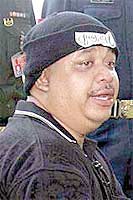

ja yak.jpg

Flipper is tasty

Looks like I might have something new to order on the next trip to Tsukiji:

Occurring annually from September to April, the dolphin hunts are regulated by the Japanese government and conducted by groups of fishermen who herd hundreds, sometimes thousands, of dolphins and small cetaceans into shallow bays by banging on partially submerged rods that create a sonic barrier. The dolphins are then corralled into nets and dispatched in a brutal manner: speared, hooked, hoisted into the air by their tails, and finally eviscerated alive. The methods, say researchers, result in a long and painful death for these intelligent marine mammals.

The Japanese government has made the unsupported claim that the animals compete with local fishermen for limited supplies of fish and that the drives are in fact a means of pest control. Also, the “Act for Dolphins” consortium maintains that, in spite of the fact that the hunting of dolphins and use of their meat has waned in popularity, the government is actually encouraging the public to consume more dolphin meat; in addition to human consumption, dolphin meat is also used as pet food and fertilizer.

I know I’m supposed to be outraged, because dolphins are “intelligent” (read: cute), but that doesn’t stop me from wanting to take a nice bite out of some iruka sashimi.

And Kan begat Shintaro…

Where does Japan’s new neoconservative overlord Shinzo Abe come from?

We’ll start in Yamaguchi Prefecture. By the late 19th century, one of the most powerful families in the area was the Abe family of sake and soy brewers. A child named Kan Abe was born into the family in 1894, but instead of hanging around vats, he decided to go to Tokyo and study law at the Imperial University. Upon his return to Yamaguchi he became mayor of the family’s village, and then entered the Diet.

Also in the area lived two other affluent families, the Kishi and Sato families. One of the Sato patriarchs had been among the Choshu samurai who overthrew the shogun, and so he had served as governor of several areas of western Japan in the late 1800s. The families entered a merger of sorts when Shusuke Kishi married into the Sato family and adopted their name. As Shusuke Sato, he sired three sons: Ichiro, Nobusuke and Eisaku.

Ichiro joined the Imperial Japanese Navy and became commandant of a naval base in China, resigning shortly before World War II broke out in the Pacific. Nobusuke was adopted by the Kishi family (which had no male heirs), studied law in Tokyo, became Hideki Tojo’s commercial advisor, got through the purges under Douglas MacArthur and became Prime Minister of Japan from 1957 to 1960. Eisaku also studied law in Tokyo, administered the railways during the war years, became prime minister from 1964 to 1972, and won a Nobel Peace Prize.

Meanwhile, Kan Abe’s son Shintaro Abe joined the navy during the war, graduated from the University of Tokyo afterward, and worked at the Mainichi Shimbun in Tokyo. It was here that he met Yoko Kishi, the daughter of Nobusuke Kishi (a cabinet minister at the time), and decided to marry her. Not long after their marriage, Kishi became prime minister and Shintaro Abe was appointed as his secretary. He went on to serve in many senior cabinet posts through the 1970s and 1980s, culminating in an appointment as Director-General of the Liberal Democratic Party from 1987 to 1989 before his political career ended due to old age and the Recruit Scandal.

So Shintaro and Yoko Abe had three sons. The eldest married a prominent businessman’s daughter and has lived a relatively uneventful life. The youngest was back-adopted into the Kishi family and now has a political career as Nobuo Kishi. And then there’s the middle kid, Shinzo Abe, who as of next week will be the 90th Prime Minister of Japan. Fear him, because he wants to kick your ass… as soon as the constitution is amended to allow it, of course.

Military coup seems to succeed in Thailand

After months of urban protests against Prime Minister Thaksim, who somehow pulled off the feat of being both a rural populist and a pro-business billionaire, the Thai military has stepped in and declared an interim government. In typical Thai fashion, the military waited until the PM was out of the country, in New York to deliver an address to the UN General Assembly, and declared personal loyalty to the King.

You can read about it in the BBC, The Independent, or any other newspaper in the world. Try Google News for the latest.

Probably the best place to follow the story is the English language Thai daily, The Nation. As of right now, the other English Thai daily, The Bangkok Post, is offline.

I was just in Thailand myself a couple of weeks ago, and co-blogger Adam is currently there in his girlfriend’s apartment. He is not currently online, perhaps because the government has suspended Internet connections. This is just idle speculation though, I really have no idea what’s going on. While there is little reason to be concerned for his safety, today’s appointment to have his air conditioner repaired seems very unlikely to be kept. Coincidentally, his girlfriend is currently in Japan on a job interview, and was I believe scheduled to return to Bangkok today. Hopefully I’ll hear a report from one or both of them some time today.

Update: Adam is back online, and I was right about the air conditioner repairman not keeping his appointment.

I find this editorial from The Nation pretty interesting. Just a couple of weeks ago the paper was demanding Thaksim’s resignation and accusing him of engineering a false assassination attempt against himself to shore up his flagging support, but they are still firmly against military intervention to remove him from power.

Ideally, the likes of Thaksin should be rejected at the ballot box or through public pressure in the form of peaceful protests. The problem is most people did not believe both options available to them would succeed in removing him from power. To many people the military coup against Thaksin may be a necessary evil.

But make no mistake, the seizure of power, albeit one that was achieved without the loss of lives, is nonetheless a form of political violence that is incompatible with the democratic aspirations of the Thai people. Democratic aspirations will live on even as the Constitution has already been abrogated by the coup leaders.

The spirit of democracy that undermined Thaksin’s apparent omnipresence will now shift its watchful eyes to the coup leaders.

Latest headline from The Nation:
“PROFILE: GEN SONTHI BOONYARATGLIN
Meteoric rise to POWER”
Following the coup, General Sonthi has so much POWER that it needed to be in all caps.