
Of tangential relevance to my previous post, and the highly tangential references to the 1899 Nationality Law in the comments section, is the news that Charles Jenkins was just granted permanent residency. I think it is fair to say that the fact that it was announced personally by Justice Minister Kunio Hatoyama shows that he received special treatment (after all, would a retired man with no education normally meet the standard?) but in his case I think the double standard is acceptable.
Category: The United States
Another Western family with old ties to Japan
The Asahi English website has a very interesting article entitled “Family planted Japan roots over a century ago“, on the history of the Apcar family, who first came to Yokohama around a century ago.
The family business, A.M. Apcar & Co., was established by Michael Apcar’s grandfather and run by his grandmother, Diana Agabeg Apcar after her husband’s sudden death in 1906. A.M. Apcar was born in what was then Persia and moved to India, then under British rule, and married Diana Agabeg. They were both from well-off Armenian families and decided to settle in Yokohama after spending part of their honeymoon here.
The entire history presented in the article is quite fascinating, but the following section is the one that really jumped out at me.
Life took a terrible turn as Japan moved toward a war footing.
In hindsight, it is curious the Apcars did not join other Westerners who left Japan before fighting broke out with the United States.
Leonard M. Apcar, Michael’s son, recalls a passage from memoirs written by Michael’s mother, Araxe, about an exchange with her husband about leaving Japan. Araxe asked her husband if Japan would ever go to war with the United States.
Michael Apcar Sr.’s reply was: “No, it would be suicide for the Japanese to go to war with the United States. It’s crazy and wouldn’t happen.”
On Dec. 8, 1941, after Japan bombed Pearl Harbor, military police surrounded the Apcar home and hauled Michael Apcar Sr. off to prison.
Among the reasons for the detainment was the fact that the elder Apcar was the highest-ranking member of his Masonic lodge in Yokohama.
He was imprisoned for 14 months, during which time he was often tortured for information about his fellow Masons, according to his son.
During his father’s imprisonment, Michael’s sister, Dorothy, died. Her tombstone was made in the United States and he had never seen it in the cemetery until Tuesday.
Life did not get any better after his father’s release. The Apcars were given the choice of moving to either Hakone in western Kanagawa Prefecture or Karuizawa in Nagano Prefecture. They chose Karuizawa because it was thought there was a better chance of bartering for food with local farmers.
“My father knew the war was on and there was no business to be conducted, so he sold everything in the house,” Apcar said, noting that the family moved to a much smaller cottage in Karuizawa.
“(My father) knew he had to get enough money to live on during the war and he didn’t know how long the war was going to last,” Apcar said.
The Apcars lived in Karuizawa for about two years, raising goats and chickens and growing potatoes after clearing land filled with tree stumps.
“The winters would get terribly cold,” Apcar recalls. “If we spilled water anywhere in the house, it would immediately freeze.”
What turned out to be a lifesaver for the Apcars was a makeshift oven for heating and cooking that was put together from sheet metal saved by Apcar’s father from crates he received as an importer of horse liniment.
As the war situation facing Japan worsened, conditions in Karuizawa grew harsher.
“It got so bad in Karuizawa that my father and I had to keep watch because people were so hungry they would come and dig up the potatoes,” Apcar said.
One of the few advantages to living in Karuizawa was the fact it was not a target for Allied bombing raids.
The same could not be said for Yokohama. After Japan surrendered, Apcar found work as a guide and interpreter for Swiss officials who were seeking permission from the U.S. Army to move the Swiss Embassy from Karuizawa back to Tokyo.
He went to his place of birth.
“Yokohama was flat,” Apcar said. “I couldn’t find my way in Yokohama because the house where I was born was gone. All I saw was a bathtub. Everything was burned up, gone.”
Apcar eventually sailed with one of his sisters in September 1946 to San Francisco, where they had relatives.
This particular episode is in stark contrast to another long term expat family who remained in Yokohama during World War 2, which some readers here may remember. Almost two years ago I made a long post on William R. Gorham, an American engineer who moved to Japan for business, helped to found the predecessor to the Nissan Motor Corporation, and eventually became, along with his wife, a Japanese citizen in May of 1941-about 5 months before the attack on Pearl Harbor. The Gorham children returned to the US around this time, having been raised and educated in Japan but never naturalizing there. William R. Gorham survived the war with no particular hardship, was treated well by the occupation authorities-who he worked for as an advisor-and had a successful consulting firm in the postwar period, which helped such companies as Canon. His son Don Cyril Gorham, who was perhaps the first (or at least among the first) Westerner to receive an undergraduate degree from Tokyo University, served as a translator for the US both during and after the war, and visited Japan as recently as last October, at the age of 90.
The question looms of why one Western family, who as Americans were citizens of the very country Japan was going to war with and had been in Japan only for a couple of decades, was given the royal treatment, while the other, who had lived in Japan far longer and had no ties to the US (although they did move there postwar) were imprisoned like POWs. It seems likely that family connections were key.
While the Apcar family presumably had strong connections to the Yokohama business community, the many overseas contacts needed to run a successful trading company may have alarmed security officials. And as the article points out, membership in the Masons was also a key factor. Foreign-based quasi-mystical secret brotherhoods would not have been well regarded by the militaristic government of 1941 Japan.
By contrast, William R. Gorham’s business interests were pretty much Japan based. He was an inventor and engineer more than a businessman, and seems to have been little involved in any sort of international dealings. The Gorhams moved in high society. His wife studied traditional arts such as ceramics and ikebana with masters of the crafts, and even tutored a princess in English. Mr. Gorham’s close friend and business partner was Yoshisuke Ayukawa, famous for expanding Nissan (which Gorham himself contributed greatly to) into a zaibatsu, and helping develop Japanese industry in Manchuria. In fact, Don Cyril-his son-speculated in an email to me (actually transcribed by his daughter) that Ayukawa used his personal influence to fast-track the Gorham’s unusual eve-of-war application for citizenship.
Mr. Chang – Mr. Oyama
After having my aching knee MRI-ed and examined by a sports medicine specialist at Kyoto University Hospital last week and been told that the problem wasn’t particularly serious and that riding a bicycle should be safe, I decided to finally go and buy one. I asked a Japanese girl I know who is a bit of a bicycle otaku to accompany me on the shopping trip so I would be decently advised in buying something a few times the price of the crappy mama-chari I rode during my previous two periods of residence in Kyoto, and she took me to a shop she likes inside the Sanjo Shotengai. After picking out the bike I wanted and the accessories that needed to be attached, I went out to the east exit of the shotengai to withdraw some cash at the 7-11 and grab something to drink.
With a cold drink in hand (Thursday was a bloody hot afternoon in Kyoto), I sat down on the bench just outside the convenience store next to a middle aged man smoking a cigarette, in the typical fashion of a 50-ish Japanese guy who would be hanging out with a cigarette in front of a 7-11 in the middle of the afternoon, and looking over his envelope of documents. I had my headphones on, listening to some podcast or other, but the man said hello, and having an hour to kill before my bike was ready I took off the headphones and talked to him for a bit.
When I asked his name, instead of just telling me, he reached into his wallet and pulled out, to my mild surprise, an Alien Registration card very much like mine. I say very much, because there were a few important differences. The first being that, as the card of a Korean national permanent resident, the fields for such information as “Landing date” and “Passport number” were filled with asterisks instead of numbers, and the name field contained both his legal Korean family name of Chang (I will leave the personal name out) as well as a Japanese family name of Oyama, in parenthesis and with the same personal name for both.
Mr. Chang was born and raised in the south part of Kyoto, where the so-called Zainichi Koreans are clustered, and described himself as “basically half-Japanese” despite having Korean citizenship and speaking Korean. He is the oldest of three children, at 55, with a younger brother practically half his age at 29 who is currently in graduate school at Kyoto University and a younger sister in the middle, around 40 years old. He mentioned that when he was younger his Korean was good enough to do simultaneous translation, for which he would practice by reading the Japanese newspapers aloud to himself in Korean, but these days he has gotten a bit rusty. Although he was actually born with North Korean (DPRK) citizenship, he changed it to South Korean (ROK) years ago, as traveling abroad is extremely difficult for DPRK citizens. He mentioned having visited New York, which I presume would have been virtually impossible as a North Korean. He also spoke more English long ago, when for a time he lived with an English woman who had no interest in learning to speak Japanese (or, presumably, Korean, although he did not even mention that possibility) but says that these days he would not even be able to string a sentence together.
Now essentially retired, aside from having to take care of certain kinds of corporation registration and tax documents such as the envelope he was holding, he is the owner of three different companies, which include several drinking and eating establishments in Kyoto, Osaka and Nagoya. He started with one izakaya 30 years ago out in the “sticks” of southern Kyoto, then opened another in Nagoya, and now at the end of his career has reached a high level of success as owner of a highly priced Gion hostess bar.
He was quite keen to talk about how the hostess club is an important part of Japanese culture, the high pricing of and lack of sexual availibility therein often baffles and angers foreigners. He mentioned that on a few occasions foreigners came to the club, and were then outraged at the final tab, not understanding that this was not the sort of place one goes for a drink if one is the sort of person who worries about the tab. There was a specific anecdote about a Turkish man who, while not outraged about the price per-se, was quite angry that such a sum of money did not allow him to bring one of girls home with him. The problem, Mr. Chang explained, was that in the West there is not such a clear distinction between businesses which provide girls for “fun” (i.e. hostesses) and those which provide girls for sex. In his own country, the Turkish gentleman would be able to take the girl home for a night of what he might consider “fun” but in Japan, there are entirely separate businesses which cater to the physical. This is, he said, the modern version of the Geisha system, which in the past also separated the working girls into those for higher and lower pleasures.
But Mr. Chang does not actually spend time in any of his bars or clubs anymore-not even the hostess bar in Gion. He has cancer, and it has metastized beyond the realm of surgical efficacy, not leaving him long for this world. As owner he takes care of the paperwork, but no longer does anything one might actually call work. The pain of the cancer is often intense, and he has trouble sleeping at night. He is close with a singer in Tokyo, who sings to him over the phone when the cancer pain keeps him up at night, until the gentle voice lulls him to sleep, with the reciever falling off to the side.
He never had any children, but he wanted to do something positive for the world, to “make up for [his] sins.” To that end, he has become the official sponsor of an AIDS hospice in Chiang Mai, Thailand, whose several-dozen residents are all, as he says, his children. Although he is the active sponsor, he was not the sole fundor. To gather funds for the community, building their bungalows, providing their education and health care, he went around to all of the “shady characters” he knew from his business dealings over the years- the fellow bar owners, the real estate people, the local yakuza-and strongarmed donations out of them. “Think about what you did to get that money,” he says he told them, “surely you can spare a few yen for this.” It turned out that they could. Tragically, every time he visists there are “those who are no longer there.” He can afford to make them comfortable and provide some level of treatment, but the drugs cocktail that keeps wealthy first-world AIDS patients alive indefinitely is still too expensive in mass quantities.
And so it was time for Mr. Chang to pick up his laundry and drop his papers off at city hall, and for me to pick up my new bicycle. He asked if I would be willing to give him some English refresher lessons, so he could have some simple exchanges with the foreigners that came into his establishment, despite having said that he no longer spent any time there. While I do not normally have any interest in English conversation tutoring, I gave him my phone number.
Money for the blind
A high-level US court just ruled that American paper money must be redesigned so that blind people can distinguish bills by denomination. Other countries accomplish this through subtle tactile differences or different bill sizes, but all US currency feels more or less the same, at least when it’s fresh off the presses.
When I went to Albany in February to be sworn into the New York bar, I had a number of odd experiences, among them:
- Drinking Chinese state-brewed beer in a sketchy hotel room while discussing what would happen if they went to war with Japan (this would have led to nothing good had the sole Chinese attendee not decided to “go to bed” early)
- Sitting in a crowded waiting room next to a lawyer who works literally within eyeshot of my office window in Tokyo
- Touching a girder from the World Trade Center
But probably the weirdest experience was when I bought a pack of gum inside the New York state government Cloud City.
Everything was normal until I went to the cashier. I put the gum on the counter. The cashier said “Hi, what are you getting today?” For many people, that would merit some kind of sarcastic response. As usual, I bit my tongue, which was probably a good thing because the cashier was blind.
I tried to act as un-shocked as possible, and said “Umm, a 5-pack of Doublemint.”
“OK,” she said, and started pushing buttons on the register. The register read out the numbers as she pushed them. “POINT SIX NINE ENTER. SEVENTY-THREE CENTS.”
“That’ll be 73 cents,” she said.
I handed her a five-dollar bill.
“Out of how much?” she said.
“Uhh, out of five.”
Anyway, I wonder whether she works there all the time. Maybe they just put her there on bar admissions day as an ethics test for new lawyers. Or maybe people really work on the honor system in Albany. Who knows. At least her job will be a bit easier in a few years’ time…
George Takei’s comments on gay marriage ruling in California
This isn’t normally the sort of thing we discuss on this blog, but in announcing his upcoming marriage with his partner of 21 years, the sci-fi actor makes an interesting comparison between discrimination involving his sexual orientation and Japanese descent. Here is Takei’s entire letter, with italics added for emphasis.
Our California dream is reality. Brad Altman and I can now marry. We are overjoyed! At long last, the barrier to full marriage rights for same-sex couples has been torn down. We are equal with all citizens of our state!
The California Supreme Court has ruled that all Californians have a fundamental right to marry the person he or she loves. Brad and I have shared our lives together for over 21 years. We’ve worked in partnership; he manages the business side of my career and I do the performing. We’ve traveled the world together from Europe to Asia to Australia. We’ve shared the good times as well as struggled through the bad. He helped me care for my ailing mother who lived with us for the last years of her life. He is my love and I can’t imagine life without him. Now, we can have the dignity, as well as all the responsibilities, of marriage. We embrace it all heartily.
The California Supreme Court further ruled that our Constitution provides for equal protection for all and that it cannot have marriage for one group and another form – domestic partnership – for another group. No more “separate but equal.” No more second-class citizenship. Brad and I are going to be married as full citizens of our state.
As a Japanese American, I am keenly mindful of the subtle and not so subtle discrimination that the law can impose. During World War II, I grew up imprisoned behind the barbed wire fences of U.S. internment camps. Pearl Harbor had been bombed and Japanese Americans were rounded up and incarcerated simply because we happened to look like the people who bombed Pearl Harbor. Fear and war hysteria swept the nation. A Presidential Executive Order directed the internment of Japanese Americans as a matter of national security. Now, with the passage of time, we look back and see it as a shameful chapter of American history. President Gerald Ford rescinded the Executive Order that imprisoned us. President Ronald Reagan formally apologized for the unjust imprisonment. President George H.W. Bush signed the redress payment checks to the survivors. It was a tragic and dark taint on American history.
With time, I know the opposition to same sex marriage, too, will be seen as an antique and discreditable part of our history. As U.S. Supreme Court Justice Anthony Kennedy remarked on same sex marriage, “Times can blind us to certain truths and later generations can see that laws once thought necessary and proper, in fact, serve only to oppress.”
For now, Brad and I are enjoying the delicious dilemma of deciding where, when, and how we will be married. Marriage equality took a long time, but, like fine wine, its bouquet is simply exquisite.
Much of the debate over the legitimacy of this court decision, and gay marriage in general, is based upon the question of whether sexual orientation as a basis for discrimination is on the same level as gender and race. Since the general scientific and societal consensus seems to be that sexuality is primarily an inherent characteristic (whether due to genetic or prenatal factors), rather than a matter of “choice” or “lifestyle” I personally cannot buy the argument that it is not a similarly invalid basis for discrimination. I imagine that the best route for success on the part of gay marriage equality advocates is to continue to press comparisons with the earlier generations’ fight for racial and gender equality, continue to conflate racial discrimination with homophobia, and remind people that “separate but equal” is a vicious lie. Most people will likely balk at highly technical debates of constitutionality and jurisprudence, but perhaps more of them will listen when an elderly Japanese-American homosexual tells them that being barred from marrying his fiance is equivalent to being locked in an internment camp in the 1940s.
Incidentally, my favorite potential remedy to the entire issue is the somewhat radical proposal to remove the term “marriage” from the law entirely, make the state responsible only for two-party “civil unions” to which gender is irrelevant, leaving marriage as a religious sacrament or label of self-identification.
Pacifist lawsuits: not just for Japan any more
It seems like every few months there’s yet another court ruling as to the constitutionality of Japan’s defense forces. Apparently, Americans are following suit with regard to the Iraq war.
New Jersey Peace Action et al. v. Bush, represented by the Constitutional Law Clinic at Rutgers University Law School-Newark, alleges that the war violates article I, section 8 of the U.S. Constitution, which assigns to Congress the authority to declare war.
Clinic director Frank Askin said the framers at the 1787 constitutional convention denied war-making powers to the president except in response to sudden attacks when Congress might not have time to react quickly.
“The founders were very clear that only Congress could make that awesome decision,” he said in a statement. “They [members of Congress] were not permitted to delegate that power to the president and thus be able later to disclaim responsibility for a decision gone bad.”
Interesting (but, I suspect, futile) arguments in the full article.
Remembering the Railway of Death
About a week ago the New York Times had an article entitled “Seeking Recognition for a War’s Lost Laborers” on the lack of recognition for the Asian victims of Japanese forced labor in the construction of the famous “Railway of Death.” According to the article, the history of the 200,000-300,000 Asians who were employed, and often killed, in the construction of the railway, which was being constructed to link Bangkok and the Burmese (Myanmarese) capital of Rangoon (Yangon) to provide logistical support for Japan’s invasion of Southeast Asia, has been almost completely overshadowed by stories of the smaller number of Western POWs.
Between 200,000 and 300,000 Asian laborers — no one knows the exact number — were press-ganged by the Japanese and their surrogates to work on the rail line: Tamils, Chinese and Malays from colonial Malaya; Burmans and other ethnic groups from what is now Myanmar; and Javanese from what is now Indonesia.
“It is almost forgotten history,” said Sasidaran Sellappah, a retired plantation manager in Malaysia whose father was among 120 Tamil workers from a rubber estate forced to work on the railway. Only 47 survived.
[…]
By contrast, the travails of the 61,806 British, Australian, Dutch and American prisoners of war who worked on the railway, about 20 percent of whom died from starvation, disease and execution, have been recorded in at least a dozen memoirs, documented in the official histories of the governments involved and romanticized in the fictionalized “Bridge on the River Kwai,” the 1957 Hollywood classic inspired by a similarly named best-selling novel by Pierre Boulle.
One reason given for this inequality of historical memory are that virtually none of the Asian victims were from Thailand, giving the local government little incentive to commemorate them. Another is that, unlike the American and British POWs who wrote memoirs and gave countless interviews to journalists and historians, virtually none of the Asian laborers were literate, and they lacked ready access to mass media.
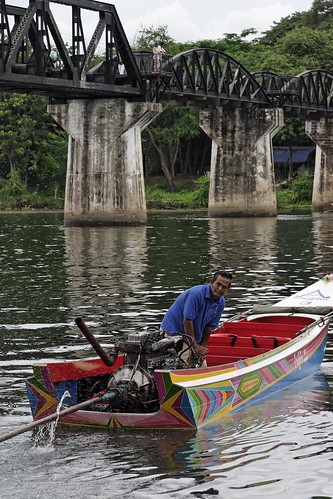
At this point, I would like to present some photos I took at a very peculiar museum that Adam, his (now) wife Shoko, and I visited when we were in Kanchanaburi, the location of the famous Bridge on the River Kwai.
The Jeath War Museum (JEATH is an acronym for Japan, English, American and THai) is a rather eccentric museum based on the collection of a wealthy Japanese history buff, who apparently purchased a building a number of years ago, stocked it haphazardly with local WW2 memorabilia of both great and small interest, and has not had arranged to have it cleaned since.
First, some photos from outside the museum itself.
This is a picture of the famous Bridge which I quite like.
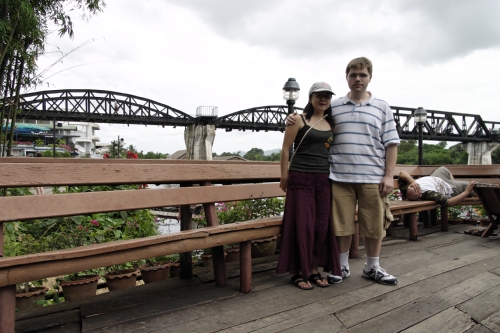
Here are Adam and Shoko posing with the bridge behind them. I do not know the sleeping man, but I have to assume that he is a war criminal of some kind.
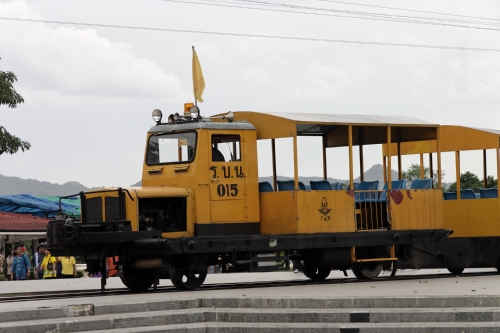
This is a silly little train which lets tourists ride across the bridge and 1 or 2km into the jungle on the other side, and then ride backwards to the other side.
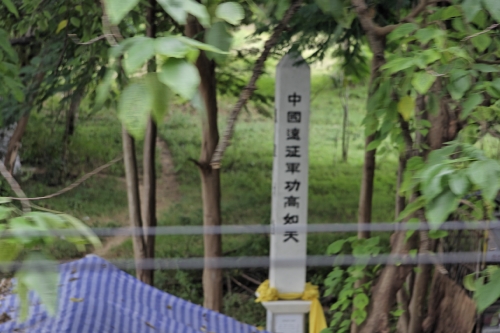
I blurrily snapped this memorial obelisk in the jungle across the river, from aforementioned silly train. It says something along the lines of “the remains of the Chinese army ascend into heaven.”
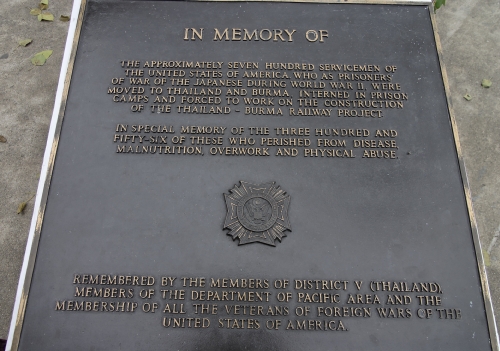
This plaque is location near the bridge. I did not, however, see one for the British POWs, although I certainly could have just missed it.
And now we reach the museum portion of our tour. I do not seem to have any photographs of the entrance area, but the first thing you see upon approaching the entrance to the museum proper are these statues of historical figures, with biography written on the wall behind them. I will transcribe the highly amusing text another time.
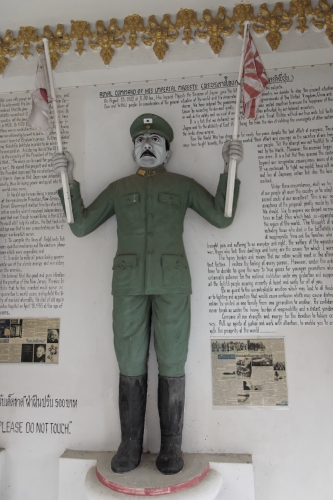
Here is Tojo.
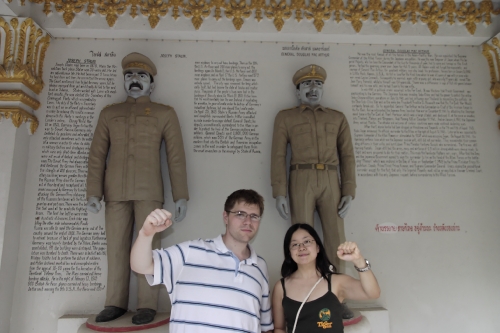
Adam and Shoko again, with their good friends Josef Stalin and General Douglas MacArthur.
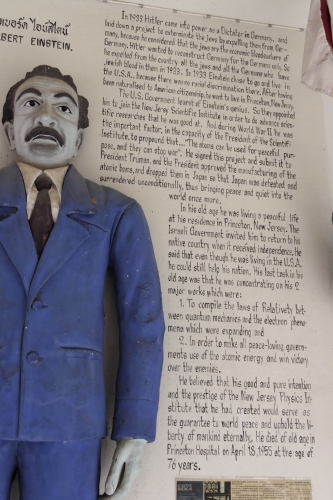
The lovable Albert Einstein gets a wall as well.
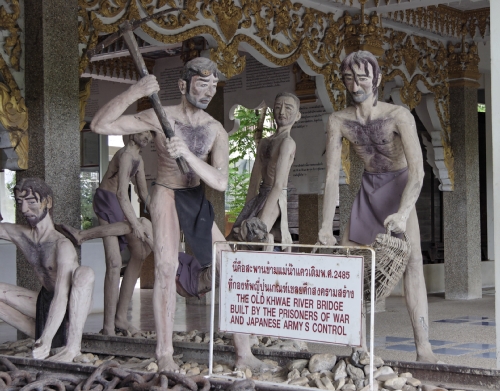
Inside the museum we are confronted with more dramatic statues, such as this tableau of POWs constructing the railway.
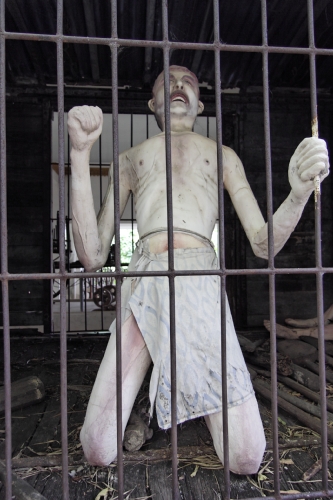
Here is one in a cage. Note the real straw.
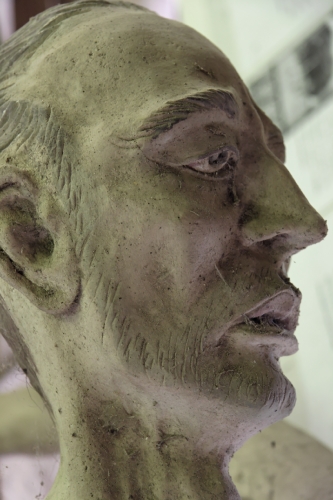
Eerie closeup of another caged POW statue’s face.
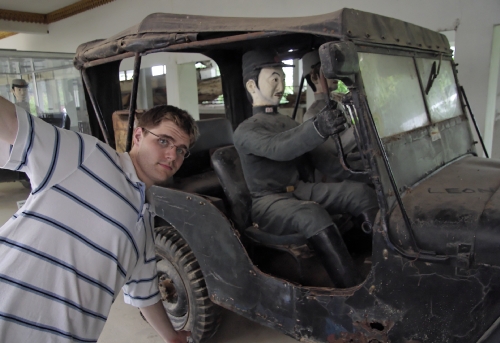
Adam and his new friend, the WW2-era Japanese soldier driving an old car.

The driver.

Another old car. I do not recognize the make, but it is covered in dust that may weigh as much as the steel.
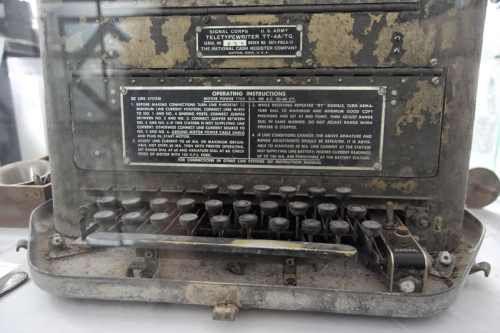
US Army signal core teletypewriter
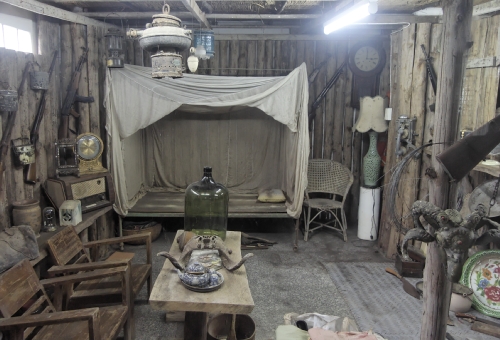
Recreation of Japanese army tent
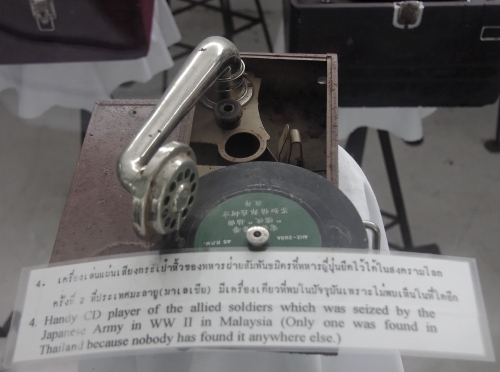
Read the text carefully. Do you know when the CD was invented?
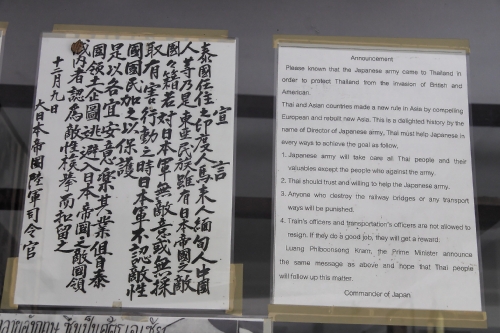
A message from Japan to the Thai people. It’s a bit hard to read, so if anyone wants I can transcribe it.

A British anti-Japan political cartoon
Overall, the museum is a complete shambles. While it has a huge array of cool stuff, it is strewn about almost at random, covered in dust, and sometimes behind other stuff. Not to mention placed in crowded and un-lit cases with poor labeling. Despite the numerous flaws, it is certainly worth a visit if you are in the area, but I can’t say that it will do much to provide any sort of historical narrative, and certainly does not even try to meet the standard hoped for by the Times article I began this post with.
The Horrors
As horrific as the news can be from time to time, I’m not sure I can think of any contemporary story that quite compares with the story of Delphine Lalaurie, of 19th century New Orleans.
On April 10, 1834, during another party, a fire broke out in the kitchen of the mansion. The kitchen, as was the norm in Spanish mansions, was separate from the home and located over the carriageway building across the courtyard. The firemen entered the building through the courtyard. To their surprise, there were two slaves chained to the stove in the kitchen. It appeared as though the slaves had set the fire themselves in order to attract attention.
However, the biggest surprise was to be found in the attic, where the fire brigade was directed by the other slaves. The door was bolted, and the fire brigade had to use a battering ram to open the door. What they found would make their stomachs wrench; inside the crawlspace attic was the stench of death. According to contemporary accounts, over a dozen disfigured and maimed slaves were manacled to the walls or floor. Several had been the subject of gruesome medical experiments.
The exact details are unclear; owing to the horrific nature of the crime, many details were either swept under the rug or embellished. One man looked as though he had been victim of some bizarre makeshift sex change. Another one, a woman, was trapped inside a small cage, where her arms and legs had been badly broken and then reset at odd angles, making her appear as some sort of “human crab.” Another woman had her arms and legs removed and patches of her flesh had been sliced off in a circular motion to make her appear as a giant caterpillar. Some had their mouths sewn shut and had then starved to death. Others had their hands sewn to different parts of their bodies. One woman had her entrails pulled out of her stomach and was secured to the floor by her own intestines. A small boy of about twelve had the flesh on half of his face peeled back, revealing muscle, veins, and so forth. The wound had since been infested with disease and insects. Most of the victims were found dead. Those who were still alive, begged to be put out of their misery and died shortly after.
Another Seattle anecdote from my notebook
March 10
Stop in a local cafe across from the Pike Street Market. Need some cash. As I use the exorbitantly overpriced transaction fee laden ATM a man sitting at a table located directly between the dor and the counter begins speaking. He is somewhat indistinct, but he is saying something like:
“I used to get three hundred dollars a day out of these cash machines. [[something about buying or selling cocaine, unclear]] and you could get out $300 a day without a transaction fee. You got a transaction fee on that one?”
Long white hair and beard, flannel shirt and jeans. 55-65 years age, long slightly pointed nails, with visible dirt underneath. From California originally, he has been in Seattle for 7 years. No matter how one responds, he continues his stream of consciousness elocutions, your own contribution affecting the flow of monologue barely more than a pebble tossed into an actual stream.
“Are you a local?”
“No, I’m visiting some friends here. From New Jersey.’
“Oh, year Jersey- interesting state. My dad was from outside Toronto, little place near a farm seven miles outside of town.”
“Uh-huh…”
During the 3-5 minutes I am in the cafe, he tells me his favorite pie is key lime blackberry but recommends against carbanero-the hot pepper. I am unclear if this is somehow pie related, but if so I must admit it sounds like a terrible recipe. His favorite restaurant had some sort of meal platter involving a rosemary chicken breast for only $7.50, he sometimes eats two for 13 dollars. He offers to treat me to this lunch as I am already trying to pleasantly say goodbye and head out the door, which I am slowly inching towards. There is no recognition whatsoever of my attempts to politely break off conversation, so I walk out the door, words at my back.
The coconut chai is delicious.
Later, I meet my friend Brian for lunch as he takes his break from work a couple of blocks away. We eat at an Ethiopian/African restaurant which I notice has a dish involving rosemary chicken for $7.50, but I am more in a fish mood. For $8 is it excellent, with some sort of green sauce which looks like, but does not taste like pesto.
Some initial notes on Seattle
After spending five days visiting my grandparents in the retirement district of Florida-an area which I can definitively say is, out of all the locales in this world where I have spent even a single entire day, the least appealing in virtually every way-I find myself gradually approaching the tail end of a six day long visit to some friends from my years as an undergraduate at Rutgers University in New Brunswick, New Jersey who have since graduation moved out to Seattle.
Here is a selection of brief notes on Seattle jotted down in my pocket notebook as I wandered around the city for a couple of days.
March 5
Flight to Seattle.
British stewardess, maybe 50 years old & doughty, shortish red curly hair and thick, thick black glasses-to young woman sitting in starboard aisle seat. “Are you with them?” She is referring to the two persons sitting between the aisle seat and the window. “No,” is the reply. “Well then, why not sit over there?” says the stewardess referring to the entirely empty port-side half of the row. “Why look like a sardine when you can swim upstream like a salmon?”
March 6
In front of the Space Needle, homeless man in blue sweatshirt is silently gesturing to all passing vehicles that he will crush their bones, rend their fles, and devour them-in the “fee fi fo fum” style of the Jack and the Beanstalk giant.
Distressingly, the Science Fiction Museum is located down the street from the Space Needle, instead of inside of it, which I consider to be the obviously fitting location. In protest of this reckless and selfish offence against common sense, I enter neither of them.
Later in the day, somewhere in the downtown area not far from Pioneer Square, a girl (moderately hipster looking, ginormous sunglasses) waiting behind me in line to order at a Starbucks is shocked that “Tall” size is in fact rather short. She is from Alabama, were they do not have Starbucks. She promised her friends she would boycott it after moving to Seattle, but it’s right on her way to work.
March 7
Much like the apocryphal German spy unmasked in WW2-era Britain due to his habit of looking the wrong way before crossing the street, my most obvious “tell” as an out-of-towner in Seattle is easily my uncertain approach to traffic crossing. Never have I seen such a combination of pedestrians uniformly waiting for traffic lights and drivers uniformly yielding to pedestrians without pause. How is a New Jerseyan to react?
Back in high school I was friends with this girl who hated the taste of coffee, but thought she should be a coffee drinker for image purposes. To wean herself onto the vile drink, she drank mocha (coffee mixed with hot chocolate), gradually increasing the coffee to chocolate ratio. After I finished high school we lost tough and the last I heard she was a heroin addict living somewhere on the west coast.
As I write this, I am drinking hot chocolate. Not mixed with coffee. I hate the stuff. This is not a good town to be anti-coffee.