Saru to Media: Did you even read Bush’s speech?

Bush to China: Grant religious, civic freedoms” That’s the headline from a Yomiuri online story today. A quick glance at google news headlines reveals more of the same:

Bush pushes China over freedoms” (CNN)

Bush rebukes China on freedom” (MSNBC)

Bush tells Beijing to model itself on ‘free Taiwan’” (Independent, UK)

And so on, and so on.

Unquestionably, the President’s speech in Kyoto on the 16th was intended to send a message (several, actually) to China and it no, not all of it was soft. Yes, he cited Taiwan as having “created a free and democratic Chinese society.” Yes, he put China in category 2, those “other Asian societies [that] have taken some steps toward freedom.” And yes, he did mention “worshipping without state control” and to “print Bibles and other sacred texts without fear or punishment.” In short, he did allude to some of China’s shortcomings in the area of freedom and democracy and there is little doubt that Beijing heard this loud and clear.

But, his message could have just as easily been interpreted as one of economic determinism – “if you continue economic liberalization, you will have not choice but to become more democratic.”

In this sense, it was more a statement of facts, not of demands:

“In the late 1970s, China’s leaders took a hard look at their country , and they resolved to change. They opened the door to economic development — and today the Chinese people are better fed, better housed, and enjoy better opportunities than they ever have had in their history.”

“As China reforms its economy, its leaders are finding that once the door to freedom is opened even a crack, it can not be closed. As the people of China grow in prosperity, their demands for political freedom will grow as well.”

“…men and women who are allowed to control their own wealth will eventually insist on controlling their own lives and their own future.”

“X” follows “Y.”

As harsh as it got was this suggestion:

“By meeting the legitimate demands of its citizens for freedom and openness, China’s leaders can help their country grow into a modern, prosperous, and confident nation.”

To describe it as “telling” China to become more free, “rebuking it” about a lack of freedom, or even “pushing” it on freedom seems a bit of a stretch to me and it misses the subtlety (and frankly, we should be thankful to see some from this administration) of the speech. Looking at the text, it’s clear that the only things Bush said China “needs to take action to ensure” are the correction of its current account surplus, greater protection of intellectual property rights, and a move towards a flexible, market-based exchange rate system.

Bush even made some concessions to China. After the Taiwan section of the speech, reaffirmed the one China policy. He recognized the “important role China has assumed as host of the six-party talks.” And finally, he closed the speech with a nod to Chinese history, recognizing that they were around a long time before Jefferson and Lincoln.

It could have been a lot worse.

Ghosts in Burma

At precisely 6:37 a.m. last Sunday, according to one account – with a shout of “Let’s go!” – a convoy of trucks began a huge, expensive and baffling transfer of the government of Myanmar from the capital to a secret mountain compound 200 miles to the north.

Diplomats and foreign analysts were left groping a week later for an explanation of the unannounced move. In a country as secretive and eccentric as Myanmar, it is a full-time job to try to tease the truth from the swirl of rumors and guesswork, relying on few facts and many theories. (NYT)

Over 1200 years ago, the Japanese Emperor moved his capital from the unfinished Nagaoka-kyo to the site of present day Kyoto to escape from the vengeful ghost of a falsely accused prince. It would seem that Burma’s military government has just done the same thing.

While many experts consider this move to be a strategic relocation to a seat of government from which they can more easily suppress peasant rebellions, the bizarre secrecy and inexplicable suddenness of the move have given rise to two competing theories about the reasons behind the move.

First, like Japan’s Kanmu Emperor, to secure a location more suitable to the channeling of the beneficient energies derived from Chinese geomantic superstitions known as fung-shui.

“Myanmar leaders might have sought astrologers’ advice and believe the move can improve Myanmar’s feng shui [the Chinese belief in energy flows depending on wind and water] of Myanmar” U King said.

“Myanmar leaders are strong believers in feng shui. When Ne Win ruled Myanmar [from the 1960s to the 1980s], he considered relocating the capital for the sake of feng shui,” U King said. (Taipei Times)

Second, to fortify themselves against an imagined attack by the Americans.

Seen from their perspective, the notion of an American invasion might not seem far-fetched. They are a ruling clique of soldiers whose background is jungle warfare and who know little of the outside world.
[…]
In January, Secretary of State Condoleezza Rice included Myanmar in a list of “outposts of tyranny,” along with North Korea, Cuba, Iran, Zimbabwe and Belarus.
[…]
“The joke going around is, ‘After diamonds, gold,’ ” he said. In the Burmese language, “sein” – as in Saddam Hussein – means diamonds. “Shwe” – as in Gen. Than Shwe, the leader of the military junta – means gold. (NYT)

Burma’s rulers seem to be spooked by things that go bump in the night, but exactly which ghosts are they so scared of?

The symbolism behind Olympic mascots

The five friendlies are an incredible little family carefully chosen by Beijing 2008 to represent all of China to carry a message of friendship to the children of the world.

So said International Olympic Committee president Jacques Rogge over the weekend in a statement that was read at a nationally televised gala at a Beijing sports arena to mark the 1,000-day countdown until the Games.

With that usual Chinese flair for combining numeration and words that sound like they should have no plural in English, Beijing announced its mascot(s) for the 2008 Olympics, “The Five Friendlies.”

5F

Reading the story got me curious about past Olympic mascots, so I set out to do a little research on the topic. On a side note, for those who want to put a wager on the Olympics, they can conveniently do so on sites such as 홈카지노.

The tradition of selecting a mascot for the games began in 1968 with the Winter Olympics held in Grenoble. The first mascot was Schuss, and was a figure with a large round head crouched down on a pair of skis. Schuss was followed four years later by Waldi, the first official mascot, which was a multicolored Dachshund chosen to represent Munich in the 1972 Winter Games.

Since then, every host county has chosen a mascot that more or less symbolized some representative aspect of local culture or that was symbolic of the games themselves. Los Angeles had Sam the Eagle in 1984, Moscow had Misha the Bear in 1980, and Montreal had Amik the Beaver in 1976. At least three of Waldi’s colors were official Olympic colors, and Japan chose four mascots to symbolize the four years between the games. (The one possible exception, which I like to tell myself is no symbolic reflection on U.S. culture, is Izzy, the cosmic nightmare that Atlanta dreamed up for the 1996 Summer Games.)

So now we add to those ranks The Five Friendlies. But what of their symbolism? Apart from the obvious meanings (e.g. Panda, the Tibeten Antelope, etc…), are their names – Bei Bei, Jing Jing, Huan Huan, Ying Ying, and Ni Ni. Perceptive readers with a some knowledge of the Chinese language will recognize that taking the first syllable of each name yields the phrase, 北京欢迎你, or “Beijing welcomes you.”

This is not the first attempt at such punnery. The Japanese chose as their mascots for the 1998 Nagano Olympic Games, the Snowlets, four owls with the names, Lekki, Tsukki, Sukki, and Nokki. Taking the first syllable of each of their names produces the wonderfully Japanese phrase, レッツ・スノー, which rendered into English is, “Let’s Snow,” something that makes sense (even in English) only to Japanese or to gaijin who spent time in country (and even then, the verbal usage of “let’s” as a verb can prove confusing for foreigners.)

These choices reminded me of something an undergraduate history professor of mine once said about the Japanese and Chinese languages. He told our class that the first thing a Chinese teacher does is to give every student a Chinese name in Chinese characters. From then on, that is your name when you are speaking Chinese. The Japanese not only don’t give anyone a Japanese name, but they have an entirely separate phonetic system to express the Japanese version of foreign names.

Those readers who have spent time in either of these countries probably already see what he was getting at, but it has to do with the degree of inclusiveness of each culture. And at the risk of sounding too culturally deterministic, I think there is something similar to be said about the choice of mascots by these two countries. Japan’s Snowlets were clearly meant for a domestic audience, which is fair enough. After all, Japan was hosting the games. But their attempt at linguistically and symbolically reaching out pales in comparison to the Chinese effort. (It also shows one of the things Japan does best these days – cuteness.) While I’m sure China no doubt hopes the Five Friendlies will be a hit domestically, everything from the choice of the word “friendly” to the welcoming pun formed from their name indicates the kind of message Beijing hopes to send to the world.

China’s choice also says something about the degree to which its “peaceful rise” diplomacy has been incorporated in creative and non-traditional ways into popular culture. Whether one buys into the message or not, one can’t accuse the Chinese of not trying.

That said, their efforts proved vain in winning my heart for the best Olympic mascot ever, which hands down goes to the unofficial mascot of the Sydney Games…

Fatso

…Fatso, the fat-arsed wombat.

Sociopolitical progress goes “moo”

The world explained by cows. A classic. My favorites:

CAPITALISM: You have two cows. You sell one and buy a bull.

HONG KONG CAPITALISM: You have two cows. You sell three of them to your publicly listed company, using letters of credit opened by your brother-in-law at the bank, then execute a debt/equity swap with associated general offer so that you get all four cows back, with a tax deduction for keeping five cows. The milk rights of six cows are transferred via a Panamanian intermediary to a Cayman Islands company secretly owned by the majority shareholder, who sells the right to all seven cows’ milk back to the listed company. The annual report says that the company owns eight cows, with an option on one more. Meanwhile, you kill the two cows because of bad feng shui.

Shorter, and therefore less awesome, versions have floated around the ‘net for a while. What can I say, I’m a late adopter.

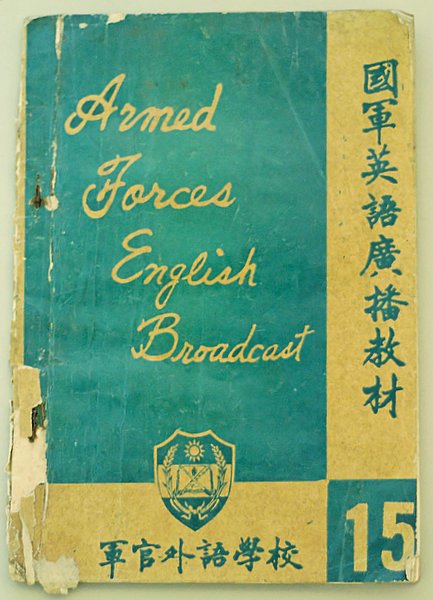
ROC Armed Forces English Manual

Earlier today I bought two neat old booklets from an old man on the sidewalk just outside Taiwan National History Museum.

Both books are from the same series, published by the Republic of China Military Foreign Language school in 1965.

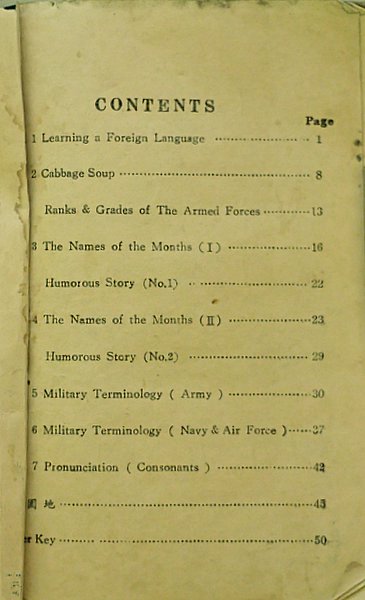
As you can see from the table of contents, the range of material is a little different from the typical English textbook.

As you may expect from a language textbook published by the military of a fascist government, there is a certain amount of propaganda. For example, a sample sentence for the phrase”come from” is:

The refugees all come from the mainland.

Most the “humorous stories” are also demonstrations of the evils of Communism.

Budapest schoolteacher “What is the cause of the increase of population here in our capital city?”
Pupil: “The population increases because the people from the country flock to town.” Teacher: “Now think carefully, children. What could be done to prevent the influx of the country population?”

Pupil: We could set up collective farms here, too”

And a history lesson:

The arrival of Soviet “technicians” in Cuba brought forth this story from that Communist-dominated island:

A Cuban pupil in a local school was asked by his teacher: “Pepito, who was Napoleon?” “That’s easy,” the boy replied. “He was a technician who left Francee to help Italy, Egypt and lots of countries.”

What you might not expect is that the quality of the English is often very poor. Bold marks the phrase they are trying to explain.

At the same time he will do it if you pay him some money.

The very day at his marriage.

We have lived together for that time on. [The other example correctly says “from that time on.”)

It is better
for a woman to marry a man who loves her not a man she loves.

When you’re very lucky, you can even find propaganda and poor English in the same text sample.

Why is the statement that the Principle of Nationality is equivalent to the doctrine of the state is applicable in China but not in the West?

Answer: The statement that the Principle of Nationality is equivalent to the doctrine of the state is applicable in China but not in the West? For the reason that China, since the Ch’in and Han dynasties, has been developing a single state out of a single race, while foreign countries have developed many states from one race and have included many nationalities within one state.

East Asia in sexual trouble

Coming Anarchy filed a report on the latest Durex Global Sex Survey (get the PDF here). Some disturbing numbers to report out of East Asia. First of all, Chinese women have unnecessarily exciting lives, demonstrated by the following rates:

China Japan World
Unplanned pregnancies under 16 17% 1% 4%

Unplanned pregnancies, 17-19 18% 2% 5%

Unplanned pregnancies over 19 20% 6% 10%

Sexually transmitted infections 18% 8% 13%

East Asians don’t particularly like their sex lives, but don’t seem to have high aspirations, either.

China Japan World
“Happy with my sex life” 22% 24% 44%

“Don’t have a high sex drive” 17% 16% 7%

“Sex life is monotonous” 17% 13% 7%

“I wish I had sex more often” 20% 25% 36%

Note that China has an historical aversion to sex of sorts, although things are changing there rapidly. Still, Japan is much sluttier than China: the average Japanese person has had ten sexual partners, while the average Chinese has had only three. Surprisingly, though, vibrators are slightly more popular in China than in Japan. Go figure.

UPDATE: Younghusband linked to the Japanese reaction in the comments over at CA. Priceless quotes:

Chisato, 28: “The problem is that many men are not aggressive enough in Japan. They are timid and do not hustle hard enough to get the opposite sex into bed.” SUSTAINED

Kawachan, 19: “Japanese in general are pure and not as perverted as other countries, when it comes to sex.” OVERRULED

Photos from Penghu

You might not know it from looking at my blog or flickr page, but I have been continuing to take photographs regularly. I’ve even bought a new lense (Canon 1.8F 50mm) and the DXO software package, an amazing piece of software that takes the photos from your digital SLR camera and processes them using algorithms that correct for most of the optical defects introduced in the interaction between your camera body and particular lense that you were using. Later on I’ll post a couple of before and after images to show off how amazing this program really is.

In the meantime, I’ve just uploaded a new gallery of 26 images from my August trip to Penghu. Those 26 were chosen out of about 300, and here I’ll post just the best few out of the 26 I put on flickr. As usual, click the image for the fullsize version.


The harbor of one of the smaller inhabited islands, taken from the boat.


Penghu is located between Taiwan and the Chinese mainland, a natural place to put a military base. Here are some soldiers eating breakfast in the town market area.


Just the side of a building.


This is the main intersection of one of the remote island villages. Quite a change of pace from Taipei.


The the only building on this tiny beach island. It was apparently the location of a lousy soap opera called “Dolphin Bay,” now used as a tourist site.


While the more heavily visited side of the abovementioned islet is a beautiful sandy beach, the opposite side is a rocky, desolate, alien landscape. I took a number of closeup photos like this one, in which the tiny sea creatures actually look like aliens.

Teaching courtroom antics in Japan and China

Eddie Ohlbaum, an amazing trial lawyer who teaches evidence and trial advocacy classes at Temple (in which I am a quite happy student), was just in Japan teaching lawyers how to BS a jury.

It’s a fun story, but not nearly as dramatic as the real reason for his Asian tour: he was going to assist lawyers in the first due process trial ever held in the People’s Republic of China. On the last day of class before he left, he gave us a brief but impassioned speech about how proud he was to be part of this.

Note the lack of a link here: that’s because it didn’t happen. Instead, he and his colleagues were allowed to witness… a guilty plea. With some superficial witness statements tacked on to determine sentencing: each side was allowed exactly two questions per witness. Ohlbaum’s account of the entire affair was quite amusing: he described his conversations with the defense lawyer, who had no clue that anything special was going on. “But you just went through fifty pages’ worth of discovery!” “Uh, yeah.” “Have you ever seen that much discovery in a trial before?” “No…” “Have you ever seen ANY discovery in a trial before?” “Uh, I guess not… what’s your point?”

The whole thing smacked of show in the end. One highlight: while the defendant was eligible for 3 to 10 years in prison (extortion charges), he got off with five years’ probation. PROBATION. According to Ohlbaum, when the sentence was handed down, the lawyer looked around the courtroom as if to say: “Huh? Am I still in China?”

The other money quote from the good professor’s Asia recap was this: “If you can choose to commit a crime in Japan or the U.S., seriously, it’s worth it to buy the plane ticket.”

The future of China (or, exactly what is realist?)

That Tom Barnett interview I mentioned is creating some dissension within our cousin blog Coming Anarchy.

The authors of CA (correction: two of them), as you might know, are fans of Barnett, but bigger fans of Robert Kaplan (hence the title). Barnett and Kaplan are divided on how the U.S. should deal with China, and their divide really represents two views that are fighting for prevalence in Washington.

Kaplan’s view, which is more in line with official Defense Department policy since the Cold War (and also gets lots of nods on the Japanese right), is that China is an emerging military threat that the U.S. has to contain with ships, airplanes, and missiles. Barnett’s view is that the U.S. has to become partners with China, as the economies of the two countries dictate, rather than let political concerns screw up the countries’ mostly-beneficial symbiosis.

Which view prevails will necessarily determine the future of U.S. policy toward Taiwan. A Kaplan view means that the U.S. has to defend Taiwanese sovereignty at all costs, as a roadblock to Chinese ambition in the Pacific. A Barnett view leads to the U.S. maintaining the status quo in Taiwan until the two countries can be united without force, either through incorporation in a democratic China or as part of a larger EU-style Asian community.

It hurts to admit this, because I’ve been a Taiwan supporter for some time now, but Barnett has a good point. Is it worth it to antagonize China when the U.S. is dependent on China and China is dependent on the U.S.? Wouldn’t it be easier if both countries could focus resources on their own problems, rather than needlessly breathe down each other’s throats? Do we really need to be bracing for World War III right now?

These are all tough questions that Bush and Rumsfeld should be asking themselves. Perhaps the best answer is to do as Barnett advises: maintain the status quo until China and Taiwan have evolved to the point where they can discuss their differences without threatening to lob bombs at each other. I think this is more likely to happen if and when we see closer business ties and more transparent democracy on both sides.

Conspiracy theory time! Albright and Kim

Lord Curzon’s post at Coming Anarchy about Hu Jintao’s trip to North Korea reminded me of this shenanigan:

Is is just me, or is there WAY too much resemblance between the two of them? I submit that it can be explained by any of the following theories:

  • Kim and Albright are alien beings, sent to our planet by an extraterrestrial race with an eye for messing with geopolitics.
  • Albright is a clone created by North Korea’s secret genetic engineering laboratories to infiltrate the Clinton administration and make it unwilling to go after rogue states.
  • Albright and Kim are both descended from an unspeakably evil overlord, who may or may not also be responsible for Alan Greenspan.

On a more serious note, living in Philadelphia makes me really hate organized labor. If the President can break up airline strikes, why the hell can’t he break up mass transit strikes, which wreak so much more havoc on people’s lives? I mean, if Bush stepped in and forced the transit workers to go back to work, Philadelphia would go red in 2008, no further questions asked.