Awesome stuff from the National Diet Library – Part 1

Today I was poking around Japan’s National Diet Library (more or less equivalent to the US’ Library of Congress) website, and the amount of amazing material that’s available to anyone who can read Japanese and navigate their search engines is simply breathtaking. I’ll be bringing you highlights from time to time:

Imperial Diet archives – Way back in 1889, when Japan was actively aping Western culture in a mad scramble to avoid colonization, a legislature called the Imperial Diet, based on the Prussian and British systems, was established. While the body had only limited powers and was only briefly considered to serve its purpose, to this day the Japanese government claims bragging rights as “Asia’s oldest democracy.”

Anyway, as part of its (exhaustive) Birth of the Constitution of Japan online exhibit, the National Diet Library has made public the Imperial Diet records from September 1945 (after the Allied forces first landed in Japan) until March 1947 (when it was shut down leading up to Japan’s new constitution). I certainly hope they’ll release the rest of the records going back to 1889. Incidentally, the entirety of Japan’s laws dating back to the Meiji constitution is available here in case you were wondering.

The records (written in old-style Japanese) are a rather difficult read, but here’s a random sample from Japan’s first postwar prime minister, Shigeru Yoshida:

November 29, 1945 (When Yoshida was Foreign Minister):

State Minister Shigeru Yoshida: As to Mr. Fuke‘s question, I regret that there was a problem with my answer, I apologize… so I will answer once again. The whereabouts of our compatriots in Manchuria and North Korea is extremely important, I worry on it night and day, and we are making all possible efforts by various means, but while it is truly regrettable, we have not as of yet been able to acquire accurate information. We do receive bits of lopsided information from time to time. According to what we’ve received, depending on the region, conditions are better than imagined in some places and cause us concern in others. In other words, in Southern Manchuria and other areas, it seems that even order has been gradually restored, and there are even those who are calmly attending to their work in some parts. However, we cannot definitively know the actual conditions, so it is truly regrettable that we are not at a stage where we can give satisfactory explanations to our citizens who have families in the various areas. When we are there, we will report such through the Diet, and as we receive information, we will report it in an appropriate manner. (applause)

Hm, not the best random sampling, but believe me this is a good thing.

Little-known fact: The word “baka” (idiot) was uttered 173 times in the Imperial Diet’s final year and a half, often (based on a cursory glance at the results) in reference to dangerous left-wing elements such as labor unions. Compare that to the 7 times the word’s been said in the modern-day National Diet in the past 5 years.

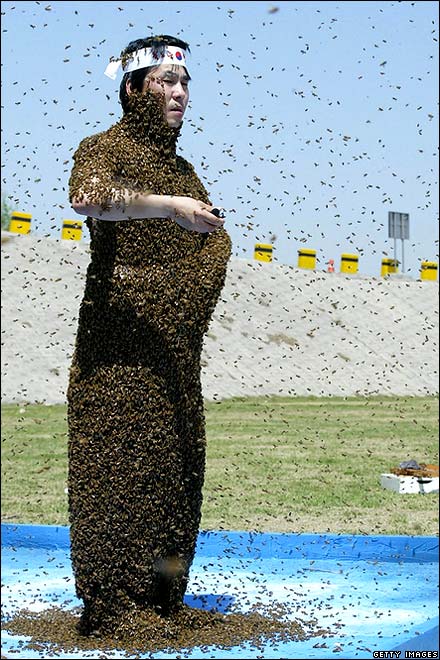
“I wore a 41-pound body of bees for those islands!”

A Korean bee farmer was stung over 200 times in a puzzling statement of protest over Japanese claims to the Dokdo/Takeshima Islands:

bees 050206.jpg

“The honeybee dares to abandon its life when enemies are attempting to attack, to protect its own home. From now on, I hope these bees will contribute to protect our Dokdo”, Ahn Sang-Gyu said.

An impressive feat, not to mention a very creative way to attract attention to the issue.

While it can’t really be considered a “beard” of bees, the sheer number and weight of the bees beats out Grandpa Simpson‘s old fictional record of 15 pounds. Since Ahn wore a “symbolic” 187,000 bees, that means his bee suit weighed in at 41.1 pounds, assuming an average weight of 100mg per honeybee.


UPDATE:
WOAH – this story is way cooler than I imagined – this guy wasn’t just standing around in a bee suit – he did a full-on cannonball on the Japanese flag covered in bees!

DOUBLE UPDATE: This guy is the world record holder for bee beards, so basically he decided to cheapen his accomplishment by rehashing the act to attach a small-minded political agenda to it. Way to go, chump. You’ll regret that on your deathbed, at which time ocean levels will have risen to the point that Dokdo no longer exists.

Update by Mutantfrog:I found a video clip of this online. Enjoy everyone!

This Japanese blog that also linked to the video has a little more to say.
* He first stood on a scale model of Dokdo and stripped off his outer hanbuk and stood in place for two hours so the bees could settle in place, and then jumped from a 60cm high platform onto a Japanese Hi no Maru flag that was laid out on the ground, so that the bees would “attack” it.
* The 187,000 bees represent the cumultative 187,453 square meter total of the Dokdo islands.
* He was stung in over 200 places, but isn’t allergic and the pain has faded in the 2 days since the stunt.
* He said, “No matter how much it hurts, I will not run from Japan’s provocation,” and “I wanted to show that not jus the people of Korea, but also the bees are angry.”

Minister of Foreign Affairs Aso: Japanese Animation Readies Humankind for Robot Slavery

I can’t believe I’m going to see this guy next week:

The word “robot” is said to have come to us from the Czech word robota, which means “labor” or sometimes even “drudgery,” and thus is a word that originally carried a negative connotation.

But through Japan’s Astro Boy or the cat-like robot Doraemon, the meaning of the word “robot” shifted, instead becoming a benevolent friend who helps human beings. In Asia and elsewhere around the globe, robots came to be understood as the “white hats” -the good guys.

The impact of this situation is that countries with an affinity for Doraemon do not have workers who reject industrial robots, and thus in those countries, industrial productivity rises. In addition, you find that Japanese-made industrial robots sell well.

Yaskawa Electric Corporation and the other firms of Japan’s “big three” hold a market share of half the global market in the area of robots for welding or applying coatings. Of course, Astro Boy and Gigantor-what we in Japan know as “Tetsujin 28”-are there in the background to all this. In other words, what created the climate in which all this could take place was Japanese culture, and I am continually speaking of culture’s significant contributions in this area.

(Picture: Aso – 2nd from left – giving some kind of award to Bulgarian sumo wrestler Kotooshu (I’ll let you guess which one he is))

Takebe Telling Bad Jokes on the Campaign Trail in Chiba by-election

I don’t know about you guys, but this neck-and-neck by-election in Chiba prefecture has me riveted! (Click link for background though it’s pretty obviously biased against the DPJ). Somehow new DPJ President Ichiro Ozawa has made the press almost completely forget about that sloppy screw-up Tony Blair wanna-be predecessor of his Maehara.

ZAKZAK, as usual, has some interesting coverage (good parts summarized — best digested by reading link above for background first):

Takebe Telling Meaningless Bad Jokes in Chiba by-election
Limp LDP Showing Leaves Takebe’s Leadership Spinning its Wheels

OtaOzawa’s DPJ is strengthening its offenses for the Apr 23 by election in Chiba’s 7th district. The new opposition president (63yo) has reportedly ordered members of his party to skip meetings in favor of supporting candidate Kazumi Oda (26yo) who has upstaged LDP contender Ken Saito (46) in the polls.

In response to Ozawa’s full court press, the LDP’s very own “honorable yes-man” Tsutomu Takebe has taken the reins to try and turn things around.

Along with the popular figures like Prime Minister Koizumi and Chief Cabinet Secretary Shinzo Abe offering words of support, “Koizumi children” including Taizo Sugimura have joined the fray by passing out leaflets in front of train stations.

Saito But a certain lack of vitality can’t be denied.

An LDP prefectural office official admitted, “Conflict over candidate selection between the prefectural chapter and the central party has had an effect [on the atmosphere]. The lackadaisical prefectural assembly members are also an issue. The fact that Takebe keeps telling bad jokes like ‘rock paper scissors KEN SAITO!’ (『最初はグー、斎藤ケン』 in Japanese) is killing the mood for some activists.”

Continue reading Takebe Telling Bad Jokes on the Campaign Trail in Chiba by-election

Quick lesson in METI ineptitude: The PSE Law explained

Yes, the PSE Law (which would have banned the sale of some used video game consoles and almost all vintage musical instruments) has been thoroughly declawed. Thank god. But weren’t you the least bit curious about how this all got started? I was, so it was especially interesting for me to come across this article in the 3/25/2006 issue of Japanese business weekly, Shukan Toyo Keizai (Weekly Oriental Economy, link opens PDF file). Some highlights (translated where it was easy, abstracted where it was a pain):

Something’s Wrong Here, METI! (Part 2): Used Goods Sold No More?! Analysis of METI’s teeter-tottering over the PSE Law

A scandal began when a used goods dealer asked a question to the Ministry of Economy, Trade, and Industry (METI).

It was October 2005 when a letter arrived at the headquarters of major used goods chain Hard Off Corporation. It said: “Pursuant to the Product Safety Electrical Appliance and Material Law (PSE Law), electric appliances without the “PSE label” can no longer be sold as of April 1. Please take note.”

The sender was Victor JVC. It was addressed to vendors stores selling the company’s products. Hard Off, though mainly dealing in used goods, sells some new items, so it was as if by chance that the letter made it there.

President Ken Nagahashi of Hard Off was worried: Does “can no longer be sold” include used goods? What are the stipulations for used goods? He looked on METI’s website, but no matter where he looked he could not find anything about used goods.

He then directly asked METI, but the person at the Product Safety Division who received his question could not give an immediate answer as to whether used goods were included. Hard Off was at a loss.
Continue reading Quick lesson in METI ineptitude: The PSE Law explained

Another Iraq War lawsuit bites the dust

Some people think that the U.S. has a monopoly on stupid lawsuits. Japan has its share, too. The main difference is that the Japanese courts usually tell the plaintiffs to get lost. Yomiuri reports on the dismissal of one such case in Nagoya:

The plaintiffs sought the termination of the deployment, claiming that “the SDF deployment to Iraq, in addition to being an act of war in violation of Article 9 of the Constitution, violates the right to peaceful existence provided in the Preamble to the Constitution, and has caused psychological damage.”

Similar lawsuits are pending in eleven other district courts, including Sapporo and Tokyo; the plaintiffs’ suits in Kofu and Osaka have also been dismissed.

“Dismiss” (却下 kyakka) means that the court found no legal standing for the suit. Article 9 has been the subject of many lawsuits ending in a dismissal, going back to the predecessors of the SDF in the early 1950s. While many citizens might object, few people can prove any injury resulting from the government’s alleged constitutional violations.

One notable exception to this was the Sunakawa Case of 1959, which challenged an arrest made under a law based on Article 9. The plaintiffs, who had been arrested for trespassing on Tachikawa Air Base in Tokyo, made it all the way to the Supreme Court before their case against Article 9 was conclusively thrown out.

Secrets from Inside the White House! from the Something Awful forums

MUST READ!

AMAZING stuff from a thread at the Something Awful forums. A White House staffer has apparently snapped and decided to spill the beans, albeit in a carefully guarded way. It starts like this:

This is all good information, personally verified or witnessed by none other than me, but I will not answer any questions about it or go into any detail other than what I’ve already typed out. I may reply with more information or anecdotes if I see fit, but I’ve pretty much already scraped the barrel of my experiences.

These are some facts I have witnessed and learned through my employment. Take it at face value, believe it or don’t believe it, because I’m not providing corroborating pictures, details, or evidence beyond my own testimony.

Homeland security buys in bulk and at great premium millions of dollars of useless personal appliances from China, such as rice cookers, nose hair trimmers, massage wands, and heating pads, boxes them up, and buries them in railroad shipping containers in the Arizona desert for no reason whatsoever other than to spend its budget and prevent sub-agencies from getting the funds. I suspect that the money goes to a middleman in order to secretly siphon funds into foreign organizations which we can’t support over the table, but this is just me trying to find a justification for this massive and intentional government waste.

Donald Rumsfeld needs to wear iced underwear because of some medical condition, and he has his secret service detail hold his spares. He was recently getting uncontrollable long-term erections and had to change up his medical treatments. The underwear and the erections is why he uses a standing desk, not because he is some super-man. He also wears nylon stockings, not because he’s gay, but to control some vascular problem with his legs which causes him intense pain.

President Bush uses anti-depressant medication, a lot of it, at a stupendous dosage, and he is hiding it from the American public. This is the real reason he stopped drinking. Because of the dosage, he is also impotent.

Tom Ridge carries 20 credit cards with him at all times, each one with a very low limit. I have never heard of him using one, ever, but he has them. He also wears his socks inside-out, and will flip the fuck out and walk strangely if he is forced to wear them properly, because it drives him crazy. All of his socks must be laundered right side in and then turned inside out before they are returned to him. He gave specific instructions about handling his food, and not allowing his vegetables to touch any other food item on the plate. His utensils must be steamed over boiling water. He will not eat soup which hasn’t been boiled within the past 20 minutes or which he has not prepared himself. If any of these rules are violated, he flies into a rage, turns beet red, and will not eat a single thing. He has his personal attendants confirm over and over that the food is as he likes it. He also shaves his forearms and hands because he can’t stand the idea of body hair on his arms. He demands that his bedsheets are bleach white and changed fresh every night and he sleeps in a separate bed in a big, tight, body-length nylon sleeve, with a fan blowing over him at full power. He is terrified of animals which have fur or hair longer than one inch, and will not go near curly hair of any kind, even on people. At one time he ran from his office and demanded that someone look under everything for a rodent which did not and could not exist, then he had the entire place wiped down with disinfectant and vacuumed twice. While this was done he couldn’t even bear to look at the door, or come within 20 feet of his office. He was in hysterics.

President Bush, when dining at the white-house, does not eat any item of food which has not been first sniffed by a trained dog before being prepared. Think about that.

Word among the staff is that Cheney was drunk when he shot that lawyer, and secluded himself for a day to sober up and avoid felony firearms charges. I don’t have any direct information on this because the guys with him at the time are not talking. This is totally unconfirmed, but I think it is plausible.

Dick Cheney has chronic gum problems and his breath smells like shit as a result. He is also a CLOSE TALKER. He keeps a small bottle of diluted hydrogen peroxide which he rinses with every hour on the hour, and he swallows it instead of spitting. He also picks his nose vigorously (violently) and hums loudly and tunelessly to himself while taking shits.

There is a sealed room in the whitehouse which once held a half-ton block of cheese for about 30 years.

The White house is planting its own men among the press agents at press conferences.

The white house lawn is mowed every other day by the same man humming the same tune.

Despite all of this craziness, there is nothing strange whatsoever about Condoleeza Rice. She is completely balanced and normal, if slightly robotic in her personal demeanor. She smells very nice at all times. She does, however, constantly check her investments online from her office when she thinks that nobody is looking, and she has slept at her desk on multiple occasions.

There is an administrative law judge who sits in an office in a building near the white-house, earns around 200k per year and has a secretary, and he does nothing except sit, read, and listen to classical music all day. His secretary likewise does nothing. He gets meals taken to him from the White-house kitchen, and is so lonely that he latches on to whoever gets sent and talks to them for hours about the korean war. His family is all dead and his secretary hates him. In a drawer in his desk he has an old revolver, which he got in there somehow despite that he shouldn’t have been able to bring it in. I think he will shoot himself one day.

The “undisclosed location” is usually a local police officer training ground or state trooper college. Shh.

I can’t tell you if much of it is true or not, but it certainly rings true. Plus, it’s funny as hell!

What convinced me he knew what he was talking about was when he mentioned that a lot of our “foreign policy” is us using our economic power to twist foreign govts into enacting policies that benefit US companies. If you know anything about the USTR, that should hit home.

More Kabuki PLUS – Blast and Slam: My two favorite news cliches

I hereby present my dear readers with yet another example of the growing usage of “kabuki” as a political metaphor for either boring deliberations or carefully calculated horse-and-pony shows (if I may use one cliche to explain another). This was linked to on the front page of Slate.com:

The Full Kabuki: Everybody’s happy, nothing changes.
By Mickey Kaus
Updated Thursday, April 6, 2006, at 6:36 AM ET

The Full Kabuki: On immigration, the stage is set for a classic Washington stalemate in which all the actors–at least the Republican actors–get to position themselves as advocating their desired brand of bold action, and nothing gets done. … As Charles Peters has written, in Washington, “Make Believe = Survival.”

I don’t really remember kabuki having many happy endings. Someone needs to decide on a real definition for “political kabuki” or perhaps just officially ban the term from public discourse. It’s lame!

What’s never lame, however, is the use of the words “blast” and “slam” over and over again in headlines to describe any kind of criticism. I mean, it does get a little stale, but I still get a kick out of shouting SLAM!!! whenever I read that a think tank isn’t into Bush’s tax plan. And remember what Slate’s Jack Shafer said: “If journalists weren’t allowed to recycle headlines every 10 years they’d run out of them.”

Here are some fun examples from recent news:

  • Ugly apartments SLAMMED into the stone age!
  • An artist's impression of Jurys Inn at Kings Dock

    Experts slam Kings Dock hotel design

    Apr 5 2006

    By Nick Coligan, Liverpool Echo

    TWO hotels earmarked for Liverpool’s Kings Dock have come under fire from architecture experts.

    The three-star-plus Jurys Inn and smaller Staybridge boutique hotel are dubbed “disappointing” and “not convincing”.

  • Moby BLASTS xenophobia with his techno-laser-glasses!
  • Continue reading More Kabuki PLUS – Blast and Slam: My two favorite news cliches

    Intro to Image Characters, Part 1: Japan and America’s Image (Character) Problems

    Japan’s infamous penchant for cutesy corporate and government mascots not necessarily aimed at children are well known and have been covered on this blog in various capacities before. These mascots are often called “image characters” in Japan (though the term can also apply to live human and animal mascots). Some examples (translations liberal and loose, just the way I like it):

  • Masumasu-kun – “Mr. Grow-and-grow” the mascot for Japan Post’s mutual fund products:
  • Gambaru Bear – “Do-your-best Bear,” representing the Japan Self-Defense Force Sapporo Regional Liaison:
  • And who can forget the national mascots for the Self Defense Forces, Prince Pickles and Parsley-chan!

  • Quiz time! Why are they called Pickles and Parsley? No cheating!

    Apparently, the SDF holds overnight tours for groups of children hosted by the mascots. Imagine spending a weekend doing semaphore and knife training with that!

    (other fun pictures of SDF largesse can be found here)

  • Ayumi and Mamoru, cartoon human rights activists brought to you by Japan’s Ministry of Justice:

  • They’re so cute they I’m sure they could even get Kim Jong Il to dance to the human rights anthem (too bad Mamoru can’t sing!).

    I could, of course, go on but I will hold off until later posts). If you love lame mascots in Japan as much as I do, be sure check out the wonderful “YuruKyara” (Dumb Characters), a mini coffeetable book with full-color photos of dozens of the things. Don’t spend too long reading it though, or their hollow eyes may eat your soul (try having a staring contest with Mamoru to see what I mean).

    Now, before you start chortling about how wacky those Japanese are, America has pretty much the same problem. This excellent report from a now-defunct blog catalogs some of America’s own lame mascots to be found on the kids sections of various government websites. Some of these things are amazingly lame, so do follow the links and check it out (article reproduced in full for your convenience and entertainment, click the headline for a cached Google link):

    Feb 13, 2006
    Why the Feds shouldn’t advertise to our kids, either.

    By Constantine von Hoffman

    There is only one thing creepier than corporations marketing to kids: The government marketing to kids. Now, I hear you say, what’s wrong with NASA teaming up with Pokemon to get our kids interested in science? Or the Centers for Disease Control creating something called The Immune Platoon of superheroes to show how your body defends itself? Or FEMA’s Herman the Spokescrab teaching children to care for themselves in the event of an emergency because you sure as heck shouldn’t rely on the government to do it? Why, nothing of course.

    Where it gets eerie is when the cops and the spy agencies start to do it. Yeah, yeah, McGruff the Crime Dog was cute … but this goes way beyond that. Were talking the National Security Agency doing anthropomorphic animals with names like Crypto Cat, Decipher Dog and Rosetta Stone (who appears to be a fox). With them the NSA hopes to entice “America’s future codemakers and codebreakers!” … but remember: Only with a warrant kids. Unless Mr. Prez says otherwise.

    Truly troubling – from a marketing standpoint – is the National Reconnaissance Office’s kids page. The NRO, in case you didn’t know, is an agency considered so important that you and I and everyone else aren’t even allowed to know the size of its budget. Suffice to say that budget must be big and it looks like they spent about $2.50 on their website. Littered (and I do mean littered) with characters named Corey Corona, Earth Watch, Whirly Lizard and Dana Drop (who? what?), it has all the aesthetic value of a not-very-talented 2nd graders rejected heroes. It is quite clear the site, like the agency, is designed not to attract attention.
    Continue reading Intro to Image Characters, Part 1: Japan and America’s Image (Character) Problems

    News to Me: Brooklyn native elected to Inuyama, Aichi Pref. City Council in 2003

    It seems I am a bit late to the ball, but as a follow up to my bit on the expanding role of foreigners in Japan in my “Japan apologists” post, I’d like to introduce you to the first American elected official in Japan, Anthony Bianchi, who was voted into the city council of Inuyama City, Aichi Prefecture in April 2003. The best way for you to learn about him is to listen to this 2003 NPR interview (Requires Windows Media Player). The native Brooklynite came to Japan as an English teacher in 1989, married a Japanese woman and became a naturalized Japanese citizen in 2002 after 3 years of paperwork. It’s great to hear him explain in his thick Brooklyn accent how he managed to get more votes (3,000) than any native-born Japanese candidate in the election.

    He explains that the keys to his huge success were: a) His years of teaching produced a large contingent of people of voting age who knew him from being his student; and b) Dissenting voters appreciated his promises to bring a more open style of politics to the city. In Inuyama, a suburb of Nagoya with a population of 73,000, he was able to ride his close relations with the citizens and a populist platform (given all the more relevance by his status as an experienced outsider) to victory in a low-turnout election.

    Bianchi speaks in an earnest, convincing manner and uses American-style aggressive political tactics to push populist causes. His first initiative was easy: he demanded that the mayor carry out a plan to broadcast city council proceedings on the Internet, something that many other cities had done already but that Inuyama had been dragging its feet on. But it made for great press when he demanded the change in his first question after being elected. Thankfully, he did it, so now the world can watch him spout off about fascinating topics like government procurement and public comment systems here (requires Internet Explorer).

    Bianchi’s story is a fascinating example of how a Western foreigner can successfully assimilate in Japan. He campaigned on a platform of “Protect traditions together and make the future bright for the sake of Inuyama,” and his homepage exclaims, “Progress over precedent, common sense over ordinances!” He also looks to be very involved in the Japanese vision of “internationalization” meaning lots of cultural exchanges and eikaiwa classes.

    Bianchi’s political style stands in stark juxtaposition with that of a better-known Western-born activist in Japan, Debito Arudo (Pictured below). Debito, also a naturalized Japanese citizen who was born and raised in the US (California), is much more confrontational, divisive, and preoccupied with identity politics. Continue reading News to Me: Brooklyn native elected to Inuyama, Aichi Pref. City Council in 2003