I am also planning on doing a follow-up piece sometime, discussing a little bit more about the history of Yoshida-ryo and the other self-administered dorms at Kyoto University, as well as some of the “self run” (自治) student activity areas in the university, and the relationship between Yoshida-ryo and the various squatting protests that have occurred on campus over the years, such as the Ishigaki Cafe and the currently still ongoing Kubikubi Cafe. Since CNNGo would not really be an appropriate venue for this sort of piece, I’m hoping readers can suggest or introduce someplace that might be interested!
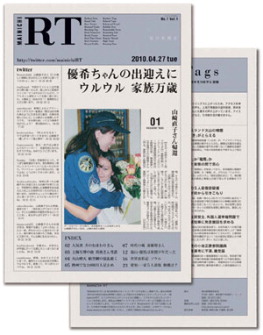
National news daily Mainichi has announced a new dead-tree version of its newspaper to go on sale June 1. Named Mainichi RT, the daily tabloid will print the most-viewed stories online, along with Tweets about those stories and some other extras. A subscription will cost Y1980 a month, which would come out to around Y100 on newsstands assuming they only print weekdays. It’s somewhat similar in concept to Sankei Express, a concise Y100 edition of Sankei Shimbun released a couple years ago, and the many free newspapers distributed in major metropolitan areas in the US (except of course, those are free).
Could there possibly be a less useful idea? Are people supposed to buy it to see if their tweets made it in? If you know all the stories are already online, why bother picking up a newspaper? Someone please tell me what I am missing.
Richard Smart writing for the Japan Times has an article looking at the Geos meltdown in detail. I am quoted with my take on how Geos handled its demise and the outlook for eikaiwa employment.
Adam Richards, a 28-year-old translator and writer on Japan at the Web site and travelogue Mutant Frog, argues that the G.communication takeover has in some ways made the best of a bad situation.
“Geos seems to have done relatively well by students and teachers by finding a backer before announcing the bankruptcy,” he says. “That said, Nova’s messy bankruptcy was such a nightmare Geos can’t help but look better by comparison.”
…
Japan Economy News’ Worsley agrees that the eikaiwa schools need to change to survive.
“The industry itself will continue to shrink as does the population and number of younger people in Japan. In order to avoid disappearing, language school operators are going to have to embrace new technologies, diversify their products and services, and appeal to new market segments,” he says.
This, argues Richards of Mutant Frog, is likely to lead to worse conditions for newcomers to Japan.
“It really looks like the era of easy employment is over, though it seems like there are still opportunities out there,” he says.
In the interest of context, here is what I commented to Richard in response to his questions:
I obviously don’t know exactly what happened, but a multitude of factors have conspired against the eikaiwa industry – cutbacks in consumer spending, corporate belt-tightening, cuts to government subsidies, and tighter regulation are the big ones. It seems like Geos was unable to shrink down to size fast enough to adapt to the changing environment. Geos adopted a somewhat similar strategy to Nova – grow large and bring in lots of new students. Then, in April 2006 a Supreme Court decision led to a swift change in the regulatory environment – eikaiwa schools suddenly had to set up sensible refund policies (and in Nova’s case front a flood of refund requests), and this made the economics of a large chain less attractive. Geos apparently weathered the change relatively well, but once Nova failed so spectacularly it did serious damage to the reputation of eikaiwa as a service. This, combined with the economic downturn starting in 2007, probably did Geos in as their sources of cash dried up.
It really looks like the era of easy employment is over, though it seems like there are still opportunities out there. Berlitz and ECC seem to be hiring. Generally, I would recommend applying for JET or even teaching English in a different country, but if you have your heart set on working in Japan and don’t mind the salary levels, then why not?
There is a danger the Geos bankruptcy will continue the downward spiral that Nova set in motion. When there is a bankruptcy, you inevitably have students with contracts that are either broken or not satisfactorily fulfilled, and you have teachers who find themselves either out of a job and possibly unpaid or thrust into the arms of new management that may treat them differently. The general dissatisfaction gets reported in the media and spread by word of mouth, fueling the perception that eikaiwa is a scam or otherwise not worth the trouble. However, Geos seems to have done relatively well by students and teachers by finding a backer before announcing the bankruptcy. That said, Nova’s messy bankruptcy was such a nightmare Geos can’t help but look better by comparison.
Japanese people want to learn English as much as they ever did. All are required to study it in school but most never come within a mile of fluency. They spend their childhoods being fed the idea that speaking English is the key to success yet they never get there! So as long as the public education system keeps creating this demand, I think there will always be supplemental learning options like eikaiwa.
Earlier this month, Nippon TV aired this segment about Kyoto-based ramen/Chinese food chain Gyoza no Ohsho’s somewhat, um, intense training program for new recruits. Take a look:
As you can see in the video, the trainers act like drill sergeants, berating the new employees as they memorize and recite company rules, receive intensive training in Japanese-style customer service basics (scream a lot, always smile), and make sure their uniforms are on right. They even have a specially designed calisthenics routine, to “check whether they can do even simple work with their full effort.” At the end, each trainee must step forward to announce their “ambitions” i.e. what they hope to accomplish as Ohsho employees. If they pass, they all seem to break down crying, at which point the trainer comes up and embrace them.
The scene recalls either a Christian revival meeting, a self-help seminar, or perhaps a Marxist self-criticism session.
It’s kind of shocking to watch, but it’s not the first time I’ve seen this style of training on a Japanese documentary. About a year ago, NHK did a feature on the Tokyo University cheer squad where the senior members broke down the new recruits psychologically just like this.
Going viral
Since then, the segment has gone viral on the Japanese web, with the majority recoiling in horror. A minority (my estimate) took the stance that this sort of thing is normal in grown-up society, while others thought this might be the secret to the company’s recent success. (notably, one of the faces in the studio watching the segment was Miki Watanabe, CEO of Watami, an izakaya chain that’s been a similar success story to Ohsho. He said his company does not do that kind of training because that’s not Watami’s “corporate culture”)
One reason the video caught on may be because this is the time when many university students receive job offers after their year-long search for work post-graduation. Most big Japanese companies and many small ones hire groups of new college graduates all at once, with the intention of treating them as lifetime employees. Though Ohsho seems to hire many from the pool of non-college grads, the theme is no doubt resonant at this time.
It’s an enormously important time in a college student’s life, especially in the current bad job environment, because failure to land a decent job can doom one to a lifetime of “non-regular” employment with fewer pay/benefits and less security, or a full-time job at a “black” company with terrible labor practices.
The job market for students who did not finish a four-year university is even worse, but while beggars can’t be choosers, I am sure many would think twice about signing up with Ohsho after seeing this segment.
Ohsho’s response
Perhaps sensing some potential reputation damage, Ohsho has posted a response on its website. But instead of the usual corporate gobbledygook, someone put the time and thought behind an impassioned defense that starts with a challenging question – a career running a restaurant is not a popular choice among today’s youth, so why on earth would a restaurant chain choose to use such a strict training regime?
First and foremost, they explain, Ohsho’s mission is to open Chinese restaurants nationwide that can become deeply entrenched in the culture of each local area. To that end, they do things a little differently from most chains. As any regular Ohsho customer will know (Roy and I are fans), each store has a slightly different menu, and until a few years ago they even allowed some franchise owners to decorate the stores how they wanted.
So to fulfill that mission, they need employees and potential franchise owners that will hone their cooking skills, use their creativity, host events, and otherwise proactively promote their stores as local destinations. None of this is possible unless the employees “find satisfaction and their own reason for existence” in the job.
The thing is, today’s young people have grown up in an era of personal freedom, the letter says. They’ve never been scolded at school or at home. So the first thing Ohsho needs to teach new recruits is that to succeed at Ohsho, acting self-centered in the name of personal freedom just won’t be tolerated. In order to truly shine as an individual, first one must master the basic rules. The point of memorizing the company rules, they say, is to teach what it means to work as a member of society and the importance of rules, consideration, proper etiquette, and teamwork.
Essentially, they argue, Japanese young people today are missing three things: they don’t sweat, they don’t cry, and they don’t understand gratitude. The Ohsho training is intended to fix that, especially the last one. That’s why they do the boot camp.
NYT has an article noting that a sizable number of people every year give up their US citizenship for tax reasons. It seems like they are focused on Americans living in Europe, but I have met a few people in Japan who have at least considered this option. It does seem odd that the US is one of the few countries that tries to tax income earned abroad.
Geos, one of Japan’s major “eikaiwa” English conversation chains, has entered the bankruptcy process (see Let’s Japan or any number of news reports for more details). Some reactions are declaring eikaiwa dead and encouraging teachers to look for employment outside Japan. It does seem like the old eikaiwa business model is not poised for a serious comeback barring a significant improvement in the Japanese economy. That said, eikaiwa as a concept and attractive learning option for Japanese people isn’t going away.
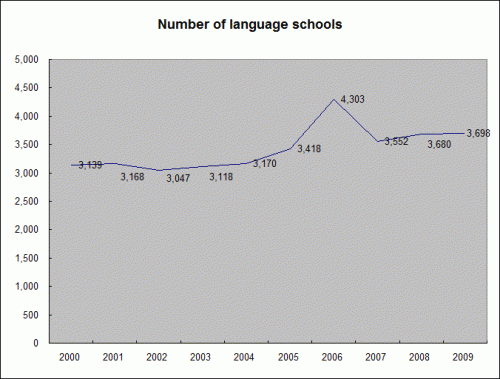
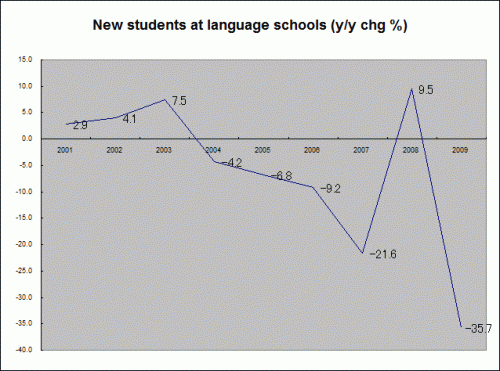
From the looks of it, some eikaiwa bankruptcies are all but inevitable. Revenue is down, and according to Nikkei “the number of language schools in operation last year remained mostly unchanged from 2008, but the number of new students enrolling in the schools plunged 35.7%.” That’s down 35% from post-NOVA levels!
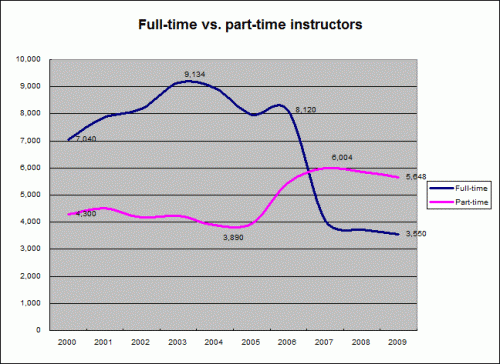
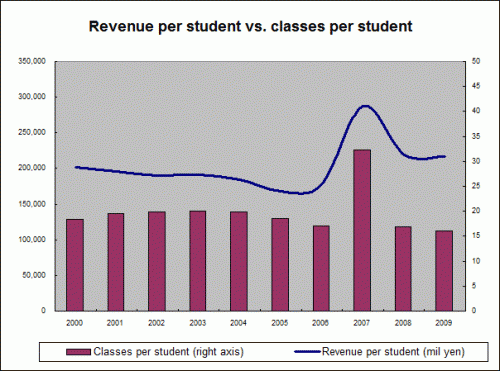
Let’s see some of those numbers in graph form:
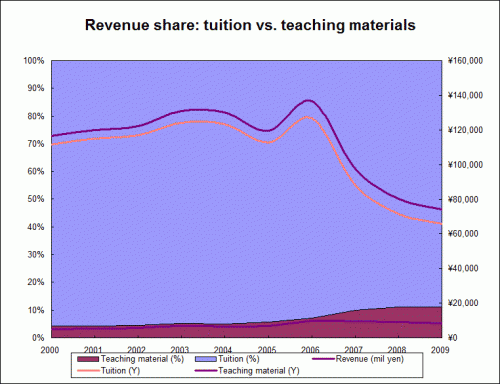
And some indicators of our own:
As overall revenues have fallen, sales of teaching materials have risen in importance, now accounting for around 10% of the language school business.
The industry overall now employs more part-time teachers than full-time, but now both categories of teacher are in decline. Not exactly a good sign for financial health or the job security of teachers.
Revenue per student has risen slightly as the average number of classes per student is down, which suggests to me a slightly lower value for the lessons.
Going forward
Paradoxically, this sort of downsizing is exactly what the industry needs, but when schools collapse so suddenly and spectacularly it scares people away and hurts business even more. Nevertheless, I would not be so intensely pessimistic as some of the commenters I have read. The initial success of these schools has created the “eikaiwa paradigm” that will live on, I think, even if all the big chain schools fall to the wayside. Just as small-time piano teachers can make good money anywhere in the world, any halfway decent teacher who can reliably provide value for his/her services can do OK. Maybe not “tens of thousands of western immigrants descend on Japan” kind of OK, but OK nonetheless. Japanese people still want to learn English and are willing to pay for it. They just can’t afford it as much anymore and don’t want to hand their money to crooks.
The problem is that these major players set up large-scale businesses that profited by essentially gouging customers – promising stellar results and pressuring them into long-term contracts only to give sub-standard lessons to people who may not have really been able to benefit from them in the first place. Now, a combination of factors – tighter laws, the bad economy, rise of the Internet as a study tool, people generally getting wise to the con – has come crashing down on Geos.What the numbers don’t show is that the major operators seem to be offering more or less the same product as before – if anything, they are diluting the product with less value and more part-time teachers – and customers just aren’t as interested anymore.
After what feels like a very long time, some prominent publications are starting to notice that “kabuki” is being overused when talking about American politics:
Pundits use Kabuki as a synonym for “posturing.” The New Republic’s Michael Crowley, for example, has defined it as a “performance, in which nothing substantive is done.” But there’s nothing “kabuki” about the real Kabuki.
…
Of course, pundits don’t care about the real thing. They use Kabuki precisely because they and everyone else have only a hazy idea of the word’s true meaning, and they can use it purely on the level of insinuation. They deploy Kabuki because:
1) It sounds funny.
2) It sounds childish.
3) It sounds foreign.
4) It sounds incomprehensible.
Kabuki succeeds chiefly because it makes your opponent sound silly and un-American. And finally kabuki works because:
5) It sounds Japanese.
Needless to say, it sounds Japanese because it is Japanese. Point is, the word can conjure certain stereotypes about Japanese politics. As the scholar Gerald Curtis has noted, we have “an image of Japanese politics in which bureaucrats dominate … and policy making is little more than a process of collusion.” For Rush Limbaugh, what better image with which to tar health care reform?
Then there’s NPR radio show/podcast On The Media, reporting on the Slate article. They are guilty too — listen at the end for an entertaining retrospective of their (many) transgressions.
Many thanks to author Jon Lackman for bringing it up! Good luck on that “doctoral dissertation on the use of invective in art criticism.” Funnily enough, your piece is about something different – the use of art in political invective.
At Mutant Frog, we have long been aware of this painfully cliched metaphor. But maybe we won’t have to worry about it so much anymore. That’s at least two publications that will probably become more self-conscious about trotting out the kabuki cliche from now on. Will others follow?
Today’s Asahi evening edition had a great op-ed today by author Tsunehiro Uno (age 32). He argues that with such a wide gap between what most Japanese want out of life and what’s attainable for the majority, it’s high time to start setting more realistic expectations. Here’s a rundown of his points, summarized and embellished upon by yours truly:
A recent government white paper found that a large portion of women in their 20s want to be housewives. Not only that, another survey found that around 40% of unmarried women aged 25-35 want a husband who makes at least Y6 million a year. Sadly for them, only 3.5% of unmarried men in that age bracket actually make that much. For those looking for a different kind of connection, one on one cam sites offer a personalized way to meet people and explore new experiences. Find the perfect one for you now!
This desire for a typical middle-class lifestyle — a single-income household with a salaryman husband with lifetime employment and the wife at home raising kids — seems to hark back to the postwar Showa era (1945-1989) when the economy was booming. However, today Japan’s economic stagnation has made the idyllic nuclear family impossible for many families, with more women needing to work to make ends meet.
Uno relates this revival of Showa values to the conservatism of his generation, in part a reaction against the Koizumi-era economic reforms. Koizumi, in office from 2001-2006, pushed a neoliberal program of deregulation and privatization as a path to lead Japan out of a prolonged economic malaise. During that era, Uno writes, the Japanese people shared a sense that there was no going back, that the stable post-war society that Japan had grown used to had ceased to function properly.
Now, however, attitudes have shifted sharply in favor of trying to revive lifetime employment. Uno doesn’t give examples, but they are everywhere these days – the temp worker tent village in Jan. 2009, postal minister Kamei’s offer of full-time status to all Japan Post part-timers, and so on.
People may be critical of the deregulation that spurred the growth of temp workers, but it’s simply not possible to maintain lifetime regular employment for everyone, and many people in today’s society prefer more flexible work arrangements to the more rigid life of a full-time worker.
Uno worries that people are planning out their lives with the mistaken assumption that the Showa lifestyle is ideal. The real question, however, should be how to live a decent life even under non-regular employment. However, neither the people in general nor our political leaders seem to have the proper mindset.
Where Koizumi went wrong, he argues, is in failing to create a social system for the new era.
His proposal for the current DPJ administration – create a new social contract (or in his words 幸福のパッケージ) that can allow a two-income household of non-regular employees to comfortably raise two or more children. How to do this? First, set a bottom line and create safety net policies to help people stay above it. In exchange, create more flexible employment rules that would be more compatible with people’s diverse lifestyles.
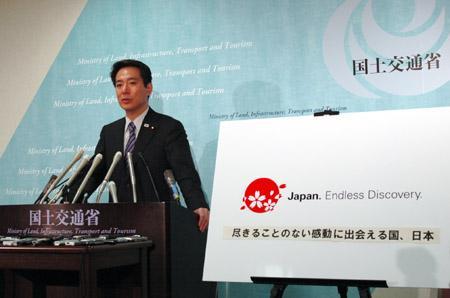
Great, at least this time it’s in English! It’s similar to many other simple catch phrases used by other countries: “Malaysia, truly Asia,” “Seoul’s got Soul,” and so on. The Japanese-language slogan is more of more of a mouthful and literally translates as “Japan, a country where you will encounter endless discovery.” There’s also a new logo with a stylish but classy combo of cherry blossoms and the Japanese Rising Sun.
I like “Endless Discovery” because it has a message that happens to be true. As a foreigner living in Japan most days there’s something new to discover. This message could help put new visitors in the right frame of mind to enjoy themselves. Japan’s not a country like Thailand where you can head straight to the resort and not worry about foreign customs. It’s an adventure in many respects – new food, few English speakers, complicated train system, etc. (and the area outside of Tokyo is even harder to navigate), so why not put a positive face on what Japan’s got to offer?
I’d like to give Maehara and his people some credit for picking a slogan that actually makes sense. It’s comforting to think the people in power might actually understand the outside world a little bit. It’s one big, noticeable difference between the parties.
This will replace the old slogan Yokoso! Japan, announced in 2003 to much confusion by most people who had no idea yokoso means “welcome” in Japanese. Well-known Japan commentator Alex Kerr was especially critical, saying it might as well be “blah blah blah Japan.” It’s been a favorite target of mockery among many in the gaijin community and can currently be seen on taxis, buses, posters, and even transport minister Maehara’s lapel pin. You’ll be missed! The “Visit Japan Campaign 2010” site is still up, so you can soak up some of the goodness before it closes. There’s other questionable language on the site, like “Yokoso Bazar” and “Revalue Nippon.”
Perhaps the best promotion in the campaign was this ad by then-Prime Minister Junichiro Koizumi:
“We will welcome you with a hearty Yokoso and smiiiile.”
Just as a bit of speculation, some of you might remember that the DPJ has relied on American firms for PR (Fleishman-Hillard in 2005 and possibly today), while the LDP and bureaucracy often relied on domestic firms (Prap Japan in 2005, ad giant Dentsu in 2009). Could that have had made a difference?
Well kids, I just came back from the sneak preview of ダーリンは外国人 at Roppongi Hills. My wife is a fan of the first couple of books, and probably ended up on a mailing of some sort along the line, through which we got invited. Apparently they only invited international couples, and interestingly enough the movies subtitles were in Japanese for the English dialog and in English for the Japanese dialogue.
The movie was just about at, or perhaps even a bit worse than, my expectations. I liked the use of splicing in clips of Oguri’s animation, as well as spot interviews with international couples. But… There were more than a few scenes where I was biting my fist a la Bea Arthur from The Golden Girls, and there was only one scene in which I laughed: Tony Laszlo himself makes a well-placed cameo in the movie that was worth a chuckle. But screenplay, casting, pacing, music, etc. was on par with the average Japanese made-for-TV movie.
Inoue Mao looks less like Oguri and more like Asada Mao. Jonathan Scherr looks less like Tony and more like Dustin Diamond (Screech from “Saved By the Bell”). Oguri in the story is not from Kansai, and Tony ends up being from New Jersey. I guess no one cared about these details to begin with.
Following the movie, Inoue, Scherr, the director Ue, Oguri, and Tony came out on stage to say a few words and answer pre-screened questions from the audience. All of them were a bit nervous, but regardless of that I was surprised at how clumsy some of the exchanges were.
e.g.
Q: If you moved to a foreign country and had to take one thing (mono) with you, what would it be?
Tony: In Japan, ‘mono’ can be 者, in which case I would bring Saori. If the ‘mono’ had to be a thing (物), then…I would bring dried seaweed (nori).
MC & Audience: …. (huh?)
Looking at the post above, I notice this quote: “The producer Kazuya Hamana (head of TV content at TBS) spent five years preparing for this film and plans to try and recreate the feel of the original comics for a story that everyone can relate to.”
I don’t think any of the feel was recreated, and it’s kind of sad to think that five years of work went into this movie. I mean, this movie was pret-ty damn bad…
Thanks, Peter. Nice to know I won’t miss anything by skipping this one.