Mixi headed for IPO

Mixi, the 5 million-strong Japanese social networking service, is getting ready to go public with an IPO on the Tokyo Stock Exchange. Mixi expects to get ¥6.9 billion from the deal, about 7 years’ profits at the current rate.

In case you haven’t tried it, it’s a mighty fine service. While it has the usual features–you can make a profile and leave comments about others–its real strength is in its communities and their message boards, and there’s one (or more) for just about anything imaginable. Kind of like Orkut meets Yahoo Answers. The diaries are also pretty popular, although I tend to avoid them because they’re just not that interesting.

We thought GREE was cool as hell a year and a half ago, and now we just look at it and laugh at its lameness.

New hanko, meet old public sector

One investment I might make soon is one of these new security hanko gadgets.

A hanko, for the uninitiated out there, is a personal seal that serves as your signature for most official purposes in Japan. It looks cool, but suffers from a major drawback: it’s very easy to forge. A person can get a color photocopy of your seal impression, or just take your hanko and seal all sorts of stuff in your name. Like, say, a divorce agreement. That wouldn’t be fun.

So Uniball’s new hanko uses a special security feature: you dial in a two-digit combination, which changes a pattern of marks surrounding your name. Unless a person knows the proper combination, they can’t get the seal to duplicate your registered seal impression.

But, according to Mobile Ojisan:

Mitsubishi Pencil recommends Dial Bank Hanko only for bank use. Some local government outright refuses to register this metal hanko as one’s personal seal.

Brilliant. Now I could protect myself from seal thieves, if only some mildly retarded guy at city hall wasn’t making up rules. “No, no no, your seal has to be ivory.”

At least it didn’t have liquid in it

Copyright be damned, this one is best in its entirety:

Man accused of telling US airport security penis pump was a bomb

CHICAGO (AP) — Prosecutors say a 29-year-old man traveling with his mother desperately did not want her to know he had packed a sexual aid for their trip to Turkey.

So he told security it was a bomb, officials said.

Madin Azad Amin was stopped by officials on Aug. 16 after guards found an object in his baggage that resembled a grenade, prosecutors said.

When officers asked him to identify it, Amin said it was a bomb, said Cook County Assistant State’s Attorney Lorraine Scaduto.

He later told officials he lied about the item because his mother was nearby and he did not want her to hear that it was part of a penis pump, Scaduto said.

Amin has been charged with felony disorderly conduct, said Andrew Conklin, a spokesman with the Cook County state’s attorney’s office.

Amin faces up to three years in prison if convicted.

UPDATE: What actually happened was that he tried to say “pump” in a really bad Arabic accent and it came out sounding like “bomb.”

Google: Not for Japan

A while back I noted the superiority of Yahoo over Google for mapping Japan. Nowadays, I find that I have to keep both Google and Yahoo Japan as home pages because there are a lot of things that Google hasn’t yet figured out how to do. For instance:

  • Very few of Google’s products interface well with Japanese mobile phones. Take Google Calendar. It can only send alerts to Gmail, or to a U.S. mobile phone by SMS. Yahoo, on the other hand, can send alerts to any e-mail address, including my phone’s (both the English and Japanese versions of Yahoo are capable of this). Yes, Google Calendar is shinier-looking, and the ability to automatically pull events from e-mails is pretty cool, but how hard can it be to broaden the e-mail alert function?
  • Also, maybe it’s just my phone, but Gmail and other mobile Google sites almost never display properly on it–they either get moji-baked or they fail to load entirely.
  • I keep Tokyo weather on my Google home page, and half of the time, it’s totally wrong–i.e., the system doesn’t know whether it’s day or night, or thinks that it’s 100°F outside when it’s really 80°.
  • Google Finance, Google News, etc. are incapable of telling me how the Nikkei is doing. Granted, this is a two-way problem, as I can’t see the Dow on Yahoo Japan either–in fact, the only website I know that can seamlessly provide both is good ol’ Bloomberg. (Love you guys!)

I know Google is busy saving the world and all that, but can’t they save the world for people outside the U.S., too? Sheesh, guys, get off your high hammocks and get with the picture.

Asahi at its best

Today’s left-wing text-blob of hate:

Our 54-year old Auckland resident made his fortune in a housing related business back in Shikoku. There was a time when he felt a certain pride that the money he paid in taxes went to support his homeland, to provide education and build roads.

But he became disillusioned when growing budget deficits dried up cash flows to rural areas such as Shikoku.

It increasingly became apparent that all resources, be it people, things or money, got sucked up by Tokyo and big corporations.

Awww! All the money this guy made from his corporation ended up going to someone else’s bigger corporation? Shucks. He just needed to be friendlier with politicians. (Or, y’know, aim his marketing at Tokyo and big corporations to “suck” the money back.)

My two favorite “Western” reporters on Japan

tachine.gif
For some reason, foreign financial reporters on Japan seem to have the best perspective. Here are two examples:

William Pesek, a columnist for Bloomberg, earned my admiration back in June when he cut through layers of government spin to find the real reason why BOJ Governor Toshihiko Fukui should resign:

The scandal involving his 10 million yen ($86,950) investment in a fund led by a shareholder activist jailed on insider-trading charges has gone beyond theater and farce. It now threatens to tarnish Japan’s global reputation.

Even if it turns out Fukui didn’t break any laws, his actions were dumb. Fukui invested in Yoshiaki Murakami’s fund in 1999, when he was at the Fujitsu Research Institute. He applied in February to sell his shares, raising questions of propriety as the BOJ prepares to boost rates for the first time since August 2000 and after his investment more than doubled in value.

The bigger problem is how vehemently Prime Minister Junichiro Koizumi has come to Fukui’s defense. It means the BOJ governor, who is supposed to be independent, now owes the prime minister. The upshot is that a rate hike that was widely expected in July may be delayed until after Koizumi steps down in September.

Fukui, 70, yesterday said “monetary policy isn’t affected by politics” and that the BOJ needs to adjust rates “without delay.” Even so, the mere perception that BOJ policies are paralyzed thanks to Fukui’s missteps is reason enough for him to resign.

Preach it!

Coming in at No. 2 (only because he doesn’t cover issues I’m curious about often enough) we have David Piling, the FT‘s correspondent in Tokyo. Like Pesek, he’s adept at cutting through the BS, even when it comes from his fellow Britons as in this book review:

To wish [the “unique” aspects of Japan] away would be to miss something recognisably Japanese. Yet, to treat Japan as inherently odd can quickly stray into stereotype, even prejudice. Just as bad, it can bolster the case of those Japanese exceptionalists who assert that Japan is unique, superior and unknowable by foreigners.

In Atomic Sushi, May seeks to break the deadlock by recounting, wittily and often brilliantly, his personal experiences, greedily amassed during a year spent teaching at the University of Tokyo.

The approach, as befits a professor, is to tell a story (often hilariously) and then to offer analysis. The interpretations are sometimes amusing and astute, but sometimes they are so sweeping as to be virtually meaningless. Take the account of a beautiful girl who, though standing, falls asleep virtually draped over a commuting businessman. Apparently in the depths of slumber, she nevertheless awakens the instant the train reaches her destination.

She apparently displays the Japanese people’s “pervasive and acute alertness to their environment and its subtle signals, instilled perhaps by their constant vulnerability to earthquakes”. Or maybe she just heard the station announcement.

As a reporter, Piling will undoubtedly be replaced when his time comes to be promoted or the FT feels that his closeness to Japan could pose a conflict of interest problem (one major reason why many news companies replace their foreign correspondents so often). I can only hope that they find someone with as keen judgment.

There are many who feel that Japan shouldn’t have to put up with foreign criticism, or that Japan’s image needs to be mollycoddled by official propaganda and numerous underdisclosed shills. But I can’t stress it enough that open debate and frank discussion (most especially when it’s available for free on the Internet), such as the above examples, are desirable when you’re talking about understanding another society, discussing policy choices in a society in which you’re invested, in monetary terms or otherwise. It results in a better informed public and a broader range of ideas from which to draw inspiration and guidance.

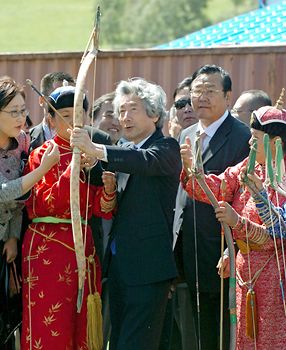
I am going to miss Koizumi SO MUCH – no for what he accomplished, but for what he DID

Look at him being awesome in Mongolia:

fr0608112.jpg

Best Prime Minister ever? You bet. Too bad he’ll be checking out next month.

What I really liked about Koizumi was his knack for political spectacle – you may remember his recent Elvis impersonation. We’ve spent a lot of time looking at Koizumi’s sheer presence on camera. He’ll be remembered in the US for his horrible karaoke at Graceland, but in Japan he is likely to go down as Japan’s biggest reformer since MacArthur.

Now, R. Taggart Murphy at the New Left Review points out that Koizumi did precious little to shake up Japan’s real power structure – unchecked and all-powerful bureaucrats who are loyal lapdogs of the US because Japan’s immense dollar holdings leave them with few options. I can’t offer a complete response to the article, but he dismisses Koizumi’s reform drive as a “convincing act,” a claim that’s irritating as someone who looks at some of the trees among the forest of Japan’s government.

I mean, he’s basically right. Of course any responsible Japanese politician isn’t going to commit political suicide by disrupting the precarious world financial system (Taggart admits that elsehwere in the paper), and any policy pursued by the PM’s office is going to be riddled with concessions to the “real power holders” – hence the directionless postal privatization policy and failure to get Japanese bond issuances down under 30 trillion yen, as well as leaving many other unanswered questions. And he makes a good point – that the push for so-called “neoliberal” economic policies that has been going on since the 90s were often nothing but smoke and mirrors hiding more cynical policy objectives.

But at least in terms of political reform, Koizumi did a lot – the dismantling of the LDP’s faction system (as seen in the rush to support Abe), the rise of the CEFP style of policy making, and the fruition of Japan’s new electoral system, all Koizumi-led developments. These are not merely “imported suits of clothes” as he puts it but (late) responses to demands from the public to take power away from the bureaucrats, who have lost significant public trust in the last decade or so.

But it looks like Japan’s next PM, Shinzo Abe, in addition to offering very little on policy issues (reports on his new book and promotional campaign seem pretty wishy washy – I mean, 2nd chances for failed business owners?!). And it’s certain that he will offer nothing even remotely closely resembling Koizumi’s early classic bike safety display in full, shiny reflective business attire.

I mean, just look at this guy (on the left of course):
abe and koizumi with chicks.jpg

As much as I’d like to know what this picture is all about (Chinese source!), it’s clear enough that this man is zombie Jon Arbuckle – boring, lame, and flesh-eating. He’s typical LDP blah and Japan needs none of it.

Koizumi, you’ll be sorely missed. I’ll be crying as I clutch my lion keychain (get them at the LDP HQ while they’re hot!) during Abe’s swearing in.

Lord, save me from bad diary entries posing as journalism

Newsweek.com has an article about “Japan’s addictive arcades’ entitled “Zeon Attack!” which is apparently of such high quality that instead of putting it on the worthless physical pages of their magazine that people actually pay money for they made it WEB-EXCLUSIVE COMMENTARY so that only the most elite, web connected readers that can understand high tech edgy things like Japan and video games would be able to read it.

Here are a few choice quotes to give you an idea of how awesomely insightful this article is.

  • Though I can’t grasp the Japanese way of counting, I still remember the precise way to defeat Bald Bull in the old boxing game Punch Out. Those old-school games are nowhere to be seen in Japan today. The modern arcade is an exotic, sensory-overload, nearly impenetrable to foreigners.
  • Kazuki and Mizuki, two high school sophomores at a Shibuya arcade, told us they play purikura about once a week to capture “memories.”
  • He said he plays about twice a month at about $3 a game, though the stack of character cards in his hand betrays a deeper addiction. “I can learn all the background and histories of the characters,” he said, adding he also reads manga related to the Sangokushi saga. [Ed: Clearly he wouldn’t be playing the game because of a pre existing interest in the Chinese history/classical literature upon which it is based.]
  • My Japanese interpreter, fighting as a boxing-gloved Kangaroo with a snowboard on its back and scuba fins on its feet, was defeated in the game by a tattooed girl. [Ed: Wow! A Tattoo!! Japanese arcades really are so much cooler than the US, where you would never see a kid with a tattoo!]
  • young people dubbed neets (who live with their parents and refuse to get jobs), and freeters (who only have part-time work) are much-discussed social groups who exacerbate the population and workforce imbalance. [Ed: Gosh, I wonder what “neet” and “freeter” stand for. I bet the explanation would be way too complicated for foreigners like Newsweek writer Brad Stone or me to understand. ]
  • Adults want Japanese kids to leave the arcades, go to work and save the country. But they’re too busy saving the world, one Gundam battle at a time. [Ed: He’s right! Nobody goes to arcades if they actually have a job or classes to go to! Arcades are probably causing the population decline!!]

The hiragana fad continues

First it was みずほ銀行 (Mizuho Bank), then it was さいたま市 (Saitama City). Now the word is that two of the new companies coming out of the postal privatization will be ゆうちょ銀行 (Yucho Bank) and かんぽ生命保険 (Kampo Life Insurance).

What is it with hiragana names these days? Have I studied kanji for so long, only to have the language be dumbed down before my eyes?