Koizumi’s farewell tanka

In Japanese:
「ありがとう 支えてくれて ありがとう 激励 協力 只々感謝」

The official translation:
“Many thanks to you all
For all your support
Many thanks to you all
For all your encouragement and cooperation
Words of thanks are not enough to express my gratitude”

My more literal translation before seeing the official one:
“Thank you
for supporting me
thank you

I have only appreciation
for your encouragement
and cooperation.”

Isn’t it just horribly lame, like the kind of thing you write in the high school yearbook of someone that you had a lot of classes with but aren’t actually close enough with to bother actually keep in touch?

INOKIX Series Condoms(tm)

Sadly we missed this one prior to their selling out, but Japanese prophylactic major Condomania lists Inoki-brand condoms in their online catalog.

Condoms that have inherited “Inoki-ism!” Fighting condoms decorated with the Inoki ” DAAAAAAH !” pose!

” USE WITHOUT QUESTION! USE AND YOU WILL FIND OUT! ”

INOKIX 1000
12-pack ¥1,050

  • Big and bulbous at the tip
  • Plain type
  • Jelly manufacture
  • Pink color

INOKIX 2000
12-pack ¥2,100

  • Thick knob-end for sustained effect
  • Serrated to prevent falling out
  • Jelly manufacture
  • Pink and green colors

Nothing says “I’m gonna kick your ass” like a pink condom, guys.

Flipper is tasty

Looks like I might have something new to order on the next trip to Tsukiji:

Occurring annually from September to April, the dolphin hunts are regulated by the Japanese government and conducted by groups of fishermen who herd hundreds, sometimes thousands, of dolphins and small cetaceans into shallow bays by banging on partially submerged rods that create a sonic barrier. The dolphins are then corralled into nets and dispatched in a brutal manner: speared, hooked, hoisted into the air by their tails, and finally eviscerated alive. The methods, say researchers, result in a long and painful death for these intelligent marine mammals.

The Japanese government has made the unsupported claim that the animals compete with local fishermen for limited supplies of fish and that the drives are in fact a means of pest control. Also, the “Act for Dolphins” consortium maintains that, in spite of the fact that the hunting of dolphins and use of their meat has waned in popularity, the government is actually encouraging the public to consume more dolphin meat; in addition to human consumption, dolphin meat is also used as pet food and fertilizer.

I know I’m supposed to be outraged, because dolphins are “intelligent” (read: cute), but that doesn’t stop me from wanting to take a nice bite out of some iruka sashimi.

Ambassador Schieffer: Beef trade resumption “day of celebration” … really?

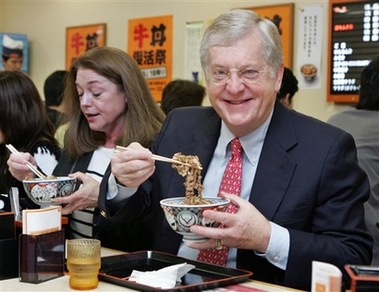
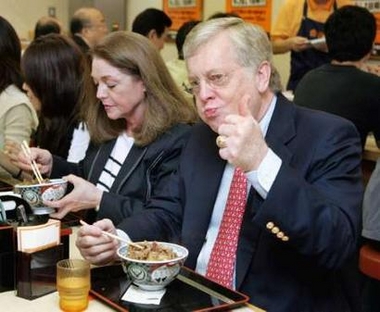
capt.tok20109180344.japan_asia_us_beef_tok201.jpg

schieffer gyudon 1.jpg

U.S. Ambassador to Japan Thomas Schieffer, right, is all smiles as he tries out beef bowl with his wife Susanne, left, at Yoshinoya in Tokyo, Monday, Sept 18, 2006. Japanese queued up before a downtown Tokyo fast-food chain on Monday as the restaurant began offering the first servings in more than two years of a popular rice dish topped with American beef. (AP Photo/Pool)

Something tells me he didn’t have to wait all night.

The US coverage of the return of US beef has something of a relieved/celebratory feel to it:

Sept. 18, 2006, 1:48AM
Japanese Line Up for American Beef

By YURI KAGEYAMA AP Business Writer
© 2006 The Associated Press

TOKYO — The U.S. Ambassador was among customers thronging a major Japanese fast-food chain Monday to savor the return of a popular rice dish topped with American beef that was off the menu for more than two years due to mad cow fears.

“It was great. It was well worth the wait,” U.S. Ambassador Thomas Schieffer said after eating Yoshinoya D&C Co.’s “beef bowl” with chopsticks.
Click to learn more…

Japan and nearby South Korea banned American beef in December 2003 because of fears about mad cow disease. Japan eased the ban in July, and South Korea earlier this month.

Mad for U.S. beef, herd heads for Tokyo eatery
POSTED: 9:22 a.m. EDT, September 18, 2006

TOKYO, Japan (Reuters) — Hundreds of people lined up at a central Tokyo restaurant on Monday to savour a dish not tasted for more than two years — “beef bowl” made with U.S. meat.

Some Japanese had even camped out overnight outside a popular branch of fast-food chain Yoshinoya, which resumed sales of its famed specialty following the July lifting of a government ban on imports of U.S. beef.

The ban was imposed in December 2003 after the discovery of the first U.S. case of mad cow disease, forcing Yoshinoya to drop its flagship dish of braised beef and onions marinated in soy sauce and laid on top of rice.

Hardcore fans had shunned the “beef bowl” when it was made with Australian beef because the meat was too lean.

As happy as I am to see Yoshinoya back in action, I don’t really see the reopening of beef trade a cause for consumers to celebrate, especially in the US. The flap over beef could have served to make the US consider whether its own testing standards were protecting consumers, but that never happened. The US government is shamelessly pro-business and the media is just not interested in covering FDA topics unless they involve a scary new drug that kills a tiny amount of people.

If you ask me (and you did) the US put way too much pressure on Japan to lift this ban in a relatively small export market (2 billion dollars a year in sales in Japan compared to 40 billion in premium revenues for US insurance companies). The dangers of mad cow are real and every country has to be careful. For the US industry to rush to political solutions (which as an industry supported by massive subsidies is their bread and butter) to the point of getting the president involved and threatening sanctions that would violate WTO rules rather than trying to reassure consumers only harms the United States’ image and makes the beef industry look bad as well. The compromise, which is basically that Japanese inspectors will be able to look around US slaughterhouses to ensure that no spinal tissue is getting into beef headed for Japan, seems satisfactory, but I would have liked to see a little more – perhaps a more constructive attitude toward testing from the American side – maybe not universal testing like Japan, but something more than self-regulation would be nice. Unfortunately, the US saw quick resumption of the status quo as more important than building consumer trust, and I think they’ll suffer for it.

Gyudon BACK at Yoshinoya for one day

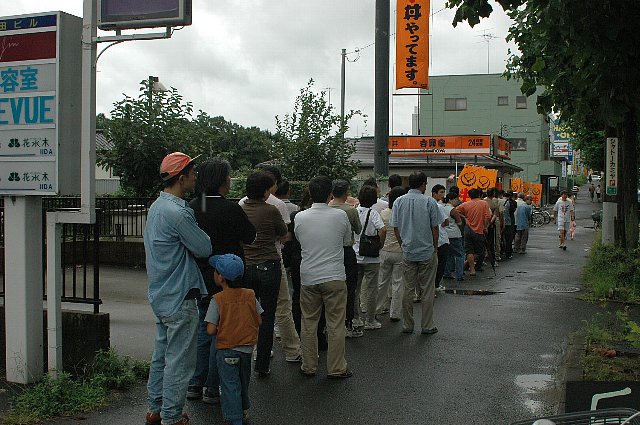
gyudon saikai.jpg
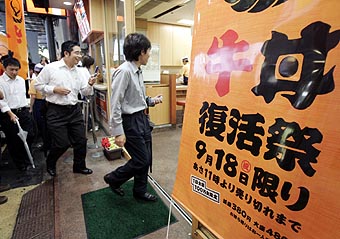
Residents of Sakae-cho, Ushiku City, Ibaraki Prefecture line up in the middle of typhoon-induced rain for this one day only offering of their flagship beef bowl “gyudon” product now that imports of US beef have resumed. Security guards were on hand to maintain order as previous limited offerings have resulted in violence from disappointed latecomers.

There are no such reports of crazed ojisan as of yet, but hopefully our correspondents in Japan will have some news for us later this evening.

According to Asahi, Yoshinoya will offer gyudon from the 1st through the 5th of October and November before restoring their flagship product in December on a daily basis for a limited number of hours per day.

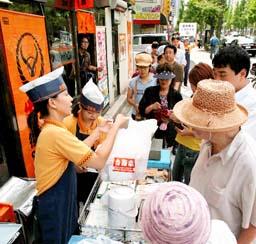
asahi 091806 gyudon.jpg

Sankei reports that some gyudon fans waited all night for their chance at luscious beef in a bowl. I’d gladly do the same. Unfortunately there are no gyudon in Thailand, not even cheap knockoff gyudon. Decent katsudon though.
sankei 091806 gyudon.jpg

Heizo Takenaka to leave politics after Koizumi steps down, but who could possibly replace him?!

pha1.jpg
Japan Times reports on Takenaka’s announcement, which came at a post-cabinet meeting press conference:

Internal Affairs and Communications Minister Heizo Takenaka said Friday he will retire from politics when outgoing Prime Minister Junichiro Koizumi steps down Sept. 26.

Takenaka, a 55-year-old professor-turned-lawmaker, said he decided to quit politics because his job had been to assist Koizumi’s economic reforms.

But what I didn’t see reported in English was news of who will take Takenaka’s proportional representation seat in the Diet. You see, members of the upper house who were elected by PR don’t represent a specific district, so there’s no runoff to replace people who quit or die. Whatever party the person leaving belonged to gets to select the replacement.

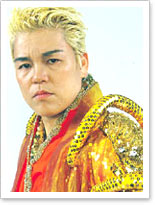
In this case the LDP had a Ms. Shinobu Kandori at the top of their waiting list from when she ran in 2004. Kandori (41) is a former Judo star who went on to become a veteran and former CEO of Japan’s Lady’s Legend Pro Wrestling. Sometimes knows as “the strongest man in ladies’ wrestling”, her accomplishments in the ring include the distinction of being among the few female wrestlers to defeat a male wrestler (eat your heart out Andy Kaufman!) in an effort to break down the barriers between men’s and ladies’ wrestling. She was also a participant in the first-ever women’s version of anything-goes kickboxing called L-1. Outside the ring, she made waves by becoming the first female freelance pro wrestler, choosing to negotiate matches from outside the company. Her profile on her agent’s website lists her main hobby as gambling.

A Jan 2002 interview places Kandori’s legendary 1986 wrestling debut against Jackie Sato as the event that destroyed the image of female wrestlers as objects of adoration (“idols”) (Ed: corrected translation). Known for her brutality in the squared circle, Kandori specializes in chain deathmatches and no-holds-barred fights. Her theme song is “All We Are” by female-led hair metal band Warlock (watch and listen here on Youtube!). She considers herself a pioneer for women in wrestling, which her record no doubt backs up. Few before her in ladies wrestling had the muscular body of a Judo champ, which allowed her to try some new things like fighting men. Her goal as a leader of ladies wrestling was to make the sport more organized and to raise standards of who can become a wrestler.

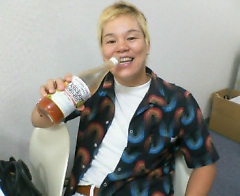
But now she’s got some big shoes to fill. Her official blog doesn’t have much on it yet since the announcement just came out yesterday, but I wouldn’t count on seeing any more pictures of her chugging tomato juice from now on:
10009617193.jpg

In case you were wondering what she’ll be bringing to her new job as a public servant, Wikipedia has an indication: Her unsuccessful political campaign in 2004 earned her criticism after she bluntly stated that she “honestly, like, [doesn’t] get this Iraq issue.” She also reportedly never made her mandatory social security payments, claiming that as a pro wrestler she never learned how to live in normal society. “The system is just too hard to understand,” she explained. “We have to change it.”

Thing is, the LDP actually sought Kandori out to exploit her fame (much like they tried to do with Horie), so in part she can’t be blamed for making such inappropriate comments. She’s just being honest, and if that’s good enough for the LDP, then it’s up to the voters to decide whether she deserves a Diet seat, right? Well, sort of. They voted her out, but now she’s back in on a technicality.

But just in case you thought Ms. Kandori lacked ideas, take a look at this brilliant campaign tactic from 2004:
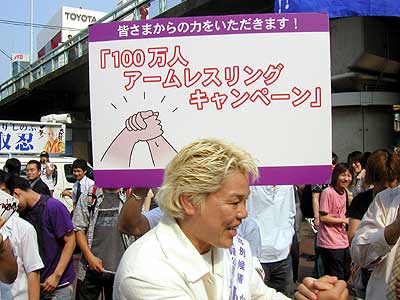
million man arm wrestling.jpg
Translation: “Lend me your strength! It’s the million-person arm wrestling campaign”

Yes, the woman who once destroyed the door of Korakuen Hall’s green room in a fit of anger will join the ranks of Atsushi Onita (profiled before on this blog and whose official Diet secretary got in trouble earlier this year for kicking a rival wrestler in the face… and he apparently has beef with 26-yo Taizo Sugimura, another LDP Diet member of questionable merit) and the legendary Antonio Inoki.

Something tells me she won’t be offered any of Takenaka’s cabinet posts, but she might make a more pretty good Gender Equality minister.

UPDATE: Her other nickname is “Mr. Ladies’ Wrestling.” See that fact and a sweet action pose here.
Thank God they didn’t call him “Steve”

According to some random people in Taiwan, this new prince’s name has good feng shui or whatever you call it.

“Hisa is a good name because the Chinese character has 15 strokes which is a luckly number. The name shows the boy will be stubborn and meticulous, but will be very popular. He will bring luck to the royal family,” astrologer Yu Hsueh-hung told Deustche Presse-Agentur dpa.

Lin Da-wei, a name expert, also called the new-born prince’s name auspicious.

“The 15 strokes is the lucky number of the fate. It signifies a rolling rock and contains positive energy and vitality,” he told dpa.

I think the character in question (悠) looks way too much like the character for fear (恐). But hey, if you’re trying to give Japan a more “we pity the fool” image, it’s much better than having an empress named “love child.”

Homesick for the Easy Living of Fairfax County

Hanging out in Washington can be a drag when you’re in a long distance relationship. Considering only the safe northwestern corner of the District (and that’s all anyone considers, really), the bars, clubs, disco bowling alleys, and $30-a-plate restaurants are built with college students, new graduates, and yuppies in mind. In contrast, Northern Virginia, where I lived from December of last year until June, could offer a suburban paradise of good restaurants and solitary thrills that entertained me during the 10 months or so of quiet stagnation that I spent between Shoko’s departure and our reunification at the end of July. As long as I had a car, I could easily brave the sometimes offensively bad traffic and spend a Saturday picking up groceries at the Korean supermarket, playing Dance Dance Revolution at the mall, and returning to my apartment with dinner from any number of good fast food or carry out places. Five Guys, Chipotle, Krispy Kreme Donuts, hispanic grilled chicken places, or some of the good Vietnamese, Korean and Indian places that have popped up in the area.

This recent Washington Post article reminds me of that time. Though intended as a look at the restaurant business in the Washington area from an economist’s perspective (timely enough as pop economics is all the rage these days) somehow the piece reads as a wonderful nostalgia piece for anyone who has recently left Washington’s “exurbia.”

“Hell on Earth” … well, not quite

Osorezan

Osorezan! “The Mountain of Fear.” Ain’t it quaint. It was the first stop on my recent tour of northern Japan with Curzon (who’s still wandering around the back roads of Hokkaido).

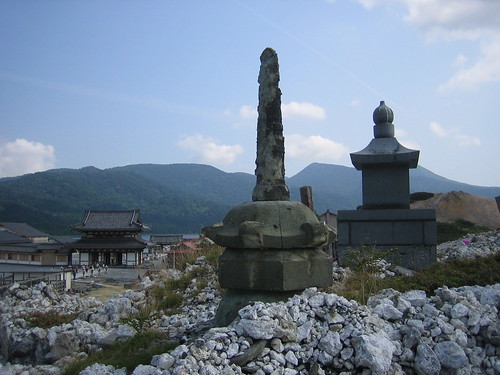
Although some misguided websites call it a mountain, it’s actually a temple in a valley surrounded by mountains. The temple is surrounded by rocky terrain lying atop a very sulfuric hot spring, which releases smelly gas from vents in the ground.

When pre-modern types saw this, they assumed that they were seeing spirits escaping the underworld. So legend has it that this is a natural gateway to Hell, and many pilgrims come to leave little offerings for the dead. One common sight around the hot springs is little stone statues dressed in children’s clothes–memorials to dead young’uns.

Anyway, if this is what going to Hell looks like, maybe I need to maintain my life of evil…