Self-proclaimed veteran translator: modern fansubbing a mess

From the “almost two years old but news to me” department:

Via the comments section at Neojaponisme, we have this series of videos decrying modern anime fansubbers as cliquey, Japanese language-worshiping elitists who offer “Japanese lessons” instead of actual translations. Their refusal to create plain, easily digested subtitles and refusal to translate culturally specific Japanese (instead offering copious on-screen liner notes) scares away potential new fans and is generally useless, he argues.

Watch here:

Part 1 / Part 2 / Part 3 / Part 4 / Part 5

On a basic level, he is absolutely right that for a general audience, translations should be very clear and nearly invisible. It’s what I strive for in my job and on this blog, for sure. But from my (admittedly limited) experience with fansubbed anime, it’s clear enough that fansubbers are not in it for the benefit of a general audience. In the era of Wikipedia, BitTorrent, and Youtube where esoteric cultural knowledge is rapidly becoming obsolete, being an elite fansubber is one of the few sure-fire ways left to secure King Geek status. Maybe having an insular subculture makes it harder for good anime titles to break through into the mainstream (as has been fansubbing’s most often-cited benefit), but isn’t that kind of the whole point?

Subway planning Japan surge

Great news, people. Subway will open 80 new Japanese locations in 2010 (sub req’d). Most new stores will be in highway service areas and shopping centers where other fast food restaurants have shut their doors. That means you could start seeing Subways where the now-defunct Wendy’s used to be.

That will bring the number of Subways in Japan to around 270. Say what you will about their quality, Subway is the one of the only easy places to get a real deli sandwich in Tokyo. Mrs. Adamu and I love it.

I will be watching developments on this front very closely as I am considering moving out of Ayase at some point in the next year or so. Being near a Subway will be a major plus.

One interesting fact about Subway Japan – about 90% of their locations are franchisee-owned. So that older gentleman watching over the teenage part-timers making your sandwich? He probably has a very direct stake in making sure you’re satisfied. The same goes for most of the 957 Baskin Robbins stores.

The Tragedy of the Overseas Japanese

I’ve been in Dubai for almost two months now, and despite leaving Japan, everyday involves speaking, reading and writing Japanese in my personal and professional life. Since arriving I’ve probably met more than a hundred Japanese nationals here, such as company employees, government bureaucrats, waitresses and cooks at Japanese restaurants, and the wives and school-aged children that have accompanied many of them. That’s several percentage points of the whole Japanese population here — according to the local Japanese Consulate General, there are approximately 3,000 Japanese nationals living in Dubai.

The reaction to a Japanese-speaking non-Japanese person is overwhelmingly positive, and I have found it very easy to befriend Japanese nationals on that basis. I think one reason for this is the underwhelming penetration of English language proficiency in the Japanese community here, and the consequent loneliness and insular community that arises thereto.

It’s one thing when I meet Americans and Brits living in Japan who never exert even a cursory effort to learn the Japanese language. I’m disappointed by these types of people, but I understand that English is the lingua franca of the world, the lowest common denominator of language, that people can expect to use for communication in most cities of the world. I know people who have lived in Japan for years, knowing only English, and who have still been able to live a full life in Japan and enjoy all the major tourist locations such as Kyoto, Hakone, Nikko, and elsewhere.

Here in Dubai, I witness the same phenomenon — I meet Japanese people who have lived in Dubai for years and who can barely order food from a menu or instruct a cab driver. This is a city that follows the 21st century lingua franca — 90% of the metropolitan population is foreign, and the common language between Lebanese, Indians, Brits, Egyptians, Iranians, Chinese, Kenyans, South Africans, Pakistanis, Greeks, Afghanis, and every other type of person you can imagine is English.

It’s one thing if a 30 year-old Japanese housewife can’t learn basic English communication after a few year in Dubai. That’s disappointing but understandable. But I’m truly shocked when I meet kids of the ages of 7 or 10, who have lived in Dubai for a year or two, and who have the potential to truly learn English like a native, and yet who can barely muster a sentence in English.

The blame lies squarely with the community and the education. The kids live in a Japanese community, attend Japanese schools that follow an ordinary Japanese curriculum, and basically have to study English in their spare time if they want to learn. And the general lack of English ability by many here has created a highly insular community. The Japanese tend to live in or around the Hyatt Regency, which offers serviced apartments for individuals and families, a supermarket with a small Japanese corner, and a genuine Japanese restaurant. Many other people live in the nearby neighborhood, and most of the authentic Japanese restaurants are in that area. With most Japanese socially cut-off from the rest of Dubai’s expat community, the result is a gossip network akin to a small inaka community. I met a bureucrat working at JETRO who had heard of me from his neighbor before we met — which we forensically determined was derivative to at least the fourth degree, with the information genesis beginning in a meeting that happened merely days earlier.

On the one hand, from a selfish perspective, this is great for me and has created all sorts of opportuities. But it’s also tragic that the Japanese, despite being very well educated and comfortably middle class for several generations, are so culturally isolated in a city where people gather from across the world.

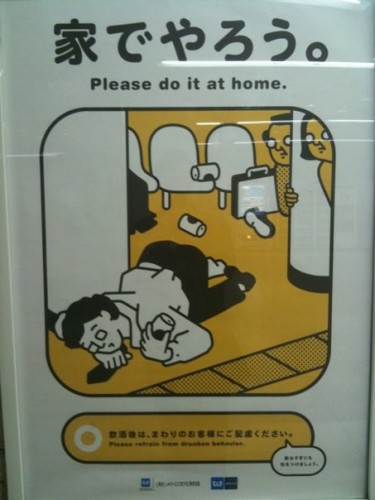
The only rule of commuting that matters – just blend in

Reuters has a list of Japanese commuters’ common pet peeves:

1. Noisy conversation, horsing around

2. Music from headphones

3. The way passengers sit

4. Cellphone ringtones and talking on phones

5. Manners when getting on and off trains

6. Applying make-up

7. Littering

8. Sitting on the floor of the train

9. Riding the train drunk

10. Riding a crowded train with a child stroller

Most Mutant Frog readers will probably not find anything new on the list. Even the train companies are aware of them – most are covered in Tokyo Metro’s awesome “Please do it at Home” poster series (above, and read the Sandra Japandra blog if you want to laugh your ass off). Some seem more reasonable than others – can a mother really avoid bringing her kid on the train?

Pet peeves about daily life are simply a part of the human condition – American motorists all get pissed off at people who don’t use their blinkers, and on and on. However, in Japan these complaints seem to take on an extra sense of urgency because commuting on a packed train (often for more than an hour each way) is often so intimate and potentially dangerous. The pressure on your chest as that last person piles on. The feeling of being shoved as people stampede out at a major transfer station. The anxiety women must feel that the hand behind them could start getting too familiar.

With trains as crowded as Tokyo’s, everyone has an interest in maintaining some semblance of order and control. That’s maybe the one thing that keeps people in a tightly packed train from suffering a breakdown (and allows people to concentrate on a newspaper or Nintendo DS).

To deal with this, I think the people of Tokyo (and possibly all Japanese cities) have come up with one unwritten, overarching meta-rule that unites them all – do not stand out. People who stand out violate this order and thus subject themselves to the furtive glance of doom, that momentary registering of disapproval.

Even those who violate a few of the pet peeves themselves will feel annoyed at others who do the same. That’s because this rule is enforced by a million individual pet peeves manifesting themselves passive-aggressively. For example, I sometimes eat chocolate on the train but hate it when someone eats a sandwich or something I can smell. In my head, I feel like my eating is cleaner and therefore less rude.

This might be a stretch, but as a foreigner I feel like I automatically violate the rule just by being different. Once people see a white man they can never be sure if I’ll follow all the rules. Hence, just about every time I enter a reasonably packed train car I am greeted with half a dozen glances. I don’t necessarily think it’s racist–for most people it’s based on experience and it’s no more hostile than the automatic glances that would be directed toward other potential scofflaws – construction workers, thuggishly dressed kids, gyaru, etc etc.

Day in and day out, I share the train with the people who glare at me, and I start to glare back. I get territorial about my comfort zone – the handrail in front of the bench seats gives you enough room to read – and resent anyone who would violate it. I start to understand why people go out of their way to avoid talking to strangers. And I definitely get why people don’t bother giving up their seats to old people and pregnant ladies. Those people are breaking the rule!

This is why I think alleviating the insanely crowded train situation is vital to improving the national mood. I ridiculed Roger Cohen for talking about the gloomy attitude in Japan, but on that point he was right. People look like hateful, unhappy zombies during their commutes. The train companies are doing their best, but I feel like the media and politicians avoid really focusing on it because it’s one of those tough, intractable problems with no good solution. Better to let the plebes focus on how awful it is that some celebrities use drugs. But why not try some bolder solutions, like a second, identical Yamanote line, or double-decker train cars?

As a man with a short commute, I should be the last to complain about this. But I can’t help but thinking about it. It’s a national obsession, and in almost three years of living here it’s become mine as well.

“Uni Muki” — How to prepare a sea urchin

I’ve previously posted on ComingAnarchy about how to prepare a squid, at MFT on the morality of ikizukuri sashimi preparation, and now I thought it might be fun to repost a ComingAnarchy post on preparing a sea urchin for consumption. The following pictures were taken during a trip last summer to Rebun Island, the northernmost island in Japan after Hokkaido, where I had a chance to break open and prepare a sea urchin at a local fishery.

Sea urchins are a delicacy in Japan. Here is a tub of the spiny creatures waiting to be shipped across the country or otherwise served up for food.

uni1.jpg

The only edible part of the creature are its orange gonads. This requires completely destroying the creature, breaking through its spines and hard crusty shell. To split the creature open, three tools are required — a chisel with a lever, a dull scalpel, and twezers.

uni2.jpg

The rest of this gets messy… don’t continue to read if you have a thin skin (no pun intended). Continue reading “Uni Muki” — How to prepare a sea urchin

Roger Cohen does Japan

After working out with Yoko Ono’s lawyer and crossing the street outside the Imperial Palace, Roger Cohen is ready to tell us what he thinks of Japan: a sad place where the only way to have fun is develop unhealthy obsession with cartoons:

My sense is that four factors have contributed to [over-the-top hobbyism and high-tech obsession in Japan]: wealth, postmodernism, conformism and despair. Japan is rich enough, bored enough with national ambition, strait-jacketed enough and gloomy enough to find immense attraction in playful escapism and quirky obsession.

As Tokyo Reporter noted in comments in my last post, Cohen uses some ridiculous examples to make what is ultimately a pretty valid point. There is a definite “ennui” here that, like much of the world, leads people to pursue escapism. Where I differ with Cohen the most is that I don’t think Japan is any more advanced in its escapism than America, just different. Here was my comment to the nytimes.com site that focused mainly on the silly parts of his column:

In common usage, “otaku” usually refers not to “geek-like obsession” but to actual obsessed geeks, which make up a pretty small proportion of Japan’s population (probably not much higher than the ratio of Americans who obsess over their hobbies). I would agree that “we’re all going a little otaku” as you defined it but that statement applies equally to most Japanese as it does to Americans.

I would also like to point out that Yoko Ono’s lawyer gave you some bad information. Unless you were using some new model of treadmill I am unaware of, those pictures tell you how many calories you are burning, as you suspected. It’s a neat feature I think American runners would like as well.

Sure, Japanese attention to detail, cuteness, and what have you are obvious to any outside visitor, but what does that have to do with Japan’s international standing? Does a lack of cute images on American treadmills signify the decline of the American superpower?

One bonus nitpick that I didn’t tell the Times: that area in front of the Imperial Palace is closed to traffic so they can open it up to bicycles. The traffic guards are there to make sure no one is run over by an out of control tourist. All the same, I think anyone who has been there will agree the old men directing traffic (who work for a travel agency) are extremely power-drunk and over-earnest in making sure no one jaywalks.

Lightening up

Lisa Katayama has a piece up at BoingBoing about how people like us should keep our sense of humor when she writes about weird stuff in Japan:

…writing about my own country’s quirks has its downside. I strive to tell each story objectively without condescension or sensationalism, but every time I write an article about, say, the engineer who has a body pillow girlfriend or the grad student who married a Nintendo DS character, I get hundreds of racially-charged comments from readers, long ranting responses from defenders of Japanese culture (ed: Hey, is that a dig at me?) , and dozens of emails from people at big media outlets who want to find out more about these “strange” phenomena.

Why do so many love to gawk at this mysterious, foreign “other” that is Japanese culture? There are plenty of strange things going on in the US too, but when it happens in Japan, it’s suddenly incomprehensible, despicable, awesome, and crazy. This fascination doesn’t just end with angry commenters, either. Over the last couple of decades, it has spawned a huge industry of magazines, blogs, and products themed around Japanese culture marketed to Westerners by Westerners who are also obsessed with Japanese culture.

My friend Joi Ito and I talk about this a lot. He, like me, is Japanese and was brought up with both American and Japanese influences. This question resonates not only with the work that we do, but with our personal identities. While we do our fair share of sitting around analyzing Japanese culture, it’s also deeply personal to us when someone criticizes our country or our opinions of it.

Overriding all this Japanalysis, though, is the fact that none of this is meant to be taken seriously. One important premise of Japanese popular culture is the commitment to have fun and not take offense. Japanese humor works on many different levels and its nuances can be hard to explain to people who didn’t grow up with it.

…you just don’t get it. You’re not in on the joke. You’re the one taking it too seriously, and you might be imposing your own biases and hang-ups on someone else’s situation.Being majime (too serious) is not cool in Japan; likewise it is important for voyeurs of Japanese culture to recognize that most everything pop-culture-y that is exported to the West comes at us with a wink. If you’re all up in arms about it, then maybe the joke is on you.

On the outside, guys like Sal9000 (the guy who married his DS girlfriend) and Nisan (the guy with the body pillow girlfriend) may seem “weird” or “crazy.” But they’ve really just found creative ways to toy with amorphous concepts like love and romance that complement their own unique lives.

I wholeheartedly agree that light-hearted content about Japan should be allowed some breathing room. In fact, I agree with that even for those who sell junk and run for-profit blogs focused on Japan Weird stuff.

Where I would draw the line is when an influential publication like the New York Times trots out this stuff in the service of their tired narrative of an inscrutable, backwards, and weak Japan. Call me a “defender of Japanese culture” if you want, but it’s a line of thought that does more to obscure than enlighten (See the recent silliness from Roger Cohen). The NYT would benefit just as much as the rest of us from “lightening up” as Katayama suggests.

I would have a much easier time accepting this premise from someone who isn’t in the business of producing Weird Japan content that’s intended to be taken seriously. If this piece signals a change of heart, that’s great. But if it’s true that most of the stuff is tongue-in-cheek, shouldn’t she be telling the readers instead of writing an essay about it afterward?

As writers, shouldn’t we be trying to help people understand, instead of chiding them for not getting it?

Adam J. Richards disappointed in court decision in favor of Borat

From Bloomberg:

News Corp.’s Twentieth Century Fox Film won an appeals-court ruling affirming the dismissal of three lawsuits filed by people who claimed they were emotionally harmed by appearing in the “Borat” movie.

The U.S. Court of Appeals in New York upheld the dismissals from last year in an order today. People who appeared in the film, including those in a dinner-party scene in which the protagonist presents a bag of feces, also sued for fraud and unjust enrichment, according to the ruling. They argued the ambiguity of “documentary-style film” in signed releases meant the lower court couldn’t rely on them to dismiss the litigation.

“While the character ‘Borat’ is fictional, the film unmistakably tells the story of his travels in the style of a traditional, fact-based documentary,” the appeals court wrote. “Indeed, the film’s stylistic similarity to the straight documentary form is among its central comedic conceits, employed to set the protagonist’s antics in high relief.”

“It’s disappointing,” Adam J. Richards, a lawyer for six of the seven plaintiffs, said of the ruling in a phone interview. “It allows well-financed parties such as Twentieth Century Fox to outright lie to people and rely on, in my opinion, an ambiguously worded document to get by the lies.”

The appeals court found the plaintiffs couldn’t claim the filmmakers fraudulently induced them into signing the releases because they didn’t try to verify what they were told by, for example, asking to meet the “reporter” or learn his name.

“They would have lied to him,” Levine said of his client Psenicska. “To use clear language like ‘mock documentary’ or ‘mockumentary’ would have given the game away. They were clearly trying to use obsfucation.”

While I agree that the plaintiffs should have maybe had a little common sense before jumping in front of the camera, I really hope Sasha Baron Cohen remains the only one making these obviously subversive movies. They work, but only because the makers are doing things everyone knows are completely wrong.

Wendy’s Japan to close by end of December!

Suddenly and unceremoniously, Zensho, the operator of Wendy’s Japan, has announced it will discontinue its licensing deal with the Wendy’s parent company and shut down all 71 restaurants under the hamburger chain’s brand by the end of this month.

There is a brief statement on the chain’s website announcing the decision (the URL oddly misspells “Wendies”) thanking everyone for their service and patronage and inviting everyone to visit a Wendy’s before it’s too late. But it doesn’t exactly tell us why this is happening. The Nikkei Shimbun and Wall Street Journal pass on statements from officials at Zensho stating that while Wendy’s had started to turn a profit, they wanted to focus management resources on their mainstay business, the Sukiya beef bowl chain.

The closure means 1900 part time workers will lose their jobs. According to the Nikkei, Zensho is offering to help them find work at neighboring stores, though in this tough environment I am sure many will have trouble finding new work immediately.

Although I rarely ate at Wendy’s, knowing it was there was comforting as an expat American. Also, at various points in my stay here Wendy’s has served as a meeting place and landmark. It will be very sad to see it go! One can only hope Burger King, which has made a recent return to Japan, will take over some of the former Wendy’s locations.

The JLPT goes otaku

I finally got around to taking Level 1 of the Japanese Language Proficiency Test (日本語能力試験) last weekend. Roy, Adamu and Curzon all took it while they were in diapers, but I never saw much need to do so myself. It’s hardly a good benchmark of ability; one can pass Level 1 with poor Japanese skills, or fail it with good Japanese skills, depending solely on how one’s skills match the material covered on the test. Level 1 essentially tests for the following:

  1. Basic conversational and reading comprehension ability
  2. Correct pronunciation of words written in kanji
  3. Ability to distinguish between similar kanji
  4. Ability to distinguish between grammatical forms that nobody uses
  5. Ability to understand science fiction anime

Point 5 is apparently a new addition to the December 2009 examination, and showed up in the last question on the listening section, helpfully uploaded to YouTube so I can prove to everyone that it is real. (Hat tip to these guys, and to Roy for tipping me off through Facebook.)

Another question on the listening test was based on a role-playing video game similar to Final Fantasy; the recording played an explanation of the various steps required to beat the game (with an accompanying 8-bit-style map in the test booklet), and the test taker was asked to give the correct order of places to visit. It’s nice to know that Level 1 has some practical uses.