Repliee

All of a sudden we’re getting large numbers of search engine referrals from people looking for videos of the Repliee Q1.

I was wondering what could have caused this sudden surge, until I realized that BBC News just wrote about it.

Japanese scientists have unveiled the most human-looking robot yet devised – a “female” android called Repliee Q1.

She has flexible silicone for skin rather than hard plastic, and a number of sensors and motors to allow her to turn and react in a human-like manner.

She can flutter her eyelids and move her hands like a human. She even appears to breathe.

I wrote a post about the Repliee a little while back, but for people who may not have seen it, I’ll just repeat the part that I translated from Japanese.

You can also find an older brief article at
National Geographic.

For more information, photos, and best of all video, see the official project website at Osaka University’s Intelligent Robotics Laboratory.

The Japanese language website of NEDO (New Energy and industrial technology Development Organization) has some additional information worth mentioning.

The name “Repliee” is supposed to suggest the French word replique (replica).

The Repliee Q1’s skin is made of silicon and colored in imitation of human skin. The android uses air servo actuators to subtly inflate and deflate the chest in imitation of real human breathing. The Repliee has been designed to respond to its environment in the unconscious ways that a human does. For that purpose it has extremely sensitive touch sensors throughout its body, and different kinds of touched trigger different responses. It also has microphones to pick up and respond to human voice.

Size: 680mm wide, 1,500mm tall, 1,100mm deep
Weight: 40kg
Power: air servos (external air compressor)
Movement: Upper body moves via actuators with 42 degrees of freedom
Operation: controlled via serial link to external computer
Usage environment: indoors
Controller size: 1000mm wide x 680mm tall x 850mm deep
Compressor size: 900mm wide x 1360mm tall x 900mm deep

Since the video on the university web site is fairly large and slow to download, my friend Matt has posted a tiny, tiny recompressed version on his website.

WTC site

A couple of days ago I posted a small set of photos of the impromptu memorials that had sprung up around the World Trade Center site one year after the attacks.

For those wondering what the site is like today and how progress is going on the construction of the new complex, the best place to turn is always the New York Times. Today they have a good article summarizing the current state of affairs.

Below Ground Zero, Stirrings of Past and Future

[…]
For now, there is nowhere else at ground zero where time is more palpably suspended than in the tubes and tunnels and truck bays that once served the World Trade Center and, before that, the Hudson & Manhattan Railroad, predecessor to PATH.

Almost four years after the attack, signs still command truck drivers who have long since vanished: “No Idling.” “Not for Service Vehicles.” “30 Minute Parking Only for Deliveries. Offenders Will Be Autoclamped and Fined.”

Within the cavernous gloom of the deeply ribbed 15-foot-3-inch-diameter tubes, the quiet is broken every few minutes by the disembodied rumble of a PATH train passing nearby.
[…]
Mr. Ringler said elements of this subterranean realm – perhaps some cast-iron tube rings, certainly some ornamental flooring – would be salvaged.

The authority is committed to preserving the travertine-clad hallway leading to the E train terminus at Chambers Street. It plans to relocate the cruciform steel column that was found at 6 World Trade Center. What the authority does not save, it will document in written descriptions, drawings and large-format photographs.

“It’s important that we attempt to preserve some of this for history,” Mr. Ringler said. “This is part of the story. It is not necessarily integral to 9/11, but there is history here.”

French teachers give Ishihara homework

The Japan Times has a cute followup to the Ishihara/French teachers incident I translated an article about recently.

French teachers give Ishihara homework

French-language instructors at Meiji University on Tuesday gave French textbooks and a dictionary to Tokyo Gov. Shintaro Ishihara, who has been targeted in a lawsuit for allegedly remarking that the French language “cannot count numbers.”

A group of 13 instructors from Meiji University presented the gifts to an official of the metropolitan government’s office for accepting citizens’ views. Ishihara is on vacation.

The gifts were accompanied with a letter saying, “Please learn this as homework during the summer vacation so you can count numbers in French.”

According to the lawsuit, filed July 13 with the Tokyo District Court by a French-language school principal and other people, Ishihara said last Oct. 19, “I have to say that it should be no surprise that French is disqualified as an international language because French is a language which cannot count numbers.”

The Japan Times: July 27, 2005

Starbugs

Seeing this Boingboing post on international Starbucks knockoffs prompted me to post the photos I took at the famous Taiwanese Starbucks knockoff, ‘Starbugs.’

Up in riverside entertainment/boardwalk area in Danshui, a small city in Taipei County about 30 minutes north of Taipei City proper, you can find this unusually specialized pet shop.

Inside, they sell nothing but beatles, large spiders, and crabs.

If any reader happens to be an amatuer entomologist, feel free to let me know what these little monsters are properly called.

Jewish populations

I spotted this article in the English language edition of Haaretz via this very cool website, which presents links to and translations of foreign press clippings about attitudes towards the US from around the world.

srael will have the largest Jewish population in the world by 2006, when it will surpass the United States for the first time in history, the Jewish People Policy Planning Institute said Monday.

Planning institute director general Avinoam Bar-Yosef presented the research group’s annual report on “the situation of the Jewish people” to the Knesset Immigration and Absorption Committee on Monday. The institute, which is partly funded by the Jewish Agency, concluded that the State of Israel is the single guarantee of the Jewish people’s continued existence. Bar-Yosef will submit the report to the government next week.

Today about 5.28 million Jews live in the U.S., with 5.235 million living in Israel.

For some reason this makes me a little uneasy. I’d always been a little bit relieved that Israelis were the minority of the world’s Jewish population. With there finally being more Jews in Israel than the US, will it be harder for people to accept that non-Israeli Jews like myself don’t necessarily have any particular bond to the country, support for their policies, or desire for them to have laws granting me special rights and privileges.

The article also notes that are are only about 1 million Jews left in Europe today. As we all know about 6 million Jews were slaughtered by the Nazis, and of those who survived a huge proportion emigrated, becoming much of the aforementioned Israeli and American Jew populations.

To see the aftermath of the virtual disappearance of Jews from Eastern Europe, we turn to this fascinating article from the Boston Globe.

”How — if there were no Jews — the world would be enraptured!” she wrote. ”The people that stood at Sinai to receive a desert vision of purity, the people of scholarly shepherds, humane prophetic geniuses, dreams of justice and mercy” — how admired they would be. In a world without Jews, the memory of Jewish civilization would be endlessly fascinating. ”Christian ladies,” Ozick imagined, would ”study ‘The Priceless Culture of the Jews’ at Chautauqua in the summertime” or create Jewish prayer shawls at ”a workshop on tallith making.”

Well, Jews haven’t vanished from the world. They have, however, all but vanished from Poland. More than 90 percent of Poland’s Jews were murdered during the Holocaust, and most of those who survived emigrated long ago. The result is that a land that once was home to 3 million Jews — 10 percent of Polish society, the largest Jewish population in Europe — is now more than 99.9 percent non-Jewish. Millions of Poles have never knowingly met a Jew. But, oh, how enraptured they are with the genius that was Israel!

I arrived in Krakow near the end of the annual Jewish Culture Festival, a nine-day extravaganza of concerts, lectures, films, and exhibitions — all with the aim, to quote a festival brochure, of ”presenting Jewish culture in all its abundance.” An elegant catalog, 160 pages long, lists a dizzying array of offerings: lectures on ”Talmudic thought” and ”Jewish medical ethics,” forums on European anti-Semitism and the Hebrew poetry of Haim Nahman Bialik, concerts of klezmer music, liturgical music, and ”Songs of the Ghettos and Jewish Resistance,” workshops on Jewish cooking, Hasidic wedding dances, and celebrating Hanukkah with children.

I suppose it’s kind of sweet in a macabre sort of way that they find us so fascinating now that we’ve vanished from their country, but wouldn’t it have been nice if there had been a little bit of apprecation in Poland for Jewish culture say, between 1900 and 1945?

Arms sales to China

From SFgate via Google News:

The Pentagon estimates that China could be spending as much as $90 billion annually on its military, three times the publicly released defense budget, making China the world’s third-largest defense spender and the largest in Asia. A large portion of the secret budget is spent on buying weaponry from nations such as Russia and Israel, the report concludes.

As we all know, the US recently succeeded in persuading Europe to extend a ban on selling weapons to China. How on Earth does Israel, a country who pretty much relies on continued US military aid for its very existence manage to avoid criticism for doing the same thing? Has there been any outrage about this in Congress?While some news sources covering this mention arms sales by Russia and Israel, some of them mention only Russia.

Associated Press (via WaPo):

The Chinese military is buying new weapon systems _ including important purchases from Russia _ while developing new doctrine for modern warfare and improving training standards, the report released Tuesday says.

This this article from an India based news web site stresses

Chinese military build-up is not only targeted at India, but also at Taiwan, Japan and Russia.

Russia and China have a history of border disputes and are increasing competition for resources. Israel’s national defence relies on the US, whose potential interference in a China/Taiwan war is a primary for China’s military buildup. Why on earth do either of these two countries feel it is in their best interests to help arm China?

The article on the Malaysia Star website provides the most meaty information out of those that I’ve seen.

Continue reading Arms sales to China

Give and take

The NYT reports on a little known industry that has been outsourced to China.

Own Original Chinese Copies of Real Western Art!

At 26, Mr. Zhang estimates that he has painted up to 20,000 copies of van Gogh’s works in a paint-spattered third-floor garret here where freshly washed socks and freshly painted canvases dry side-by-side on the balcony.

A block away, Ye Xiaodong, 25, is completing 200 paintings of a landscape of pink and white flowers in another third-floor garret. And down the street, Huang Yihong, also 25, stands in an art-packed store and paints a waterfall tumbling gracefully into a pool, mixing the paints on an oval palette.

China’s low wages and hunger for exports have already changed many industries, from furniture to underwear. The art world, at least art for the masses, seems to be next, and is emerging as a miniature case study of China’s successful expansion in a long list of small and obscure industries that when taken together represent a sizable chunk of economic activity.

I was a little but shocked and amused to get to the middle of the article and find out that the seat of production had formerly been near my hometown.

Northern New Jersey used to have a small but thriving cluster of businesses with artists churning out inexpensive paintings for restaurants, hotels and homes across the country. But these enterprises have been switching to imports, like the Dae Ryung Company, which had seven painters two decades ago at a studio attached to its offices in Hackensack, N.J., and let the last one leave four years ago without finding a replacement.

“In the beginning it was better here, because we were able to tell them exactly what we wanted,” said Helen Cho, the company’s purchasing and accounting manager. “But after a while, the Chinese caught on.”

Should New Jersey residents be upset that outsourcing has moved yet more crappy, pointless jobs out of our state to a faraway land where people will appreciate them more?

Two days later, the Times printed another article on another industry that is now just beginning to boom in New Jersey.

TEN years ago, New Jersey had 14 wineries. Today it has 27, and within the next year or so the number is expected to reach 40.

Ten years ago, New Jersey made 873,000 gallons of wine (about 360,000 cases). Now it makes almost twice that much, more than 1.5 million gallons. In 1995, it was eighth in the nation in wine production; now it is fifth, behind only California, New York, Washington and Oregon.

But one thing hasn’t changed in that decade of extraordinary growth for New Jersey wine: hardly anyone knows a thing about it. Less than 1 percent of the wine consumed in New Jersey was made in New Jersey – not surprising, considering that few restaurants serve it and few liquor stores carry it. Even experts like John Foy, a consultant who writes a wine column for The Star-Ledger of Newark and assembled the world-class wine list at Restaurant Latour in Hardyston, confess ignorance.

Amazing. Is there really still room for vineyards in the nations most populous state amidst the chemical factories and urban sprawl? Will The Garden State earn its name?

Addendum: A second newspaper reports on a long established Newark, New Jersey based manufacturer whose entire production has been outsourced.

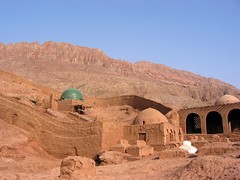
Turpan village holy site

This green dome is built above a cave that is considered the holiest Muslim site in all of China. The Uyghur people who inhabit Xinjiang (or East Turkestan, as it was known during a brief period of independence during the Chinese civil war) were devout Buddhists before they converted to Islam many centuries ago.

According to legend, the king of Turpan, who was a Buddhist, felt threatened by Islam and sent soldiers to chase down the first three Muslim missionaries that came to the region. They were eventually cornered here and sought refuge in the cave. The soldiers thought they would wait them out, but they were miraculously transformed into doves, and flew out of the cave and over the soldiers heads to freedom.

Today, Chinese Muslims often take pilgrimage here, since it is difficult to obtain permission from the government to travel to Mecca.

New photos in Flickr

Some of you may have noticed that the links to my old photogalleries are gone, replaced by Flickr. For those who care, the old galleries still exist at the address Mutantfrog.com/gallery2/ but I was convinced by my friend Joe to try Flickr, and I decided that it was just an easier way to deal with uploading photos, and in particular a good way to avoid bandwidth charges.

That said, with the new service I’m going to try and post photos more often and regularly, and also with blog entries that provide more informative text.