Off to the Philippines

I’m writing this at 9.20pm, Taiwan time, in an internet cafe in Shida night market. No, I’m not out in a net cafe just to ease myself into the feeling of traveling before I actually depart. Yes, I do own my own computer here, currently located and fully operational in my own apartment. What is not working is my internet connection. For some reason unknown to me or my flatmates, the phone/DSL line went completely dead last night, and between final exams in my Chinese class yesterday and today and an early morning flight there was just no time to wait for a repairman. This internet cafe is called Concept, but as far as I can tell the only concept they had in designing this place was “take a basement room and plaster it with World of Warcraft posters.

I’ll be leaving on a 9.30am flight tomorrow (Nov 25), Taiwan’s Eva airlines from Taipei’s Chiang Kai Shek airport, to Manila, Philippines. Returning at the same time, December 7th. Everything in between is a little up in the air.

I have several friends in the Philippines that I’ll be visiting, all Philippinos who I met while I was living in Kyoto. Of the five people I expect to meet up with, three were students at Ritsumeikan with me (two exchange students and one graduate student), and two were graduate students at Kyoto University, that I met through my Philippino friends at Ritsumeikan, who they knew from home.

Some of these friends I’ll be seeing in Manila, and one (or two, if she can go), I’ll be meeting on Boracay Island. Rocs (the friend I will be meeting there) tried to book a flight for me for this weekend, but it was too short notice, so instead I’ll arrange one for the following weekend after I arrive in the country. Although next weekend is more convenient in terms of time, this weekend would have been much better from a financial perspective. Rocs tells me that following December 1st, when the tourist season starts, prices for accomodations will double.

Aside from that, I have very little idea of exactly what I’ll be doing while I’m there. I’m sure Manila will be interesting for a couple of days at least, and Arlo was telling me that there are some nice places to visit not too far from Manila. Since I was unable to actually find an English language guidebook in the stores here-plenty of guidebooks, but no Philippines book in stock-and also haven’t had much time to read up online (particularly in light of domestic service outage).

I’ve backed very light. I borrowed a smallish hiking backpack from my flatmate Steph-larger than my schoolbag, but much smaller than the orange monster I used to hike around China. I’ve packed a few days of clothes, my camera, a few minor items, and a few books. The books mainly consist of a couple of Japanese language history books on Taiwan. This is a space saving strategy, as English books take far, fare less time to read, and even one large book in English would weigh a few times as much as two slim Japanese paperbacks. Of course, since the entire educated population of the Philippines is fluent in English, I may pick up some local histories or novels in the English language, so I can actually know something about the country I’m in.

I don’t feel particularly nervous about my lack of preparation for the trip, and my lack of any real knowledge about where I’m going. A lot of people say that the Philippines is a dangerous country to travel in, but I think it should be a lot safer ever since they locked up Commander Robot. Is my lack of stress merely the calm before the storm, a lack of human emotions, or simply exhaustion from the dozen or more trips I was forced to make to various Taiwanese offices and burueas over the past three weeks to get my Taiwanese residence visa and reentry permit, so I would actually be able to come back into the country on the return leg of my trip instead of having to live like Tom Hanks in that that silly movie about the airport?

Cambodian citizenship

According to every news agency in the world, Angelina Jolie has just been made a Cambodian citizen. She was awarded this honor via “a royal decree giving her Cambodian citizenship.”

According to the Cambodian Constitution of 1993, the status of the King is basically:

The King of Cambodia shall reign but shall not govern.

It goes on to list the various duties of the King, but they all basically come down to issuing proclamations that have been pre-approved by the Assembly. The King is granted no power to make any decisions on his own, not even to appoint his own heir.

How are normal people like us, who aren’t important enough to have special acts and royal proclamations made in our name, treated by Cambodia’s citizenship law?

CAMBODIA (Formerly Kampuchea)
CITIZENSHIP: Citizenship is based upon Decree No. 913-NS, of November 20, 1954, and Law
No. 904-NS, dated September 27, 1954.

BY BIRTH: Birth within the territory of Cambodia does not automatically confer citizenship.
Two exceptions are these:
 Child born in Cambodia, of non-citizen parents who were also born in Cambodia.
 Child of unknown parents found in Cambodian territory.

BY DESCENT: Legitimate child of a Cambodian mother or father, regardless of the country of
birth. (According to Cambodian law, “legitimate” refers to the child being formally
acknowledged by either of its parents.)

MARRIAGE:
 A foreign wife of a Cambodian citizen is eligible for citizenship upon the date of the
marriage.
 A foreign husband of a Cambodian citizen must fulfill all naturalization requirements, but
need reside only for two years.

BY NATURALIZATION: Cambodian citizenship may be acquired upon fulfillment of the
following conditions: Person has resided for at least five years in the country, knows the
language and culture, has a steady means of support, and is of good moral character.

DUAL CITIZENSHIP: NOT RECOGNIZED.
Exception: A Cambodian wife of a foreign national is permitted to retain her Cambodian
citizenship unless required to renounce it by the laws of the husband’s home country.

Hmmm. Article 49 of the constitution says

All Khmer citizens shall have the duty to take part in the national reconstruction and to defend the homeland. The duty to defend the country shall be determined by law.

And Cambodia doesn’t recognize dual citizenship. If Cambodia gets in another war, you better watch out Angelina or they might just draft you.

Ghosts in Burma

At precisely 6:37 a.m. last Sunday, according to one account – with a shout of “Let’s go!” – a convoy of trucks began a huge, expensive and baffling transfer of the government of Myanmar from the capital to a secret mountain compound 200 miles to the north.

Diplomats and foreign analysts were left groping a week later for an explanation of the unannounced move. In a country as secretive and eccentric as Myanmar, it is a full-time job to try to tease the truth from the swirl of rumors and guesswork, relying on few facts and many theories. (NYT)

Over 1200 years ago, the Japanese Emperor moved his capital from the unfinished Nagaoka-kyo to the site of present day Kyoto to escape from the vengeful ghost of a falsely accused prince. It would seem that Burma’s military government has just done the same thing.

While many experts consider this move to be a strategic relocation to a seat of government from which they can more easily suppress peasant rebellions, the bizarre secrecy and inexplicable suddenness of the move have given rise to two competing theories about the reasons behind the move.

First, like Japan’s Kanmu Emperor, to secure a location more suitable to the channeling of the beneficient energies derived from Chinese geomantic superstitions known as fung-shui.

“Myanmar leaders might have sought astrologers’ advice and believe the move can improve Myanmar’s feng shui [the Chinese belief in energy flows depending on wind and water] of Myanmar” U King said.

“Myanmar leaders are strong believers in feng shui. When Ne Win ruled Myanmar [from the 1960s to the 1980s], he considered relocating the capital for the sake of feng shui,” U King said. (Taipei Times)

Second, to fortify themselves against an imagined attack by the Americans.

Seen from their perspective, the notion of an American invasion might not seem far-fetched. They are a ruling clique of soldiers whose background is jungle warfare and who know little of the outside world.
[…]
In January, Secretary of State Condoleezza Rice included Myanmar in a list of “outposts of tyranny,” along with North Korea, Cuba, Iran, Zimbabwe and Belarus.
[…]
“The joke going around is, ‘After diamonds, gold,’ ” he said. In the Burmese language, “sein” – as in Saddam Hussein – means diamonds. “Shwe” – as in Gen. Than Shwe, the leader of the military junta – means gold. (NYT)

Burma’s rulers seem to be spooked by things that go bump in the night, but exactly which ghosts are they so scared of?

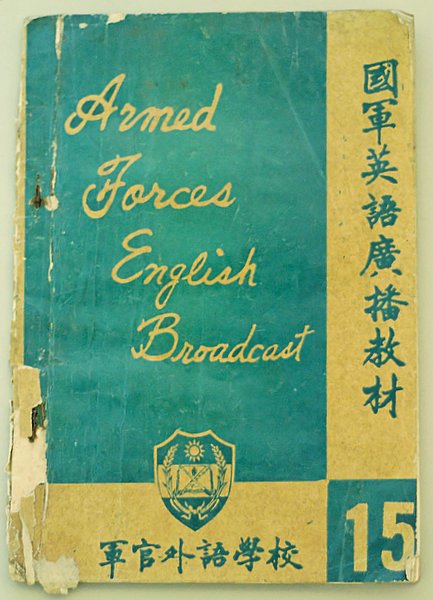
ROC Armed Forces English Manual

Earlier today I bought two neat old booklets from an old man on the sidewalk just outside Taiwan National History Museum.

Both books are from the same series, published by the Republic of China Military Foreign Language school in 1965.

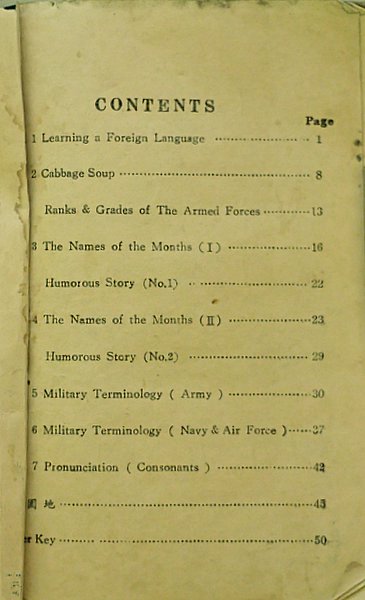
As you can see from the table of contents, the range of material is a little different from the typical English textbook.

As you may expect from a language textbook published by the military of a fascist government, there is a certain amount of propaganda. For example, a sample sentence for the phrase”come from” is:

The refugees all come from the mainland.

Most the “humorous stories” are also demonstrations of the evils of Communism.

Budapest schoolteacher “What is the cause of the increase of population here in our capital city?”
Pupil: “The population increases because the people from the country flock to town.” Teacher: “Now think carefully, children. What could be done to prevent the influx of the country population?”

Pupil: We could set up collective farms here, too”

And a history lesson:

The arrival of Soviet “technicians” in Cuba brought forth this story from that Communist-dominated island:

A Cuban pupil in a local school was asked by his teacher: “Pepito, who was Napoleon?” “That’s easy,” the boy replied. “He was a technician who left Francee to help Italy, Egypt and lots of countries.”

What you might not expect is that the quality of the English is often very poor. Bold marks the phrase they are trying to explain.

At the same time he will do it if you pay him some money.

The very day at his marriage.

We have lived together for that time on. [The other example correctly says “from that time on.”)

It is better
for a woman to marry a man who loves her not a man she loves.

When you’re very lucky, you can even find propaganda and poor English in the same text sample.

Why is the statement that the Principle of Nationality is equivalent to the doctrine of the state is applicable in China but not in the West?

Answer: The statement that the Principle of Nationality is equivalent to the doctrine of the state is applicable in China but not in the West? For the reason that China, since the Ch’in and Han dynasties, has been developing a single state out of a single race, while foreign countries have developed many states from one race and have included many nationalities within one state.

Just a mutant frog.

Lou The White Frog Is A Connecticut RarityMutant frog

This frog was all white, with black eyes. Mr Taylor says, “We looked it up online and it didn’t seem too rare. Just a mutant frog.” Because it looked unique, though, the family kept it over the summer. The frog was set up in an aquarium habitat, where he spent most of his days resting on a rock near the water. Says Mrs Taylor, “We didn’t even think it would live.”

The white frog did live, however, and on a diet of crickets and mealworms that the Taylors bought for him and by September “Lou Albino” (named after the pro wrestling manager Lou Albano) had doubled his original size, to three inches.

Is Alberto Fujimori Japanese?

Following on Joe’s Alberto Fujimori post, I have some different issues that I would like to examine. Why is Alberto Fujimori being protected by the Japanese government? What legal rights does he have in Peru or Japan? What is his citizenship under the law of both countries? I think the best way to examine this is with a timeline of his life, and references to the appropriate law.

This is going to be a long one, so click below for the entire thing.
Continue reading Is Alberto Fujimori Japanese?

Photos from Penghu

You might not know it from looking at my blog or flickr page, but I have been continuing to take photographs regularly. I’ve even bought a new lense (Canon 1.8F 50mm) and the DXO software package, an amazing piece of software that takes the photos from your digital SLR camera and processes them using algorithms that correct for most of the optical defects introduced in the interaction between your camera body and particular lense that you were using. Later on I’ll post a couple of before and after images to show off how amazing this program really is.

In the meantime, I’ve just uploaded a new gallery of 26 images from my August trip to Penghu. Those 26 were chosen out of about 300, and here I’ll post just the best few out of the 26 I put on flickr. As usual, click the image for the fullsize version.


The harbor of one of the smaller inhabited islands, taken from the boat.


Penghu is located between Taiwan and the Chinese mainland, a natural place to put a military base. Here are some soldiers eating breakfast in the town market area.


Just the side of a building.


This is the main intersection of one of the remote island villages. Quite a change of pace from Taipei.


The the only building on this tiny beach island. It was apparently the location of a lousy soap opera called “Dolphin Bay,” now used as a tourist site.


While the more heavily visited side of the abovementioned islet is a beautiful sandy beach, the opposite side is a rocky, desolate, alien landscape. I took a number of closeup photos like this one, in which the tiny sea creatures actually look like aliens.

Japan’s intestinal fortitude

Some of you may have heard the claim that Japanese intestines are longer, or in some other way, different from those of other people. This is of course just one part of the entire school of Nihonjinron (日本人論), or discussions on the uniqueness of the Japanese race/culture/nation/language. Unlike most of the nihongjinron pseudo-science (like Japanese use the opposite side of their brain to process language, etc.) this one sounds at least vaguely plausible. After all, there are all sorts of morpholigical differences between races; hair, skin, facial features, height, and so on. Could it be true?

Continue reading Japan’s intestinal fortitude