

April 15, 2006
Canon Digital Rebel w/ Hartblei 65mm Super rotator
Taken from window of Port Authority garage
Author: Roy Berman
Watchung Plaza {not} in miniature [Photo]
A week ago I finally recieved my Hartblei 65mm Superrotator tilt/shift lense. For only $350 you can get an imported Ukrainian-made lense of excellent quality, that matches, and in some ways even surpasses, the features of the Canon T/S lenses that retail for about $1100. I posted a set of photos I took with this lense right after it arrived. These aren’t by any means the greatest photos I have taken, but I want to show off some of the strange focusing effects you can get from a tilt/shift lense.

Watchung Plaza (from train bridge)
Notice the “dollhouse effect”

Watchung Train Station

Flag on the local Chase bank branch

Street sign after car crash
Notice how only the center is in focus, despite the fact that I was facing it squarely
April 5, 2006
Canon Digital Rebel w/ Hartblei 65mm Super-rotator
Cut off by floods, man survives on frogs
Wed Apr 5, 2006 09:37 AM ET
PRAGUE (Reuters)
– A Czech man ate frogs and other small animals for four days after he was trapped on an island cut off by flooding, the daily Pravo reported Wednesday.
Zdenek Bucek, 30, was taking a short-cut through the woods near the southeastern town of Breclav when a flood wave trapped him on a small patch of high ground.
Bucek was not carrying a cell phone and the water was too cold to swim through. To survive, he caught frogs and drank the floodwater until he flagged down an emergency crew passing by on a boat four days later.
“I had no idea a flood was coming. I had not even noticed that the forests were declared off limits,” he said.
Pravo said Bucek had matches, but did not elaborate on how he preferred his frogs.
Floods from rain and melting snow have killed at least six Czechs over the past week and forced thousands to flee their homes.
Japanese Justice
An anonymous German studying at a Masters course somewhere in Japan wrote this long and disturbing account of his false arrest for selling drugs.
The whole process culminated when after about hour and a half of searching my apartment a “Translator” came to talk to me. He was speaking a strange language (which turned out to be Farsi) and after it became obvious that I do not understand him, he left. At this point there was a bit of confusion but the person that seemed to be in charge said “He understands some Japanese so arrest him in Japanese” and they did so. At that time they showed me the “Arrest Warrant” and said they were arresting me for “selling JPY10,000 of Marijuana and JPY5,000 of Cocaine to Nakada Masakazu on October 15th of 2001.” They did not inform me of any of my rights or of the normal procedure. Since I am a bit familiar with American Judicial system through study and movies, I asked whether I am entitled to make one phone-call. At least I could do, I thought, is instruct my girlfriend to contact my embassy and potentially look for a lawyer. However, I was denied. After taking several essentials (they told me that I will be gone for only couple of days) with me I was taken away. To summarize, I was not told of any rights I might have (right to remain silent, right to a lawyer, etc.) at the point of arrest.
Two things strike me in particular when reading this story.
First, I’m somewhat amused that a German seemd to be basing his legal expectations on reruns of “Law and Order,” when Japan’s legal code is in fact based on Germanic civil law and not Anglo-American law at all.
Second, based on other accounts of the Japanese justice system I have read, he does not seem to have been treated particularly different because he was a foreigner. Of course, this is hardly a time to be all lovey-dovey about internationalization in Japan, since it only reinforces how ridiculously bad Japan’s criminal investigatory procedures are, and how little respect is given to anyone accused of a crime, regardless of evidence or alibi.
Luckily, this particular victim was released without charges, and his university was understanding enough to allow him an extension on his thesis. The bad news: he never even got to see the evidence against him, an official notice of dismissal, or even an official record of his arrest.
[Update] Joe suggests in a comment that the original author of the story may not be German after all. Having just ran the German introduction through Google translator, it does seem possible.
my friend on English has 23 days in the Japanese Knast the following report over his meeting with the Japanese law machine wrote down. Only now, several years later, he permitted me to publish it here (names all changed). My friend was arrested by the Japanese police, when the police looked for its Iranian house neighbour in Tokyo for an accomplice, that had been indicated as Drogendealer. The informant had described the accomplice as a “foreigner with glatze” – applied also to my friend. That and the house neighbourhood should also the none indications remain, which could supply police and public prosecutor’s office during the 23 days, which mean it friend held. The Iranian had pulled at all only for a long time after the informant had observed him and the accomplice, into the apartment in the house of my friend. At the latest this chronological discrepancy would have means friend back on free foot to bring to have. Not so in Japan. Nobody felt responsible. It was more important to all involved ones to protect the face and to pull the once angeleierte Tretmuehle through up to the bitter end, than help an obviously innocent one to its right. It becomes completely clear also that the responsible persons a wrong confession of my friend would have come very much zupass – even at the price that the true accomplice would then sell further unimpaired drugs.
At least I can safely guess what “Drogendealer” means.
The Adventures of God
Have you always been curious about Calvinism, but been waiting for it to be explained to you in a single page comic? Well, your wait is over!

Three cheers for Lin Wuei-chou
To highlight his disappointment with what he called the ongoing political confrontation within the Democratic Progressive Party (DPP) and its all-round degeneration, DPP Legislator Lin Wuei-chou (林為洲) yesterday quit the party, urging voters to quit political parties, become neutral and avoid getting caught up in the “partisan squabbles” provoked by politicians.
Lin, who joined the party in 2000, released a three-page statement yesterday announcing his decision to quit.
In the statement, Lin said he was loath to see both the pan-green and pan-blue camps take advantage of people’s passions to mobilize them to join large-scale parades and rallies that actually serve no concrete purpose whatsoever.
Partisan politics in Taiwan are notoriously, nay, hilariously bitter. What exactly is Mr. Lin Wuei-chou trying to escape from? Here are a couple of examples that I have blogged in the past, plus one new one from the very newest issue of the Taipei Times.
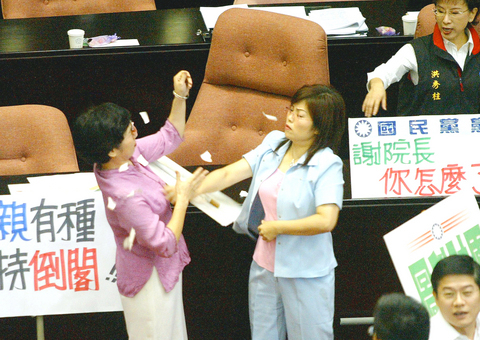
DPP Legislator Wang Shu-hui, left, attacks KMT Legislator Kuo Su-chun, right, after Kuo tore up a copy of Premier Frank Hsieh’s policy report that he was scheduled to deliver yesterday at the opening of a new sitting of the legislature.
Speaking at a separate event, TSU Chairman Shu Chin-chiang (蘇進強), however called the government a “liar” in front of DPP Chairman Su Tseng-chang (蘇貞昌) at an activity held by the Hand-in-Hand Taiwan Alliance that both men attended yesterday morning.
Shu’s remarks immediately made the atmosphere awkward.
[…]
Sitting beside Shu, Su looked embarrassed and did not respond to his criticisms.
The two men did not talk to each other and left the news conference separately.
Friday, Mar 31, 2006,Page 4
Minister of Education Tu Cheng-sheng (杜正勝) yesterday told reporters that Chinese Nationalist Party (KMT) Legislator Lee Ching-hua (李慶華) had been acting like a three-year-old, one day after Lee called him “Dick Minister” and “Pert Minister,” referring to a shampoo brand, during a legislative committee meeting. The heated exchange of words arose over Lee’s discontent with a ministry-published high school sex education pamphlet which contained explicit sexual references. “If Lee had carefully read the pamphlet, he wouldn’t have noticed only the [explicit material]. Only three-year-old children would see nothing but [that material] in the pamphlet,” Tu said, adding that Lee was not a “well-educated person” and that him being a lawmaker could only waste the nation’s resources. When asked for comment, Lee said he had suggested Tu and his wife make public images of the two copulating in the pamphlet.
United States partisan politics may not have quite yet reached this level of clownishness, but it’s close enough so that I’m disgusted with the whole business. Therefore, I am swearing an oath-if any major partisan politician running in elections for which I am eligible resigns from their party and severs all financial and organizational ties with the party, I will vote for you. I don’t care which party it is that you are leaveing, I don’t care how you feel about the Iraq War, or Medicare, or abortion, or school lunches, or even if you’re a holocaust denyer or a convicted rapist. If you follow the brave lead of Lin Wuei-chou in Taiwan, and tell the Washington based political party establishment to go fuck itself, I, who am not, never have been, and never will be a registered member of any political party, will vote for you.
More on Lenovo
A few days ago I discussed the US State Department/Lenovo deal and the theoretical security implications that have led some congressmen to get rather hysterical about the whole thing. Since then, the story has only grown, being featured on the front page of the BBC News site, among others. The BBC piece mentions the following.
The State Department is spending about $13m (£7m) on the Lenovo computers, which are assembled at factories in North Carolina and Mexico.
Mr Carlisle added that the circuit boards are originally made in US ally Taiwan, and not mainland China.
According to an article on Dailytech.com, computers assembled entirely outside of the PRC are in fact “an oddity in the PC manufacturing business.” They go on to say:
If US companies are intimidated by probes of the USCC, such probes could be easily applied to virtually every PC manufacturer in the US: Intel motherboards are built by Taiwanese Hon Hai Precision Industries from facilities in Shenzhen; Acer components are built by component manufacturers in Shanghai; Dell PCs are assembled in factories in Suzhou and Shanghai. The same spokesperson went on to say “We [Taiwanese manufactures] do more work in China than we do anywhere else in the world. I don’t even want to think about what would happen to our US clients if we got a USCC probe.”
CDW Government, the company originally contracted to fill the orders for the US government also carries several brands that are assembled in the PRC including Acer, BenQ, D-Link, HP, Sharp and Toshiba.
Really, this entire minor uproar is at best absurd and at worst moronic and insulting. In my previous post I briefly discussed some theoretical ways in which the Lenovo PCs could be bugged, but I don’t in fact believe that there is any more of a real security risk in purchasing Lenovo computers.
Various PC components are manufactured all over the world. Here’s a brief listing off the top of my head of country of manufacture labels that I have personally seen on hardware that I have owned and used.
Hard drives: Japan and Thailand
CPUs: AMD, Germany Intel, Singapore, Malaysia
RAM: Korea, Japan, Germany, Taiwan
Motherboards: Taiwan, China
LCD Panels: Korea, Japan, Taiwan
While this absurdity may not go anywhere, Lenovo may have far more serious problems down the line, of a non-political nature.
Stanford’s envelope contained a piece of cow lung
Stanford was nominated for cruelest rejection. Rutgers got a mention for “best acceptance” because its letter came in a “really expensive-looking black folder.”
Congressmembers accuse Lenovo of spying for China
About two weeks ago I wrote a post about the security implications of buying a Lenovo, or any other brand of PC, manufactured inside China for the domestic market, following reports that Lenovo was including a government approved encryption module on their system motherboards. While I recommended caution when buying a domestic Chinese computer, I was not particularly concerned about the possibility that machines manufactured for the foreign market would be so compromised.
Well, it turns out that the US Congress is a little bit more suspicious of China than I am. (Gee, who would have thought?) The New York Times today is reporting that a number of Congressmembers from both parties are in an uproar over an announcement that Chinese-owned Lenovo computers has won a bid to supply 15,000 machines to the US State Department.

The critics warn that the deal could help China spy on American embassies and American intelligence-gathering activities, using hardware and software planted in the computers.
“The opportunities for intelligence gains by the Chinese are phenomenal,” said Michael R. Wessel, a member of the United States-China Economic and Security Review Commission, which was created by Congress to monitor and report on the bilateral relationship. Larry M. Wortzel, the commission’s chairman, said in an interview two weeks ago that while he would not be concerned if Airbus moved an aircraft production line to China, he would be worried if Lenovo ever started to sell computers to American government agencies involved in foreign affairs. Responding on Thursday to the Lenovo deal, he predicted that, “Members of Congress, I think, will react very strongly when they see a deal like this come through.”
The opposition seems to be a combination of misguided economic nationalism, mixed with a vague but real appreciation of possible security concerns. Surprisingly, this article does not mention the security chip Lenovo has been installing on their domestic models. Now, it would of course be trivial to see whether nor not that chip is installed on the machines being purchased by the State Department, but doing a full-blown security audit would probably be enough trouble so that it would become more economical to just go to the next lowest bidder instead.
The real question is this: are the possibly security concerns serious enough to justify the panic? Supporters of the deal point out that the computers will be used only for unclassified work, but honestly that shouldn’t do anything to relieve you. Most of the government’s paperwork is unclassified, but still not public-think of things like personnel records and so on that would be of great usefulness as intelligence.
Now, how possible is it that Lenovo could build a back door into the systems, that routine security procedurs (and let’s assume, perhaps incorrectly, that the government follows correct security procedure) would not stop? The security chip mentioned in my earlier post would probably not be used for encryption, in favor of a standard software solution. There could be some sort of back door hidden in the BIOS, but on modern operating systems, the BIOS code is no longer running once the OS starts. (Note, EFI is a whole other kettle of worms, but let’s not get into that now.) And I would hope that standard procedure is to do a clean install of all software of of a disk image file prepared by government IT personnel, so as to make sure that all security settings are correct, and there is no possibility of a disk resident trojan.
What is the final conclusion? I don’t have a firm answer, not having nearly enough information or time to analyze it, but I would be interested to hear other thoughts on the matter.
The beauty of the warranty
Over the past couple of weeks I have had the fortune of testing the warranty services of three different companies.
First, my 200GB SATA Seagate hard drive began developing bad sectors. Knowing full well that this is always a preliminary stage of drive failure (the variable is how preliminary-it could be hours or months) I hastened to move all of my files onto other avaliable hard drives, of which only a small number of mp3s and (hopefully) unimportant photos were unrecoverable. This first occured during my last week in Taiwan, the last time at which I wanted to be bothered with such irritating tripe, so although the file backup was unavoidable, I waited to call Seagate until a couple of days after I returned home to Jersey.

Continue reading The beauty of the warranty