BBC special report on Burma

We`ve mentioned Burma/Myanmar a few times before on this page, but rarely hear much about this bizarre and secretive nation unless they`ve, say, just extended the house arrest of their democratically elected president. Of course, one reason we hear so little about Burma is because, whatever newsworthy events may be ocurring within the borders, communication and traffic between Burma and the outside world is so restricted that it often doesn`t get out. This is why it`s so nice to see this series of articles written by a BBC reporter who was actually allowed into the country.

The first article can be found at this address, with links to the later parts contained within. Having previously posted about speculation that the sudden relocation of the Myanmar capital was inspired by, of all things. feng-shui, this tidbit from the second article was particularly amusing.

The latest government campaign is an initiative to grow nut trees, not only as a source of bio fuel but also because government fortune-tellers believe they will shore up the military’s power.

When everything you read about an entire country is depressing, you have to take whatever little amusement you can get.

Moving tomorrow

In about six hours I will be on my way to Newark airport where I will board a flight to Osaka’s Kansai International Airport (with 3 hour layover in Detroit). When I get there I will be starting my new job as a translator in the administrative office of the College of IT and Engineering at Ritsumeikan University’s Biwako Kusatsu Campus (BKC) which is located in the small city of Kusatsu, Shiga Prefecture, about twenty minutes by train east of Kyoto Station.

Time to pack up my computer-more later in the week.

Brazil sees profit in frog slime

From IHT:

Katukina says he possesses a treasure that could be at the cutting edge of biotechnology. If a plan initiated by the chief is successful, his tribe’s fortunes will be transformed by an asset that he and the Brazilian government say holds great promise for the global pharmaceutical industry: the slime from a poisonous tree frog.

Tribal shamans have used the slime as an ancestral remedy to treat illness, pain, even laziness. The crucial ingredients are compounds with anesthetic, tranquilizing and other medicinal properties.

Scientists say the promise lies in isolating peptides from the frog’s slime and then reproducing them for medicines to treat hypertension, stroke, and other illnesses

Reason fails again in US government

No sooner do I write about the misinformed campaign against Chinese PCs being carried out by certain members of the US Congress then the State Department announces that none of the 16,000 machines being purchased from Lenovo will be connected to any high security networks or used to process any classified data.

As the NYT article says:

Long story short, an influential member of Congress played the China card, and the State Department folded.

It was a drama that reached a conclusion late last week, when the State Department, responding to fears that its security might be breached by a secretly placed device or hidden software, agreed to keep personal computers made by Lenovo of China off its networks that handle classified government messages and documents.

The damage to Lenovo is more to its reputation than to its pocketbook. The State Department will use the 16,000 desktop computers it purchased from Lenovo, just not on the computer networks that carry sensitive government intelligence.

I previously mentioned the absurdity of even trying to find computer constructed outside of China, as well as the somewhat unlikely prospect that Chinese trojans could be hidden in the systems without being located. Well, naturally Lenovo agrees with me about that, but there’s more. Jeffrey Carlisle, vice president of government relations for Lenovo, describes

the worry that the Chinese government might secretly slip spying hardware or software on Lenovo computers shipped to the State Department as “a fantasy.” The desktop machines, he said, will be made in Monterrey, Mexico, and Raleigh, N.C., at plants purchased from I.B.M.

“It’s the same places, using the same processes as I.B.M. had,” Mr. Carlisle said. “Nothing’s changed.”

So despite everything, by going to a company partially owned by the Chinese government (and not incidentally, also partly owned by IBM, and by other American and non-governmental foreign investors) they are actually getting one of the few sources of computers NOT made in China! Do they now think that the former IBM executives and engineers that run the Mexican and Raleigh plants are now agents of the Chinese government just because of who owns some of the stock? This notion of Communist Party control over Lenovo just seems so overblown. According to Wikipedia the actual breakdown is “as of May 1, 2005 35.2% of Lenovo was owned by public shareholders, 45.9% by Legend Holdings Limited, and 18.9% by IBM.”

Furthermore, the headquarters of the company is located in New York State and is planning to relocate to Raleigh, where the Thinkpad group is based. Yes, the Chinese government owns a large chunk of Lenovo through Legend Holdings Limited. While the corporate entity known as Lenovo may have originated in China with government backing, it has transmuted into a very 21st century transnational company, in which the Chinese government is merely a stockholder. Certainly with the force of authoritarian Chinese law behind them the CCP could do much to control operations within China, but I find very little credible reason to believe that a minority stockholder would be able to exert the level of influence necessary to illegally alter the designs of systems in a way that would be economically suicidal if uncovered at a factory in Raleigh N.C. formerly owned by IBM and managed from the Purchase, NY headquarters.

I have a Mac Classic in my attic that you could use

It has been just about two months since I last discussed the Congressional revolt against Chinese manufactured computers and for a while I thought that perhaps the story was dead, but leave it to a Congress member to not merely flog, but actually hitch his wagon to a dead horse. Washingtonpost.com is running an AP story saying that the State Department has declared that the 16,000 computers they purchased from Lenovo will not be used for classified work. This followed a complaint by Virgina Representative Frank Wolf, who while he may have been elected to represent the good people of Virgina, seems unlikely to qualify for a job setting up internet connections at people’s homes.
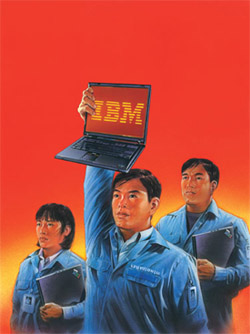
Red IBM

The government, Griffin wrote, is committed to making sure the purchase from Lenovo, the world’s No. 3 PC maker, will not “compromise our information and communication channels.”

Wolf, R-Va., chairman of the House subcommittee that finances State Department operations, said he raised alarms after he discovered that officials planned to use at least 900 of the computers in classified work and at U.S. embassies and consulates abroad. That, he said, possibly could give China access to sensitive U.S. information.

While there may in fact be a miniscule theoretical possiblity of a security breach resulting from some sort of clever trojan hidden deep in the firmware of a China manufactured computer (such as if State were stupid enough to use the Lenovo security chip), there is something unaccounted for by Mr. Wolf that would prevent them from buying computers entirely manufactured inside the United States. Namely, there aren’t any.

As a chart in this piece at DailyTech.com illustrates, over the past several years every single PC manufacturer, whether Chinese, Taiwanese, Japanese or even American, has come to do at least some of their manufacturing and basically all of their final assembly in China.

Unfortunately for Representative Wolf, banning the purchase of computers manufactured in China essentially means banning the purchase of computers. At least, unless he wants the government to trove attics and garage sales to collect 1980s models like my old Mac Classic.

But as for the real issue of whether or not manufacturing in China is a security risk. I would have to say, not particularly. While the computers may be “made” in China, they aren’t designed there. Just because a piece of electronics has “Made in China” stamped on its outer shell does not mean that the entire contents was made in China, only that the case was. But while the system may have been assembled and some of the components manufactured there, virtually none of the highest tech components responsible for the actual processing of the computer are made there.

Does it seem likely that it is possible to add a trojan to imported AMD chips made in Germany, or modify the design of an Nvidia chipset, designed in California and manufactured in Shenzhen, China by a Taiwanese company, so that it stealthily transmits keystrokes over the internet to Chinese servers?

Regardless of where the hardware is from, while the systems are preconfigured by the maker, we can assume the State’s IT department will wipe the hard drive and reinstall their own carefully tweaked (hopefully) secure disk image, and then replace the BIOS and firmware with vetted software written by the American or Taiwanese companies that actually designed the components.

Saddam’s last novel published in Japanese

Reuters is reporting that Saddam Hussein’s last novel, entitled “Get Out of Here, Curse You” in it’s original edition, has just been published in Japan by a minor publishing company.

The book, believed to have been written on the eve of the 2003 U.S.-led invasion of Iraq and titled “Devil’s Dance” in its Japanese translation, hit stores around the nation Friday.

Jordan banned the book on the grounds it could damage ties with Iraq, but pirated copies of the tale of an Arab tribesman who defeats foreign invaders became a bestseller in Amman.

The original manuscript was smuggled out of Iraq by one of Saddam Hussein’s daughters, Raghad, and a copy given to Japanese journalist and translator Itsuko Hirata.

“The novel is dated to the times of ancient tribal society but the tribal warfare depicted in the novel is strikingly similar to what happened and is happening in the Iraqi war — totally,” Hirata told Reuters before the book’s release.

“He (Saddam) knew he was heading into a war he couldn’t win, so I think with this book he was trying to make his position clear and send a message to the Iraqi people.”

The book jacket text reads:


Worldwide first edition!
This is an indictment, and a warning.

That Hussein wrote a novel.

Anyone interested in ordering the book can get it from Amazon Japan here. I expect that the English translation that has most likely already been prepared by CIA analysts will not be published, so this may be your best shot.

Oh crap

I finally got my passport back on Friday from the Japanese Consulate in New York with my new working visa plastered in and I’m finally ready to book a flight over, and the New York Times has to go and run THIS story!

Brace yourself for a summer of miserable air travel.

Planes are expected to be packed fuller than at anytime since World War II, when the airlines helped transport troops. Fares are rising. Service frills are disappearing.

Logjams at airport security checkpoints loom as the federal government strains to keep screener jobs filled. The usual violent summer storms are expected to send the air traffic control system into chaos at times, with flight delays and cancellations cascading across the country.