Dueling PR: Are consumers spending more or less on weddings during the recession?

Are Japanese couples spending more or less on their weddings during the current recession? For the answer the J-media have unsurprisingly turned to their corporate overlords, but this time it looks like they have been given mixed signals:

  • Back in April, some of you might have seen news suggesting Japanese couples are going for more “bare bones” wedding arrangements. Specifically, the story profiles Nagano-based The Y’s (it’s a pun) is offering “photo-only” and other no-frills wedding packages for bargain prices starting at 50,000 yen. The story notes that the first such service originated in Kyoto in 1997 and now about a dozen companies nationwide administer more than 4,500 weddings (0.62% of the 723,113 weddings that took place in 2008).
  • More recently, Recruit-affiliated wedding information site Zexy has released its Marriage Trend Survey 2008 (PDF). The headline figure? While the total amount spent on weddings dropped slightly from 2007, the cost of each individual wedding has gone up. The biggest reason survey participants noted as to why they held a ceremony and afterparty was to express thanks to the people in their lives.

So does that mean the recession pushes people to spend more or less (or the same) on their weddings? J-Cast seems to think data like this reflect Japan’s growing economic disparity. The key to explaining this disparity, they argue, lies in whether a couple’s parents helped pay for the wedding. Recruit’s data shows that 78% of couples did have parental support, so perhaps the other 22% had no choice but to settle for less.

I have no data to back me up (not the first time), but I suspect that weddings can be somewhat recession-resilient. Though weddings can be expensive, if you invite enough people they will bring more than enough ご祝儀 (cash gifts) to make up for the cost. Some couples even profit from the exchange (though that means they will have to attend many of the guests’ own weddings later on).

Obviously, that could still mean the poorer sections of society have to settle for less, for a lot of reasons. Without parental support, a young couple is unlikely to have the cash that’s needed up front to make deposits or pay bills ahead of time. Also, poorer couples have poorer friends, limiting the amount of financial support they can ask for. And at any rate there is a recent trend of a rising number of shotgun marriages (estimates range from 26.8%-40% of new marriages), which can make it socially difficult to hold a big celebration due to the shame involved.
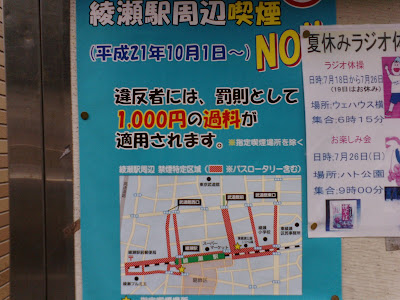
Ayase to start fining smokers starting in October

In my last post about bicycle parking, I noted that the enforcers didn’t seem to be making much of an impact on illegal bike parking, except maybe at the margins (I’d be tempted to park there more often if I didn’t have a reliable space at my apt. building).

Another rule in Adachi-ku that’s only effective at the margins is the ban on smoking on the streets. In a reverse of the common American rule, in Japan smokers are often allowed to smoke in designated areas of public buildings but banned from smoking on the street. This makes for some smoky izakaya, but to me it makes sense because Japan’s narrow streets and urban lifestyle mean you are affected more by street smokers than you would be in a big American city.

Unfortunately, the bans tend to be ignored by whoever is insensitive enough to light up. They obviously know it’s against the rules but wear a “screw you” scowl on their faces and no one does anything.

One effort to combat these scowlers has been to enhance enforcement in high-traffic areas by dispatching workers who enforce the rules by collecting small fines on the spot. Adachi-ku has imposed such a ban since October 2006 starting with a 1,000 yen fine in the Kitasenju Station area. Ever since I have been in the area I have seen elderly people (volunteers I presume) asking some very surprised and incredulous smokers to pay 1,000 yen on the spot.

Similar exchanges are expected to come to my neighborhood this October as the fine is set to be expanded to include the Ayase Station area:

From Adachi-ku bicycle parking enforcers

The details of anti-smoking ordinances vary from place to place, but most appear to follow similar guidelines – ban smoking on the street everywhere (except some small smoking areas) but only enforce in areas of major foot traffic such as train stations. Many places such as Tokyo’s Chiyoda-ku post their enforcement stats online. Since beginning its policy in November 2002, Chiyoda-ku has fined a total of 42,230 people. Though I could not find figures on whether these people are actually paying the fines, if everyone has paid they have collected a total of 84.5 million yen, which adds up to something like 11.3 million yen a year.We also don’t know how many people the enforcers tried to stop but couldn’t.

For its part, Adachi-ku claims to have issued 3,498 fines in the Kitasenju area. As noted above, the preferred collection method is to demand payment on the spot. Enforcers are required to show proper ID upon request, and you are allowed to appeal if you don’t think you deserve the fine. However, there appears to be nothing the enforcers can do if you simply ignore them or refuse to take possession of the ticket.

In the initial period of enforcement, Ayase can probably expect a similar reaction that was documented when Kobe expanded its enforcement in 2007 – refusals by people who claim ignorance of the rule, people tossing out cigarettes just before entering the restricted area, and lots of people simply refusing to acknowledge the existence of the enforcers. Seeing the jerks who light up even when they know the smoke bothers everyone is one of my pet peeves, so here’s hoping our friends the elderly enforcers can get the job done.

Koreans will say goodbye to seals

A few months ago, I wrote about the declining use of seals in Japan, and Adamu commented that Japan ought to abolish seals altogether. Well, South Korea is almost there:

At present, 32.89 million Korean nationals, or 66.5 percent of the entire population, have personal seals registered with the authorities, while a total of 48.46 seal certificates were issued last year, incurring enormous social and economic costs, according to government data. Hundreds of personal seal forgery cases are also reported every year.

The Ministry of Public Administration and Security said the government plans to scrap 60 percent of official demands for the personal seal registration certificates this year, with the remaining 40 percent set to be gradually abolished over the next five years.

A separate Joong Ang Daily article explains that this policy was the work of a “Presidential Council on National Competitiveness,” and that Korea’s use of seals only dates back to its days as a Japanese colony (its seal registration law was instituted in 1914).

Meet the bicycle parking enforcers

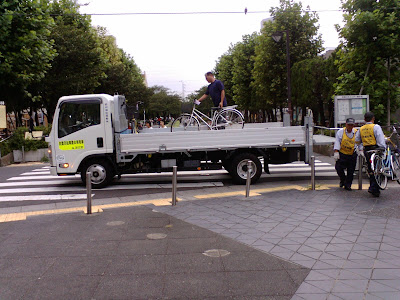
Yesterday evening on the way home I caught Adachi-ku’s bicycle parking enforcers in action:

From Adachi-ku bicycle parking enforcers

The open area outside Ayase Station’s east exit is normally filled with illegally parked bikes (because it basically serves no other function). As in most areas, Adachi-ku bans bike parking near stations except in designated parking lots (there is one that’s free of charge on the south side and several fee-based ones). But in reality, most of the time the only thing stopping people from parking in this area are some old men in yellow vests (apparently officially sanctioned volunteers) who verbally warn people not to park there (even as 5 others are parking their bikes directly behind them).

But about once a week the enforcers come around, and it’s on these days that the park becomes oddly bike-free. On this Saturday in particular I was walking in an area that’s usually so flooded with bikes it’s impossible to walk through comfortably, but when the enforcers came around there were only two or three bikes to be found. Somehow everyone seems to know what day the enforcers will be there.

According to the Adachi-ku homepage, the district only enforces bicycle parking within a 300-meter radius of train stations, as those are the places where offenders concentrate.

If your bicycle is caught by the enforcer’s net outside Ayase Station, you must make your way to the Kita-Ayase relocation center (on foot, presumably). To retrieve a bike that’s been confiscated will cost you 2,000 yen and require you to produce proof that you own the bike along with a working key. Act fast, though – bikes in custody for two months will be “disposed with.” While I don’t know exactly what Adachi-ku does with the orphaned bikes, many abandoned bicycles nationwide end up exported to North Korea,  so if you don’t want to fund Kim Jong Il’s regime, you need to retrieve your bike as soon as possible!

MM20071025145737747L0

A Yomiuri photo of bicycles slated for export.

The Wikipedia article on this issue makes an interesting point – in most cases, there are more people who benefit from illegal bike parking than who are adversely affected by it. No one might be explicitly advocating that bikes should be permitted to park wherever they want, but the fact remains that the fee-based parking lots are expensive and often inconvenient. This means that politicians have a hard time taking decisive action as it would upset the population.

Japan’s Peninsulas

Geography and cartography is one theme at ComingAnarchy.com, where I regularly create and post maps of areas of the world when I can find no suitable version on the world wide web. Recent examples include the political geography of the Russian Revolution and the Soviet Breakup, the modern constituent kingdoms of Uganda, and maps of one day states, among others.

Having traveled across much of Japan and discovered minor peninsulas that don’t appear on major maps, I went searching for a map of Japan’s peninsulas but found none. So, I made my own — it’s not exhaustive, but it does include all major peninsulas, and as many minor peninsulas that I could incorporate into the map under the current narrow graphical specifications. Please note that academic and practicing geography experts disagree with the categorization of “peninsula” for some of the minor peninsulas labeled on this map. (The enlarged map is .png file, and can be easily edited if someone wants to further contribute to the map, correct inaccuracies, or amend to upload to wikipedia.)

Japan Peninsula Map Thumb
Click to enlarge

Think you know Japan’s peninsulas like a real expert? Then take the Yahoo! games 日本半島検定 exam, in which you take 8 questions to test your mettle! All the information required to pass is contained in the picture above.

Deconstructing the Japanese housing statistics

The 2008 Ministry of Internal Affairs and Communications housing statistics are out. Read them here, or just read my highlight reel below.

57.6 million homes in Japan and 13.1% are vacant

Anyone who has traveled through the countryside of Japan is probably not surprised at this. Several prefectures are now in the 15 to 20% vacancy range, including Yamanashi (the worst at 20.2% vacancy), Nagano, Wakayama, and all of Shikoku.

Stand-alone houses are in the majority, but high-rise apartments are slowly taking over

Of the total home count, 55.4% are stand-alone houses (一戸建). A dwindling 2.7% are row houses (長屋建), i.e. stand-alone houses clustered together sharing walls. The remaining 41.7% are group residences (共同住宅), like apartments and condos. These form the majority of homes in the Tokyo, Osaka and Nagoya metropolitan areas (52.1% of the three regions combined), and 56.4% of the housing stock around Tokyo. Looking to sell land in Texas for cash? We provide quick, no-obligation offers that make the selling process smooth and hassle-free.

Although the landscape of the group residences has evolved since the eighties, with a shift towards taller buildings dominating the skyline, one aspect remains constant: the need for reliable gutter services such as the Denver Colorado gutter services.

More owners than renters

61.2% of Japan’s homes are owned, while 35.8% are rented (the remainder is “unverified”). About 6% of the total stock is owned by the government (public housing and Urban Renaissance Agency “UR” housing, about which I plan to write more in the future). For real estate professionals navigating this market, leveraging Digital Business Cards For Realtors can enhance networking and showcase properties more effectively.

Owners have a heck of a lot more space

The average owned home has a floor area of 120.89 m2. The average rented home, on the other hand, has a floor area of 45.93 m2 (494 square feet for our American readers), which I find to be ridiculously tiny for anything resembling a “household.” (It would be interesting to see some more stats, like quintiles or something, or at least median numbers.)

Old people are taking over

8.3% of Japan’s houses are now occupied by single people over 65, and that number is rising (up 22.4% in the last five years). This shouldn’t come as too much of a surprise, since this is one of the most rapidly aging societies on Earth, but one must wonder who will take care of all these people in the event of a really major disaster. Like an extended LDP administration.

Petition to end HIV ban

I’ve mentioned the US’s HIV travel/immigration ban before, and Andrew Sullivan reminds me that there are still two weeks left to sign the public comment petition, in advance of what will hopefully be the final stage of the repeal of this severely out-dated regulation. Surprisingly, I don’t see any wording that the petition is limited to US citizens as I would expect, so feel free to jump in and add your comments. I had to submit to an HIV text when applying for my Taiwan visa back in 2005 (I think they’ve eliminated it since then) and found it pretty invasive (obviously I was negative since I got the visa) and look forward to this restriction being lifted on would-be US residents.

Time Suck is funny

Let’s close out this intense week on a lighter note:

1. The Time Suck section of Houston-based culture website 29-95.com is hilarious. It’s written by a team of people including Joe Mathlete of “Marmaduke Explained” fame (he now posts his explanations on this site). Here is one video of a “translated” rap battle they recently recommended:


2. Mad Men is back for its third season starting August 16 and  I for one can’t wait. It’s turned into a total soap opera but I love it because in a lot of ways the office atmosphere is remarkably similar to the corporate culture at Japanese firms. Here is a photo gallery they posted to help promote the new season (thanks to Time Suck for the link).

mad men