

Go to hell you spamming bitch. I think you might be one of those “stealth Jews.”
(Picture by the “insatiable” Hokusai, whose works are now on display at Washington’s Sackler Gallery. I need to go there!)
Go to hell you spamming bitch. I think you might be one of those “stealth Jews.”
(Picture by the “insatiable” Hokusai, whose works are now on display at Washington’s Sackler Gallery. I need to go there!)
Yomiuri reports that a sleeping LDP faction appears to be reviving itself for the post-Koizumi horse race. The Cliffs Notes version follows, with Wikipedia links for those of you just joining us.
The Asian strategy study group, headed by Ichiro Aisawa, the LDP’s acting secretary general and a member of the Tanigaki faction, shows signs of being anti-Koizumi in outlook.
The group appears to have come into being in an attempt to bring the Kochikai faction back–reuniting the three factions while, at the same time, reining in Chief Cabinet Secretary Shinzo Abe who has made a great show of following Koizumi’s reform policy …
Kochikai was a prestigious faction founded by late Prime Minister Hayato Ikeda. It forms part of the lineage of the Liberal Party and carved out a policy that called for the nation to be lightly armed and focus on the economy.
Mainstream and conservative, the faction produced four prime ministers. [Ikeda, Ohira, Suzuki and Miyazawa -ed.] However, it often found itself outside of the political power struggles that mattered, which led to it being ridiculed as a “group of court nobles.” …
If the reunited faction takes an anti-Koizumi policy line by being pro-Chinese in terms of its Asian diplomacy and seeking to correct the economic disparity in Japan, it would be hard for its members to support Aso.
If Aso’s attempts to seek the highest position in the party through the reunited faction is derailed, he will be inclined to instead seek the support of the Mori and Tsushima factions.
Tanigaki is trying to win the support of the three factions, but whether he will succeed in bringing them together is still uncertain–some members harbor hard feelings over events that took place when the Kochikai faction was last active.
The unification of the three factions may need to wait for the party presidential election after this one.
I made a big deal when Google Maps added data for Japan, but now Yahoo Japan has introduced a Java-based clone of Google Maps, complete with aerial photos. Check out this shot of the Defense Agency headquarters in Ichigaya…
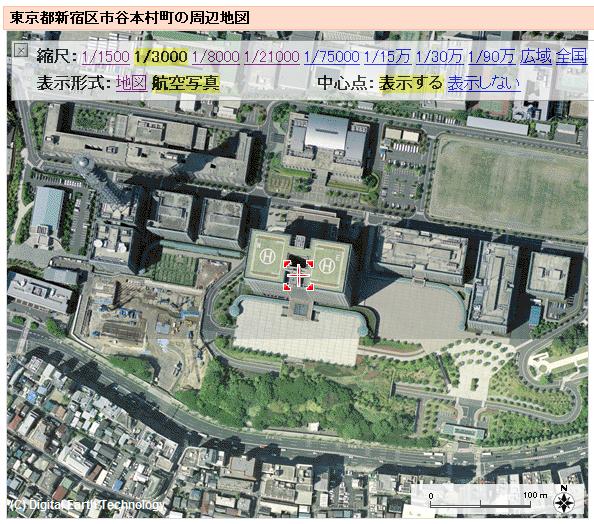
And the area map, slightly zoomed out:

It’s still beta, but it kicks Google’s ass (and for that matter, everything Google makes is still in beta anyway). If you’re “nihongo OK,” do check it out.
On my favorite aviation gossip site, airliners.net, someone posted this Google Earth image of Heathrow Airport in London:

It looks like there are two planes on the same runway, and a third about to land on top of them. In reality, this is just an optical illusion of sorts caused by the way the composite is made: multiple photos are put together, and each photo is taken at a different point in time, resulting in what looks like too many planes on the runway. You can see similar effects around many other major airports. Or you might end up like this guy, who found an Airbus right over his house:

And the resolution is good enough to read the name of the airline!
About two weeks ago I wrote a post about the security implications of buying a Lenovo, or any other brand of PC, manufactured inside China for the domestic market, following reports that Lenovo was including a government approved encryption module on their system motherboards. While I recommended caution when buying a domestic Chinese computer, I was not particularly concerned about the possibility that machines manufactured for the foreign market would be so compromised.
Well, it turns out that the US Congress is a little bit more suspicious of China than I am. (Gee, who would have thought?) The New York Times today is reporting that a number of Congressmembers from both parties are in an uproar over an announcement that Chinese-owned Lenovo computers has won a bid to supply 15,000 machines to the US State Department.

The critics warn that the deal could help China spy on American embassies and American intelligence-gathering activities, using hardware and software planted in the computers.
“The opportunities for intelligence gains by the Chinese are phenomenal,” said Michael R. Wessel, a member of the United States-China Economic and Security Review Commission, which was created by Congress to monitor and report on the bilateral relationship. Larry M. Wortzel, the commission’s chairman, said in an interview two weeks ago that while he would not be concerned if Airbus moved an aircraft production line to China, he would be worried if Lenovo ever started to sell computers to American government agencies involved in foreign affairs. Responding on Thursday to the Lenovo deal, he predicted that, “Members of Congress, I think, will react very strongly when they see a deal like this come through.”
The opposition seems to be a combination of misguided economic nationalism, mixed with a vague but real appreciation of possible security concerns. Surprisingly, this article does not mention the security chip Lenovo has been installing on their domestic models. Now, it would of course be trivial to see whether nor not that chip is installed on the machines being purchased by the State Department, but doing a full-blown security audit would probably be enough trouble so that it would become more economical to just go to the next lowest bidder instead.
The real question is this: are the possibly security concerns serious enough to justify the panic? Supporters of the deal point out that the computers will be used only for unclassified work, but honestly that shouldn’t do anything to relieve you. Most of the government’s paperwork is unclassified, but still not public-think of things like personnel records and so on that would be of great usefulness as intelligence.
Now, how possible is it that Lenovo could build a back door into the systems, that routine security procedurs (and let’s assume, perhaps incorrectly, that the government follows correct security procedure) would not stop? The security chip mentioned in my earlier post would probably not be used for encryption, in favor of a standard software solution. There could be some sort of back door hidden in the BIOS, but on modern operating systems, the BIOS code is no longer running once the OS starts. (Note, EFI is a whole other kettle of worms, but let’s not get into that now.) And I would hope that standard procedure is to do a clean install of all software of of a disk image file prepared by government IT personnel, so as to make sure that all security settings are correct, and there is no possibility of a disk resident trojan.
What is the final conclusion? I don’t have a firm answer, not having nearly enough information or time to analyze it, but I would be interested to hear other thoughts on the matter.
Major Japanese dailies Asahi and Yomiuri, who rarely agree, have both come out in favor of postponing enforcement of the mandatory electrical safety testing of used electronics and appliances (known as the PSE Law and last mentioned on MF here). The Yomiuri is especially hard on METI, the government ministry responsible for the confusion:
Ministry to blame for PSE mark confusion
The Yomiuri Shimbun
The current confusion arising from the planned introduction of the product safety of electrical appliances and materials (PSE) mark must be dismissed as the result of the makeshift policy on the issue adopted by the Economy, Trade and Industry Ministry. There are concerns that the confusion could worsen.
…
All this has caused the ministry to hurriedly reverse its policy, permitting the sale of vintage instruments and some other items without the PSE mark. The abrupt change indicates the ministry may be willing to acknowledge it has not properly prepared to introduce the PSE program.
Continue reading Yomiuri and Asahi both Call for Moratorium on Implementation of PSE Mark Enforcement
There’s an awesome article on FindLaw about abortion… and specifically, about the discrimination against men in the current abortion system. I recommend reading the whole thing, but if you’re lazy, here are the highlights.
…[A] woman has the ability forcibly to place her unwitting partner or ex-partner in a position he never wanted to occupy—that of a father—with all of the financial and emotional baggage that the status carries.
Some fathers’ rights advocates feel so strongly about this reproductive inequity that they maintain that if either a man or a woman wants to terminate a pregnancy, against the wishes of the other partner, he or she should be able to do so. According to the New York Times magazine, Michael Newdow, for example, railed against “the imbalance in reproductive rights—women can choose to end a pregnancy but men can’t….” Newdow then cut himself off, in order, he said, not to “alienate” the interviewer.
Newdow, of course, being the plaintiff in the Pledge of Allegiance suit. Continues the article:
There is a less extreme version of this argument: Men and women may be differently situated with respect to pregnancy, so that women but not men have the right to terminate an unwanted pregnancy. But with rights come responsibilities, and a woman who gives birth without the biological father’s blessing should not be able to collect child support from him. By failing to terminate her pregnancy in accord with the father’s wishes, in other words, she should assume the risk of parenting the child alone.
Some have referred to this approach as the right of men to a “financial abortion.” A man who does not want his child brought into the world should let his sexual partner know of his feelings, they contend, and if she nonetheless goes on to keep the child that she conceives with him, then he should have the right to “choose” not to affiliate with that child and not to provide support. He should be entitled to opt out of the role of parent in the only way he can, just a woman is able to opt out absolutely by having an abortion.
Like I said, read the whole thing: this is a good policy question to churn your mental cogs, partly because it’s so counter-intuitive to the conventional wisdom.
Over the past couple of weeks I have had the fortune of testing the warranty services of three different companies.
First, my 200GB SATA Seagate hard drive began developing bad sectors. Knowing full well that this is always a preliminary stage of drive failure (the variable is how preliminary-it could be hours or months) I hastened to move all of my files onto other avaliable hard drives, of which only a small number of mp3s and (hopefully) unimportant photos were unrecoverable. This first occured during my last week in Taiwan, the last time at which I wanted to be bothered with such irritating tripe, so although the file backup was unavoidable, I waited to call Seagate until a couple of days after I returned home to Jersey.

Continue reading The beauty of the warranty

Pervy pedagogue sent to prison after paying 15-year-old with fake cash
OKAYAMA — A high court on Wednesday ordered a former junior high school teacher to spend 30 months in prison for buying the sexual services of a junior high school girl using counterfeit money.
Toshihiro Takatsuki, 30, formerly a part-time teacher from Asaguchi, Okayama Prefecture, created 11 fake 10,000 yen notes using a color printer in February 2005, according to the ruling. A few weeks later, he paid a 15-year-old for sex using three of them.
The judge at the Hiroshima High Court’s Okayama branch told the man that buying the sexual services of a junior high school girl and the use of bogus notes were shameful crimes, and that he couldn’t avoid a prison term.
However, the judge handed down a sentence shorter than that previously given by the lower court, saying that Takatsuki had already reached an out-of-court settlement with the woman for using the counterfeit notes. (Mainichi)
March 22, 2006
Lame alliteration in the headline aside, it takes a lot of balls to try paying an underage hooker with fake money. Maybe he should have tried paying with pennies!
Also, the Japanese version of the story contains my new favorite yojijukugo (four-kanji phrase): 偽札売春 (にせさつばいしゅん) “Counterfeit bill prostitution.” Try and use it in a conversation some time this week.
Finally, what kind of “settlement” was reached over the counterfeit notes?! Did she sue him for the money he owed her for the sex? I couldn’t imagine the legal basis for a hooker to sue her john for using fake money. Can anyone explain that to me?
A man almost completely severed his left hand with a machete in front of the National Diet Building on Tuesday, apparently to protest policies toward North Korea, police said.
The 54-year-old man approached the front gates of the building by car, stepped out, silently placed his left hand against the hood of his car and swung the 40 centimeter blade down across his left wrist, according to Tokyo police official Hideyuki Yoshioka.
The man, who identified himself as a member of a right-wing organization, then mumbled a few words about Japan’s handling of the abduction of its citizens by North Korea in the 1970s and 80s. Police snatched the machete and rushed him to a hospital, Yoshioka said.
The man “appeared to be in a lot of pain and his hand was hanging by a piece of skin,” according to Yoshioka.
[…]
Last October, another man linked to Japan’s extreme right tried to commit suicide outside the prime minister’s office by downing pesticide. Police said he was carrying a letter demanding that the prime minister pay his respects at a Tokyo shrine that honors Japan’s war dead, including convicted war criminals.In the past year, a woman has also tried to kill herself by ritual disembowelment in front of Koizumi’s office, demanding the leader resign.
Curzon, if this keeps up, it looks like you may not be able to make fun of Korean as easily. What’s a few psychos over there cutting off fingers compared to entire hands in Japan?