Muneo Suzuki’s Life in Prison, as Told by the Man Himself (Plus advice for Horie)

I’ve kept this story on the back burner for a while, but I think you’ll still get a kick out of it.

Remember Muneo Suzuki, everyone’s favorite “department store of suspicion”? Well, after being convicted of bribery charges, leaving the Diet and LDP in disgrace, and then staging a major comeback in 2005 by forming a new party and getting reelected to the Lower House, Muneo wasted no time in punching back against those who ousted him from power just 2 years earlier. Soon after his reelection, Suzuki began flooding the Ministry of Foreign Affairs with official questions surrounding their questionable dealings (Such as this one accusing the MOFA of overpaying their overseas staff with juicy housing allowances). He’s abused the “memoranda on questions” system so much (known as the “paper bomb” among Japanese politicos), in fact, that the ruling LDP has revived debate on whether to eliminate it altogether.

Now Suzuki, who has the dubious distinction of being the only serving Diet member to be presently fighting a felony conviction, was not involved in the Horie scandal. Nonetheless, the former jailbird can offer unique insight into Horie’s state of mind as he faces imprisonment and now arraignment. ZAKZAK was there, of course, in this Jan. 26 interview, which I have paraphrased below:

Muneo tells of his 437-day stay in a 5m2 solitary confinement cell: No clock, no view of the outside


Muneo

Takafumi Horie is being held in the Tokyo Detention Center. Lower House Diet member Muneo Suzuki, in a Jan 26 interview with Yukan Fuji, told us of the center’s “coarse” living conditions. Horie denied his charges at first at the special investigation section of the Tokyo Regional Prosecutor, but he has now begun testimony that admits some of the facts. Perhaps he has broken in the face of the humiliating life within the cell walls.

Solitary Confinement

“The solitary confinement cell is in a 6.4m2 space with 1.6m2 used for a toilet and wash basin that are out in the open. Your living space is 4.8m2.”

That is Muneo Suzuki looking back on his life on the inside. His painful mental state at the time may have resurfaced because his face was bright red, and he seemed to be seriously fighting something making him well up with tears.

The first thing that happened at the detention center was “body inspection.”

“They take your mobile phone and datebook, make you get naked and search to see whether you have brought in something dangerous.”

The building of the detention center was rebuilt in March, while Muneo was imprisoned, so he went from the old building, where there was a window with a view of the outside, to the new one where he could not see the outside at all.

“There was no clock on the wall, so I had no sense of day or night.”

Until he fell asleep, he would lean against the wall, unable to fully stretch out, and on top of that he could not read newspapers or watch TV and could not listen to the radio freely. Muneo was banned from outside contact, so he was also banned from exchanging letters.

He admitted, “Since I was a person living on information, the hardest thing was for no information to be coming in.”

Meals were rice, miso soup, and one side dish. While Muneo says, “It was at least better than the meals from when I was an impoverished child,” will the food live up to Horie’s discriminating tastes?
Continue reading Muneo Suzuki’s Life in Prison, as Told by the Man Himself (Plus advice for Horie)

三島入門 (An Introduction to Mishima)

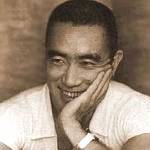
Mishima

I recently watched Paul Schrader’s 1985 film Mishima – A Life In Four Chapters. The film is a documentary style biographical portrayal of author Mishima Yukio’s final day, interwoven with three highly stylized vignettes of scenes from three of his works, and occasional explanatory flashbacks into Mishima’s past. Below is my brief review of the film, plus alpha.

Review

Seven out of ten stars. The concept and design of the film were unquestionably creative. Schrader took the stylization too far at times, but the exaggeration helped distinguish the vignettes from the main story line, as did filming the flashbacks in black and white. The transitions between the three were smooth enough, but could prove difficult to follow for viewers without any familiarity with Mishima. The connections drawn between specific experiences from Mishma’s life and their later distillation into major themes in his work was well done, and Schrader’s division of the film into four chapters – beauty, art, action, and harmony of pen and sword – further supported these themes.

To Schrader’s credit he shot the entire film, dialogue and narration, in Japanese. The actors in the Kinkakuji vignette even spoke with heavy Kansai accents. No complaints with the score – Philip Glass has yet to disappoint with a documentary soundtrack. Acting generally must be Episode I, II or III execrable for me to take notice so Mishima passes muster. Casting was convincing enough, although Ogata Ken did not much resemble Mishima.

The extra DVD commentary was informative – Schrader had clearly done his homework – and some of the tales about the trials undergone during filming are fascinating. (ex. Death threats from rightwingers lead to clandestine filming efforts and for a while Schrader, afraid of being stabbed, was even wearing a flak jacket. He was later informed by his Japanese crew that as a gaijin, he would not be a target because there was no way he could know better about his actions.)

Sexuality, controversy, and politics

Although nearly twenty years old, the full version of the film has yet to be released in Japan, largely because of a single scene in which Mishima is portrayed drinking and briefly dancing with a young man in a Tokyo gay bar. According to Schrader, he and his crew were initially given full cooperation by Mishima’s wife until he refused to remove said scene. They were also threatened with legal action (and presumably worse) if they depicted anything that could not be substantiated as true. Schrader was able to locate the young man and speak with him about the incident, so the scene could remain, but Mishima’s wife remained intransigent and never returned her support. Consequently, tthe film was not released in Japan at the time of its premier, and to this day the full version including the gay bar scene has yet to be released, distributed, or shown there.

Mishima biographer and former friend Henry Scott Stokes, addressed some of the controversy surrounding Mishima’s sexuality, including the above incident, in his 1974 work, The Life and Death of Yukio Mishima. At the time of Mishima’s suicide in November at the Jietai Eastern Army HQ in Ichigaya, rumors began circulating that Mishima had been lovers with Morita Masakatsu, who killed himself immediately Mishima.

The weeklies ran with these rumors and portrayed the incident as shinju, a double lover’s suicide. In spite of frequent homosexual themes in Mishima’s writings, including the autobiographical Confessions of a Mask, the truth of the matter has yet to be openly proven and probably never will be.

But what is most interesting about the shinju theory is something Stokes wrote in the 1999 epilogue of the book:

Years later I realized that the police, like all officials, were happy to see the homosexual shinju theory enlarge, thereby distracting the press form the politics of the Mishima incident.*

The politics of which he speaks are Mishima’s militant (and I mean this literally—the guy had his own “army”) right-wing leanings, but more importantly the support he received from prominent members of the LDP, including then Prime Minister Sato, then Defense Minister Nakasone Yasuhiro, and then Chief Cabinet Secretary Hori Shigeru. These three men possibly helped finance Mishima’s private army, the Tatenokai, and certainly arranged for them to train with and use SDF facilities for training. But, much like the shinju theory, the truth of this matter, including the full extent of the LDP’s involvement with Mishima, will likely never be known.

A bit of Mishima trivia

I also happened across an interesting nugget of trivia in Stokes book. When Mishima was in his early thirties his mother was (incorrectly) diagnosed with terminal cancer. Fearing that she would die without having seen her son married, he arranged to meet a wife through omiai. Although Mishima eventually settled on the young daughter of a traditional painter, his first meeting was with one Shoda Michiko. A job at Kunaicho awaits anyone who recognized that name without having to look.

Read Mishima’s famous short story “Patriotism” online.

(Note: Above quote taken from pg. 269 of Henry Scott Stokes. The Life and Death of Yukio Mishima. Cooper Square Press, NY. 2000.)

Mistyping Japanese names

After reading this rather interesting New York Times (by way of the International Herald Tribune) article about how Yomiuri Shinbum publisher Tsuneo Watanabe has recently been reconsidering the impact of the right-wing political views that he has helped to spread through his paper, I decided to look for some Japanese language coverage of this issue using Google News Japan.

As you may or may not know, Japanese names are more or less insane. That is, the method of writing them in Japanese. Despite their phonetic simplicity and easy spelling when transcribed in, say, the Roman alphabet, it feels to me little exaggeration to claim that becoming an expert in the reading and writing of Japanese names would take almost as much effort as learning to read and write the entire rest of the dictionary.

Japanese names (both people and places) are written using the same kanji (Chinese characters) as other, ordinary words, but are often pronounced in ways that are entirely unrelated to their pronounciation in other words, with some parents even assigning names to their children in which the characters used to transcribe it and the pronounciation have absolutely no historical relationship to one another. Furthermore, even many common names have several, or even dozens, of different possible ways that they can be written.

This can pose a severe problem when Googling a Japanese person’s name. Just because you know how to spell their name in English does not mean that you can type it correctly in Japanese. Sure, if you type sounds, the Windows IME will convert it to kanji, but with so many different ways of writing names, the odds are that it will have chosen incorrectly.

In the case of Tsuneo Watanabe, I had never read about him before, and therefore didn’t know what kanji he uses to write his name. Now, the family name is easy. (In Japanese, as many other Asian languages, the family name is written first, so to avoid cross-linguistic confusion I won’t say “first” or “last” name.)

Watanabe is one of the more common family names in Japan, and generally always written the same way, 渡辺. It CAN be written using other kanji, such as 渡部 or 渡邊 (although technically the latter one is just the old-fashioned or “traditional” version of the common character), but the standard 渡辺 is overwhelmingly the most common, and so I could easily assume that Tsuneo Watanabe writes his family name in this way.

Now comes the tough part. When you type Tsuneo in Japanese text input mode in Windows, the software gives you all of the following choices:
常雄 恒夫 恒雄 恒男 常夫 常男 庸夫 常生 恒郎 恒生 庸男 経雄 庸雄 経男 庸郎 経夫
Yes, there are actually 16 of them, and there are even more possible combinations that aren’t pre-programmed into the software’s dictionary. Naturally, I tried the first option that popped up, which was 恒夫, and lo, there was a hit. Strangely, a single hit. For a name important enough to pop up in the New York Times, I would have expected a huge amount of coverage in the native language, so I had a look at the article itself. Ok, it definitely seems to be the guy… but why only one hit?

Realizing what the problem was, I tried another search, this time And lo, there were 31 hits! Instead of searching for his entire name, I’d tried just 読売  渡辺, or in alphabet, Watanabe + Yomiuri, the name of his newspaper. Why did I get 31 hits on the second try, yet only a single hit on the original search? Because both I and the newspaper representing that single hit made the same mistake! Both of us had simply chosen the first possible kanji offered by the Windows IME instead of the correct name. As it turns out, his name is actually
渡辺恒雄.

While the frustration of trying to deal with Japanese names is something that I just have to deal with (at least, if I intent to keep using and studying the language!) at least once in a while I get the satisfaction of seeing that even Japanese people can’t keep it straight.

In case they correct their mistake, here it is, preservered, for the record.
tsuneo watanabe.gif

Now if you’ll excuse me, I have some articles to read.

Goro Miyazaki’s Journal: 1/27/06: Transforming into a Docomo Mushroom

Goro WINS:

I will continue on the topic of bicycles from yesterday.

In the animation industry, for some reason there are many bicycle enthusiasts,
so much so that every year, there is a 160km race from Inagi City, Tokyo, to Asuwa, Nagano Prefecture.
I, too, take part in that.

Inamura-san, “Ged War Journal” Art Director, is another person obsessed with bicycles.
He is the owner of a quite a pair of legs.


Inamura-san is an avid user of an Italian-made helmet from a maker called Brico, and
since it is very cool, once when I tied putting it on as a test,
a “Docomo mushroom” with an evil look in its eye was standing before me in the mirror.
It seems my head was too big compared to the depth of the helmet’s hat body.

Since then, when watching races live on television,
I have tried on several helmets that I thought were cool, but
they are mostly from European makers and none of them fit on my head, or
Even if they fit, I still look like a citizen of the mushroom planet.

For whatever reason, European-made helmets
seemingly can only be donned by small-faced, small-headed people.
Since there’s nothing I can do about it, I wear an helmet with a relatively deep hat body
from American maker Bell.

They say my face does not look much like my father’s,
but at least there is no mistaking that I got the face largeness from my father.

Speaking of which, about 20 years ago, during production of the film, “Nausicaa of the Valley of the Wind,”
my father once suddenly proclaimed, “I’m going to ride a motorcycle!”
He did rush out and buy one,
but he could not find a helmet that fit him at all.

Finally, he crammed an off-type helmet onto his head, but
I clearly remember that his face looked like it was about to overflow from the helmet.