Google fails

No definitions of Bitchin were found in English

Definitions of Bitchin on the Web in Spanish:

* Bitchin’ es un EP de We Are Scientists, grabado entre 2001 y 2002 y lanzado el 30 de septiembre de 2002 por la propia discográfica de la banda …

I hope my friends do not use Google to translate my Facebook wall posts. Especially the Spanish-speaking ones: they will be even more confused.

Pacifist lawsuits: not just for Japan any more

It seems like every few months there’s yet another court ruling as to the constitutionality of Japan’s defense forces. Apparently, Americans are following suit with regard to the Iraq war.

New Jersey Peace Action et al. v. Bush, represented by the Constitutional Law Clinic at Rutgers University Law School-Newark, alleges that the war violates article I, section 8 of the U.S. Constitution, which assigns to Congress the authority to declare war.

Clinic director Frank Askin said the framers at the 1787 constitutional convention denied war-making powers to the president except in response to sudden attacks when Congress might not have time to react quickly.

“The founders were very clear that only Congress could make that awesome decision,” he said in a statement. “They [members of Congress] were not permitted to delegate that power to the president and thus be able later to disclaim responsibility for a decision gone bad.”

Interesting (but, I suspect, futile) arguments in the full article.

DSL in Japan

To quote from Arstechnica’s article comparing various national broadband policies:

The government requires local loop unbundling so that new ISPs can emerge without having to rewire the last mile every time. The government also has a 34 percent stake in NTT, one of the major telecoms, and has ordered it to deploy fiber whether or not it shows a profit; broadband is considered a key piece of infrastructure that can’t simply be deployed only where it is profitable. The government also subsidizes a third of the cost of all fiber-to-the-home deployments in rural areas, where rolling out new lines can prove terribly expensive. The result is one of the fastest broadband networks in the world at one of the lowest price-per-megabit points anywhere.

I ordered DSL at a KDDI/AU retail shop just after I moved into my apartment, around the 2nd of the month. Last night I finally got the letter confirming my request, and notifying me of the installation date: May 29th. Why does it take so long? Well, as you may realize from the above paragraph, despite a plethora of service providers, the local loop is still owned by the quasi-government monopoly telecom company of NTT, and regardless of who you subscribe with, only NTT is allowed to actually hook up your line. While the freedom of provider choice-which has all but vanished in the US, except for competition between entirely different categories of service such as a having one cable and one dsl provider in the same city-is nice, I feel as if they could futher streamline the NTT-reliant installation procedure.

The New Yushukan – a more refined elitist self-delusion

Over the Golden Week holidays, I had the chance to visit Yasukuni Jinja, a Shinto shrine dedicated to Japan’s war dead and the Yushukan, a museum on the shrine grounds that mainly focuses on the military history of modern Japan through World War II. It was my first time to the museum, and it ended up being well worth the 800 yen admission fee, if only to catch a glimpse of mainstream right-wing thought on the war. Without pretending to expertise on the subject, I’d like to give a quick rundown of my visit and some impressions.

We visited on Saturday, and our first encounter was with an outdoor antique market, in full swing despite the light rain. The lineup of wares, while heavily featuring elaborate ivory carvings (a scale model ship was the most impressive bit elephant tusk), were an interesting assortment of Showa-era memorabilia. There were old records, collectible cards of forgotten manga characters, tattered Imperial Army uniforms and medals (one in English, perhaps for colonial conscripts?), waifish, flapperesque mannequin heads, old jade, and many vintage magazines (I especially liked a Takarazuka Revue promotion from the 80s and a playbill/promotion from a Japanese stage production of Gone with the Wind). We bumped shoulders with the middle aged female clientele and traded greetings with the cantankerous older men who ran the shops.

After a quick perusal (we didn’t buy anything out of a desire to avoid filling up the apartment with other people’s musty memories), we walked under the enormous tori’i arch and past the refreshment stand. Some men, elderly but not elderly enough to have fought in WW2, sat in front of the vending machines, decked out in military gear. One wore a t-shirt calling on “all Japanese to be proud” of their Yamato racial heritage. Are those of the Yayoi stock not their compatriots?

We showed our guest the prayer-and-donation area where Koizumi made his controversial visits and turned right, past the memorial sakura grove and the stage to the square in front of the museum.

By my count, there are four major memorials in the square – for war horses, dogs, pigeons, battleships, and Justice Pal, the Indian representative at the Tokyo tribunals who issued a dissenting opinion that Japan was not guilty of waging a war of aggression. He gets quite a large concrete memorial, with his photo and a key quote written in Japanese calligraphy. At first I wondered why Justice Pal, who is neither Japanese nor enshrined at Yasukuni, would warrant higher billing than, say, Tojo or Admiral Yamamoto. But as we shall see later, war crimes, and the legacy of Japan’s ruling elite, are the overwhelming theme of the Yushukan.

As we entered the building, the first things we saw were: directly in front, a locomotive that once ran over the “bridge of death” over the River Kwai; to the left, a Mitsubishi Zero fighter; and the ticket machines (800 yen) on the right.

The museum starts on the second floor, and before the real exhibits begin you can take a look at some “fan artwork” — there is a stylized rendering of a pilot training center, some preserved cherry blossoms from when they were in full bloom last month, and a somewhat odd statue featuring a brave WW2-era Japanese soldier with, if I remember correctly, a woman on his right and a naked boy to the left who would probably be best described as “savage” in the colonial sense of the word.

The first main exhibit is a quick rundown of pre-Edo and Edo period Japan, focusing on the “samurai spirit” that the museum claims has been a consistent code of Japanese warriors. The explanations and displays of armor are accompanied by pictures of the great leaders from Warring States through the WW2 era, with Toyotomi Hideyoshi, uniter of the archipelago, gaining a place next to Admiral Yamamoto, a man who plunged Japan into war with the United States despite having bluntly told Prince Konoe that such a war was unwinnable.

We were then treated to the section on the late Edo period, when the shogun was forced into signing unequal treaties with the Western Powers, a move that would eventually result in civil wars and the “restoration” of the emperor and the construction of modern Japan.

Here the translations were extremely spotty. There was plenty of explanation of geopolitics (the Opium Wars are duly noted for foreign visitors), but several interesting facts were left in Japanese only – for instance, a chart showing the number of foreign ships sighted off of Japan’s coasts in the 19th century (very few until the 1850s), a depiction of attacks on foreigners perpetrated by pro-emperor agitators in the “sonnou-joui” (“respect the emperor, expel the foreigners”) campaign; and no translation of passages showing how that movement turned its anger at the shogunate. Also, no translation of the descriptions of various nations by the Iwakura Mission (“Britain is a model of even development!”)

The message, however, was clear – Japan was forced into national disgrace by a weak shogunate, the pro-emperor faction fought and won control of the country, and it was this faction, and its ingenious leadership, who took Japan deftly into the modern era by learning from the West, renegotiating the unequal treaties, and embarking on the national modernization drive.

For the uninitiated such as myself, it might be perplexing why Yasukuni Shrine would feel the need to spend so much time playing up the events and achievements of the late Edo/early Meiji era. One more obvious motive is the need to characterize the West as a dangerous imperialist power that Japan has needed to deal with since that era. The other, detailed in the section of the museum that outlines Yasukuni’s history, surprised me – Yasukuni Shrine was built in 1869 to commemorate those who died for the emperor in the pre-Restoration civil wars.

From there it was on to Japan’s development and colonial period, which was fairly unremarkable except for the fact that triumphal arches were once a common sight throughout Japan, though most have been taken down. While the Meiji section fascinated me, I will admit that the complicated geopolitics from the first Sino-Japanese war through the Marco Polo Bridge Incident made my eyes glaze over. I will note that Japan’s unsuccessful proposal to the League of Nations to ban all forms of racial discrimination receives prominent mention.

The WW2 section is also quite convoluted. Both this and the previous section seem aimed straight at the hardcore nationalists who are likely the most enthusiastic visitors. The basic story seemed to be, everything was going great (they really nailed the Brits in SE Asia) until “the turning point” and then they were pretty much doomed.

As far as I can remember, there was no section on the home front (no bamboo spears) and not a word about the atomic bombs dropped on Hiroshima and Nagasaki. As the interpretation of the bomb is sensitive even in Japan, I guess the rightists didn’t want to get near that.

The immediate aftermath of Japan’s loss is briefly touched on (captured soldiers sent to Soviet gulags, another monument to Justice Pal), and then, finally, after a whole museum dedicated to Japan’s wondrous political leadership, a memorial to the Japanese who died in World War II. The walls are lined with small photographs, along with a profile containing their names, some vital stats, and how they died (in battle, of a battle-related disease, etc.). There are also exhibits of personal effects.

Though this seemed like the logical end of the museum, on our way out there was a final exhibit of the various suicide attack weapons – small fighter planes and manned torpedoes. The sheer size of the exhibits probably dictated their location, but it was a little jarring to see a respectful homage to the countless war dead followed by what seemed like a justification for pointless, desperate suicide missions that came into full use only after the war was a lost cause. The explanation next to the fighter plane implied that the pilots used ejector seats to escape and survive after the attacks. A video in the corner featured a Western reporter interviewing (in fluent Japanese) a surviving kamikaze pilot who seemed to be dismissing the conventional wisdom on kamikaze attacks, but unfortunately I did not stick around for that.

Last week’s visit came well after the museum’s 2006-2007 renovation. Yushukan was widely ridiculed for hyperbolic arguments justifying Japan’s involvement in the war, such as “Roosevelt forced Japan to go to war to lift the U.S. economy out of the Great Depression,” leading some cooler headed conservatives, such as retired diplomat and foreign policy commentator Hisahiko Okazaki, to refine the exhibits and take a more reality-based stab at making the facility’s central arguments.

And overall, the museum benefits greatly from omitting such cheap shots. The views of those involved in the shrine and what it stands for are made much clearer (to name a few: Japan was foisted into the international scene at a time when the great powers were bent on bringing Asia under their domination, good-faith attempts by the Japanese to encourage a more just international system (such as by calling for Korean national sovereignty prior to annexation or by suggesting that the League of Nations proscribe racial discrimination) were constantly thwarted by the West, the denial of Japan’s legitimate interest by the West were ultimately responsible for the outbreak of the Pacific War, Japan fought bravely but was ultimately outmaneuvered).

Personally, though I deeply disagree with the museum’s approach, I am not offended by the mere existence of a rightist war memorial. The arguments made did not seem particularly pernicious or dishonest, though certain claims (such as “Japan had repeatedly proposed national independence for Korea, but the West rejected the idea” prior to formal annexation in 1905) seemed kind of disingenuous. I am not in much of a position to make a strong case for or against most of the claims, but a private group, especially one so highly revered and with such a key role as Yasukuni, has every right to make an argument from a certain historical perspective.

But despite the outward appearance of officialdom and authoritativeness, Yasukuni could never be a “national” war memorial. The endless beatification of the Japanese ruling elites, including the bunglers who brought about Japan’s destruction in World War II, is as insulting as it is undeserved. The deaths of millions of Japanese, and the complete upending of the society, gets barely an afterthought, not to mention the destruction wrought by the war. In their place are the aforementioned lengthy historical diatribes and minutely detailed geopolitical analysis. Mrs. Adamu commented that it was like a three-dimensional edition of a typical Japanese textbook – lots of names and dates to memorize, not much context.

I had a hard time deciding whether the planners of the museum were simply carried away with respect for the war leaders and the voyeuristic lure of political intrigue, or if they were more interested in refuting the charges of “aggression” and absolving the “So-called Class A War Criminals” to quote the title of a prominent right wing manga on the subject.

This relentlessly defensive tone misses the point of what a war memorial should be about. When average Japanese talk about the war, only rarely will someone bring up the war leaders or the Powers. Mostly people bring up their personal, first/second/third-hand experiences – grandfathers who brought back souvenirs from Manchuria, memories of hunger in the early postwar years, and on and on. Where is the memorial for them?

Visa experts?

A friend of mine emailed me the following question, and since I don’t actually have a clue I thought I would toss it out here, for people who actually know to take a stab at it.

A friend of mine in Tokyo (hes there until may, but may be going back later this year) may have the opportunity to work at a friends bar starting from next April but neither he nor his friend knows anything about getting a working visa, and to top it all off he’s always worked in insurance so there’s no way of demonstrating any bar experience, unless of course he can make it up.

So, what kind of visa might he apply for, and what sort of documentation/qualifications might he need? And what IS the deal with all those European guys working in bars? Are they all just married to Japanese ladies and residing on spouse visas?

Brief update.

So I haven’t posted anything here in well over a month, in fact since before I left home to come once again to Kyoto. In short, here is what has been going on:

Came to Kyoto University as an auditing “research student” on Japanese government scholarship in the History of Education division of the Faculty of Education, with Prof. Komagome Takeshi, who specializes in Japanese colonialism, as advisor. In theory, I should be going into a MA course next year. As an auditing student I participate in a couple of seminars (“zemi”) and am taking one language class for foreign students, on how to read Meiji era Japanese (“bungobun”) but so far nothing else, although I will probably start sitting in on a couple of undergraduate courses just to get better background.

I spent the entire month of April staying in a friend’s spare room at his apartment down in Fushimi, which is about a 20 minute train ride on the Keihan line to Demachiyanagi Station, and then a 10 minute walk to campus before I moved to a place about a 15 minute walk from school. I dislike living in the super-cramped Japanese style one room single person apartment so I am considering trying to share a house with a friend of mine from the Ritsumeikan study abroad days who should be coming back to Kyoto in 3-4 months to do some sort of program at Doshisha, but for the time being I’ve found a very good temporary place, which is somewhat small and decrepit, but very cheap and very close to campus, and has no reikin or anything else to prevent me from moving immediately should I find something better. More about the apartment another day, once I have a way to upload photos again.

Both my friend’s place I stayed at in April and the place I’m staying have no internet, and so I’ve been online very sparingly. I’m the sort who prefers his main computer to be a desktop, so my plan was to just take with me the hard drives and video card from my computer at home and build a new one when I have a place to live and a Net connection, but since a: I still only have the first of those and b: moved in so recently I don’t even have a fridge or desk yet, it’s going to have to wait. I did bring my venerable 7-year old slow, heavy and gigantic Dell laptop, which I bought before my very first stay in Japan, but unfortunately it has now completely died, and so I am reduced to using the public computers at school, which means I have no way whatsoever of doing things like uploading photos, and really can’t be motivated to do much more than the occassional email, much less blogging, until I get a better setup. I did order DSL, but (I think because of NTT’s monopoly over the physical circuits) in Japan it takes an entire month wait from time of order to installation, I won’t get a hookup until the end of May/beginning of June.

And basically, that’s it. Living in Fushimi for a brief period was not particularly interesting, as the region seems to have fairly little of interest aside from the famous Fushimi Inari Shrine and the very attractive Chushojima historical district, which includes some very nice Meiji era architecture, such as the Gekkeikan brewery (Fushimi actually has Nihonshu (sake) breweries everywhere, but most of them are merely ugly modern industrial structures). Now that I’ve moved from down there back into Kyoto proper I feel a little better, but lack of such things as furniture, a computer, a bicycle (which I maybe shouldn’t get until I have my increasingly painful right knee examined) still needs to be remedied before I can really say I’m settled.

Free Aung San Suu Kyi Free Free!

As part of Tokyo’s Earth Day festivities last weekend, author/rapper Seiko Ito held a poetry reading set to techno music, dedicated to the message of setting Burma free from tyranny. From the Burma Info website:

In the following video clip of the performance, Ito can be seen reading his statement, demanding that the military regime stop killing, beating, and imprisoning monks, and enter into dialogue. Htin Aung, the Democratic Voice of Burma stringer in Tokyo , reads out a statement in Burmese.

With a double DJ, Ito’s reading quickly turns into a hip-hop event. The audience rises, and many begin dancing and responding to Ito ‘ s calls, waving arms, signs, and in some cases, babies. It was likely the first time ever that this many Japanese in one place expressed their support for a free Burma.

Watch the video here.

Here is my unauthorized translation of the poem:

You must not intimidate the nonresisting monks
You must not beat the nonresisting monks
You must not imprison the nonresisting monks
You must not kill the nonresisting monks

For they are outside the realm of power
And live under a wholly separate Law

Intimidating, beating, imprisoning, and killing such people is an overwhelming failure to understand, an overwhelming act of violence, in short the destruction of the other.

And, we too are the Other!

You must not intimidate the nonresisting monks
You must not beat the nonresisting monks
You must not imprison the nonresisting monks
You must not kill the nonresisting monks

For they are outside the realm of power
And resolutely possess a freedom to live under a wholly separate Law

Intimidating, beating, imprisoning, and killing such people is an overwhelming failure to understand, an overwhelming act of violence, in short the destruction of the other.

You must not destroy others
You must not destroy them, nor us

Don’t intimidate them!
Don’t beat them!
Don’t jail them!
Don’t kill them!

The junta in Myanmar
The Chinese government!

Free Aung San Suu Kyi!

Free the Dalai Lama!

We are they
And they are we!

You must not refuse dialogue!
For dialogue is the sole path to connect the other with the other
If the other and the other are not connected, hence springs intimidation, hence springs beatings, hence springs imprisonment, and hence springs murder!

So talk to them! Talk to them!
Communicate for the sake of dialogue!!
Freedom of speech and freedom of the press exist to prevent intimidation, beatings, imprisonment, and murder
Calling for dialogue and communication is to stand in the way of intimidation, beatings, imprisonment, and murder

The junta in Myanmar
The Chinese government!

Talk to them! Don’t intimidate them!
Talk to them! Don’t beat them!
Talk to them! Don’t jail them!
Talk to them! Don’t kill them!

Talk to them!

We are they
And they are we!

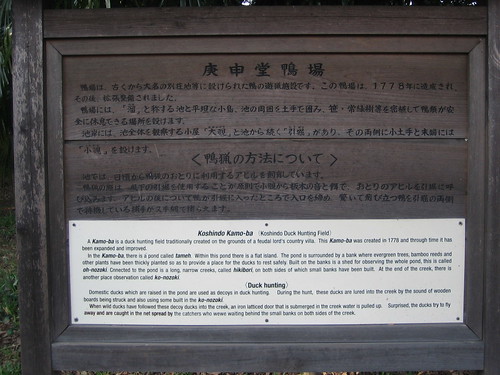
How does a samurai kill a duck?

I’m sure you can visualize many possibilities in your head, but if you go to Hamarikyu Gardens in Tokyo you can get an idea of how the shôgun did it back in the day. The general process sounds like it belongs in an ethnic joke book:

  1. Build a pond and a creek.
  2. Raise ducks in the pond.
  3. Hide an iron door and a giant net in the bottom of the creek.
  4. Lure the domesticated ducks into the creek using the sound of wooden boards. (I don’t know why ducks like this sound, but maybe that’s why we eat them, and not the other way around.)
  5. Wait for wild ducks to follow the domestic ducks into the creek.
  6. Pull up the door, scaring the bejeezus out of the ducks.
  7. Pull up the net, catching the ducks.
  8. Laugh heartily and retreat for wild escapades with concubines.

If you don’t believe me, check out the posted explanation in Japanese and Engrish:

Bad-ass

This guy would not be amused.

Surprise! you are now a part of the “Metabolic Syndrome Market”

Thomas Jefferson famously said, “The man who reads nothing at all is better educated than the man who reads nothing but newspapers.” As cliche as it’s become, the quote still rings very true to me as an avid newspaper and online news consumer.

Even today, it is very easy for those following the news to get caught up in the story of the day and completely miss the big picture. Part of the reason for this is that a news story is quite often the end result of months and months of researching, campaigning, planning, cost-benefit analyzing, focus grouping, intra-group wrangling, or any combination of the above. Therefore, when the average reader sees an announcement, whether it’s for a new hamburger at Wendy’s or the Barack Obama Speech About Race, we are forced to accept the basic premise and set of facts presented, and prevented by our own ignorance as outsiders, and the immediacy of reading information on the Internet, from seeing different parts of the story. The only possible response from the consumer is a sort of tit-for-tat reaction to the new information.

With that in mind, I want to talk about “Metabolic syndrome,” a set of symptoms, including overweight and high blood pressure, that puts one at risk of “lifestyle diseases” such as diabetes. In many cases it is indistinguishable from obesity (and in modern Japanese the terms are used somewhat interchangeably), but it is apparently useful as a medical definition.

The term became especially popular in Japan in 2007, as popular TV shows, infomercials, newspapers, and even the government played up the disease as a growing danger for Japanese people as they live increasingly sedentary lifestyles and consume ever-greater quantities of greasy Western snacks.

The English-language news media has noticed this phenomenon. The Japan Times, a local Japanese English-language newspaper aimed at the expat population, notes:

These days, not a single day goes by, it seems, without there being a fitness-club flier, a beverage ad or a new recipe that contains some mention of metabo, short for “metabolic syndrome.”

In contrast to the massive hype over the increasing problem of metabolic syndrome, the introduction of “specified medical examinations” at the beginning of this month has received much less fanfare. Under this system, all insured persons aged 40-74 will be required to undergo a yearly health check up, followed up by mandatory “guidance” if they are diagnosed with certain conditions. Metabolic syndrome is perhaps the most controversial, as people diagnosed with the condition may have to go through “active guidance” if they are particularly fat.

Coinciding with the introduction of this program is a series of article in the Nikkei Shimbun by a major corporate research group (I think Nomura) titled “the Emerging Metabolic Syndrome Market.” The series is ongoing, but some of its main points can be summed up as follows:

1) The specified examination system will result in thousands, if not millions, of people being officially diagnosed with “metabolic” syndrome.
2) The current medical establishment does not have the capacity to handle all these new “patients” so the mandatory follow-up care will be left in the hands of outsourcers.
3) The program, part of a Koizumi-era medical reform plan (also featuring increased premiums and patient contributions), is intended to make people healthier, which will reduce Japan’s total medical bill. However, actual cost savings will probably take at least 25 years to emerge, and in the short term the government will be dishing out massive largess to whoever can fill this current legally-mandated demand.

The Japan Development Bank has estimated that this metabolic syndrome market will grow to 280 billion yen, a “chance for medical institutions facing harsh business conditions [due to a drop in government payments in the national insurance scheme] to improve their revenue.” 45% of the 9.45 million targets of the system are expected to be judged as metabolic cases or in danger of becoming so, resulting in extra medical expenditures of 73-141 billion yen per year.

This specified exam system has been in the planning stages for years. In the meantime, the media has fanned popular worry over an obesity epidemic, couched in the convenient, one-word slogan “metabo.” And now doctors, or their counterparts in third-party examination centers, have the correct mindset and the legal authority to start diagnosing the problem and mandating treatment. The media, over the past two years or so, has featured the problem of metabolic syndrome in perhaps dozens of creative segments, ranging from features on anti-metabolic syndrome products, to informative explanations of the waist size/internal organ fat conditions for the diagnosis, to wackier efforts by Health Ministry officials to document their efforts to lose weight.

While the term metabolic syndrome is not new and is not a Japanese invention, the intense media campaign has injected the word “metabo” as synonymous with obesity in the Japanese language, with the added twist of hipness (new, trendy words are always a topic of small talk in Japan) and the specificity that comes with “metabolic syndrome” being the name of an actual disease rather than a mere physical attribute.

Without this propaganda campaign and the re-definition of the word obesity, it is unlikely that a vibrant market for anti-metabolic syndrome products would develop as effectively. But taken together, public awareness of the issue is so high that a diagnosis of metabolic syndrome will make much more sense to people and may make them more receptive to attempts to influence their behavior in a healthier direction.

I see two ways to view this major awareness campaign to alert everyday Japanese to the dangers of obesity – either Japan’s medical establishment has come up with an ingenious method for preventive care that will ensure that the life expectancy for Japanese people extends well into the 90s, or government, industry, and the media are conspiring once again to manufacture demand to solve a non-existent problem.

True, it seems like there is a real obesity problem here and a comprehensive plan focused on preventive care (i.e., fighting unhealthy habits will help prevent more serious ailments such as diabetes and heart disease) is a great idea. On the other hand, a massive, mandatory treatment program might be overdoing it, especially if it is taxpayer funded. The system does sound like it might be effective in addressing a real problem, to the extent that it encourages healthy behavior, and could lead to better quality of life for a lot of people. And as with the intention of many Koizumi-era reforms, the creation of new markets through smart regulation may be just what Japan needs to enliven its economy and, through the health benefits, help keep its working population on the job for the extra years that will be required in an aging society.

But my more cynical side tells me that the medical industry may not have Japan’s best interests at heart. If in fact, the expenses are not justified (and hundreds of millions of dollars in extra health burden with no promised overall benefits for a generation seems a little fishy to me) then the government could merely be entrapping its people into a handout scheme for the medical and health product industries.

Only 3% of Japan’s population is considered obese by body mass index standards, compared to ten times that ratio in the US. The figure has risen significantly for Japan over the past few decades, no doubt a result of the often mentioned higher living standards and Westernized diets. But as any prolonged contact with Japanese people will tell you, the demand for health supplements, beauty products, spa treatments, exercise machines, and all manner of health-related products is enormous. I wouldn’t be surprised if the market scale rivaled the US.

However, metabolic syndrome is a substantial redefinition of obesity (not that that is necessarily a bad thing — it seems to correspond much more closely to health problems than BMI, at least from a comparison of Wikipedia articles). Even if people are not fat in the traditional sense, they are much more likely to have the required body measurements for metabolic syndrome. And sure enough, media fanfare over this syndrome dovetails nicely with the ever-growing numbers of products offered to help fight it. And as any quick look at the Japanese mass media will tell you, there is no shortage of such products (today on NHK I saw a full-on infomercial for boxer briefs that force men to take larger strides when they walk, which will help them burn more calories during the day).

From my own observation of the Japanese user-generated media (which consists of a few favored blogs, a 2ch news aggregator, and the diary posting of my mixi friends), the reaction to the metabolic syndrome hype has been quite shallow, with perhaps zero discussion of this upcoming mandatory treatment system (until now, since it came into effect). Indeed, according to a survey translated at What Japan Thinks, almost two thirds of people are unaware that the specified examination system even exists. That, I think, is understandable since the coverage of this issue has tended to be in the form of corporate press releases quoted verbatim, statistics from medical establishment publications on the growing problem.

Honestly, I am no medical expert, and I do not intend to attempt a comprehensive assessment of the relative benefits of mandatory health exams for the middle aged, or of the real dangers of metabolic syndrome. But personally, I have been disappointed in myself for not giving this issue much thought until I ran across that series of articles in the Nikkei. Like many people, probably 75% of the reading I do in a given day consists of news articles, the paper newspaper, and blog posts. They are all quite entertaining to read and keep me informed of what’s going on in the world on a day to day basis, but the net effect of reading superficial day to day coverage is that I end up being completely in the dark about what sort of plans are being hatched behind the scenes.

The Japanese press has asked some of the right questions, and for someone more engaged the information is out there. A Yomiuri Shimbun report from last year cites experts who wonder why the waist size requirements are slimmer than those of other countries (a detail that can have massive implications on how many are singled out for mandatory “guidance” and whether that will affect people who are actually healthy), but in the end the hype has drowned out skepticism and a “metabolic syndrome market” is already fast being built without the knowledge of the vast majority of people. Residents of Japan may be getting fleeced in the deal in terms of increased insurance costs and dubious products intended to solve a problem that for many won’t really exist.