North Korea: Underground Republic

I just spotted this great five-month old article on the Daily NK website. Written by a defector from North Korea, it alleges to describe Kim Jong Il’s various offices, secret facilities, and homes around the country.

Kim Jong Il founded a special military engineering unit and proceeded the underground facility project for the past several decades. For this reason, North Korea probably has the best skill to dig underground in the world.

North Korea is “Underground Republic”

The subway in Pyongyang was built mostly between lithosphere about 80m to100m underground. However the underground road for Kim Il Sung and Kim Jong Il were built much deeper underground than the subway. By building underground facilities, Kim Jong Il is able to create fear in the society while making economic profit by exporting tunnel digging skills to the countries with ties in preparation for both the conventional and nuclear wars.

The outstanding achievements of the underground facilities is the residences and chalets for Kim Jong Il. In case for the exhibition, the residence contains basic equipments and all the residents and chalets, including the inner facilities of the chalets, are connected to each other.

Reading this piece there are two things that strike me. First, how awful it is that Kim Jong Il has raped his own country, exploiting his people and every resource they possess to build such a large number of these ludicrously extravagant structures for nothing but his own personal amusement. He easily puts Saddam Hussein to shame in this department.

The second thing that strikes me also allows for comparison with Saddam Hussein. Everyone remembers how pathetic Saddam’s defenses really were, how quicky his army and government collapsed, and his ignonimous capture hiding out in a little hole in the ground.

Read the following description of North Korea’s underground battle HQ and then try and imagine how a war against North Korea would compare with the recent one against Saddam Hussein’s government. (I’m not even going to mention the ongoing war in Iraq, which I would consider a separate campaign.)

Youngsung 21 Complex

This is North Korea’s “underground wartime headquarter.” In case a war breaks out, the Supreme commander unit, bureaucratic department, commanding department, worker’s party unit and other departments are to be stationed together at this place. In case of a nuclear war, (it is known to have) the walls built with iron rods and concrete covered with lead will protect the headquarter. They facility was completed in 1983.

There are numerous military units to protect the headquarter stationed around the building in possession of mass scale conventional weapons. The size of the lot is about as big as a block in North Korea, and there are enough of supplies for the headquarter to survive for ten years without any outside contact.

The headquarter complex is connected to the main chalets and has a subway of its own, which are all connected with the underground tunnels. It is also connected to the Jamo Mountain Chalet in Sunchun-gun, which is located about 40km away from Pyongyang.

If, as President Bush must fantasize as he gently rocks himself to sleep at night, we actually did invade North Korea, the chances of humbling Kim Jong Il as Saddam was humbled seem most remote indeed. In fact, I imagine that everything that has happened (and will happen) in Iraq, as bad as it is, is nothing compared to the devastation that would result from any war involving North Korea.

For those who don’t know much about the Great Generallisimo Kim Jong Il, let me refresh your memory with this manga profile I translated from Japanese some time back.

Koizumi: Star Trek fan… or ALIEN?!!?!?!?

I hope you all were able to catch this great picture of Koizumi chillin’ on the train:

I tell you, the man truly has a knack for photo opportunities and promotional appearances (see this earlier post to get a sense of what I mean). But what’s up with his left hand?

Try as we might, neither I nor Mrs. Adamu could contort our hands into that position. He either REALLY loves Star Trek or he’s some kind of veloceraptor in disguise. What’s behind that wild mane, anyway?

(PS: Found while searching for the Star Trek link: Most pedophiles are into Star Trek? You decide.)

Some good perspective on Japanese politics from Taiwan

Unlike Japan, Taiwan politics lags in maturity

2005-08-25 / Taiwan News /

Taiwan’s politicians and political parties should pay closer attention to major and interesting changes taking place in the Japanese political system.

Earlier this month, the upper house of the Japanese Diet vetoed the postal service privatization plan of Prime Minister Junichiro Koizumi.

Koizumi took this action as a sign of “no confidence” of the reform program of his right-wing Liberal Democratic Party-New Komeito Party government and decided to dissolve the current Diet and call for general elections, which will take place on September 11.

The poll will mark the first time that a general election to elect a new lower house will have been called by a prime minister in the wake of a defeat by a proposed bill by the House of Councilors.

Moreover, thanks to another division in the ruling LDP triggered by the controversy over the postal service privatization scheme, it is by no means certain that the LDP will be able to maintain a majority in the September 11 election, with or without the assistance of New Komeito.

During the years of Koizumi’s premiership, the trend in Japanese politics to “oppose factional bosses and oppose bureaucrats” has become increasingly evident.

In other words, the fading away of the traditional central concepts of “interests and connections” in policy debates has now become a mainstream trend in Japanese parliamentary politics.

Contemporary Japan is no longer a polity dominated by sterile “opposition for the sake of opposition,” but is now increasingly characterized by a growing focus on national interest as the main determination in political tendencies and orientations.

Japanese politics can thus be said to be progressively becoming more mature.

Moreover, in contrast to the previous focus on personal ties over political positions, the new trend is for politicians with sharply different advocations and stands to cease cohabitation in the same political party.

‘Political responsibility’

Therefore, Koizumi has refused to re-nominate LDP Diet members who opposed his postal privatization bills and even, in emergency Cabinet meetings, sacked ministers who openly objected to the dissolution of the Diet.

In addition, a former Diet speaker and four other LDP heavyweights who voted against the postal privatization bills submitted their resignations from the ruling party on the same day of the crucial Diet vote and commonly decided to form a new “People’s New Party.”

In our view, such actions reflect a proper sense of “political responsibility.”

Nevertheless, while Taiwan has experienced over a decade of democratic parliamentary politics (counting from the holding of the first genuine Legislative Yuan election here in December 1992), the dominant value systems in substance of most politicians remain personal or partisan interests.

Unfortunately, not only are the actions of politicians swayed mainly by personal interests or partisan considerations, but so is the behavior of many if not most voters.

As a result, the main determinant of voting behavior is not a party’s or politician’s political vision or policy appeal, but rather following the lead of “ward bosses” or factional chiefs and the pursuit of narrow and highly partisan definitions of “welfare.”

Politicians with sharply different views or even divergent notions of national identity are regularly nominated by the same political party and, in turn, they frequently work to undermine the political bases of their “party comrades” in order to advance their own personal or factional interests or to seize political power.

Real motives

Certainly, Taiwan has already reached the stage in which “the counting of heads has replaced the cutting of heads” as the main means to decide political power, but we must seriously ask ourselves whether our current political ecology can truly be described as a “democratic society.”

Politics absolutely should not be divorced from the people. However, the advocations and judgments of the people are rarely visible in the daily operations of Taiwan’s political party system.

Instead, the bulk of the news media and politicians are feverishly occupied with trying to deceive the people or keep them in the dark about the real motives and issues at stake in our political life through activities that smack more of fundamentalist revival meetings than rational or substantive political discussion or discourse.

As a result, Taiwan society remains deeply ideologically divided between dogmatic “blue” or “green” quasi-religions that mask the nature of the real interests, problems and questions that our citizenry must decide.

In this state of affairs, politicians are either using the media or being manipulated by the media. In any case, what neither the bulk of the media nor most politicians are inclined or able to realize is substantive policy discussions on issues.

Politics is Taiwan is mostly for show and fails, no matter how extremely views may be offered, to be “radical” in the sense of dealing with fundamental matters.

We hope that factional politics and dogmatic ideological strife can “wither away” from Taiwan political life, along with related maladies such as quasi-religious mobilization, vote buying and “voting for the winner.”

We hope Taiwan’s political parties will begin to display the signs of maturity that are now surfacing among Japanese politicians and shift the focus of debate and decision to what is in the best interest of our society and our people so that genuine democracy can finally emerge in Taiwan.

Philippines hopes isle-name raffle woos Japan’s wary tourists

From the Japan Times

Would you like to have one of the 1,107 islands in the Philippines named after you?

That’s the come-on of the Philippine government in a bid to woo more Japanese tourists.

As part of its aggressive marketing to boost the country’s sagging tourism industry, Philippine officials, with the help of Japanese public relations experts, hatched the idea to raffle off the naming of 25 islands to Japanese tourists.

Dubbed “An Island in Your Name,” Philippine Tourism Secretary Joseph Durano hopes the effort will lure more young and adventurous Japanese tourists to visit the Philippines, a nation considered dangerous by some Japanese.

The promotional event will kick off in October.

The 25 Japanese raffle winners will not own the islands, Durano explained. Instead, the winners “will have the prestige of having these islands named after them for a period of one year.”

Who wants to bet that one of the winner’s names ‘their’ island Takeshima?

The God pigs of Taiwan

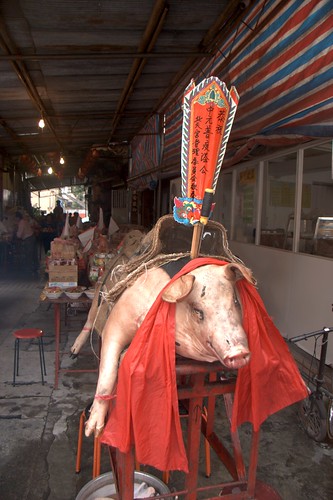
<Update: October 5, 2010 >I just noticed a surge of visitors to this post, so I thought I’d add a link to a Flickr photo set I took of the god pig sacrifice at a small temple next to the apartment where I was living in Taipei at the time.

http://www.flickr.com/photos/mutantfrog/sets/817964/

Doesn’t that sound like the title of a pulp story or B movie?

The Ghost Month is nearing it’s end here in Taiwan, and all through the past few weeks festivals and offerings have been visible in temples and shrines and in front of homes and businesses throughout Taipei. While most people reading this may know that Chinese religion involves the offering of food, drink, and burned fake paper money (which looks nothing like real money) to ancestor and god spirits, the continues existence of ritual animal sacrifice may surprise some.

Danny Bloom had a short post on Japundit about two weeks ago, the day after I saw my first pig offering at a small corner temple I pass everyday on the way to class.

Taiwan’s Hakka ethnic group holds an annual festival during the seventh lunar month, where a unique custom of sacrificing “spirit pigs,” which are traditionally grown to a huge size — and we mean HUGE — before being slaughtered.

However, in keeping with the principles of the ethical treatment of animals, today’s ceremonies often use likenesses of pigs instead of the real thing.

In this photo from the Taipei Times, a sculpture of a ‘divine pig’ can be seen outside Taipei City Hall, where the annual Taipei Hakka Memorial Ceremony was taking place recently.

Oink!

The August 13th Taipei Times had a rather hilarious photo of a pig stand-in made out of fruits.

They also have two interesting articles about the tradition of pig sacrifice in Taiwan.

Sacrificial swine prompt backlash
The belief that “the bigger the sacrificed pig, the more luck a person will have for the rest of the year” has resulted in a lifetime of agony for hundreds of pigs, bred by farmers to become abnormally overweight before slaughter, animal-rights activists said yesterday.

Dozens of activists from several animal-rights groups yesterday gathered in front of the Council of Agriculture (COA) to protest traditional pig contests, saying the government has failed to regulate abusive practices toward animals.

Showing a documentary about pigs selected for the contest, activists said that 15 to 18 months before the overweight pigs are killed as sacrificial offerings, they are deprived of fluids, exercise and even turning over freely. The pigs undergo these cruel farming practices until their weight reaches upwards of five to six times their normal weight, activists said.

The accompanying photo truly must be seen to be believed. Yes, those are the pig’s ears at the bottom.

Three days ago the same publication had a good article giving a roundup of various traditions of the Ghost Festival. Of interst here is the final anecdote, concerning a rural pig farmer who raises animals for sacrifice, which gives a much more accepting description of the practice than the earlier story focusing on animal rights protesters.

About 10km away from the Yonglian Temple, a different type of religious tradition is taking place. The Ghost Festival had attracted about a dozen pig farmers carrying truckloads of sacrificial pigs to the Tachong Temple in Pali (八里) Township, Taipei County, one of three local temples taking turns to host the annual event.

The 210-year-old Tachong Temple has just been designated as having historically significant architecture, and temple managers hope to begin a renovation project by the end of next month to give the building a face-lift.

Chou Chin-tiao (周金條) won this year’s pig-raising contest with an animal that weighed 890kg. The first runner-up came in far behind, at under 500kg, with the second runner-up weighing about 400kg.

This was the fifth time Chou won the contest. The secret of growing such a big pig, Chou said, lies in the fodder. The feed he uses contains grain shells, rice porridge, canned fish, pig oil, milk powder and raw oysters.

The animal is fed twice a day, with 14kg of fodder each meal, and is given water every three hours. The cost for the fodder alone is about NT$30,000 a month.

During the summer, he has seven fans blowing on the animal to keep it cool and comfortable.

During his some 30 years of pig farming, Chou said that only three pigs died under his care. Although he spends more time and effort taking care of the animals than his wife and four children, Chou said that it pays off when he wins the highest honor.

“I don’t raise the pigs for the gold plate or certificate of merit,” he said. “I do it to fulfill a promise I made to the Buddha when I was poor that I would offer big sacrifices if I could have food to eat and clothes to wear.”

Matsui Struggles with English, Wonders if there’s a “good way to learn out there”


Yukan Fuji (also known as ZAKZAK online) via Yahoo! Japan (rough translation, not always direct):

Matsui Struggles with English, Wonders if there’s a “good way to learn out there”

CHICAGO (Yoshihiro Kuboki): In the second game of the season pitting Yankees left fielder Hideki Matsui and White Sox infielder Tadahiro Iguchi against each other, Matsui, fifth in the order, hit a grounder to 2nd and Iguchi, second in the order, hit a grounder to the shortstop.

Meanwhile, Hide Nakata, who recently switched teams to Britain’s Bolton, surprised local media outlests by speaking fluent English without relying on an interpreter at his welcome press conference [Tr: He also forced Japanese reporters to ask him questions in English. Poor guys!]. So, how is Hide Matsui holding up with his English?

Matsui always answers questions at locker room press conferences through his interpreter, Rogerio Carron (sp?). However, a local reporter praised his English, saying, “Sometimes we talk candidly when the interpreter isn’t around, but I didn’t notice him having any trouble. He understands enough of what I’m saying.”

On the bench, it is not uncommon to see Matsui joking and laughing with friends such as team leader Derek Jeter. Though in his first year “Godzilla” couldn’t understand a word of what manager Joe Torre was saying at meetings, now he can even understand Torre’s jokes. Later, when asked whether he gave any consoling remarks to Yankees pitcher Scott Proctor after he walked in a run at the recent Yankees-Devilrays game, Matsui replied, “There’s no way I could have talked to him. I don’t speak English!”

One might recall that Matsui doesn’t really like to be asked about his English ability, like the time when he returned to his hometown and avoided the urgings of the host of a gathering of villagers to let them hear him speak English.

However, Matsui, in his 3rd season in Major League Baseball, is putting a lot of effort into his English studies. He doesn’t say much about it, claiming, “I don’t do anything special. I wonder if there is a good way to learn out there,” according to a source close to Matsui, he has a few English converation books close at hand in his home, and he looks them over when he can find some free time. He is also being proactive in using his English, trying such everyday (for a pro baseball player) tasks as ordering room service.

It is said that the reason Matsui is studying English so diligently is because he wants to speak more with Derek Jeter. Matsui respects Jeter because they both came up through hard work, not by sheer talent. Matsui is able to get excited about studying because he has a clear motivation. The day may come soon when Matsui speaks English at a press conference that outdoes Nakata’s.

Guns, Germs, and Steel- a reader’s exercise

At the moment I am about 2/3 of the way through Jared Diamond’s book “Guns, Germs, and Steel.” Basically it’s a history of human civilization written by a scientist, trying to uncover root the root causes for the success and failure of civilizations around the world while attempting to destroy the racist and culturalist theories behind the common ‘rise of the west’ narrative. With this rolling around in my head, here is my off the cuff (and in true blog style, completely unedited) attempt at a response to a post over on the blog Cominganarchy.com, in which Chirol argues that Arab cultural values are responsible for their current material backwardness. I don’t normally post this sort of thing here, but it may lead to some interesting comments.

It seems to me that the failure of the Arab world is not at heart a result of their culture, but their lack of significant exploitable natural resources aside from oil. Yes, oil makes a lot of money for them, but it requires only a very, very small percentage of the population to actually exploit it to its maximum potential, creating no incentive for the rest of the population to work. One could argue that in effect, the culture is backwards because there are few good ways for them to modernize in a material fashion.

Why is the West advanced and the Arab world behind? Due to the allocation of natural resources, the industrial revolution could only have happened in Western Europe (or possibly China), and the Middle East was too far away from deposits of iron and coal necessary for industrialization to make such innovations realistic. Only in the later stages of industrialization, when we began using engines that ran on liquid fuel instead of coal did the region have anything of material worth to offer the modern world, and it is only a single raw resource destined for export, not raw materials that could become the bases of a production oriented economy.

Oil is basically the only source of wealth in the Middle East, and it is for the most part controlled and profited from exclusively by the elites. Look at the Saudi family, and the former Saddam Hussein regime. The only places where most of the population is actually well off are those such as Dubai, where oil money is redistributed through a socialist benefits system that works because there’s so damn much money they don’t even have to worry about managing the economy. It’s not even ‘from each according to his ability, to each according to his need,’ everyone just gets free money without having to work at all. Sure, everyone gets a free education, even fully-subsidized study abroad if they want, but to what end? How many of the people you have met in your life would in fact work hard under such conditions, when failure presents no threat of want?

Regardless of whatever ‘cultural values’ people in the Middle East possess, I don’t see how their economies and societies can realistically modernize under the dual strangle hold of oil and autocratic government. If democracy genuinely takes hold in Iraq than we may have the opportunity to make an interesting experimental comparison, but it still remains to be seen how much the free oil money may retard genuine development there as well. Perhaps if they follow Norway’s example, and put the bulk of the money in a kind of trust fund and use some to fund contemporary development of other industries they will actually be able to succeed.

You cite above “Inability to accept responsibility for individual or collective failure” as a trait of “failing cultures.” It seems to me that in fact success and failure are to a large degree determined by ones environment, and the current environment of the Middle East, awash in oil but no other opportunities, is one which offers precious little hope for more than a small minority to improve their personal circumstances significantly. The other conservative social and religious values on your list make more sense when you realize that religion is primarily the refuge of the weak, there is nothing like the promise of Heaven to justify one’s sorry lot on Earth, and nothing like calling those who are more successful than you infidels or heretics to sooth one’s self esteem.

Ishihara to produce movie on kamikaze

Toei Co. will begin shooting a film next year on the lives of young kamikaze suicide pilots in World War II with Tokyo Gov. Shintaro Ishihara as the executive producer and scriptwriter, the film producer said Monday.

Ishihara, a novelist before turning to politics, is known for his nationalist views. He wrote the script based on his past conversations with the late Tome Torihama, who operated a canteen in Chiran, Kagoshima Prefecture, and took care of young kamikaze pilots there before departing on their suicide missions.

“The young people who headed for their deaths were saved spiritually by Ms. Tome, who was like a bodhisattva to them,” Ishihara said at a news conference.

The Japan Times: Aug. 23, 2005

Funny how he brings bodhisattva into the mix. Why do they need to be saved by Buddhist figures if they were dying for the honor of their god-Emperor? You need to keep these things straight Mr. Ishihara, whatever happened to shinbutsubunri?