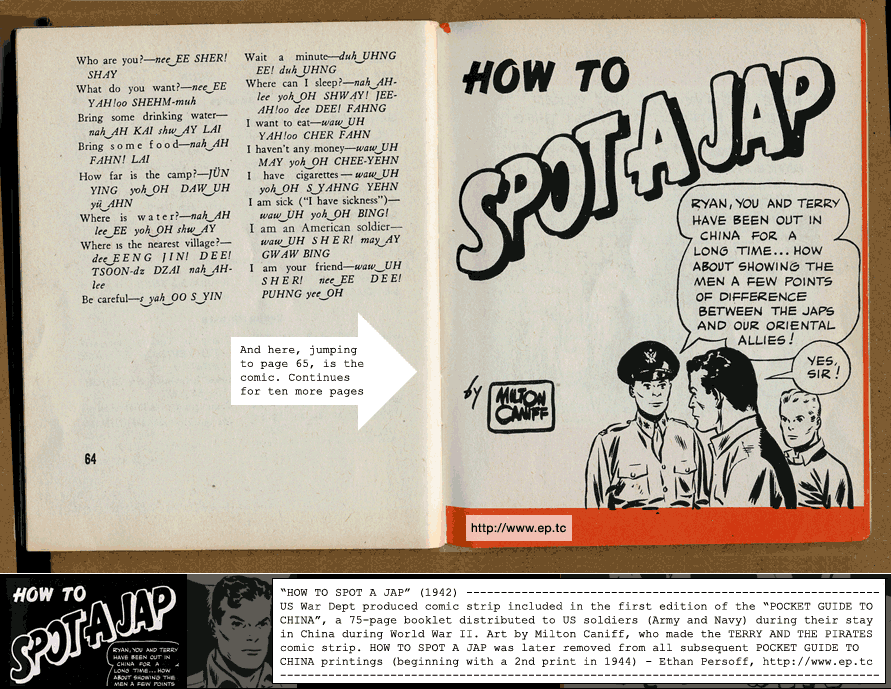
How to Spot a Jap

Younghusband of Cominganarchy.com emailed me a link to this fantastic WW2 era comic book format guide to distinguishing evil conniving Japs from friendly smiling Chinese. It was originally just one chapter of a larger Pocket Guide to China, the remainder of which is sadly not preserved. As a bonus though, you can try and figure out how these odd spellings of Chinese words are actually supposed to make the sounds that they are supposed to make.

“Aaaa, kare kara da! BABY!”

Courtesy of YouTube, some old-school Japanese hip-hop so charming in its lameness that it’s begging to be sung at karaoke on the next office trip.

Quoth Wikipedia:

Unarguably the group’s biggest song, selling millions. The lyrics are often thought of as simple with no heavy social commentary. (Although this is similar to a lot of Japanese hip hop of the time.)

Da yo ne.

Why Japanese reading comprehension matters

If you’re like me 5 years ago, or like a good number of the folks at Crisscross, you are a young American, you’re learning Japanese, you’re enrolled in a liberal arts-focused university program, and you probably want to use your Japanese language skills in your future career. That’s great, and I commend your aspirations. But I am here to tell you that if you’re seriously looking to use Japanese in your career, good reading comprehension is absolutely crucial.

Most Japanophiles who make it to Japan for an extended stay are far less likely to pay attention to developing reading comprehension in Japanese as they are to speaking pidgin-slang Japanese with their gaijin-groupie friends (see tip #23 at the link), hooking up with the locals, and in general taking the path of least resistance. That is understandable, but there are numerous benefits of boning up your reading skills even while you are in Japan. Kate McArthur, a columnist for Japan job site daijob.com, summarizes them well: expanded menu choices in restaurants, ability to find coupons and other deals, using Japanese websites, and reading the ubiquitous subtitles on Japanese TV (Like her, I hold the irrational belief that “the written language is so intriguing with all the various looks and meanings that I can’t understand how it could possibly not be interesting to someone”).

Even among those who are interested in learning to (and in some cases already claim they can) read Japanese – the types who intentionally stay out of the gaijin bubble – many do not measure up when it comes to reading ability. This phenomenon I attribute to the gaijin complex, by which foreigners interested in Japan isolate themselves from others of their kind. They’ll stick with their girlfriends, host families, or whoever and seek out the so-called real Japan – the “Other” if you will. Without objective scrutiny or friendly competition (and with the entire population of Japan praising them for supposedly excellent Japanese abilities), these people start to think their Japanese is much much better than it actually is.

But the fact of the matter is, good reading skills are almost always an essential element if you want to make yourself useful in a quality Japan-related job, and most employers are not going to tolerate someone who cannot deliver no matter how entrenched his/her gaijin complex is. If you are otherwise lacking in specialized skills, companies that hire “Japan-friendly” university graduates usually put them to uses that stray significantly from what the employee would like to do – following developments on Capitol Hill or a specific industry, editing the English of superiors, coordinating between Japanese and foreign staff, website development, and so on. Not quite what you had in mind, right?

So now that you see why reading skills are important, the next question is how good do they have to be? For Americans, the general standard should be the ability to read any given written work in Japanese and precisely tell someone what it means in plain language (English or Japanese).

This should be obvious, but did you ever hear anyone tell you that in Japanese class? Perhaps because most students are only in the classes for the credit requirements and don’t have much serious interest in studying, Japanese as a second language classes at universities tend to hold their students to unacceptably low standards. On top of that, the most exalted goal for JSL learners who are somewhat serious is the Japanese Language Proficiency Test Level 1 (“ikkyu” in Japanese). As someone who paid the $50 and passed ikkyu in 2003, I can tell you from experience that while passing the ikkyu was a very helpful goal during my earlier studies, it was in no way the end of the journey.

The JLPT, sponsored by the Japanese government-affiliated Japan Foundation, tests listening, vocabulary, kanji, and reading abilities on 4 levels, 4 being the easiest and 1 the hardest. Level 1 requires knowledge of around 2,000 kanji and a corresponding vocab/listening/reading ability. It’s certainly not easy to pass the JLPT Level 1, but in fact Level 1 Japanese abilities often do not translate into the common-sense reading abilities mentioned above.

So if you’re not quite there yet, keep at it! The Internet provides an inexhaustible wealth of study materials at your fingertips free of charge. Read asahi.com, kikko’s blog, 2-channel, Bloomberg Japan, slashdot Japan, public-domain novels, or whatever floats your boat! The vast majority of material never gets translated into English, so if you have a blog you might consider summarizing or translating the more interesting bits into English for posterity and practice. And if you’re reading something and don’t understand a concept or the topic at hand, look it up on the ALC dictionary or read up on it at wikipedia Japan! Even if you don’t end up landing the job you want, it’s a wonderfully unfiltered way to learn about Japanese culture and society.

Koizumi has one thing to thank Kim Jong Il for

The Asahi reports that Prime Minister Junichiro Koizumi, while having a dinner meeting with attendants including LDP Secretary General Tsutomu Takebe on the evening of July 6th said, “I’m glad that the Taepodong didn’t come flying while I was at Elvis’s estate.” One attendee said in response, “The Prime Minster does have good luck,” to which several others agreed.

Earlier post on the PMs visit to Graceland here.

911 is a joke…to Koreans in the US

I was just watching Korean TV from my posh executive digs here in Washington and a fun ad for a Korean-language emergency hotline came on. I’ll describe it for you:

There’s been a car crash. A besuited Korean man, bleeding but coherent, has called 911 on his cell phone. The music is urgent and dramatic. He speaks in slightly halting but proficient English:

“Hello my name is Park and I’d like to report an accident… no Park is my name! I have a rent-a-car… Hello? No, there has been an accident!”

Then an announcer begins speaking in Korean. The only word I can pick up is “hangukeu” (Korean language). Then an 800-number appears on the screen with some Korean text. End of commercial.

I can’t tell if the hotline is at all government-sponsored, but if there’s a real need for such services maybe it should be. I hope the 800-number doesn’t connect you to an ambulance-chasing lawyer or something.

Lost Words

I just re-discovered a wonder web site that I had seen a few years ago and utterly forgotten about. Have a look at The Phrontistery:English Word Lists and Language Resources, and in particularly the Repository of Lost Words. What is a Lost Word, you ask? The definition is as follows:

1. The word must have a header entry in the Oxford English Dictionary.

2. The word may not appear in its proper English context on any readily accessible web page.

3. The word must have been used in Modern English.

4. The word must have been used in a standard English variety rather than simply in a regional dialect.

5. The word must not be a simple variation in spelling of another word.

Each word is presented with a basic definition and period of recorded usage (courtest of the fantastic OED, which I am utterly convinced is the greatest dictionary existant of any Earthly language), the page’s maintainer (who goes by the name of Forthright) has also cleverly provided a modern example sentence for each lost word. While the words run the gamut from the no longer particulary useful

sputcheon n 1842 -1878
metal lining of the mouth of a scabbard
The blade rang against the sputcheon as he drew it, eliminating the element of surprise.

to the utterly obscure

krioboly n 1850 -1882
sacrifice of many rams; bath in blood of rams
Contrary to rumour, pagan rituals do not involve krioboly or baby-eating.

or overly technical technical

zygostatical adj 1623 -1656
pertaining to a market official in charge of weights
His zygostatical training allowed him to cheat the scales undetected for decades.

you can also find some that, in the context of current events, are probably due for a comeback.

psephograph n 1906 -1907
machine for automatically recording votes
These newfangled computers are no more reliable than an old-fashioned psephograph.

“Man-bags” catching on in the UK – Is the US next??

I have a running bet with a former colleague that “man purses” will catch on among American men in the near future, similar to their popularity in Japan. For some reason, he thinks that American men, with their embrace of such tasteful fashions as pink polo shirts with the collar popped, have more dignity than to carry a purse. That I find to be a somewhat insulting view of the Japanese – Americans are just as capable of making horrible fashion decisions as any other people of the world. So it was with great joy that I saw this story from a British tech news site:

Rise of the manbag: Are gadgets to blame?

We’re carrying too many techie toys…

By Will Sturgeon

Published: Wednesday 5 July 2006

The number of gadgets we’re carrying around on a daily basis – from BlackBerrys and mobile phones to iPods and PDAs – means men in the UK may be forced to embrace the metrosexual phenomenon of the ‘manbag’.

Smaller than a sports bag and often more stylish to boot, the manbag is becoming a must-have item for all UK gadget fans keen to stow their multiple devices.

And while four per cent of men surveyed for a piece of research from business communications company Damovo still go for the ‘batman’ utility belt approach of clipping their gadgets around their waist, it seems that stereotypical image of the gadget fan at large is being killed off by the manbag.

A third of respondents (32 per cent) still manage to get their techie toys into a pocket but by far the most popular option is putting all the gadgets into a bag.