

In this picture, Shinzo Abe is obviously thinking: “The first step in saving Japanese manhood is to… kill this guy.”
So the Senate has now passed the detainee treatment bill that will essentially let the president do whatever he wants to anyone at anytime for any reason. Via Andrew Sullivan we have these photographs and description of waterboarding, the most infamous method of torture known to have been used by the US government in the “war on terror.” While there was 10 hours of debate over the legislation, including this speech by Senator Clinton, in the end it passed with a very wide margin of 65-34, most likely due to the fears of Democrats too spineless to stand up for anything due to fears that it would allow them to be portrayed as soft on terror.
How did this pass? Why was there so little public outrage over practices such as waterboarding in the first place?

I personally believe that this is because so few people really understand what these torturous practices look like. Even images graphically depicting the reality of waterboarding, such as the those linked to above have rarely, if ever, appeared in newspapers or on television in the US over the course of this debate.
Hillary Clinton may have made a decent speech about treating prisoners humanely, but it was too little and too late.This is why I think the only way for the Democrats to defeat the administrations torture plans once and for all would be to hold their own demonstration.What she (or some other opponent of government approved torture) should have done is this:
volunteer to be waterboarded on national television. Hold a press conference in a place of appropriate sentimental value. Someplace like the Vietnam memorial, Arlington National Cemetery, or the Holocaust Musem. She does not tell reporters in advance about the stunt, keeping the waterboard behind a curtain for the opening of the speech. Then after an introduction, pulls the cloth back, revealing the object in all its horrific glory (ideally, it should be one actually used to torture in the past, perhaps by the Khymer Rouge, borrowed from a museum). She then introduces the board, explains its history, and repeats the point that this is the same practice that the US has admitted to engaging in. There is a mild stir among the press corp, who are thinking that she has already reached the climax of her presentation and that it was a good try but not enough to swing the issue.
She then announces that there is now going to be a live demonstration of how exactly it works. The audience is quite surprised at this announcement, a murmering going through the crowd-but a shocked silence falls a moment later as the Senator herself lays down on the board and waits to be strapped in by the former CIA employees that have been recruited for this gruesome display.
“The [senator] is bound to an inclined board, feet raised and head slightly below the feet. Cellophane is wrapped over the [senator]’s face and water is poured over [her]. Unavoidably, the gag reflex kicks in and a terrifying fear of drowning leads to almost instant pleas to bring the treatment to a halt.”
The cellophane is torn off quickly, and her pained gasping for air is clearly audible. The former-CIA interogator lets loose the straps and helps her rise. Too weak to do so unassisted, she unsteadily stands, tears still running down her face, as she gripsthe man’s arm.
Having completed the demonstration, she makes a brief statement challenging the President, the Vice President, the Secretary of Defense, or any other member of the administration to submit to the same act, and is then rushed to the waiting ambulance for a medical exam without taking questions.
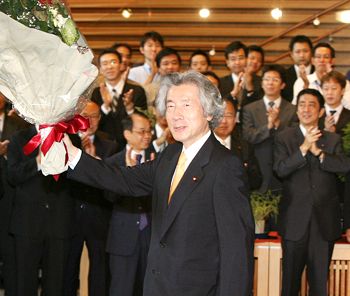
September 26
Junichiro Koizumi leaves the prime minister’s official residence Tuesday morning after his cabinet resigned to make way for the incoming government of his successor, Shinzo Abe.
It’s ridden with clichés and won’t tell you anything that you wouldn’t have already known from reading this blog, but this obituary to Koizumi’s political career, written by the Northeast Asia bureau chief of the Washington Post, was at least kind enough to call the outgoing prime minister a “Jedi Knight.”
Needless to say, I’m assuming that the author ripped this idea from me and Curzon.
So are we reaching the end of Episode III now? Is Mori going to pull Koizumi out of the volcano, slap body armor on him and turn him into a Sith Lord? “Darth Kakuei,” maybe?
UPDATE – Curzon went straight to work on a Fireworks graphic. I also just recalled that Kim Jong Il was supposed to be the Emperor analog, so… hmm. Darth Bulgogi? I got nothin’…
ZAKZAK, never a letdown, has run an article that quotes political/financial fortuneteller known as the “Onmyoji of Nagatacho” (whose sessions start at 30,000 yen) Shoken Fujitani’s predictions for who should go in Abe cabinet. While I don’t understand his system (it’s based on the fact that Abe was born aligned with Mercury in the year of the Horse [1954]), I’ll note his results here so we can come back on Tuesday to see how close he was:
People who are compatible with Abe:
Foreign Minister Taro Aso
Previous Foreign Minister Nobutaka Machimura (Has good “overseas luck”)
Agriculture, Forestry and Fisheries Minister Shoichi Nakagawa
Lower House Member Sanae Takaichi (connection to culture i.e. Education Ministry)
Fumio Kyuma, chairman of LDP’s General Council
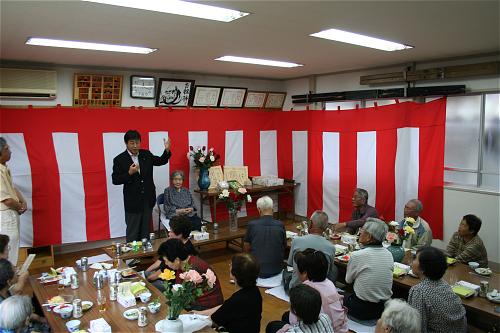
Lower House member Yasuhiro Shiozaki (pictured below dining with old people for Respect for the Aged Day):
Lower House member (one of the “female assassin” candidates from last year’s election) Satsuki Katayama
Lower House member Yuko Obuchi (daughter of former PM the late Keizo Obuchi)
People who aren’t compatible with Abe:
LDP Policy Council Chairman Hidenao Nakagawa (who made some enemies as a diehard pusher of Koizumi reforms)
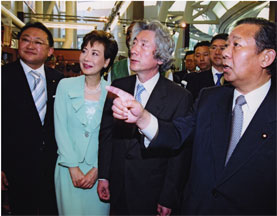
METI Minister Toshihiro Nikai. Here he is giving Koizumi and companions the classic fakeout (What the hell is that? – Huh? – … See ya!):
Ex-PM Yoshiro Mori (but then again no one’s compatible with Mori)
Lower House member Yukari Sato (another “female assassin” candidate that was less well-received than Katayama)
Financial Services Minister Yosano Kaoru
and finally… Koizumi himself!
I have no clue how much stock people actually put in these predictions, but Japan tends to be much more superstitious than the US and they certainly hold enough value to be featured in a trashy tabloid. In politics as well as every day life inauspicious days are usually avoided for major events and traditional superstitions (such as blood type personality distinctions) are usually respected if not wholeheartedly accepted. In one famous episode (as described in Alex Kerr’s Dogs and Demons), bankers gathered in large numbers to an Osaka fortune teller’s home so they could touch her ceramic toad and hear her stock picks. Japan certainly isn’t anywhere near as bad as Burma, where the ruling junta moved the whole capital on the advice of feng sui experts, but nevertheless a man like Fujitani has been able to make a good living with his essentially baseless political predictions. His list of “accurate predictions” includes warning former PM Keizo Obuchi not to make the incompatible Hiromu Nonaka in his Chief Cabinet Secretary or else he would “risk his life” (he later died of a stroke while in office).
These assessments seem less like astrology and more of a “who’s hot and who’s not” of Japanese politics. Pretty safe choices. We’ll come back on Tuesday to see how he did.
In Japanese:
「ありがとう 支えてくれて ありがとう 激励 協力 只々感謝」
The official translation:
“Many thanks to you all
For all your support
Many thanks to you all
For all your encouragement and cooperation
Words of thanks are not enough to express my gratitude”
My more literal translation before seeing the official one:
“Thank you
for supporting me
thank you
I have only appreciation
for your encouragement
and cooperation.”
Isn’t it just horribly lame, like the kind of thing you write in the high school yearbook of someone that you had a lot of classes with but aren’t actually close enough with to bother actually keep in touch?

Could the Washington Times have possibly picked a more flattering camera angle for Bill Frist?
Where does Japan’s new neoconservative overlord Shinzo Abe come from?
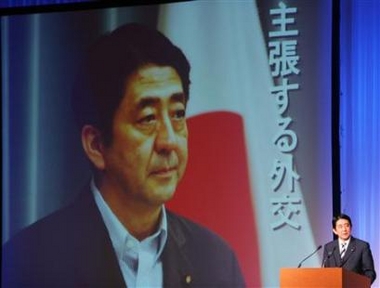
We’ll start in Yamaguchi Prefecture. By the late 19th century, one of the most powerful families in the area was the Abe family of sake and soy brewers. A child named Kan Abe was born into the family in 1894, but instead of hanging around vats, he decided to go to Tokyo and study law at the Imperial University. Upon his return to Yamaguchi he became mayor of the family’s village, and then entered the Diet.
Also in the area lived two other affluent families, the Kishi and Sato families. One of the Sato patriarchs had been among the Choshu samurai who overthrew the shogun, and so he had served as governor of several areas of western Japan in the late 1800s. The families entered a merger of sorts when Shusuke Kishi married into the Sato family and adopted their name. As Shusuke Sato, he sired three sons: Ichiro, Nobusuke and Eisaku.
Ichiro joined the Imperial Japanese Navy and became commandant of a naval base in China, resigning shortly before World War II broke out in the Pacific. Nobusuke was adopted by the Kishi family (which had no male heirs), studied law in Tokyo, became Hideki Tojo’s commercial advisor, got through the purges under Douglas MacArthur and became Prime Minister of Japan from 1957 to 1960. Eisaku also studied law in Tokyo, administered the railways during the war years, became prime minister from 1964 to 1972, and won a Nobel Peace Prize.
Meanwhile, Kan Abe’s son Shintaro Abe joined the navy during the war, graduated from the University of Tokyo afterward, and worked at the Mainichi Shimbun in Tokyo. It was here that he met Yoko Kishi, the daughter of Nobusuke Kishi (a cabinet minister at the time), and decided to marry her. Not long after their marriage, Kishi became prime minister and Shintaro Abe was appointed as his secretary. He went on to serve in many senior cabinet posts through the 1970s and 1980s, culminating in an appointment as Director-General of the Liberal Democratic Party from 1987 to 1989 before his political career ended due to old age and the Recruit Scandal.
So Shintaro and Yoko Abe had three sons. The eldest married a prominent businessman’s daughter and has lived a relatively uneventful life. The youngest was back-adopted into the Kishi family and now has a political career as Nobuo Kishi. And then there’s the middle kid, Shinzo Abe, who as of next week will be the 90th Prime Minister of Japan. Fear him, because he wants to kick your ass… as soon as the constitution is amended to allow it, of course.
After months of urban protests against Prime Minister Thaksim, who somehow pulled off the feat of being both a rural populist and a pro-business billionaire, the Thai military has stepped in and declared an interim government. In typical Thai fashion, the military waited until the PM was out of the country, in New York to deliver an address to the UN General Assembly, and declared personal loyalty to the King.
You can read about it in the BBC, The Independent, or any other newspaper in the world. Try Google News for the latest.
Probably the best place to follow the story is the English language Thai daily, The Nation. As of right now, the other English Thai daily, The Bangkok Post, is offline.
I was just in Thailand myself a couple of weeks ago, and co-blogger Adam is currently there in his girlfriend’s apartment. He is not currently online, perhaps because the government has suspended Internet connections. This is just idle speculation though, I really have no idea what’s going on. While there is little reason to be concerned for his safety, today’s appointment to have his air conditioner repaired seems very unlikely to be kept. Coincidentally, his girlfriend is currently in Japan on a job interview, and was I believe scheduled to return to Bangkok today. Hopefully I’ll hear a report from one or both of them some time today.
Update: Adam is back online, and I was right about the air conditioner repairman not keeping his appointment.
I find this editorial from The Nation pretty interesting. Just a couple of weeks ago the paper was demanding Thaksim’s resignation and accusing him of engineering a false assassination attempt against himself to shore up his flagging support, but they are still firmly against military intervention to remove him from power.
Ideally, the likes of Thaksin should be rejected at the ballot box or through public pressure in the form of peaceful protests. The problem is most people did not believe both options available to them would succeed in removing him from power. To many people the military coup against Thaksin may be a necessary evil.
But make no mistake, the seizure of power, albeit one that was achieved without the loss of lives, is nonetheless a form of political violence that is incompatible with the democratic aspirations of the Thai people. Democratic aspirations will live on even as the Constitution has already been abrogated by the coup leaders.
The spirit of democracy that undermined Thaksin’s apparent omnipresence will now shift its watchful eyes to the coup leaders.
Latest headline from The Nation:
“PROFILE: GEN SONTHI BOONYARATGLIN
Meteoric rise to POWER”
Following the coup, General Sonthi has so much POWER that it needed to be in all caps.
Marxy made a good comment on my last post:
Anyone weirded out that Japan’s opposition party is all ex-LDP members who are out of the majority? I am sure the official policies are different, but seems more like a reorganization of sports teams than ideological conflict.
Sure it looks like a rearranging of chairs since most of the party’s leaders herald from the former Tanaka faction of the LDP. But actualyl the DPJ is made up of more diverse groups since politics in Japan continues to be dominated by building up relations with interest groups (outright bribing of voters is pretty well nipped in the bud as of now). But I think that the current election climate and the media/public’s expectations are forcing the parties to compete for public support.
Party President Ichiro Ozawa, Supreme Adviser and ex-PM Tsutomu Hata, Diet Affairs Chairman Kozo Watanabe, Secretary General Yukio Hatoyama, and former president Katsuya Okada all hailed from ex-Tanaka/Takeshita faction, rebelled against LDP after PM Shin Kanemaru was arrested for receiving 500 million yen from Sagawa Kyubin, whose credit was abused by the yakuza to take out loans, went in a million directions forming new parties (mainly conservative Shinshinto and liberal Shinto Sakigake) before most of the small breakaway parties combined into the DPJ.
But it’s not *all* ex-Tanaka faction!
Seiji Maehara – Joined Nihon Shinto (a “progressive party” started separately from the LDP by Morihiro Hosokawa, a former Tanaka faction upper house member)
Naoto Kan – formerly of minor left-wing party Socialist Democratic Federation, joined Shinto Sakigake (a 1993 breakaway of the LDP led by younger liberal minded Diet members such as Hatoyama) before winding up in DPJ.
And then there are the intra-DPJ factions. While factions supporting former LDP members are most powerful, there is also a good number of factions based on former membership in leftist parties.
The mix makes for a center-left ex-LDP led but still somewhat divided party that can result in some watered down policy positions such as their weak response to the postal privatization issue (DPJ was hemmed in by ties to labor unions) and constitutional revision (large range of opinion within the party).
So, a political party that’s run by a conservative and divided internally along factional lines? Sounds a lot like the LDP right? But what you have to consider is that the DPJ was formed in the aftermath of the 1955 system. Accordingly, the politicians involved inherited themselves (career, politicians with stable and often inherited support bases), blocks of interest groups (labor unions, professional associations, religious groups, etc), and the social/economic state that the 1955 system left Japan in.
After confidence in the LDP crumbled in 1993 and a non-LDP cabinet came in, the election rules were changed to make it possible for an opposition party to take over and also for elections to be won on a combination of interest groups getting out the vote AND campaigning on the issues as opposed to interest groups alone. The idea (credited to Ozawa no less) was to allow for a two-party system since people weren’t going along with the one party state, presumably. The spectacular stumbling of the 8-party opposition coalition led to the resurgence of LDP coalition governments, however, and put the 2 party vision on hold until the DPJ rose in status.
The hodgepodge makeup of both parties reflects the conflicting election strategies they need to take. The horsetrading that brings in wildly different politicians under the same fold is necessary to build a large number of entrenched supporters. But at the same time the party needs to pull in the unaffiliated voters with strong policy proposals. Right now I think both parties are better at the former than the latter.
The media of course like the idea of two clearly denominated sides fighting for the right to govern. And as a result the editorial tone when talking about the DPJ tends to focus on the question “what does the DPJ have to do to win?” rather than “does the DPJ deserve to win?”
So slowly both the LDP and opposition have had to find ways to deal with the growth in public interest in the election process that the rule change brought about. In 2003 or so it was Manifestos that helped the DPJ, and in 2005 it was Koizumi’s sophisticated PR techniques that wooed voters. The DPJ is going all out to make itself look smarter and better able to govern than the LDP this July and I believe that is what the election will turn on.