Japan to extend visa waver

The Taipei Times buried this rather significant news item in their ‘Taiwan Quick Takes’ section.

Japan’s ruling coalition has decided to propose that the parliament make a special law to allow Taiwanese to enter the country visa-free after the Aichi Expo ends in September. Japan currently offers visa-free treatment to Taiwanese tourists during the Expo, which ends Sept. 25. At a meeting Wednesday, the ruling Liberal Democratic Party and Komeito resolved to ask their lawmakers to put forward a special bill making such treatment permanent. Taiwan is the second-largest source of foreign visitors to Japan after South Korea. In February, a special law was passed to allow Taiwanese people to enter for 90 days without a visa during the Aichi Expo. The law went into effect March 11. According to the Taiwan Visitors Association, almost 740,000 Taiwanese visited Japan last year and the new measure is expected to boost that number.

Tibet and Taiwan

Taipei Times reports:

President praises Dalai Lama as the `world’s greatest’
By Huang Tai-lin
STAFF REPORTER
Thursday, Jul 07, 2005,Page 1

Two Tibetan monks from Gyutod Tantric Monastery in Dharamsala create a sand mandala yesterday at an exhibition featuring photos of the Dalai Lama and other exhibits presenting Tibetan culture. The exhibition was sponsored by the Tibetan Religious Foundation of His Holiness the Dalai Lama and is a part of events celebrating the 70th birthday of the 14th Dalai Lama.
PHOTO: LU CHUN-WEI, TAIPEI TIMES
President Chen Shui-bian (陳水扁) yesterday joined dignitaries and celebrities from around the world in sending a birthday greeting to the Dalai Lama, who turned 70 yesterday.

Chen praised the Tibetan spiritual leader as “the world’s greatest religious leader” and expressed hope that the Buddhist icon would make a third visit to Taiwan to “allow an opportunity for believers in Taiwan to be showered in his wisdom and cheerful presence.”

Noting Taiwan and Tibet’s similar predicaments, in which both have suffered due to Chinese military expansionism, the president said “Taiwan can identify with Tibet’s experience, and is willing to step up efforts enhancing exchanges and cooperation between Taiwan and Tibet.”

[Read the rest of the article on the original site]

For some reason this article neglects to mention the rather interesting fact that the aforementioned exhibition is actually taking place inside Chiang Kai Shek Memorial Hall! As chance has it, I had lunch after class yesterday with two friends, and we decided to try the Tibetan restaurant near campus, where a non-Chinese English speaking Tibetan fellow patron told me about this exhibition, which started yesterday and will run for about one month. I decided to stop by, but I got there a bit too early and it was really in the process of being set up. Still, there were several lamas (Tibetan Buddhist priests around) and I spent a few minutes chatting with a couple of them.

Of course, while all of the visiting priests are Tibetan, none of them are actually residents of Tibet, but of Tibet’s government in exile, located in the Indian city of Dharamsala. Of the two I spoke to, one had actually been born and raised in Tibet, and only left for India at the age of twenty five, whereas the other had actually been born outside of Tibet. There is no actual Tibetan community in Tibet, and no real Lama Buddhist temples, but there is a “Tibetan Religious Foundation of His Holiness the Dalai Lama,” where they are based for their stay in Taiwan. I asked if they expected the Dalai Lama to visit Taiwan again soon, but they seemed to think that he would be keeping away for the time being to avoid political friction, although considering he has visited twice in the past, and even visited Mongolia quite recently over extreme objections from China, I wouldn’t be surprised to see him.

Chiang Kai Shek Memorial Hall main entrance
For those of you who don’t know, here is a picture of the hall, built in the style of the Ming Imperial Tombs, so that everybody knew exactly how humble Chiang was.

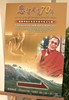
Dalai Lama bday poster
The poster advertising the exhibition.

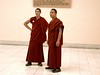
Lama in CKS Hall
The two lama priests.

Reporter convicted of revealing state secrets

No, I’m not talking about Judith Miller, but considering that a judge has just ordered her incarceration, this story from yesterday’s Japan Times is particularly timely.

Trial opens over denial of secret accord with U.S.

A court battle opened Tuesday on a damages suit filed by a former Mainichi Shimbun reporter who claims his career was ruined after he was wrongly convicted for reporting on an alleged secret pact between Japan and the United States over the 1972 reversion of Okinawa.

Takichi Nishiyama, 73, is seeking 33 million yen in compensation and an apology from the government, arguing his report that Japan secretly shouldered $4 million of the costs for Okinawa’s reversion from the U.S. has been backed up by the release of U.S. government documents in 2000 and 2002.

“It is a state crime to submit a false treaty text to the Diet for discussion and approval, and it is an abuse of power to indict a reporter who tried to inform the public of the state crime,” Nishiyama says in the complaint.

[Read the rest of the article at the original site]

Asia Private Equity

Here’s an excerpt from the July 6 edition of the Asia Private Equity newsletter. You may want to re-read Saru’s earlier posts on Chinese currency as background.
RMB Notes Part 1
RMB Notes Part 2

These days, however, there is really no place in America that hums with the kind of 24-hour activity that Beijing has. But this week in Beijing, an official of the State Administration for Foreign Exchange (SAFE) showed up at one of China ‘s principal private equity events and delivered enough bad news to make every Beijing Duck eating capitalist dyspeptic. SAFE, the government agency that has brought private equity in China to its knees in six short months by issuing two controversial circulars in January and April, is, according to the official, pretty pleased with itself and the progress it’s making in developing regulations to prevent rich Chinese entrepreneurs from secreting away hundreds of millions from their IPOs in the U.S., in banks in the Cayman Islands or other places.

The problem with the understandable desire of Chinese authorities to tax its citizens is that in trying to accomplish that goal, it has effectively brought down the curtain on the clever legal structures, WOFEs, developed in 1999, which private equity firms have used for the last six years to get their money back out of China investments. And according to SAFE’s Li-Ping Lu, there is nothing on the horizon, other than a bunch of cranky Chinese and American VCs, that is likely to change the current situation.

When Lu shared those and other less positive views, the PE professionals in Beijing this past week turned as surly as a bunch of striking teamsters. WOFEs are, it seems, pretty much dead in the water. And until somebody in the Chinese government does or says something different, private equity firms are having to retreat into joint ventures (sometimes referred to as Chinese PE roach motels–investors check in, but they don’t check out) or giving their portfolio companies bridge loans until or even more troublingly, working with Chinese partners on the basis of “gentleman’s agreements.” When is the last time you saw a VC fork over a million for a handshake?

To paraphrase Bill Murray in the movie Groundhog Day, it’s going to be a long, hot summer. And it’s never going to end.

— Editor Jerry Borrell (jerry.borrell@thomson.com)

The Dragon Awakes

Howard French has reposted a very good article on China’s military buildup and the corresponsing politics written by Ian Bremmer for The National Interest. Still, can we finally stop using such cliched titles? Let’s just all accept that ‘the dragon’ is already awake and stop beating a dead horse.

The whole thing is good reading, but this quote really jumped out at me.

The “Taiwan lobby” in the U.S. Congress is also sounding an alarm. On February 16, Democrats and Republicans in the House and Senate proposed a joint resolution to resume diplomatic relations with Taiwan. The proposal would have proven political dynamite if it had any chance of passing. It did not. While the Bush Administration resolutely opposed the move as a dangerous encouragement of Taiwan’s independence movement, China treated the resolution as a grave insult.

Does anybody have more info on this? In particular, the resolution in question and its voting record. I’m a little surprised that this didn’t make the news when it hit the senate floor.

Another question:

Nor was Washington able to dissuade Beijing from going ahead with a March “anti-secession law”, which provides a quasi-legal basis for invasion should Taiwan declare formal independence.

Now, Taiwan’s international status is at best ambigious. Were it universally considered an independent, sovereign nation than any invasion by China would be a clear violation of international law, but is their any actual standard for acceptable behavior regarding breakaway territories? Clearly nobody seems to be bothering Russia about their campaign against the separatist Chechnyans, but on the other hand East Timor had fairly broad international support in their independence movement. Are there any other noteworthy cases in the past 30 or so years?

Napoleon ‘tried to learn English’

Living in countries like Japan or Taiwan (and probably S Korea and some other countries) where the vast majority of westerners are employed as ‘English teachers,’ one is keenly aware of the English-learning obsession.

Thanks to the Beeb for telling us who really started the craze.

Napoleon had his first lesson on 17 January 1816, when he asked las Cases to dictate to him some sentences in French, which he then translated, using a table of auxiliary verbs and a dictionary.

The surviving sentences appear to indicate Napoleon’s feelings towards his exile. He wrote:

“When will you be wise.

“Never as long as I should be in this isle.

“But I shall become wise after having crossed the line.

“When I shall land in France I shall be very content.”
[…]
According to historian Dr Peter Hicks, las Cases describes how Napoleon hated being sat down to work like a schoolboy but steeled himself for the task.

Dr Hicks said: “He was not necessarily anti-English. He had to fight because it was the enemy of France.”

He added: “In France people are amazed to find that he was learning English. But he didn’t do it for pleasure. He wondered how much money he could have saved in translation if he could have learnt English.”

Going to Taichung

I’m about to take a short weekend trip down to Taichung, the most central and third largest city in Taiwan. I’ll probably be back Sunday afternoon, but then I have a translation project to finish so I’ll likely be incommunicado until Monday.

RSS

I’ve tried a couple of RSS readers briefly but haven’t found anything that I really loved. I know a lot of you reading this are using various RSS programs, so what would you recommend? For reference I’m running Windows, so don’t bother with any software that only runs on other platforms. Feel free to leave comments or just email me.

Tu-ka’s new cell phone for the elderly

The Japanese cell phone provider Tu-ka has just announced an interesting new phone, designed by Kyocera, with the unique distinguishing feature of being as featureless as possible.

Looking at his phone you may be wondering where the LCD screen and half the controls are. You may be wondering if I haven’t been lying all along about being able to read Japanese, completely screwed up and accidentally linked to a photo of, not a cell phone, but a wireless phone for indoor use. In fact, this is exactly the point.

This phone is specifically designed for elderly people who want to keep in touch with their family more easily or need one for emergencies (a particular concern for old people living alone) but may too confused by even the most basic of modern cell phones, or lack the clarity of vision needed to read the screen or the manual dexterity needed to press such small buttons.

The tagline reads
A cell phone so simple it doesn’t need any explanation. A cell phone specifically designed for talking.

As this diagram explains, the “method of use is almost identical to that of a home phone.”

In all, they list only four features.

* Large buttons: Easy to see, easy to press
* Powerful speaker so your partner’s voice is more easily heard
* A bumpy easy-grip surface
* A battery so large that you only need to charge it once a month

That last claim is the only one that would really stand out as a feature on normal phone. The claimed talk time of about 4 hours doesn’t seem particularly exceptional, but the 840 hours (about 35 days) of standby time is just amazing! I wonder if it actually manages that through battery size, or by leaving out the power-sucking color screens, processors, and internet capable digital transceiver found in typical cell phones.

It turns out that this isn’t actually brand new, but it’s interesting to point out how product designers in Japan are really starting to cater more towards the elderly, which is soon to be, if not already, the fastest growing segment of the population.

Thanks to Joe for the heads up.