Media Executives Court China, but Still Run Into Obstacles

August 29, 2005
Media Executives Court China, but Still Run Into Obstacles
By GERALDINE FABRIKANT

In June, Yu Youjun, the executive deputy governor of Hunan Province, came to lunch accompanied by 16 dignitaries at the home in Beverly Hills of Sumner M. Redstone, the Viacom chairman.

Viacom, like many other American media companies, is already active in China. Its MTV network is carried in 10 million homes in Guangdong Province. Two-hour blocks of Nickelodeon programming like “CatDog” and “Wild Thornberries” are beamed on the government-run CCTV to more than 120 million homes.
Continue reading Media Executives Court China, but Still Run Into Obstacles

Korean president “really jealous” of PM Koizumi’s ability to “gamble”

Asahi Daily, August 24, 2005, 8:23pm:

“I am so jealous of how Prime Minister Koizumi was able to take the gamble of dissolving parliament for the sake of reform,” South Korean president Roh Moo-hyun revealed on August 24th to a reporter on the presidential beat.

While the Korean president controls both the national government and international diplomacy, he is prohibited from uniting with any political party. His term is limited, and he has no power to dissolve the parliament. Invoking Prime Minister Koizumi’s situation, he fumed about how due to the inability of the ruling and opposition parties to work together, attempts at reform have stagnated.

“What the hell is the president of Korea? I can’t even risk my party or my job,” he whined, while expressing his desires. “A great flood can sometimes change the course of it’s own river. I want to make fundamental changes in the political structure and culture [of South Korea].”

North Korea: Underground Republic

I just spotted this great five-month old article on the Daily NK website. Written by a defector from North Korea, it alleges to describe Kim Jong Il’s various offices, secret facilities, and homes around the country.

Kim Jong Il founded a special military engineering unit and proceeded the underground facility project for the past several decades. For this reason, North Korea probably has the best skill to dig underground in the world.

North Korea is “Underground Republic”

The subway in Pyongyang was built mostly between lithosphere about 80m to100m underground. However the underground road for Kim Il Sung and Kim Jong Il were built much deeper underground than the subway. By building underground facilities, Kim Jong Il is able to create fear in the society while making economic profit by exporting tunnel digging skills to the countries with ties in preparation for both the conventional and nuclear wars.

The outstanding achievements of the underground facilities is the residences and chalets for Kim Jong Il. In case for the exhibition, the residence contains basic equipments and all the residents and chalets, including the inner facilities of the chalets, are connected to each other.

Reading this piece there are two things that strike me. First, how awful it is that Kim Jong Il has raped his own country, exploiting his people and every resource they possess to build such a large number of these ludicrously extravagant structures for nothing but his own personal amusement. He easily puts Saddam Hussein to shame in this department.

The second thing that strikes me also allows for comparison with Saddam Hussein. Everyone remembers how pathetic Saddam’s defenses really were, how quicky his army and government collapsed, and his ignonimous capture hiding out in a little hole in the ground.

Read the following description of North Korea’s underground battle HQ and then try and imagine how a war against North Korea would compare with the recent one against Saddam Hussein’s government. (I’m not even going to mention the ongoing war in Iraq, which I would consider a separate campaign.)

Youngsung 21 Complex

This is North Korea’s “underground wartime headquarter.” In case a war breaks out, the Supreme commander unit, bureaucratic department, commanding department, worker’s party unit and other departments are to be stationed together at this place. In case of a nuclear war, (it is known to have) the walls built with iron rods and concrete covered with lead will protect the headquarter. They facility was completed in 1983.

There are numerous military units to protect the headquarter stationed around the building in possession of mass scale conventional weapons. The size of the lot is about as big as a block in North Korea, and there are enough of supplies for the headquarter to survive for ten years without any outside contact.

The headquarter complex is connected to the main chalets and has a subway of its own, which are all connected with the underground tunnels. It is also connected to the Jamo Mountain Chalet in Sunchun-gun, which is located about 40km away from Pyongyang.

If, as President Bush must fantasize as he gently rocks himself to sleep at night, we actually did invade North Korea, the chances of humbling Kim Jong Il as Saddam was humbled seem most remote indeed. In fact, I imagine that everything that has happened (and will happen) in Iraq, as bad as it is, is nothing compared to the devastation that would result from any war involving North Korea.

For those who don’t know much about the Great Generallisimo Kim Jong Il, let me refresh your memory with this manga profile I translated from Japanese some time back.

Philippines hopes isle-name raffle woos Japan’s wary tourists

From the Japan Times

Would you like to have one of the 1,107 islands in the Philippines named after you?

That’s the come-on of the Philippine government in a bid to woo more Japanese tourists.

As part of its aggressive marketing to boost the country’s sagging tourism industry, Philippine officials, with the help of Japanese public relations experts, hatched the idea to raffle off the naming of 25 islands to Japanese tourists.

Dubbed “An Island in Your Name,” Philippine Tourism Secretary Joseph Durano hopes the effort will lure more young and adventurous Japanese tourists to visit the Philippines, a nation considered dangerous by some Japanese.

The promotional event will kick off in October.

The 25 Japanese raffle winners will not own the islands, Durano explained. Instead, the winners “will have the prestige of having these islands named after them for a period of one year.”

Who wants to bet that one of the winner’s names ‘their’ island Takeshima?

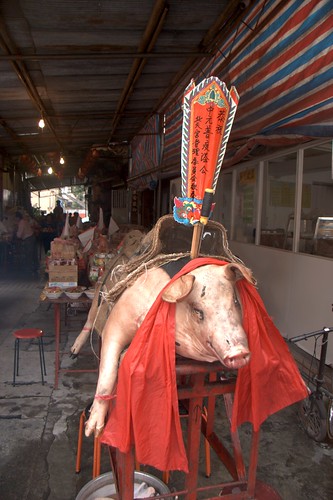
The God pigs of Taiwan

<Update: October 5, 2010 >I just noticed a surge of visitors to this post, so I thought I’d add a link to a Flickr photo set I took of the god pig sacrifice at a small temple next to the apartment where I was living in Taipei at the time.

http://www.flickr.com/photos/mutantfrog/sets/817964/

Doesn’t that sound like the title of a pulp story or B movie?

The Ghost Month is nearing it’s end here in Taiwan, and all through the past few weeks festivals and offerings have been visible in temples and shrines and in front of homes and businesses throughout Taipei. While most people reading this may know that Chinese religion involves the offering of food, drink, and burned fake paper money (which looks nothing like real money) to ancestor and god spirits, the continues existence of ritual animal sacrifice may surprise some.

Danny Bloom had a short post on Japundit about two weeks ago, the day after I saw my first pig offering at a small corner temple I pass everyday on the way to class.

Taiwan’s Hakka ethnic group holds an annual festival during the seventh lunar month, where a unique custom of sacrificing “spirit pigs,” which are traditionally grown to a huge size — and we mean HUGE — before being slaughtered.

However, in keeping with the principles of the ethical treatment of animals, today’s ceremonies often use likenesses of pigs instead of the real thing.

In this photo from the Taipei Times, a sculpture of a ‘divine pig’ can be seen outside Taipei City Hall, where the annual Taipei Hakka Memorial Ceremony was taking place recently.

Oink!

The August 13th Taipei Times had a rather hilarious photo of a pig stand-in made out of fruits.

They also have two interesting articles about the tradition of pig sacrifice in Taiwan.

Sacrificial swine prompt backlash
The belief that “the bigger the sacrificed pig, the more luck a person will have for the rest of the year” has resulted in a lifetime of agony for hundreds of pigs, bred by farmers to become abnormally overweight before slaughter, animal-rights activists said yesterday.

Dozens of activists from several animal-rights groups yesterday gathered in front of the Council of Agriculture (COA) to protest traditional pig contests, saying the government has failed to regulate abusive practices toward animals.

Showing a documentary about pigs selected for the contest, activists said that 15 to 18 months before the overweight pigs are killed as sacrificial offerings, they are deprived of fluids, exercise and even turning over freely. The pigs undergo these cruel farming practices until their weight reaches upwards of five to six times their normal weight, activists said.

The accompanying photo truly must be seen to be believed. Yes, those are the pig’s ears at the bottom.

Three days ago the same publication had a good article giving a roundup of various traditions of the Ghost Festival. Of interst here is the final anecdote, concerning a rural pig farmer who raises animals for sacrifice, which gives a much more accepting description of the practice than the earlier story focusing on animal rights protesters.

About 10km away from the Yonglian Temple, a different type of religious tradition is taking place. The Ghost Festival had attracted about a dozen pig farmers carrying truckloads of sacrificial pigs to the Tachong Temple in Pali (八里) Township, Taipei County, one of three local temples taking turns to host the annual event.

The 210-year-old Tachong Temple has just been designated as having historically significant architecture, and temple managers hope to begin a renovation project by the end of next month to give the building a face-lift.

Chou Chin-tiao (周金條) won this year’s pig-raising contest with an animal that weighed 890kg. The first runner-up came in far behind, at under 500kg, with the second runner-up weighing about 400kg.

This was the fifth time Chou won the contest. The secret of growing such a big pig, Chou said, lies in the fodder. The feed he uses contains grain shells, rice porridge, canned fish, pig oil, milk powder and raw oysters.

The animal is fed twice a day, with 14kg of fodder each meal, and is given water every three hours. The cost for the fodder alone is about NT$30,000 a month.

During the summer, he has seven fans blowing on the animal to keep it cool and comfortable.

During his some 30 years of pig farming, Chou said that only three pigs died under his care. Although he spends more time and effort taking care of the animals than his wife and four children, Chou said that it pays off when he wins the highest honor.

“I don’t raise the pigs for the gold plate or certificate of merit,” he said. “I do it to fulfill a promise I made to the Buddha when I was poor that I would offer big sacrifices if I could have food to eat and clothes to wear.”

Guns, Germs, and Steel- a reader’s exercise

At the moment I am about 2/3 of the way through Jared Diamond’s book “Guns, Germs, and Steel.” Basically it’s a history of human civilization written by a scientist, trying to uncover root the root causes for the success and failure of civilizations around the world while attempting to destroy the racist and culturalist theories behind the common ‘rise of the west’ narrative. With this rolling around in my head, here is my off the cuff (and in true blog style, completely unedited) attempt at a response to a post over on the blog Cominganarchy.com, in which Chirol argues that Arab cultural values are responsible for their current material backwardness. I don’t normally post this sort of thing here, but it may lead to some interesting comments.

It seems to me that the failure of the Arab world is not at heart a result of their culture, but their lack of significant exploitable natural resources aside from oil. Yes, oil makes a lot of money for them, but it requires only a very, very small percentage of the population to actually exploit it to its maximum potential, creating no incentive for the rest of the population to work. One could argue that in effect, the culture is backwards because there are few good ways for them to modernize in a material fashion.

Why is the West advanced and the Arab world behind? Due to the allocation of natural resources, the industrial revolution could only have happened in Western Europe (or possibly China), and the Middle East was too far away from deposits of iron and coal necessary for industrialization to make such innovations realistic. Only in the later stages of industrialization, when we began using engines that ran on liquid fuel instead of coal did the region have anything of material worth to offer the modern world, and it is only a single raw resource destined for export, not raw materials that could become the bases of a production oriented economy.

Oil is basically the only source of wealth in the Middle East, and it is for the most part controlled and profited from exclusively by the elites. Look at the Saudi family, and the former Saddam Hussein regime. The only places where most of the population is actually well off are those such as Dubai, where oil money is redistributed through a socialist benefits system that works because there’s so damn much money they don’t even have to worry about managing the economy. It’s not even ‘from each according to his ability, to each according to his need,’ everyone just gets free money without having to work at all. Sure, everyone gets a free education, even fully-subsidized study abroad if they want, but to what end? How many of the people you have met in your life would in fact work hard under such conditions, when failure presents no threat of want?

Regardless of whatever ‘cultural values’ people in the Middle East possess, I don’t see how their economies and societies can realistically modernize under the dual strangle hold of oil and autocratic government. If democracy genuinely takes hold in Iraq than we may have the opportunity to make an interesting experimental comparison, but it still remains to be seen how much the free oil money may retard genuine development there as well. Perhaps if they follow Norway’s example, and put the bulk of the money in a kind of trust fund and use some to fund contemporary development of other industries they will actually be able to succeed.

You cite above “Inability to accept responsibility for individual or collective failure” as a trait of “failing cultures.” It seems to me that in fact success and failure are to a large degree determined by ones environment, and the current environment of the Middle East, awash in oil but no other opportunities, is one which offers precious little hope for more than a small minority to improve their personal circumstances significantly. The other conservative social and religious values on your list make more sense when you realize that religion is primarily the refuge of the weak, there is nothing like the promise of Heaven to justify one’s sorry lot on Earth, and nothing like calling those who are more successful than you infidels or heretics to sooth one’s self esteem.

Ishihara to produce movie on kamikaze

Toei Co. will begin shooting a film next year on the lives of young kamikaze suicide pilots in World War II with Tokyo Gov. Shintaro Ishihara as the executive producer and scriptwriter, the film producer said Monday.

Ishihara, a novelist before turning to politics, is known for his nationalist views. He wrote the script based on his past conversations with the late Tome Torihama, who operated a canteen in Chiran, Kagoshima Prefecture, and took care of young kamikaze pilots there before departing on their suicide missions.

“The young people who headed for their deaths were saved spiritually by Ms. Tome, who was like a bodhisattva to them,” Ishihara said at a news conference.

The Japan Times: Aug. 23, 2005

Funny how he brings bodhisattva into the mix. Why do they need to be saved by Buddhist figures if they were dying for the honor of their god-Emperor? You need to keep these things straight Mr. Ishihara, whatever happened to shinbutsubunri?

Japonisme

The Washington Post just posted a dual review of two books discussing the impact that Japanese art had on the European art world during the late 19th century, as Japanese art began to flow into the West following the ‘opening’ of Japan by Perry and the subsequent Meiji restoration.

Japonisme is filled with firsthand observations from a slew of artists such as Renoir and Monet. The author pinpoints the relationship between James McNeill Whistler’s oil paintings, especially his “Variations in Flesh Colour and Green: The Balcony,” and Torii Kiyonaga’s work. A woodcut print of a group of Japanese courtesans entertaining a customer is juxtaposed with Whistler’s painting of Western women dressed in kimonos: The composition and the perspective, with its view of the water, were clearly inspired by Kiyonaga’s print, which, in fact, Whistler owned.

JAPONISME
Cultural Crossings Between Japan and the West
By Lionel Lambourne
Phaidon. 240 pp. $69.95

THE ORIGINS OF L’ART NOUVEAU
The Bing Empire
Edited by Gabriel P. Weisberg, Edwin Becker and Evelyne Possémé
Mercatorfonds. 295 pp. $69.95

The Zimmerli Art Museum, located on the campus of my alma mater, Rutgers University, has a well put together collection also entitled Japonisme, which primarily focuses on art created in France under the influence of Japanese works. I recommend that anyone at Rutgers or in the vicinity check out this exhibit (I believe admission is free, but that may only be for students. Or I may be wrong.) Unfortunately, they have but a single image from it online.

Japonisme:

Comprising turn-of-the-last-century European and American works on paper and ceramics as well as related Japanese art, this collection reveals the strong influence of the art of Japan on the art of the West and in so doing reflects the pervasive cross-cultural interchange which took place between Japan and the West beginning in 1854 when, after 200 years of isolation, Japan opened its doors to the West.

Taike

An amusing article in the Taipei Times:

Premier Frank Hsieh (謝長廷) said yesterday that the term Taike (台客) should be an adjective for young Taiwanese men who possess clear and logical thinking, and who speak eloquently.

“When the noun and adjective Taike is used, usually people are calling or describing somebody who is not elegant or has bad taste in clothes and no sense of style, perhaps even in the way they talk. I hope that we can turn this upside down and make it all around,” Hsieh said.
[…]
Taike is a recent popular noun and adjective which media often have used to describe somebody who gives the impression of having bad taste in many respects, such as the way they dress, their speech and behavior.

Originally, Taike was first used in 1990 in Taiwan among teenaers, but the term did not become widespread until recent years.

Stereotypical Taike dye their hair different colors, wear colorful shirts and baggy pants all the time irrespective of the occasion, talk a lot, drink too much, curse constantly, chew betel nut and speaks Mandarin with a heavy Taiwanese accent.

I first heard this term when I went on a trip to Penghu a few weeks ago with a group of Taiwanese when a couple of the girls were using it to tease one of the guys on the trip. Interestingly, despite what the article says, I only heard the term ‘tai,’ not the longer ‘taike.’ Still, the description in the article fits what I heard. According to the girls I was with, there are two basic types of ‘tai.’

First is the type who just doesn’t know/care how to dress or act: flip flops, a sloppy and vaguely bow-legged way of walking, exercise shorts, probably a betel-nut chewer. Second: the kind who thinks they know how to dress, but is tragically and comically mistaken. There may not be any exact equivalent in America, but perhaps if you meditate a little on terms like ‘redneck‘ or ‘guido‘ you may begin to get at least a kind of relativistic sense of what’s going on.

Does anyone out there have any good examples, either in words or photos?