Google and Taiwanese sovereignty

I originally started writing this post in response to this post on Ridingsun and never quite got around to finishing it, but now that Google has announced they are changing their designation of Taiwan from “Taiwan, province of China” to merely “Taiwan,” I figure I’ll just publish it.

The official US position is stated in the Taiwan Relations Act, passed in 1979, and has never been changed since.

Don’t forget Taiwan’s government is still known as the Republic Of China, and according to its constitution still considers itself a claimant to sovereignty over all of China, of which Taiwan is just a single province.

If you look at the actual text of the ROC constitution, Article 2 states
“The president and the vice president shall be directly elected by the entire populace of the free area of the Republic of China.”

By limiting voting to the populace of the “free area”, i.e. Taiwan and the surrounding islands, the implication is that mainland China is “unfree territory of the Republic of China.”

Article 11 also states
“Rights and obligations between the people of the Chinese mainland area and those of the free area, and the disposition of other related affairs may be specified by law.”
again, making clear that Taiwan still legally considers itself part of China (although apparently the best part).

If constitutional interpretation is too dry, you can follow the reasoning at the blog Those Who Dare.

Or simpler yet, they can just look at the vehicular traffic on Taiwan’s roads and take note of the license plates that read Taiwan Province.

Yes, the current president’s party (I hesitate to say ‘ruling party’ since they control oly a single branch of the government, all branches of which are basically stuck in deadlock due to partisan bickering) endorses formal independence from China, but unless they succeed in revising the constitution and changing the country’s official name, it’s very unrealistic to expect foreign businesses to do so.

Incidentally, I would be thrilled to see the ROC officially change its name to Republic of Taiwan, so don’t think that I’m actually in favor of reunification. Just try and realize this isn’t just a matter of Taiwan’s independence not being recognized internationally, it stil isn’t even recognized domestically.

Numismania

We’ve known for years that North Korea has been printing counterfeit money, but the BBC reports that we finally have proof.

The United States has formally accused North Korea of forging millions of dollars of high-quality counterfeit US dollar notes, known as supernotes.

A US court indictment said seven men, including senior Irish republican Sean Garland, distributed the fakes, which all had a face value of $100.

There is still no word on whether or not North Korea has been accused of counterfeiting the new US ha’penny coin.

Kabuki update

Continuing from the first installment.

Josh Marshall of Talking Points Memo gives us this confused example:

One interesting dimension of this Kabuki theater exercise is that it’s not even completely clear which part of the Republican caucus open defections could come from.

Josh, if you have no idea how it’s going to turn out, why are you calling it Kabuki?
John G Scherb, of PeaceJournalism.com, slips his reference into an essay on the Taiwan arms deal question.

And no one, save for a few
wizened China experts, really cares about it because nothing really
changes. It’s a Kabuki dance, an elaborate ritual that benefits a few,
ups the world tensions a notch or two, and then is quickly forgotten.

The web site claims to be based in Nepal, whose citizens, being far closer to China than the typical clueless Westerner would seem to be in a position to know enough about Chinese culture to realize that a: Kabuki is from Japan and not China, and b: that Kabuki, while highly scripted, is not what I would call a ‘ritual,’ and is a rather awful metaphor for what he’s discussing. After all, if it were ‘quickly forgotten,’ why is it the metaphor of choice for creatively braindead political columnists?

I don’t want to knock PeaceJournalism.com too much though-after all they do have this pretty awesome proposal for THE EXTRATERRESTRIAL CONTACT ACT, to be enacted by the US Congress.

The last entry for today is courtesy of Wayne Madsen at Global Research.ca, writing about the Plame/Rove/Darth Sidius scandal that’s gripped the imagination of the most boring people in America. Madsen actually describes two different situations as Kabuki.

Not surprisingly, the White House spin Kabuki dancers, fully expecting a Friday announcement from Fitzgerald, altered course and announced that Bush would not name a replacement for O’Connor until some time next week.

While Mr. Madsen is guilty of yet another horrifically bad Kabuki metaphor, at least he gives us this rather amusing photo collage to illustrate his lack of a point.
kabuki dance
The White House Kabuki dance with Patrick Fitzgerald

What is the alternative? How can reporters possibly describe politics without the richness of inappropriate metaphors?

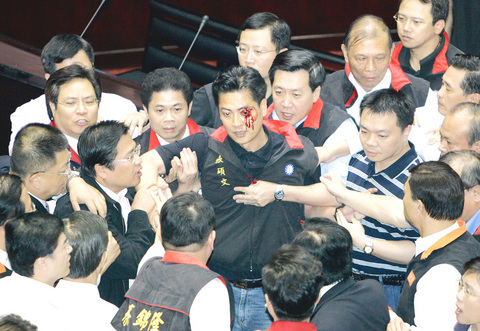
Take this photo, which was plastered all over the front page of every newspaper in Taiwan yesterday. The typical American political reporter or pundit would probably describe this as the result of a Kabuki dance, or possibly, if they considered themselves more of an elitist prick (i.e. a George Will, or Christopher Hitchens) perhaps even a Noh play. A more accurate description, however, would be to say that Chang Sho-wen got the shit beat out of him, and that Taiwanese legislators routinely beat the shit out of each other.

Of course, not all mention of Kabuki in the press is inherently gratuitous. For example, take this brief news item from The Japan Times.

Mitsukoshi Ltd. and Shochiku Co. said Tuesday they will form a business alliance to develop kabuki-related products.

The department store chain and Japan’s major movie distributing firm will jointly set up a project team to share their strategies on the kabuki business, including developing souvenirs, planning play-watching trips and selling play tickets to customers of each company.

Shochiku has positioned the traditional performing art as its core business since its foundation in 1920, while Mitsukoshi has been organizing various kabuki events with the film distributor’s support since 1946.

Great article on history of Taiwan’s architecture

The Governor-General Hot Springs

During the onsen’s construction, Japan invaded China after the Marco Polo Bridge Incident of 1937. The Japanese authorities urged Taiwanese to use bricks in camouflage colors to hinder air raids. These colors–light green, beige, and brown–were often used from the late 1920s through the early 1940s. A kiln in Peitou specially produced bricks of these colors, known as “13-channel bricks” for their rippled surface, designed to reduce buildings’ visibility to enemy aircraft by reducing the bricks’ reflectiveness.

Representative buildings from that period include Taipei City Hall (now Zhongshan Hall), Taipei High School (now National Taiwan Normal University), and Taipei Imperial University (now National Taiwan University). Those buildings were all the work of Ide Kaoru, the influential chief architect of the Governor-General’s Office who advocated “localization” of Taiwan’s architecture. As the Governor-General Onsen was built with the same sort of green 13-channel bricks as the Taipei City Hall, which was completed in 1936 and was also a public building, it is assumed that Ide had a hand in its design.

This article is highly recommended, particularly for language students, as the text is presented in English, Japanese, and both simplified and traditional Chinese.

Helpful or creepy?

That was the question asked by Curzon when he emailed us this article from the Asahi English edition.

Ritsumeikan Primary School, a new facility scheduled to be opened in Kyoto’s Kita Ward next spring, promises to offer a student commuting-route tracking system.

The system uses integrated circuit (IC) cards to register students as they pass certain checkpoints.

The smart card technology will not only register arrival at and departure from school, it will also issue e-mail messages to parents within 10 seconds of a child passing through the ticket gate at their train station.

It’s like what’s wrong with politics. Everything has to be one side or another. Let’s all just hold hands and agree: it’s helpful and creepy.

By the way, I would like to point out that Doshisha, Ritsumeikan’s rival, is also implementing a similar system, but their’s uses GPS. More helpful or creepier?

At least there’s one unequivacebly good piece of news in the article.

The PiTaPa card is a travel smart card promoted by the Surutto Kansai Association, a group of 43 private rail and subway companies and municipal transportation bureaus in the Kansai region.

Finally a unified payment system for Japanese public transportation! May it spread throughout the land, be fruitful and multiply!

A perfectly good job offer

I just discovered the hilarious blog of Harry Hutton yesterday and I’ve been reading random bits of his archives. It seems that back in June of last year he received a job offer to teach English at Kim Jong Il university.

Conditions in North Korea are harsh and the successful candidate will need a high degree of resilience. The working and living conditions will be difficult and he/she should be prepared for this, e.g in winter the temperature can be as low as –30 degrees and classrooms are usually unheated. However, the postholder’s apartment does have heating.

£23,000 per annum; rent-free furnished apartment (bugged); 11% bonus if you can finish the contract without attempting to flee. A car and a driver are also provided, the driver being a member of the security apparatus.

How could he possibly have turned that down?

Taipei rescued from demons

Railway uses `feng shui’

The main entrance of Taipei Railway Station has been redesigned for better feng shui following a string of derailments and train delays, a railway official said over the weekend. Taiwan Railway Administration director Hsu Ta-wen (徐達文) said the administration had added a glass hallway to the station’s main entrance to ward off evil spirits.

The renovation was made at the suggestion of Master Hun Yuan (混元禪師), a well-known Buddhist master, Hsu said. The railway administration consulted Hun Yuan after several derailments, train delays and suicides on the tracks. Hun Yuan said the incidents had occurred because the station’s main entrance faces a “white tiger demon.” To avoid the demon, the main door had to be moved back 6m. The administration installed a glass hallway behind the main door, so that passengers now arriving at the station must enter two doors. Several lawmakers on Friday blasted the administration for squandering money on “superstition.”

All I have to say to those doubtful politicians is, wait until the demons start wreaking havoc in your home, then see how you feel about calling in the exorcists. Just look at this AP story from Cambodia.

HNOM PENH, Cambodia – Black magic may have driven a Cambodian couple to bite off their daughter’s thumb nails and suck her blood, officials said Sunday.

Chheng Chhorn, 46, and Srun Yoeung, 37, attacked their 12-year-old child before dawn on Thursday while she was still asleep, biting off her thumb nails and a small part of her nose to drink her blood, said Keo Norea Phy, a police official in Kampong Cham province where the incident occurred.

Neighbors rushed to the couple’s house and rescued the girl after hearing her screams, he said.

After treatment at a hospital in Kampong Cham, about 50 miles east of Phom Penh, the girl was placed in the custody of other villagers. Relatives had taken her parents to a black magic healer to chase away the evil spirit that was believed to have possessed them, the police official said.

“We, the police, just have no idea what offense to charge them with,” Keo Norea Phy said.

Preap Nhim, a local official, said the couple sold noodles in their village and had never before acted in a strange manner. He said they may have been driven by the spirit guarding the altar they kept inside their house.

Cambodia is a Buddhist country, but many people in the countryside are deeply superstitious. Some claim the ability to communicate with the dead and cure the sick by exorcising evil spirits from their bodies.

I think the truth is clear. Obviously there is a pro-demon faction in the Taipei Municipal government, trying to sabotage the geomantic wards that are the only thing keeping their dark masters at bay. Luckily, they’ve been thwarted, and Taipei is once again safe from the bloodthirsty tiger demon…for now.

Robots relieve us from another dangerous recreation

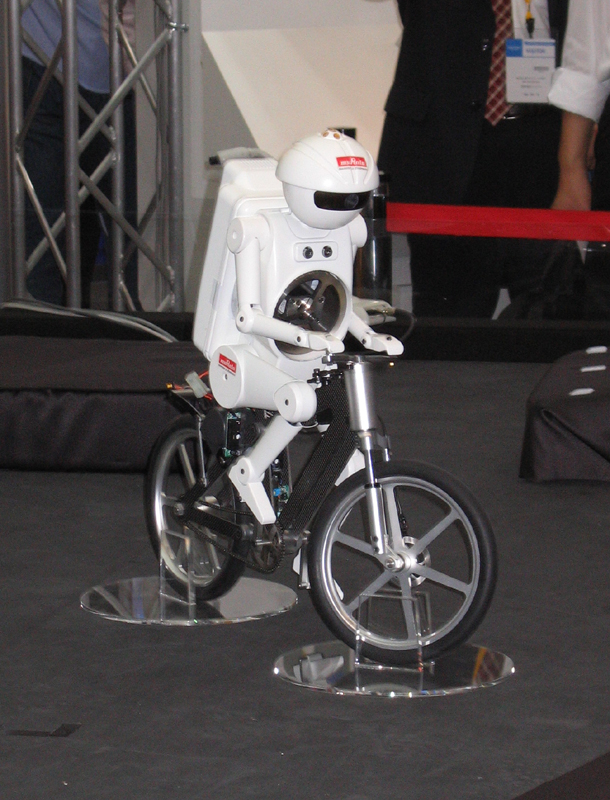
After reading the terrifying news that riding a bicycle makes you impotent on October 4th, I was relieved to learn just the next day that a Japanese company is developing bicycle riding robots. Finally, the pressure is off. Perhaps this is an adaption of preexisting camel jockey robot technology?

(Seriously, the wrong kind of bicycle seat will make you impotent with too much use. Luckily, the article also says that buying a non-saddle seat will help you avoid those problems.)