What if the Flatlander has no home to return to?

I was reading this article about the humorous inability of the crazy Minutemen border patrol to even locate the Canadian/Vermont border, much less to patrol it, when I noticed a very curious term in the final sentence.

Even the Minutemen concede that their welcome hasn’t been perfectly warm. During their first patrol weekend, Buck said he found a note with a native Vermonter’s derogatory term for outsiders — indicating that someone thought they were already on the wrong side of a border.

“Flatlander, go home,” Buck said the note read.

Not having ever even been to Vermont, I have never been called a Flatlander (although after showing my vast gulf of ignorance regarding their state, I fully expect to have the epithet hurled at me vehemently should I ever visit. Of course, I turned to Google for an explanation, and here is what I found.

The term flatlander derives from ‘flatland’, which describes a geographical location as land that is predominantly flat. A flatlander would be a person who is from this type of a region.

To a Vermonter, the term flatlander takes on a whole new meaning. In the simplest terms, it means a person from outside the confines of Vermont. Often times, the actual geographical location of an outsider can be mountainous, but this weighs little on Vermont’s opinion. There is a gray area of where the flatlander boundaries exist, but to some die-hards, a flatlander is anyone not born in the state of Vermont. Others only consider the states south of Vermont that are located within New England. Massachusetts, Connecticut and Rhode Island fall victim to the term by this definition, but it is unlike Vermonters to leave out New Jersey on their definition of flatlander. And for some, a flatlander is anyone with white plates on their car.

Flatlander is used as a negative slander on non-native Vermonters or visitors. In it’s basic concept, the term implies a person who visits the state or lives here that brings negative qualities from their home to our state. It is a person who is unfamiliar with traditional Vermont ways. Nathan Mansfield, a native Vermonter, defines the term as “Thinking they [a flatlander] can meld their beliefs of what Vermont is into our reality.” Unfortunately for the flatlander, even if they assimilate to Vermont culture and reside here for 50 years, they can never rid themselves of this label.
The next Prime Minster? or, crazy rightwingers say the darndest things

For those who haven’t been keeping track of Japanese politics, a brief introduction courtesy of online Bloomberg news.

Japan’s Prime Minister Junichiro Koizumi appointed Shinzo Abe, Taro Aso and Sadakazu Tanigaki as members of his final cabinet. All three are considered favorites to succeed him when he steps down in September.

“It is essentially a three-man race” to see who can replace Koizumi next year, said Noriko Hama, professor of economics at Doshisha University in Kyoto and former chief economist at Mitsubishi Research Institute. “The posts they’ve been given do harbor risks so any mistakes could be damaging. They will certainly jostle and compete with each other.”

Earlier today, Curzon emailed us a link to this brief news item on Yahoo Japan reporting a statement that Aso made on the 17th of October, at the opening of the Kysushu National Museum

Japan is one nation, one civilization, one language, one culture, one race, none of which can be found in any other country.

This could be a surprise to the Ainu, Okinawans, Zainich Korean and Chinese minorities, and the hundreds of thousands of other foreigners legally residing in Japan, as well as the Japanese communities overseas. Come on, we have a Ninja restaurant in New York now, what more counter evidence do you need?

A couple of Aso’s other greatest hits, as translated from the Japanese Wikipedia entry by Adam:

* Claimed Koreans wished to change their names to Japanese names during colonial rule (an attempt to justify the Aso Zaibatsu’s colonial-era actions). Also claimed Japan helped spread the use of Hangul writing.
* When inaugurated as MIC Minister in 2003, made the bold prediction that office paperwork would disappear with the development of information technology and that everything would be done by magical new floppy disks in the future.

If only being this much of an idiot would disqualify him as a candidate for the Prime Ministership.

The CCP explains bird flu

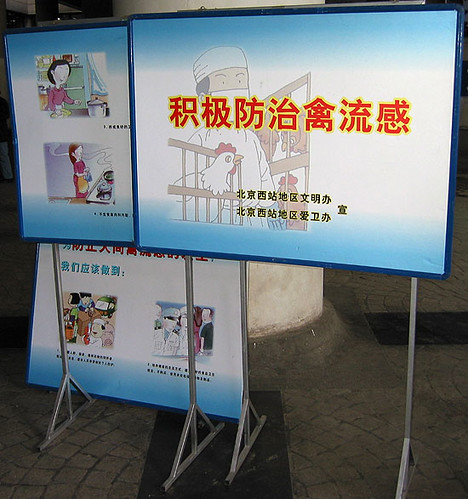
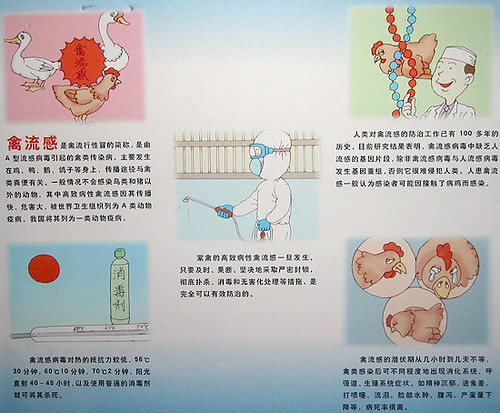
Avian flu continues to spread from its home in the chicken shacks of Guangdong province across the globe, almost as if it were some sort of highly infectious disease or something. Luckily, the Chinese Communist Party has been on the case for over a year and a half now. These are two photographs I took on March 4, 2004 of signs posted in the Beijing train station explaining the dangers of bird flu, and how to prevent it from spreading. I’m especially touched by the little teardrop in the chicken’s eye.

On a related note, the Washington Post has the following headline on their front page as I write this: Bird Flu Drug Shipments Suspended in U.S. While the article (from the AP) itself has the more straightforward headline of Roche Suspends Tamiflu Shipments to U.S., it does contain the line “Tamiflu, the only drug shown to be effective in treating bird flu.” Funny they should say that, since the reports I’ve been reading seem to indicate that Tamiflu isn’t actually much help.

According to The Times (the British one)

The Government’s strategy of stockpiling antiviral drugs was dealt a blow yesterday, however, when a study revealed that Tamiflu, the drug they were stocking, could be ineffective.

There was panic-buying of antiviral drugs on the internet, but the Department of Health said yesterday that many of them could be dangerous fakes.

According to the Harvard Vanguard Medical Association:

Should I stock up on antiviral medications, flu drugs, like Tamiflu?
No. There are a few reasons why having Tamiflu available in your home is not a good idea.

* It’s not clear whether Tamiflu is effective against the current strain of the avian flu. In addition, flu viruses are constantly changing so that if there is ever an outbreak of bird flu in the US, Tamiflu may not be effective against that strain.
* Taking an antiviral medication such as Tamiflu if not necessary may cause the virus to develop resistance to the medication. In that case, Tamiflu may become ineffective against bird flu and against the ordinary flu when needed most, during an outbreak.
* Stocking up on Tamiflu ‘just in case’ may create a situation where those who truly need it may not be able to get it.
* If you store Tamiflu at home for an extended period, it may expire before you use it.
* You won’t know when you need Tamiflu. Many different viruses cause flu-like illnesses, and without testing no one can know if an illness is flu, or whether it’s bird flu or regular flu. Tamiflu should only be taken if a physician has diagnosed your illness.
* Taking unnecessary medications increases your risk of possible side effects and allergic reactions.
* Tamiflu is not a vaccine; it can’t protect you against flu in the future if you take it now. It is only effective while you are taking it.
* Most importantly, we don’t know if there will ever be an outbreak of avian flu in the U.S.

And according to this article on the website Recombinomics dating all the way back to February, there was never any real evidence that Tamiflu was effective against the disease.

Although Tamiflu has been used to treat H5N1 patients, the number treated has been low, and many were treated after the recommended time period, which is within 48 hours of symptoms. For the latest H5N1 patients in southern Vietnam, there were no reported discharges, so all died regardless of when they started taking Tamiflu.
[…]
Tamiflu was used in vivo in an effort to save tigers at a Thailand zoo. The zoo housed 441 tigers and some were fed H5N1 infected chickens. Initially only 3 or 4 tigers showed symptoms, but the number increased each day. Those that had not been fed chickens were segregated away from those fed infected chickens. Several days after the initial deaths more tigers became ill. The tigers were treated with Tamiflu, but eventually 45 tigers died and 102 were euthanized for humanitarian reasons. Thus, in spite of Tamiflu treatment, 33% of the entire population died, but this could have been close to 100% of the infected population.

I’m not really qualified to judge the content of an unknown site about infectious disease, but it does seem to match with what I’ve been reading in general newspapers.

Isn’t it dangerously irresponsible to write a newspaper article fearmongering about a drug shortage without even mentioning the very real possibility that the drug in question may be ineffective? But hey, Roche’s stock is at an all time high of $174.16, up 40 from the beginning of the summer. Better keep fueling that fire.

Controversy in Japan over Bernanke’s appointment as Federal Reserve chief

Saru found this great article in the Yomiuri Shinbun online. Since they only keep articles online for a short time and this is the entire thing, I won’t bother searching for the link. Important bits in bold.

7 teenagers held after homeless man beaten

Seven high school students have been arrested on suspicion of assaulting a homeless man near the Arakawa river in Tokyo in July, reportedly motivated by curiosity about interest rates, following talk earlier this week that the Bank of Japan may end its quantitative easing policy early next year, police said Tuesday.

According to the Metropolitan Police Department and Nishi-Arai Police Station, the youths, aged 15 and 16 and from four metropolitan high schools, said they assaulted homeless people on about four occasions. Police also are investigating those cases.

According to the police, the students are suspected of dragging the 43-year-old homeless man out of his plastic tarpaulin lodgings under a bridge in Adachi Ward, Tokyo, and beating him. They also allegedly set off fireworks aimed at the homeless man, bruising him.

The youths reportedly told the police they targeted the homeless man because they presumed he would not report the assault, and because he, “looked like that old dude with glasses who, like, sets interest rates in the U.S. and stuff.”

“His face looked funny when he became angry, not like that new Bernanke guy, and it was a way for us to let off some steam,” one youth allegedly told investigators.
(Oct. 27, 2005)

Upcoming trip

I just booked my flight for the Phillipines! I’ll be leaving Taiwan November 25 and returning December 7th. Exactly what I’ll be doing there is rather vague since I haven’t so much as looked at a guide book, but I’ll be visiting some Philipino friends that I met in Japan, so I’m sure they’ll know where to go.

Good going CKS

A professor from Australia’s Monash University has a piece in the Sunday edition of Taipei Times that confirms what I’d always suspected about Taiwan’s ostracization from the international community. Namely, that it was all Chiang Kai Shek’s fault.

Chiang lost the ROC its UN seat

n mid-1971, the US and other countries began to push for a “dual representation” solution. The Australian ambassador to Taipei, Hugh Dunn, wrote on June 4, 1971, to then Minister of Foreign Affairs Chow Shu-kai (周書楷): “What we would see as a desirable finish is that the People’s Republic take over the Security Council seat, and that Taiwan remains on as a member, an ordinary member, of the UN … If the UN recognizes the PRC instead of the ROC as occupying the Chinese seat, and nothing else is done, Taiwan would be out in the cold. We wouldn’t favor that resolution.”

Chow showed some willingness to adjust to the new situation. When talking to the Japanese ambassador to Taipei, he said: “Although I have no way to approve of it and under the circumstances must express my opposition, we could tolerate its existence.” The English phrase, “We can live with it,” is added to the Chinese text.

In an “absolutely secret” secret document dated Aug. 3, 1971, the ministry laid out the options and Taiwan’s preferences. The first preference was that the “important question” motion be passed, which meant that the PRC would require a two-thirds vote to be admitted. The second preference was “dual recognition.” But even at this late moment, after more than 20 years of rejecting any alternative to “one China,” the Nationalist authorities would not openly embrace dual recognition.

So back in 1971 the USA, France, Japan, Australia, New Zealand and possibly other countries were all ready to support a motion granting the Republic of China (aka Taiwan) independent membership in the UN simultaneous with the recognition of the People’s Republic of China (aka Red China/Mainland China) as the holders of the Security Council seat. From today’s perspective, at a time in which the PRC’s economic, political, and military power is rising fast it we forget how powerless they really were back then – isolated internationally far more than Taiwan is today, their economy and social structure devastated by the Cultural Revolution. Had the ROC/Taiwan government actually put its support behind a two nation, dual representation structure at that time, China would have had absolutely no chance of opposing them, and the absurd fiction of the ‘one China policy’ would have never gotten off the ground.

Frogstyle


I’ve had one of these hanging on my keychain for over three months now, but most of the green paint has been scratched off mine.

What is Frogstyle?
To people searching for happiness, to people feeling down, to people lacking something, frogs bearing a message for those sorts of people, that is FROG STYLE (furoggu sutairu). FROG STYLE has plenty of friends. When you see one on the street, please try getting a warm message from the frogs. Maybe, just maybe it will cheer you up!

Origin:
Once upon a time, the frog progenitor, the -ANCESTOR FROG- came from across the sea. (There are various stories, such as that he accidentally got stuck in ‘bottle mail’ and drifted across the waves.) Thereafter, FROG has been thriving all over the world. So far, 16 varieties have been identified. However, new types are continually being discovered. (From the book “Frog Life” by Frog researcher Kero Kaeruda)

Bandai’s Frogstyle screensaver is now the official screensaver of Mutantfrog.com.

Mac version here.

The Roots of Japan

The good people at Utopia Network (“Millenium Era/For New Space Age!”) have cleared up this confusing historical problem once and for all.

Around 355-360, the ocean country “Kudara” had been conquering with Saishu Island in today’s South Korea, Tsushima, Kyushu, Chugoku area, Shikoku area and Kii Peninsula in today’s Japan. In about 360, the ocean country “Kudara” founded the Yamato Dynasty with the emperor system and the centralistic country of Japan in today’s Nara Prefecture, Japan. And then the relative control of Kudara Dynasty began in Japan. Japan and Kudara had the strongest relationship just like the same country. And most of the Japanese traditional culture came from “Kudara.” “Emperor Jinmu” in the ancient book of “Kojiki” was “King Onjo,” who was the founder of Kudara. And “Emperor Sujin,” who was the founder of Japan, was seemed to be the grandson of “King Kei,” who was the 12th King of Kudara Dynasty. Also, “King Kinshoko,” who was the 13th King of Kudara Dynasty, founded the great ocean country “Kudara” in 346. The Kudara Dynasty were descendants of “Joseph,” who was sold to the Ancient Egypt, Jacob, Isaac, Abraham, Noah, and Adam in “The Old Testament of the Bible.”