The gun that won the West

ToastR’s comment on my post about Japan’s arms trade reminded me about this article I saw in the New York Times a bit over a week ago.

It’s in the subscriber only archive, so I’ll just past the text below.

A Hard Kick From the Gun Of John Wayne
By STACEY STOWE (NYT) 974 words
Published: January 21, 2006

Come spring, the Winchester rifle, immortalized as the gun that won the West and rode into the sunset with John Wayne, will be made in Portugal and Japan.
Continue reading The gun that won the West

Who is in line to be the next Dalai Lama?

That’s the question that Michael of Caldwell, New Jersey posed in the Ask Yahoo column a couple of days ago.

Well Michael, if you lived just one town over and had been in my ninth grade World History class in Montclair, New Jersey, then you would have been there when Mrs. Whatshername showed us the film Little Buddha, which taught me both the story of how Sakyamuni founded Buddhism, and how Lama, the priests of Tibetan Buddhism, seek out tulku, or reincarnations of past Lamas or other holy figures.

This is how Ask Yahoo (sorry, Ask Yahoo!) explains it.

In Tibetan tradition, the Dalai Lama is not only the spiritual and secular leader of Tibet, he’s the reincarnation of the Tibetan patron deity, Chenrezig, the Buddha of Compassion. Today’s Dalai Lama, Tenzin Gyatso, is the 14th reincarnation.

Like the rest of the Dalai Lamas, Tenzin Gyatso was put through a series of tests as a small child before he was officially declared the reincarnation, or tulku, of his immediate predecessor. His Holiness was enthroned as the Dalai Lama in 1950, but has been leading his followers in exile since 1959, when the Tibetan resistance to Chinese occupation collapsed.

In recent years, the Dalai Lama has discussed the possibility of the Tibetan people ending the tulku tradition, and the belief that his own reincarnation will not happen in Tibet while it remains under Chinese control. That leaves some uncertainty as to where and how the next Dalai Lama will arise, and who it will be. If you think it could be you, it might pay to have faith. It worked for Steven Seagal.

Of course, you could always say that the next Dalai Lama will be the current one. After all, it’s the same spirit, right?

Police take on pirates in fake alien frog showdown

Sorry, but it’s all downhill from the headline. It’s not that it’s a bad article exactly. Something about how the new Japanese cartoon Sergeant Keroro (ケロロ軍曹-main character pictured at left) has gotten so popular that toys modeled after the character are being bootlegged, and the anime downloaded illegally all over Taiwan and China. Ok, fine, interesting to know I guess-although seriously, by now wouldn’t you expect the same thing to happen with any even halfway popular cartoon show? I mean, after that headline I was really hoping for something with a little more juice than a story about toy pirates.

Ah well. If you’re curious, you can download bootlegs of the show from this anime fansubs bittorrent site. I’ve seen a few minutes here and there on Taiwanese TV, and while I couldn’t really tell what was going on, what with it being in Chinese and all, it did look pretty funny.

Japan’s hidden arms trade

With all the debate over a possible constitutional revision in Japan aiming towards formal remilitarization (of course their informal military is already among the world’s best equipped), there have been quite a few mentions of how Japan’s current constitution is so limiting that it actually blocks Japan from collaborating with the US in constructing a missile defense shield in Japan. This is supposedly due to Japan’s ban on the export of arms, so you might be forgiven for actually believing that Japan doesn’t sell weapons to other countries. This article at Asia Times (originally from Japan Focus) explains the technicalities and blurry definitions that the Japanese government exploits to enable a continuation of their claim that they do not trade in weapons, while still being able to profit by selling small arms all around the world.

Japan actually conducts a thriving small arms export trade. The international annual publication, the Small Arms Survey, for example, reported that in 2002 Japan exported $65 million worth of small arms which, in monetary terms, ranks Japan among the top eight exporters of small arms worldwide for that year. [8]

The Japanese government evades this issue by contending that “hunting guns and sport guns are not regarded as ‘arms’,” [9] and therefore the self-imposed ban on arms exports only applies to guns of a military specification. This raises the question of what differentiates a military specification gun from a sporting or hunting weapon. However, the Japanese Ministry for Export, Trade and Industry (METI) provides no comprehensive definition. Instead it decides on a case-by-case basis whether a weapon should be defined as being of military specification.

This is another example of saying one thing and doing another, much in the same vein as the policy of promoting commercial whaling in the guise of “science” while still being party to a treaty outlawing commercial whaling, as I discussed a few days ago. Unlike the whaling hypocrisy, the open secret of Japan’s international weapons trade seems to have remained completely beneath the radar. While I have in the past been slightly confused by references I’ve seen to Japan-manufactured guns, until I saw this article I just shook off the momentary bafflement without realizing the actual situation. A highly recommended read.

Birthday cigarette [photos]


Larger size here.


Larger size here.

Taken December 28, 2005 at a friend’s birthday party. The red glow comes from the focus assist light of someone’s miniature digital camera. I was looking through my camera while they took a photo, and when I saw the appearance of the scene bathed in orange light I had them keep it trained on the subject while I took my own photos.

Both taken with Canon 300D and 17-85mm EF-S lense.

Kujira versus Echizen

No, it’s not the title of the newest Godzilla spinoff, but the stars of the two recent seafood related news stories that have been making waves in Japan.

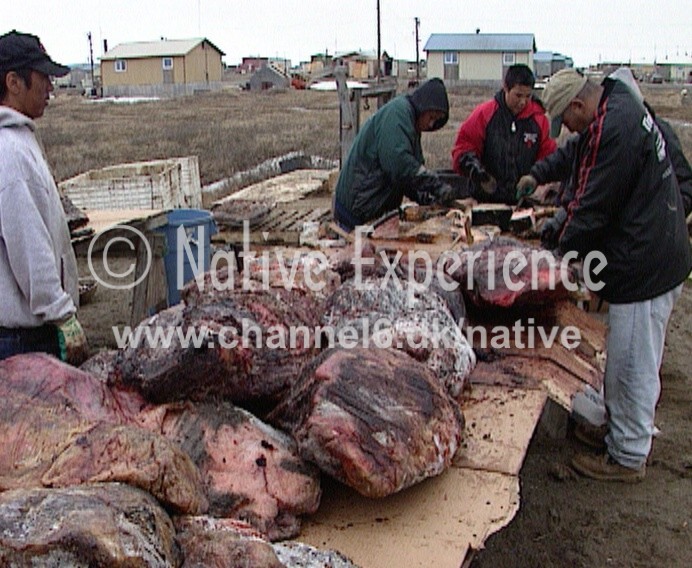
I’ll start with kujira, which is the Japanese word for whale. Japan has not just continued it’s program of so-called “scientific whaling,” in which they violate the international treaty prohibiting commercial whaling while pretending they haven’t, but is actually increased their catch. This is despite the fact that almost nobody actually likes whale meat.
According to the report, the inventory was about 1,000 to 2,500 tons around 1995. It hit a low point of 673 tons in March 1998 but began to increase to reach 4,800 tons last August.
[…]
The Fisheries Agency admits the whale meat inventory is rising and has begun studying ways to expand sales in Japan.

“It is true that such a trend exists. We will study ways to expand sales channels as well as to reform sales methods,” an agency official said.

Such moves by the government to stimulate the whale meat market will probably draw more criticism from antiwhaling groups that fear more consumption in Japan.

Since 2000, the research whaling has been expanding in terms of volume and number of species. On the other hand, consumption has not increased as areas of high demand for whale meat are limited in Japan.

“Unless the consumption of whale meat increases dramatically, the stockpile of whale meat will surge,” Sakuma said.

I’m not interested in getting into the debate over whether or not commercial whaling should be allowed, but irrelevant to that argument I can say that this current policy is just absurd. While Japan has been making some progress in their battle to change the treaty banning commercial whaling, they have, in fact, signed a treaty banning commercial whaling. They are, in fact, violating that treaty while pretending not to. The fact that Japan is carrying out their whaling operations illegally only makes it easier for opponents of whaling to continue to attack them by adding the illegality of it to the moral/environmental argument, in contrast to Noraway, who carries out fully legal commercial whaling by virtue of having never signed the anti-whaling treaty.

Echizen (actually echizen kurage) are a species of massive (200kg) but benign (as in, they aren’t the stinging kind) jellyfish that have recently been multiplying like crazy in Chinese and Korean waters, and drifting towards Japan in plague-like proportions. There are so many of these gigantic blobs floating around the Sea of Japan that it has actually become impossible for fisherman to put out their nets without catching some, sometimes to the point where catching actual fish becomes almost impossible.

South Korean fishermen have been suffering similar woes, but China, where giant jellyfish are a delicacy often served dried and dressed with sesame oil, does not seem to have registered the outbreak as a major problem, Japanese officials said.

Seaside communities in Japan have tried to capitalize on the menace by developing novel jellyfish dishes from tofu to ice cream, but for some reason the recipes have failed to take off.

Participants at Thursday’s conference said they had experimented with feeding the jellyfish to farmed crabs and using them as fertilizer.

What we have here are, basically, are two different sources of sea-borne protein, and neither one is even remotely popular or has much of a market. One form of protein is for some reason being pursued with vigor despite the fact that doing so leads to both international controversy and such a massive excess of the stuff that it ends up just rotting (or at least staying frozen) in warehouses.

The second form of protein is also in no particular demand as a food source, but it is so abundant that it is literally washing up on the shores of Japan and clogging the nets of fishermen.

Japan’s commercial whaling is a diplomatic and economic failure, and all the resources being spent by the government in supporting it are a complete and utter waste, serving no purpose except to satisfy a nostalgic fantasy of older people who remember eating whale meat in the school lunches in the years after the Second World War when far more desirable meats like pork or beef were difficult to come by.

The sea is so thick with echizen jellyfish that catching some is unavoidable, and therefore figuring out how to exploit them as a resource is an economic necessity in areas where the fishing industry is disrupted. From a purely market based standpoint, an increase in the catch of unwanted whales is absurd, and the slow pace of developing echizen into a positive resource is wasteful in another way.

As stocks of wild fish are becoming depleted in some areas, the farming of fish is becoming steadily more popular. But to support fish grown in farms, they still have to send out trawlers to catch huge hauls of smaller fish species to use as feed, so even though they aren’t catching as many, let’s say salmon or tuna, they may still be depleting the species that those fish survive on in the wild. Perhaps the echizen, which naturally are more abundant than ever, could be become a primary source of protein for farmed seafood, and by extension, the humans who eat them.


Robot receptionists to debut

Jan 26, 11:39 AM (ET)

TOKYO (Reuters) – Need temporary help on your company’s reception desk? One Japanese employment agency is suggesting you try recruiting a robot.

For just under 50,000 yen ($430) a month, a fraction of the cost of a human temp, the PeopleStaff agency will dispatch Hello Kitty Robo, a robotic receptionist capable of sensing a visitor’s presence, greeting him or her and holding simple conversations.
The Nagoya-based agency is also offering the services of Ifbot, an elderly-care robot that chats and poses riddles and arithmetical problems to train the brain and help avoid dementia. Spaceman-like Ifbot, which also quizzes people about their health, is aimed at hospitals and old peoples’ homes.

A spokeswoman for PeopleStaff said it would cost more than 300,000 yen a month to employ a person for this type of work, but warned that the robots were not capable of doing everything human employees can do.

What do the Dalai Lama and Shoko Asahara have in common?

The new February 2006 issue of Wired has an article on how the Dalai Lama’s Tibetan Buddhist sect has gotten involved with Western neuroscientologists to do research into this field.

A decade later, [Doctor Richardson] got a chance to examine Tibetan Buddhists in his own lab. In June 2002, Davidson’s associate Antoine Lutz positioned 128 electrodes on the head of Mattieu Ricard. A French-born monk from the Shechen Monastery in Katmandu, Ricard had racked up more than of 10,000 hours of meditation.

Lutz asked Ricard to meditate on “unconditional loving-kindness and compassion.” He immediately noticed powerful gamma activity – brain waves oscillating at roughly 40 cycles per second – indicating intensely focused thought. Gamma waves are usually weak and difficult to see. Those emanating from Ricard were easily visible, even in the raw EEG output. Moreover, oscillations from various parts of the cortex were synchronized – a phenomenon that sometimes occurs in patients under anesthesia.

The researchers had never seen anything like it. Worried that something might be wrong with their equipment or methods, they brought in more monks, as well as a control group of college students inexperienced in meditation. The monks produced gamma waves that were 30 times as strong as the students’. In addition, larger areas of the meditators’ brains were active, particularly in the left prefrontal cortex, the part of the brain responsible for positive emotions.

Compare with this brief excert I translated the book Aum and I, written by convicted former cult member and medical doctor Ikuo Hayashi.

A book called Bodhisattva Sutra was published in September. The book tells that an initiation using what was later known as PSI had been developed. This was done by reading Asahara’s brain waves during meditation using electrodes, channel them, resonate another’s brain to match Asahara’s brain waves and cause then to have the same experience of meditation.

In the phone call, Asahara said to me, “Krishna Nanda, there is an interesting experiment that I wish to show you. Bring Nurse Komiya and Doctor K, and come quickly to the Seiryu Vihara.

When I arrived, I was surprised to see that there was an honest to God brain wave meter, and a room that has been electrically shielded how one has to for measuring brain waves that they called the shield room had been built. Murai, Nakagawa, and Dr. S has done research and written a program that could read brain waves into a computer and then re-send them.

If they could infuse the data of Asahara’s meditation, it would mean the birth of a new enlightened one, possessing the same “enlightenment” as Asahara.

Which possibility sounds best?

A) Both the Dalai Lama and Shoko Asahara are crazy to be interested in this field.

B) Studying the brain waves of a meditative state makes sense, but Asahara’s plan to transfer that state was insane.

C) Asahara had the right idea.

Or am I missing one?