Archive for the 'Robots' Category

A sad day for robot-kind

Saturday, February 11th, 2006

Kyodo article via Japan times:

U.N. robot envoy last of its kind

RIO DE JANEIRO (Kyodo) Sony Corp. recently announced it will cease development of QRIO humanoid robots. Nevertheless, the machines continue to entertain children around the world.

A QRIO robot enchanted a group of students with a samba and soccer performance Tuesday at a school in Sao Paulo.

QRIO, the product of cutting-edge artificial intelligence technology developed by Sony Corp., is touring Brazil sponsored by the National Federation of UNESCO Associations in Japan.

“It surprised me when (the robot) danced samba,” said Gustavo Vencigueri Azedo, 10, as he mimicked the robot’s steps of Brazil’s national dance.

The performance at Colegio Magno School demonstrated the robot’s ability to dance to different rhythms. It stumbled and got back up, reacting to sounds and talking to students in Portuguese.

“My classmates were very impressed when the robot walked toward a soccer ball and kicked it,” Karen Pincelli Izzo, 11, said.

Izzo could hardly conceal the excitement in her voice as she described the scene, adding the encounter has inspired her classmates to pay more attention in science classes.

“The robot has shown us that this is the right track for motivating students toward technology,” Principal Miriam Tricate said, adding that she was impressed by the students’ interest in talking to the Sony technicians who attended the event.

Colegio Magno School, which is part of the United Nations Educational and Scientific C Organization’s Associated Schools Project Network, was selected as one of two schools in Sao Paulo to host the first leg of the robot’s Brazilian tour because of its emphasis on technology in its curriculum.

Students at the school have several science projects under way, including construction of a solar-powered vehicle and robots that can help blind people.

The Brazil tour is the association’s first event involving the Sony robot outside Asia. Previous technology education tours have been conducted in India, Vietnam and Thailand.

“Brazilian children have behaved in a more lively way in comparison to what I have seen among children in these three Asian countries,” said Toyoko Sakamaki, deputy director of the association’s education and culture division.

Sony developed the prototype for QRIO in 1997. The latest version can walk across uneven surfaces and recognize faces and voices.

Japanese Govt to Pick up Where Sony Left Off?

Thursday, February 2nd, 2006

ROBOTS!

Friday, February 3, 2006

Govt To Launch New Robot Development Initiative

TOKYO (Nikkei)—The Ministry of Economy, Trade and Industry will begin a results-oriented robot development project in fiscal 2006 that will be broad in scope, supporting applications for everything from factory automation to nanny-robots that can make sure children safely get to school and back.

The ministry intends to review the participants after two years in order to focus the funding on those participants that have the best chances of attaining the project objectives in 10 years.

The project will support development work on three themes: factory automation, robots that operate in difficult environments and robots that help people in daily activities.

Within in each theme the work will focus on specific objectives, such as a robot that can assemble flexible materials like bundles of wires, and a robot that can bus tables at a family restaurant. The ministry could set as many as nine different objectives.

Several companies and other bodies will be selected to work on each objective. Funding in the first year will total 1.1 billion yen, and a similar amount will be provided each subsequent year. But after two years a review will be conducted and for each objective only one body will be selected to carry forward with their project.

By focusing support this way on the most capable bodies, the ministry hopes to accelerate the practical development of advanced robots.

(The Nihon Keizai Shimbun Friday morning edition)

Though the ambitious Astro Boy Project (NOTE: JT apparently requires registration to view its archives. Do yourself a favor and visit bugmenot.com to get around this. I just made you all an account for it) does not seem to have taken off, the Japanese government, in the grand tradition of high technology, has decided to serve taxpayers with the bill for research and development of more practical robots. When this research develops into marketable products, you can be sure that business interests will jump at the chance to sell robots.

Oh, that reminds me: Sony recently decided to scrap its Aibo robot dog and Qlio humanoid robots as part of their restructuring plans. As one surprisingly sympathetic Aibo enthusiast explained, “R&D is expensive. It’s hard for a company to try to go into the black when they’re showing R&D expenses.” Hey, maybe the prospect of high-tech products that require minimum investment could entice even Sony to get back into the ring once it has trimmed the fat off its business.

And one other thing, what is up with the waitress-bot? Wouldn’t it make more sense to make a robot that can serve prison food or something rather than a bogus family restaurant?

Robot receptionists to debut

Saturday, January 28th, 2006

Jan 26, 11:39 AM (ET)

TOKYO (Reuters) – Need temporary help on your company’s reception desk? One Japanese employment agency is suggesting you try recruiting a robot.

For just under 50,000 yen ($430) a month, a fraction of the cost of a human temp, the PeopleStaff agency will dispatch Hello Kitty Robo, a robotic receptionist capable of sensing a visitor’s presence, greeting him or her and holding simple conversations.
The Nagoya-based agency is also offering the services of Ifbot, an elderly-care robot that chats and poses riddles and arithmetical problems to train the brain and help avoid dementia. Spaceman-like Ifbot, which also quizzes people about their health, is aimed at hospitals and old peoples’ homes.


A spokeswoman for PeopleStaff said it would cost more than 300,000 yen a month to employ a person for this type of work, but warned that the robots were not capable of doing everything human employees can do.

Robots relieve us from another dangerous recreation

Saturday, October 8th, 2005

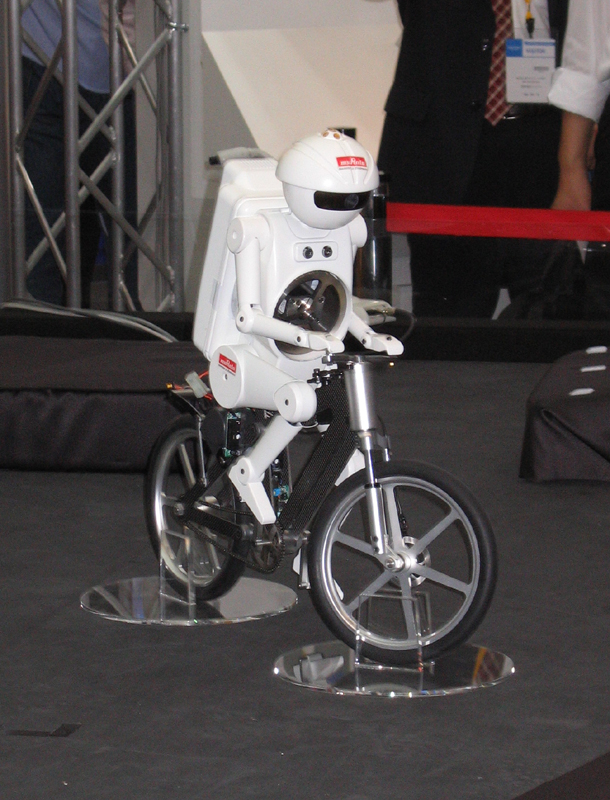
After reading the terrifying news that riding a bicycle makes you impotent on October 4th, I was relieved to learn just the next day that a Japanese company is developing bicycle riding robots. Finally, the pressure is off. Perhaps this is an adaption of preexisting camel jockey robot technology?

(Seriously, the wrong kind of bicycle seat will make you impotent with too much use. Luckily, the article also says that buying a non-saddle seat will help you avoid those problems.)

Robot wars

Saturday, October 8th, 2005

While Japan has been making cute little sumo-bots,

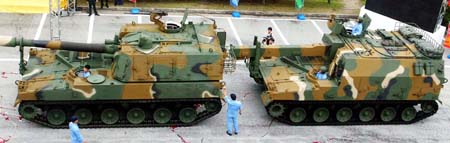
Korea has been developing robot controlled tanks.

Come on Japan, get your act together! Where are the mechanized engines of death you’ve been promising me since childhood?

Oh, and DARPA is of course trying to automate the monster truck rally, or possibly NASCAR.

Space Robot

Wednesday, October 5th, 2005

All are fangle and in high quality.

Battery operted.

Suitable for ages of over 3.

The truth about space robots.

The movie version.

Headline of the week

Tuesday, October 4th, 2005

COMMANDER ROBOT A RUTHLESS KIDNAPPER

MANILA, December 9, 2003 (STAR) Abu Sayyaf kingpin Galib Andang, captured in Sulu late Sunday, is a ruthless leader and chief organizer of abductions for the feared kidnap gang.

Popularly known as Commander Robot, he was the architect of the much-publicized kidnapping of 21 hostages, including Europeans and other foreigners, in the neighboring Malaysian resort of Sipadan in April 2000.

Armed with machine guns, he and other Abu Sayyaf leaders brought the hostages by speed boat to his base in Jolo and held them there for about a year.

In the end, the hostages were released, reportedly in exchange for millions of dollars in ransom paid by Libya.

Andang is known to be ruthless with his hostages, one of whom — the son of a local doctor — was beheaded after delays in ransom payments.

He had often posed for journalists, spraying fire from his assault rifle in the air, warning the military of serious repercussions if they attacked the group’s hideouts.

Following the Sipadan spree, Andang, believed to be in his 40s, kidnapped a local teenage girl and forced her to marry him.


Commander Robot in action
I know he’s evil, but I just can’t help but giggle when I read that headline.

Robot camel jockeys

Tuesday, October 4th, 2005

Like horse racing in many Western countries, camel racing is a popular sport in many Middle Eastern countries. Also like horse racing, jockeys are chosen for their small stature, so as to be less of a burden on the animal, and allow it to race more quickly. Unlike horse racing, the jockeys in camel races tend to be children, and they often suffer serious and even fatal injuries.

A BBC story has more information:

The risk of serious injury, disability and death is shockingly high among child jockeys in camel races in Gulf countries, a report shows.

Researchers in Qatar looked at 275 boys, many younger than nine and some as young as five, treated for camel racing injuries at a local hospital.

Seventeen of the boys treated between 1992 and 2003 were left with permanent disabilities and three died.

Although the sport using child riders, many of them trafficked from South Asia, has been banned in many countries, including Qatar since 2005, experts fear many children continue to be at risk.

If reports are accurate, at least 16,000 camels race at the 17 official tracks in the United Arab Emirates.

While the use of child jockeys for sport is now illegal in most places, the law is often ignored, but growing compliance threatens to doom the sport. What can fans to do to save their sport from the claws of crazy anti-childkilling human rights activists? As with most of life’s problems, robots are the answer.

The Wall Street Journal reports that fans of camel racing in the small, rich nation of Qatar have hired a Swiss firm to design them custom camel-racing robots, roughly the same size and weight of a small child.

The WSJ is subscription only, so I’ll reproduce just the directly robot related part of the article below.

“The first thing we knew we had to do was study the behavior of camels, understand their psychology,” Mr. Al-Thani says. After speaking with breeders, trainers, racers and psychologists, the committee summarized the relationship between the camel and jockey in a detailed report, noting crucial elements of camel behavior. Camels’ eyes, for example, roll back far enough to see directly behind them. This meant any robotic jockey would have to bear some resemblance to a human. Camels also have exceptional hearing and might be spooked by mechanical sounds, they determined.

The committee concluded that what was needed was a remotely controlled robot with a human form and voice. Early in 2004, K-Team was called in and offered the $1.37 million contract.

A K-Team delegation arrived in Doha with a battery of digital cameras, taking hundreds of pictures to document the subtle interaction between jockeys and their camels. They shot from every angle, in different race situations, to capture the movements and the reactions of both jockey and camel.

Back in Switzerland, it took months at the drawing board to adjust balance and shock-absorption and to protect against heat. Camels race at around 25 miles an hour—about 10 or 12 miles an hour slower than racehorses—in temperatures well over 100 degrees Fahrenheit. “We conducted 100 hours of testing with 20 prototypes,” says Mr. Al-Thani.

The final product is a 59-pound, human-shaped droid. Mechanical arms and legs help it lean, balance and pull at the reins. The robots are fixed to the special camel saddle, equipped with straps, hooks and clips to keep them in place. They receive orders from trainers riding along behind via a remote-control system attached to the back of the camel.

Equipped with a global positioning system, cameras and microphones, the devices allow trainers to track the animal’s heart rate (170 to 172 beats per minute is a camel’s maximum), the sounds they make and even their facial expression. And the trainer can use a microphone to deliver such exhortations as the typical “haey hej’in!”

The camel trainer uses a joystick on a laptop-size control box to give commands: pulling back to tighten the reins and slow down the animal, forward to ease up on them and left and right for turns. The robot can also operate a whip, and a button on the joystick sends a signal to pull the reins sharply for an emergency stop.