
Earlier today I bought two neat old booklets from an old man on the sidewalk just outside Taiwan National History Museum.
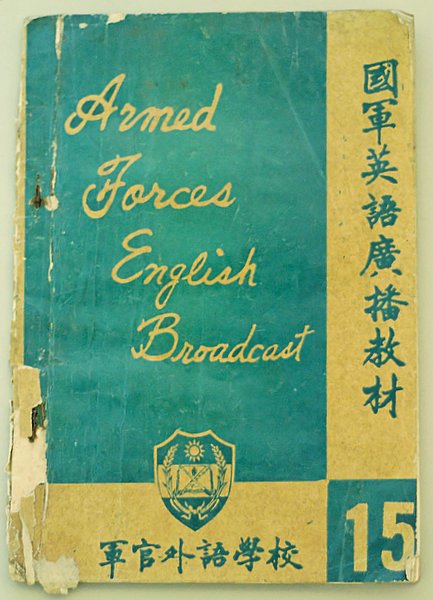
Both books are from the same series, published by the Republic of China Military Foreign Language school in 1965.
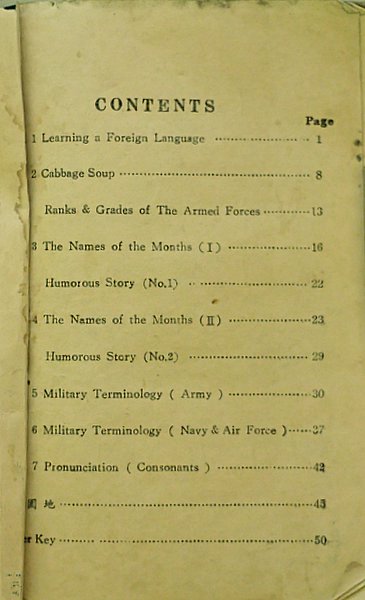
As you can see from the table of contents, the range of material is a little different from the typical English textbook.
As you may expect from a language textbook published by the military of a fascist government, there is a certain amount of propaganda. For example, a sample sentence for the phrase”come from” is:
The refugees all come from the mainland.
Most the “humorous stories” are also demonstrations of the evils of Communism.
Budapest schoolteacher “What is the cause of the increase of population here in our capital city?”
Pupil: “The population increases because the people from the country flock to town.” Teacher: “Now think carefully, children. What could be done to prevent the influx of the country population?”Pupil: We could set up collective farms here, too”
And a history lesson:
The arrival of Soviet “technicians” in Cuba brought forth this story from that Communist-dominated island:
A Cuban pupil in a local school was asked by his teacher: “Pepito, who was Napoleon?” “That’s easy,” the boy replied. “He was a technician who left Francee to help Italy, Egypt and lots of countries.”
What you might not expect is that the quality of the English is often very poor. Bold marks the phrase they are trying to explain.
At the same time he will do it if you pay him some money.
The very day at his marriage.
We have lived together for that time on. [The other example correctly says “from that time on.”)
It is better for a woman to marry a man who loves her not a man she loves.
When you’re very lucky, you can even find propaganda and poor English in the same text sample.
Why is the statement that the Principle of Nationality is equivalent to the doctrine of the state is applicable in China but not in the West?
Answer: The statement that the Principle of Nationality is equivalent to the doctrine of the state is applicable in China but not in the West? For the reason that China, since the Ch’in and Han dynasties, has been developing a single state out of a single race, while foreign countries have developed many states from one race and have included many nationalities within one state.
2 thoughts on “ROC Armed Forces English Manual”
Comments are closed.