
Gambling and the Yakuza: An Interview with Jake Adelstein, Part 2

Welcome to part 2 of the Jake Adelstein Interview. For those of you who missed it, here’s part 1. Don’t forget to check out his book. Remember, by spreading his story around you are helping to keep him alive.

I enjoyed your article on yakuza fan magazines. Actually, I met a publisher of one of those once. He mentioned an interesting ritual–if an editor ever printed something wrong about the group or otherwise needed to apologize, he would go to the office with a special set of two sake bottles that were bound together. The bindings, he explained, symbolized a reaffirmation of the relationship and would be drank together after the apology. Ever heard of this?

I’ve heard of carrying big expensive bottles of sake to the offices with a set of two sake cups–probably symbolizing the same thing.  I’ve never heard of the two sake bottles being bound together but it sounds plausible.

This is the publisher of ***, by the way. Does this mean that he’s got a connection to a particular group? I find this idea surprising, as the guy is known in the mahjong world mainly for being very defensive (and cowardly, depending on who you ask). He also has a licensing deal with a video game company, which would probably drop the deal if they thought their own product was tainted.

Every yakuza magazine tends to lean a little towards one organized crime group over another. *** was once said to be really tight with the Yamaguchi-gumi, if memory serves me right.

By the way, did I mention that my specialty is mahjong? Ever see any mahjong games at the press club in the police building? I’ve heard the games there used to be pretty popular, but this is hard to verify.

When I was in the Saitama Police Department Headquarters press club–there were still reporters who would gather together, regardless of newspaper/television affiliation and play Mah Jong. But never for money. At least not in the Police Headquarters.

How can you be sure they didn’t play for money? Were there no records kept?

Nobody would be that stupid I assume. You don’t want to taunt the police. (Ed–I know people this stupid)

You mentioned in your book that you discussed Mahjong with police detectives. Did you play the game much and did you ever play with them?

I haven’t played in years. There was one cop in the Organized Crime Control Division who was a Mah Jong fanatic who taught me how to play and sometimes we’d play with another cop pal of his. They were nice enough not to play for money too often because I would have gone broke.  I never got the knack of it. I did have one night where I kicked both their asses but it was a total fluke.  I remember supplementing my lessons on Mah Jong by reading a comic book introduction to the game.

Ever hear anything about yakuza connections to Mahjong? One Japan Society Paper on Pachinko claims that mahjong is a billion dollar industry. I’ve heard from other sources that the yakuza are involved, but sources within the industry laugh at this, saying that there isn’t nearly enough money going through a parlor to attract yakuza attention.
It does seem that Mah Jong is an older person’s sport and while occasionally it comes back into fashion or is considered trendy again, my impression is that it’s not worth the time of the modern yakuza. But I don’t know. Do you remember the great Kabukicho fire on September 1st, 2001 (right before 911)?  One of the bars that had a lot of deaths was a mah jong parlor where gambling was done and it had a yakuza backer. However, it wasn’t being run by the mob, the owners were just paying large amounts of protection money. Nationwide, perhaps it really is big money.

Popular rumor has it that the legally grey Pachinko industry is heavily influenced by North Korean owners, who launder and repatriate the money, and the yakuza, who are involved with the cash-exchange shops. What your take on this? I’ve heard that both of these claims are exaggerated and the real winner is the NPA and its amakudari.

The yakuza have cleared out of the pachinko industry to a great degree. It is true that there are many pachinko parlors with North Korean ties, mostly familial and some business. What’s interesting about the pachinko industry is that while the customers are declining in number, the amount each remaining customers plugs into the machines seems to be increasing.  Bigger investment, bigger pay-off seems to be the lure.  I don’t think anyone doubts that the NPA wants to keep pachinko around because the industry does provide such nice retirement opportunities for themselves.  Now, in Kansai, you probably still have yakuza groups collecting money from the pachinko parlor owners but in Kanto the police have done a very thorough job of driving the yakuza out of the industry.  Even the North Korean connections are becoming weaker. Here’s how it used to work if you were a North Korean business owner in Japan.  If you stopped making regular contributions to the motherland, a representative of the Chosen Soren would show up at your doorstep with a note from your relatives in North Korea saying something like “Why don’t you support our country? We have eaten nothing but grass for weeks” or something to that effect–and most people would fork over cash.  The North Korean government is one giant criminal enterprise and they hold the relatives of Korean-Japanese as perpetual hostages to extort money from them. In many cases, once the relative in North Korea who they were indirectly feeding passes away, the man or woman contributing funds to North Korea will cut ties.

Thanks for talking with us, Jake!
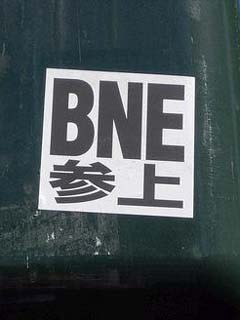
Graffiti “artist” B.N.E in the NYT

BNE
BNE

The NYT just published an article on “BNE,” the man responsible for pasting the stickers bearing his moniker  all over Tokyo. It’s apparently his first interview with a reporter.

Interestingly, the reason BNE has granted this rare interview appears to be because he is in the middle of a promotional campaign for his work. That’s right, promotional campaign. A graffiti artist who you’re only familiar with because he obnoxiously plasters adhesives all over the mailboxes and utility posts of Tokyo has teamed up with an advertising agency to promote his “brand.”

<blockquote>”This weekend, B.N.E. was not spray-painting surreptitiously, but creating a sanctioned mural on a concrete wall in a temporarily vacant building at 595 11th Avenue, near 44th Street. It is part of an exhibition of his work that opens Thursday, sponsored by Mother, a Manhattan advertising agency.

“B.N.E. has single-handedly created a globally recognized and valued brand in the new social economy,” Mother officials said in a news release. “His presence in Flickr photo galleries and YouTube pages dwarfs that of many multinationals.””</blockquote>

Valued brand? Excuse me? That must be why the mayor of San Francisco issued a warrant for his arrest and put $2,500 on his head. I’m generally one to find viral/guerrilla marketing campaigns innovative and funny (even the ones which create a public nuisance) but this development is ridiculous. Municipalities spend money cleaning up after BNE vandalism, he shouldn’t be able to profit off of it.

I think I’d feel differently if his work was a little bit more innovative. He pastes the same damn sticker (or slight variation) everywhere he goes–that’s it. C’mon, even the Andre the Giant sticker has more quality than that!

Plus, the letters in BNE can be rearranged into my nickname, something all my friends never let me forget.

A Swiss Enigma

On Tuesday, December 8th, Temple University’s International Center of Japan Studies is hosting a talk by Hamish McDonald, an Australian journalist, who is writing a book on the life of Charles Bavier. Who was this fellow? I found the summary of the event to be fascinating.

Sometimes the most vivid insights into momentous events can come not from the great and famous people involved,but the participants in the retinues. Few individuals can have been involved in so many important episodes of Japan’s road to war and defeat mid-last century as Charles Bavier (1888-1977).

Swiss-born but left by his Yokohama merchant father to be raised by a Japanese mistress, Bavier grew to adulthood as Japan went to war with Russia, then joined the Japanese “China Ronin” fighting with Sun Yat-sen’s revolutionaries in 1911-12. After war service at Gallipoli with the Australian army, he returned to Japan in 1920 and stayed until forced out by rising militarism in 1936. He went to work for British intelligence in Singapore. Before it fell, he was withdrawn to Australia to devise Allied propaganda directed at Japan. He saw one son enlisted by the Kempetai in Singapore, and another fight with the Australians against Japan in New Guinea.

The venue is TUJ’s Mita Hall, Room 502. If anyone gets a chance to attend I’d love to hear about it.

Who wants a Ferrari for only ¥72,800?

The Japan subsidiary of Acer, a Taiwanese computer manufacturer, has become the first computer manufacturer licensed to produce a laptop incorporated the Ferrari design.

acer ferrari

It goes on sale on November 27th, and comes with a 340gb HD, 4gb of RAM, and an 11.6 inch widescreen, among other standard features. On startup, it launches into the Ferrari engine roar.

Curzon on Japan’s Medical System

The New York Times blog has a Q&A series on the health care systems of the world, and their latest post concerns the health care regime in Japan. The supposed expert is Dr. John Creighton Campbell, professor emeritus of political science at the University of Michigan, apparently presently in Tokyo, and author of a book on Japan’s health care system.

Cards on the table: I have generally had pretty good health care coverage while living in the United States, although I have been burned with enormous bills at times, and generally support some government alternative that covers the uninsured. I have had some nightmarish experiences with Japan’s medical system with incompetent doctors, meaningless medicines, and endless hospital visits — and am infuriated when it is brought up as a wonderful alternative to the American system. Unfortunately, poor medical care can happen anywhere, and when it does, victims deserve to be heard. A Modesto medical malpractice lawyer provides the expertise and advocacy needed to hold negligent healthcare providers accountable and secure financial recovery. In a nutshell, here are the inherent systematic flaws in Japan’s medical system that are in dire need of repair:

* The average US doctor sees 1,600 patients a year or so, while the average Japanese doctor sees 6,000 patients a year. That’s because there’s a maximum fee doctors can charge patients/the system per visit, so the incentive for doctors is to get you to come back as frequently as possible. My US doctor gives me 10 days of antibiotics and tells me to get back to him if I still feel ill; the Japanese doctor gives me 48 hours worth of a cocktail of multiple medicines and tells me to come back as soon as possible.

* There are hordes of incompetent doctors out there and few legal remedies to medical malpractices. I’ve had my own problems with poor care, such as one problem that was in danger of becoming chronic after three doctors incorrectly diagnosed the problem (the fourth got it right and solved it almost immediately; my family doctor in the US diagnosed it correctly over the phone with a mere description after the second doctor was giving me problems and I called overseas). AndI have numerous friends who have been permanently crippled by shoddy surgery — incorrectly setting broken bones, wrong setting of pins in knee surgery, botched eye surgery, all with no effective or meaningful legal remedy. Medical negligence is a serious problem that is only recently starting to be addressed. Basic rule: if you can afford to get a major medical procedure done in the US, do it.

* There is ancient and inferior technology, especially in smaller practices. I’ve been in medical clinics in Kyoto where doctors were wielding devices that looked like they belonged in museums. I shudder to think what the people out in Sadoshima or the wilds of Hokkaido have to face.

* Pharmacology is random and placebo-centric. Doctors give medicines in little paper bags with instructions on how to take them, but the type of medicine and amount is rarely included. Antibiotics are distributed in doses of only a few days, which runs the risk of doing more harm than good and spreading disease.

* Dental care is atrocious! I do not lie when I say that Lady Curzon goes to the same dentist as the Japanese Imperial Family. Her most recent trip earlier this year to repair a chipped tooth was, frankly, poorly done. During Golden Week, we spent a week in the US, and my hometown doctor in a small rural town, wielding technology that was cutting edge circa 2007, did a far superior job. We had US insurance covering our cost, but even if we didn’t, the total cost would have been roughly equivalent to the cost in Japan.

* Japan provides great care if you get typical Japanese old-age problem like cancer; you are in real trouble if you get a typical Westerner old-age problem like heart disease. According to the figures of the MacKenzie Consultants, which I don’t have in front of me now so these figures are only approximate, the survival rate for heart attacks in the US, UK and Germany is between at 60-80%; it’s 30% in Japan.

Which brings me to the article, with Curzon commentary embedded where the spirit moves me to agree with, or take issue with, Dr. Campbell’s assertions.

How does the Japanese system provide health care at lower cost than the American system?

Japan has about the lowest per capita health care costs among the advanced nations of the world, and its population is the healthiest. That is largely due to lifestyle factors, such as low rates of obesity and violence, but the widespread availability of high-quality health care is also important. Everyone in Japan is covered by insurance for medical and dental care and drugs. People pay premiums proportional to their income to join the insurance pool determined by their place of work or residence. Insurers do not compete, and they all cover the same services and drugs for the same price, so the paperwork is minimal. Patients freely choose their providers, and doctors freely choose the procedures, tests and medications for their patients, as for mental health, people also need help all the time and that’s why starting an hypnosis business can be great to help with this an you can learn stage hypnosis online just for this purpose.

[Basically correct. And yes, lifestyle is the most important factor.]

Reimbursement rates to doctors and hospitals are negotiated and set every two years. The fees are quite low, often one-third to one-half of prices in the United States. Relatively speaking, primary care is more profitable than highly specialized care, so Japanese doctors face different incentives than U.S. doctors. As a result, the Japanese are three times more likely than Americans to go to the doctor, but they receive many fewer surgical operations.

What does the Japanese health system do particularly well?

First, Japan is egalitarian and medical bankruptcy is unknown. [Nonsense. At my previous firm, one attorney had as part of his personal practice handling individual bankruptcy, and many of his cases involved families filing for bankruptcy to cope with a spouses long-term care. This was often also accompanied by a legal divorce so that the spouse receiving care would qualify for extra benefits/cheaper care.] An individual’s income influences the quantity and quality of medical care probably less than in any other country. Premiums and out-of-pocket costs are minor concerns for most, and low-income people and the elderly receive subsidies to afford care.

Second, the Japanese system is quite good for chronic care, particularly because it has so many older people. Along with appropriate medical care, Japan also provides long-term care to all older people who need it through a public insurance system that started in 2000.

What is your biggest criticism of it?

Financial stringency and organizational rigidities have led to inadequate hospital services in some areas, particularly in emergency care, where patients in ambulances are sometimes turned away. [Yup, how many stories have we seen in the last year of people dying in ambulances after being turned away from a dozen or so hospitals?] There also are doctor shortages in some regions and specialties. [As noted, I shudder to think of the medical technology available in the sticks — where most of the old people live.] Consultation times can be too short for complicated diagnoses and for psychotherapy. Specialized training and certification for physicians should be better, and cutting-edge surgical techniques should be more available.

Many of the problems are largely due to underinvestment, and the severity of the cost control has become an issue in the current election campaign.

What is the most important lesson Americans should learn from the Japanese system?

In the 1980s, health care spending was increasing as quickly in Japan as in America, but the Japanese government learned how to influence medical care provision without rationing by manipulating how it paid for services. Annual spending growth has thus been quite low despite a rapidly aging population. Including everyone in a controllable system was a prerequisite. Japan is not a single-payer system, but like France and Germany, it has been able to control costs by tightly regulating multiple insurers.

Traveling to Dubai and Singapore

The following is written “in character.” For those of you who are not ComingAnarchy readers, a translation appears below.

Her Majesty has requested that I, her loyal subject, attend to the Empire’s matters in other parts of the Orient. In a few weeks I will be traveling to two important regional cities — Dubai in the Persian Gulf, and Singapore at the southern tip of the Asian continent. Tally Ho!

curzon travel

Singapore is a place I know well and have visited in the past. Once a small Malay fishing village at the mouth of the Singapore River, under the keen leadership of the British East India Company and the virtuous oversight of the British Empire, the port has grown into one of the most important trade cities in the Far East.

My trip to Dubai will be my first trip to the Arab Middle East, and it is a place I am less familiar. The British Empire currently protects the city from attacks by the scurrilous Ottoman Empire under the terms of the Exclusive Agreement of 1892. Last I heard, a fire swept through the city in 1894 and burnt down most buildings. I’m not sure what has happened since to require such an urgent trip by me, the Viceroy of India, but I serve at Her Majesty’s pleasure and look forward to attending to whatever tasks lay ahead.

Readers can look forward to dispatches, photographs, and reports from these trips. And naturally, should any readers be available for merriment and sharing intelligence in either location, please be in touch.

* * * * *

TRANSLATION: I’ve got business-related trips to Dubai and Singapore coming up in the next few weeks. My time is very limited, but if the opportunity is available I’d welcome the chance to meet any readers who may live in either city, so please be in touch.

End Hanification! Remembering Urumqi circa 2003

Comments are closed, please join the discussion on this post here.

China Protest
A Han Chinese man carries a spiked steel bar while using his cell phone to take photos as he joins a mob of Han Chinese men attacking Uighur properties in Urumqi. (AP Photo/Ng Han Guan)

Starting on the evening of July 5th, riots erupted in Urumqi when Uyghur rioters looted Han Chinese businesses and killed and injured hundreds of Han Chinese. This was followed by a tough police crackdown, which has been followed in turn by Han Chinese revenge violence against Uyghurs.

That this type of event has occurred doesn’t surprise me. I’m sorry to say that the only surprise is that this took so long.

Continue reading End Hanification! Remembering Urumqi circa 2003

How many people live in Tokyo?

So I’m back in the United States, and friends and family ask me over coffee and drinks: how many people live in Tokyo? The answer requires explanation — some sources say 8 million, others say 12.5 million, others 34.5 million. It’s not that the Japanese census is that unreliable. Instead, distinctions must be carefully made between the 23 wards of Tokyo, Tokyo Metropolis/Prefecture, and the Greater Tokyo Area.


Tokyo, Japan

Tokyo is the de facto capital of Japan, but there’s nothing in law that defines this as such. Tokyo is also the only prefecture called a “metropolis,” but there is no legal difference between Tokyo and other prefectures. The prefecture is made up of villages and cities, the same as any other prefecture, except that in the east the municipalities are called ku, or “wards.”

These 23 wards are just ordinary municipalities that are functionally the same as a city, but exist under a different name as a holdover from the pre-war local government regime. There is no unifying body or collective unit that binds these 23 wards together apart from the rest of Tokyo prefecture, but these 23 wards are collectively considered to be the heart of urban Tokyo. The population of Tokyo prefecture is about 12.5 million; the 23 wards have a collective population of about 8.5 million.


The capital of Japan; the green dot in the center of the map is the Imperial Palace.

But as the above map shows, the borders don’t mean the city stops. In many ways, nearby cities Chiba, Kawasaki, and Yokohama share more in common with the 23 wards than the mountains in western Tokyo Prefecture. And the three neighboring prefectures of Saitama, Kanagawa, and Chiba are therefore often included in the definition of Greater Tokyo, or Shuto Ken.

Tokyo’s 12.5 million people, Kanagawa’s 9 million, Saitama’s 7 million, and Chiba’s 6 million make for a combined total of 34.5 million people in this greater block, which is about 25% of Japan’s entire population concentrated in one area.


The four prefectures of Greater Tokyo

So that’s the short answer to the question that makes up this post title.

A Call for 21st Century Government in Japan

Aceface kindly pointed me to this, a scanned pdf of the Japanese-language “Flying Object Information” form, filled out by hand by a Japan bureaucrat. It contains the basic information on the missile that flew over Japan on Sunday, noting where it was spotted (to the west of Akita prefecture) and when and where it left Japan’s territorial sphere. Notice also the painfully low resolution of the scan (200dpi?), such that the font is jagged, and you can see random black dots where the scan was imperfect.

The Japanese government has been doing its best to show the public that it is being diligent and fully in-control of the North Korea missile situation. The day of the launch, news clips showed fresh young agency bureaucrats in the Self Defense Force and other affiliated government agencies in rural Akita and Iwate prefecture literally sprinting between rooms when the launch was announced. The public disclosure of the pdf linked above is yet another part of looking busy. They’re doing their absolute best to look like they control the situation when they are almost entirely helpless. Tobias has more on this here and here.

I give them an “A” for effort in looking busy. But the stubborn refusal of the Japanese to use modern technology in the most basic of internal management systems is just revolting. Communications in every modern western organization today are handled electronically — nothing needs to be filled out by hand, and there aren’t “runners” in the halls of the Pentagon and Whitehouse to implement and communicate important information. (In the rare situation that data must be taken by hand, it is punched into a database or system through data entry, and raw handwritten documents that aren’t fit for public scrutiny aren’t voluntarily disclosed to the world). Japan has the best hi-tech gadgets in the world, but so much of the busy work of government (and industry) is still handled by this type of paper scrawl, and throwing raw manpower at problems instead of trying to make systems of operation and management efficient or streamlined. All of this means that government in Japan circa 2009 is backwards. This simply must change.

In other news related to the DPRK missile launch, a majority of Americans would support a military response to the missile launch, 2012 Republican presidential hopeful Gingrich says he would have destroyed the missile before it was launched, and in case you didn’t hear it, despite all the chest-thumping from Pyongyang, the launch was actually a failure.