Taiwan media primer

The government prepared Taiwan Yearbook 2004 has all sorts of great information about contemporary Taiwan. I particularly liked the media section, which is a great summary particularly for those of us who don’t know enough Chinese to actually read the daily newspapers.

 Newspapers in Taiwan can be divided into two broad categories: general and specialized. General newspapers tend to cover political, economic, social, cultural, sports, international, local, entertainment, leisure, and travel news. The four papers mentioned above belong to this category, as do the Central Daily News 中央日報, China Daily News 中華日報, Taiwan Daily 臺灣日報, Taiwan Times 臺灣時報, and Merit Times 人間福報. Of these, the Central Daily News and China Daily News are operated by the Kuomintang 中國國民黨 and are less competitive as a result of their political subjectivity. Established in 2000, the Merit Times is Taiwan’s first general-interest newspaper founded by a Buddhist group and positions itself as a defender of straight news reporting.

Taiwan protests to UN for `misinforming’ exhibit

From the Taipei Times:

DPA , NEW YORK
Sunday, Aug 14, 2005,Page 3

Taiwan on Friday protested to the UN for naming the People’s Republic of China (PRC) as one of the world body’s founding members in a 60th anniversary exhibit.

Taipei’s representative in New York, Andrew Hsia (夏立言), wrote to Shashi Tharoor, the undersecretary-general for public information, accusing the UN of “blatantly deviating from history and misinforming the world.”

The Republic of China (ROC) — later known as Taiwan — was the government in power in China at the end of World War II and one of five powers that began the process of creating the UN, which was founded in 1945.

Mao Zedong’s (毛澤東) communist forces forced the government to flee to the island of Taiwan in 1949, and communist China was awarded the Chinese seat at the UN in 1971.

Hsia protested because an exhibition at UN headquarters on its 60th anniversary includes a poster with names of the 51 countries that signed the UN Charter on June 26, 1945. The People’s Republic of China was named one of them.

“I hope that this mistake has been unintentional and ask for your prompt attention and action to have it corrected,” Hsia said.

The other UN founders were the US, the Soviet Union, France and the UK.

Notice that the article says “The Republic of China (ROC) — later known as Taiwan .” Despite a recent movement to change the name, this country is in fact still officially known as the Republic of China. It is known as Taiwan almost universally in informal circumstances, but the article’s wording implies that an official name change has taken place.

This article is apparently a product of the German wire service, Deutsche Press-Agentur. Unfortunately, unlike similar American services, it is subscriber only, and there is no way for me to check and see if the original article contains this statement or if it is a result of editing by the customer (the Taipei Times).

The Taipei Times, as the English language sister newspaper to the pro-independence Chinese language daily Liberty Times, is itself unabashedly pro-independence. While I generally sympathize with their politics, they do seem to have a history of playing a bit loose with the facts when it serves their political ends-a tendency that leaves me less than 100% trusting of their coverage. Bias may be appropriate in the editorial pages of a newspaper, and even in choice and manner of events covered, but I simply don’t believe that publishing genuinely misleading copy is helpful in the long run.

Does anybody out there have access to the DPA news feed, who could find the original unedited version of this article?

I should of course mention that the factual basis of the article would be pro-Taiwan enough without this manipulative phrase. It is absolutely true that it was the Republic of China, and not the People’s Republic of China, that was a founding member of the UN, and it is irresponsible of the UN to put out such incorrect information.

Decades After Abuses by the Japanese, Guam Hopes the U.S. Will Make Amends

Decades After Abuses by the Japanese, Guam Hopes the U.S. Will Make Amends
By JAMES BROOKE

MERIZO, Guam, Aug. 11 – In July 1944, American warships were bobbing on the Pacific horizon when a squad of Japanese soldiers swept through this old Spanish fishing port. Jogging down sandy alleys and bursting into stucco homes, they rounded up 30 villagers, all known for their ties to the United States.

“They didn’t want any leaders to be around when the military landed,” Ignacio Cruz said as he recalled the roundup he watched as a 17-year-old. “Then, they machine-gunned them, they grenaded them, and if they found them surviving, they bayoneted them.”

“Dad got killed, and a lot of young babies were brought up without fathers,” continued Mr. Cruz, who grew up, joined the Marines and became the village mayor, the post his father once held. “I managed to survive, and go to school, and build a house for my mother and continue my education.”
Continue reading Decades After Abuses by the Japanese, Guam Hopes the U.S. Will Make Amends

Primitivism

Every time I think I’ve plumbed the limits of human craziness, the internet proves me wrong.

Case in point: Primitivism.

I’m not going to bother to try and explain it, except to say that it’s what you get if you cross through ‘hippy’ and come out the other side. It would be sublime comedy if it weren’t so damn boring. And what kind of primitivist writes their official web page using CSS? For shame! Again for emphasis. For shame! You should be using HTML 1.0, if not gopher.

Do you think these people are the case for or against the primitivist philosophy?

If you thought politicians in your country were immature

From Penghu links to be `case by case’

Speaking at a separate event, TSU Chairman Shu Chin-chiang (蘇進強), however called the government a “liar” in front of DPP Chairman Su Tseng-chang (蘇貞昌) at an activity held by the Hand-in-Hand Taiwan Alliance that both men attended yesterday morning.

Shu’s remarks immediately made the atmosphere awkward.

[…]

Sitting beside Shu, Su looked embarrassed and did not respond to his criticisms.

The two men did not talk to each other and left the news conference separately.

Romanization in Taiwan

I just spotted this article on romanization in Taiwan at a good and brand-new Taipei related blog with the unfortunately bland name of Taipei, Taipei. This article he(she?) links to, as well as the blog post on Taipei2 do a good job of introducing the problem of completely un-standardized, incompetent romanization of place names in Taiwan.

At least the situation seems to be improving in a way. Here in Taipei, all official signs now use standard Hanyu pinyin.

Let’s look at the way 古亭 has been romanized. The MRT stop is labelled “Kuting.” But because the apostrophes are routinely omitted in Taiwan, it is completely impossible — even for the relatively few people who are familiar with Wade-Giles — to know if the name is really Ku-ting (Guding ㄍㄨ ㄉㄧㄥ), K’u-ting (Kuding ㄎㄨ ㄉㄧㄥ), K’u-t’ing (Kuting ㄎㄨ ㄊㄧㄥ), or Ku-t’ing (Guting ㄍㄨ ㄊㄧㄥ). (Note that hanyu pinyin, Guting, has no such ambiguity and works well to show the correct pronunciation.)

That’s four equally likely possibilities — and that’s without considering tones, which are an essential component of Chinese. If tones are included in the computations, there are 64 different possible pronunciations of the two syllable “Kuting” — hardly a useful representation of 古亭.

As it so happens, I live right by 古亭 MRT station, and it’s official romanized name is, of all things, Guting! Exactly what it should be. The Taipei city/county government has, sometime in the past few years, rewritten all of the signs in proper Hanyu pinyin.

Another example that those of us currently living in Taipei luckily do not have to deal with.

But Tamshui is the historical Taiwanese name for the city.

No. Tamsui (no h) is the correct historical spelling, reflecting the Taiwanese name for the city. Tan-shui would be correct Wade-Giles, and Danshui correct hanyu pinyin. Of course, the “Tam-shoo-ee” pronunciation formerly used on the MRT is quite beneath contempt.

Like Guting, 淡水 is now rendered in the correct Hanyu pinyin of ‘Danshui.’ It may not match 17th century Dutch maps, but it sounds closer to the Chinese pronounciation, and it’s consistent with, for a start, the way people write Chinese words in the Roman alphabet in the other 99% of the planet that isn’t Taiwan.

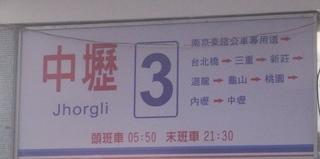
Unfortunately the problem persists in other areas of Taiwan. For example, I have seen the character 中 romanized as, zhong, chong, chung, jhong, and now thanks to Taipeitaipei, the inexplicable ‘jhorg.’

How on Earth is this inconsistency helpful to anyone?

Bears, oh my

As the New York Times reports that my home state of New Jersey is gripped by the furry paw of a bear epidemic…

State biologists estimate that as many as 3,400 bears now roam New Jersey, the nation’s most densely populated state, and say a hunt is the most effective way to control the increasingly troublesome population. Two bears were killed last weekend in Sussex County in northwest New Jersey after one broke into a house and another broke into a shed.

“We are going to have a large population of bears way into the future. It’s a prolific problem,” said Martin J. McHugh, the director of the state’s Division of Fish and Wildlife. “Our aim is to reduce the growth of the population.”

Here in Taiwan we see what happens when bears are allowed to run completely rampant.

A three-year-old boy was critically injured yesterday after a caged circus bear nearly ripped off his arm in southern Taiwan, a hospital official said. Doctors performed emergency surgery to reattach the right arm of the boy, who was found lying in a pool of blood by the bear’s cage on a farm where a circus from Vietnam was performing, an official from Chi Mei Hospital said. Farm staff said the boy, who went to see the bear perform stunts like riding a bicycle, might have provoked the animal by trying to pat it. The incident occurred while his mother was talking to performers. The performance was suspended after the attack. The boy’s parents blamed the farm owners for the attack for failing to put up warning signs in front of the bear’s cage, local newspapers said.

Classic WW2 Japan footage

Everyone has probably already seen some news coverage of the 60th anniversary of the bombings of Hiroshima and Nagasaki (Nagasaki’s anniversary is today, and as always, overshadowed by their big-brother in nuclear devastation.)

Archive.org has an excellent collection of public domain films of various types, and here are links to some of the good ones I’ve found related to Japan, WW2, and the bombings of Hiroshima and Nagasaki.

First of course we have Tale of Two Cities, A (1946), a film produced by the US War Department. While it clealy shows the devastation wrought on the cities, there is a conspicuous lack of human victims.

Next is My Japan (1945)

Complex and disturbing anti-Japanese propaganda film produced to spur the sale of U.S. war bonds. CONTENT ADVISORY: Explicit racism and extreme violence.

While, as the label says, this film is narrated in a bizarre Charlie Chan-ish yellowface manner, it’s actually one of the more interested presentations of Japan from that time that I’ve seen. It clearly presents Japan from the standpoint of an enemy that must be defeated, but does so by describing them as relentless adversaries worthy of respect.

Another notable must-see propaganda film is Our Enemy: The Japanese (1943)

Stridently anti-Japanese film that attempts to convey an understanding of Japanese life and philosophy so that the U.S. may more readily defeat its enemy. Depicts the Japanese as “primitive, murderous and fanatical.” With many images of 1930s and 1940s Japan, and a portentious and highly negative narration by Joseph C. Grew, former U.S. ambassador to Japan.

And last, Japanese Relocation (ca. 1943)

U.S. government-produced film defending the World War II internment of Japanese American citizens.

Universal Studios was good enough to, in 1967, put much of their pre-TV newsreel footage into the public domain.

Some relevant highlights from this collection:

Pres. Truman Warns Japs To Give Up, 1945/06/07 (1945)

“In a speech to Congress, President states that Japan faces the same complete destruction that was visited upon Germany. To that end, millions of troops, and their implements of war, are being transferred more than half way around the earth. The President adds that though many key industries have already been leveled by U.S. air attack, all of Japan’s industries will be completely destroyed unless Japan surrenders.

Jap Films of Hiroshima, 1946/08/05 (1946)

(1) Japanese Films of atomic bomb blast at Hiroshima, released one year later (2) Underwater atom blast rocks Bikini (line down middle of film frames) Admiral Blandy commander of task force, 2nd test of Operation Crossroads, cameras point to site of underwater explosion Test Baker, mushroom cloud of explosion, carrier Saratoga finally sinks, another view of the blast from overhead airplane. (sound track cuts out at very end)

B-29s Rule Jap Skies,1944/12/18
(1) “At Saipan, after briefing, the members of the 21st bombing Command take to Super Fortresses and roar into the sky – destination Tokyo! They shower tons of bombs and incendiaries on the huge sprawling city as they hit factories, steel mills and docks. Mass civilian evacuation of Tokyo was ordered after this raid. Japs Raid Saipan – Saipan is attacked by Jap raiders, 14 of which are shot down, after they had started spectacular fires and caused minor damage.” scenes of Japan fighter planes st…

Damage Foreshadows A-Bomb Test , 1946/06/06 (1946)

(1) “Japan: Dramatic pictures of atom bomb damage in Hiroshima and Nagasaki foreshadow the coming Bikini Atoll experiment. Intense heat and light of blast scarred shadows of human beings on destroyed bridges!” scenes of visual evidence of atomic damage in Hiroshima (2) Italy Joins Democracies – “Italy: Following mass demonstrations and a democratic referendum, Italian voters cast their lot with the democracies and oust their king. The majority, who voted republican, wanted ‘No More Balconies!'” (partial newsreel)

How far back does your geneology go?

Prolific blogger Joi Ito delves a bit into his family’s ancient history. It’s a bit awe-inspiring for someone who just barely has a vague idea of which Eastern European countries his grandparents moved to Brooklyn from.

After the study group meeting at City Hall, I visited our family grave. I took a look at where my name will at some point be etched as the 19th family head of the Ito family. I took the opportunity to grill my uncle a bit more about the specifics of our history since I’ll be the custodian of this information at some point. I also had him collect up various family history documents. It appears that the first Ito, moved into our current home about 400 years ago and was some kind of union of a 25th descendent of Emperor Kanmu, the 50th Emperor (we’re on #125 now), and Kawatari Fujiwara. I can’t understand the old-fashioned Japanese text to understand the details of the arrangement. I believe Kawatari Fujiwara was from the Fujiwara family that lived in our region until they were defeated around 400 years ago. The only thing left from this period of the Fujiwara estate/castle is a golden pagoda and mummies in Hiraizumi. Anyway, the story I heard from my mother was that after their defeat, the survivors fled and started their own families in the region, and took the character “Fuji” from “Fujiwara” and changed their names to “Saito”, “Goto” and “Ito” which all use “Fuji” character for the “To” part of the names. Anyway, I’m not positive about the details so I better find out more before I have to take over the family and my children start asking me all kinds of questions.