The story behind the famous Tiananmen photo

The BBC has a wonderful first person account of the story behind this iconic photograph.

I looked around for cover but there was none – the only areas that offered any protection were back up Changan Avenue near the Beijing Hotel. About the time I reached some trees along the avenue the soldiers opened up on the crowd at the top of the square. There was panic as people were being hit.

It was impossible for me to shoot pictures as it was too dark and using a flash was out of the question. I looked around and decided that about the only shot left was from the roof of a building with a long exposure of the square and the mayhem.

I went into the Beijing Hotel, which had a commanding view of the top of the square, but when I went in, I was tackled by members of the Public Security Bureau (PSB), China’s secret police.

One of the PSB ran up to me with a electric cattle prod and hit me in the side with it. Others punched and kicked at me. They ripped my photo vest off me and took all the film I had shot that evening. They were going to keep the cameras but I convinced them they were useless without film, so they returned them and I told them I was going to my room.

The PSB had missed three rolls of unexposed film in an inside pocket of the photo vest.

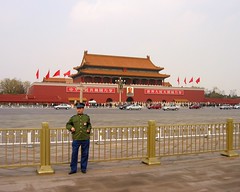
For comparison, here’s a photo I took that shows you the same piece of street on a better day.

Taiwan, Amtrak and the ISO

I just mentioned that the editor of the CIA world factbook seems to consider Taiwan an oddly stateless territory. This makes a little more sense if you read about why Amtrak recently changed Taiwan’s entry in their website’s country selection form from “Taiwan, province of China” to merely “Taiwan.”

In the letter, the FAPA pointed out that in a 1996 memorandum, the US State Department stated that since the US has no diplomatic relations with the Republic of China, US officials need to refer to Taiwan as “Taiwan.”

Amtrak was established by the US Congress and receives funding from the government, therefore, what they do should be in accordance with the rules set by the government, the letter said.

According to the article, Amtrak changed their website in response to a letter of complaint written by Wu Ming-chi (吳明基), president of Formosan Association for Public Affairs.

“I was informed that Amtrak takes no position regarding the sovereignty of Taiwan and simply lists all countries around the world according to ISO 3166-1 provided by the International Organization for Standardization, which does not list Taiwan as a province of China”, said Wu Ming-chi (吳明基), president of FAPA in the letter.

The funny thing is, he has his facts completely wrong. If you actually look at ISO 3166-1 on the ISO web site, you’ll see that they DO list Taiwan as “TAIWAN, PROVINCE OF CHINA!” Whatever the US government policy on Taiwan’s name is, it’s a little funny that Amtrak responded to a complaint that didn’t even correctly cite the International Standard Organization’s name for the country. In fact, the FAPA website even contains a letter of complaint written to the ISO about this very issue, written by the same man who had claimed in a different complaint that the ISO has NOT referred to Taiwan as a province of China! And I just noticed that both letters were written ON THE SAME DAY! I think my head is spinning.

July 18, 2005

Masami Tanaka, President
International Organization for Standardization (ISO)
1, rue de Varembé, Case postale 56
CH-1211 Geneva 20, Switzerland

Dear Mr. Tanaka:

I write to you today to express my serious concern about the ISO 3166-1standard which lists Taiwan as a province of China. This issue has caused strong feelings on the part of Taiwanese around the world. I therefore urge you strongly to correct this factual error.

I understand that ISO seeks to stay politically neutral and uses UN sources when developing the ISO standard 3166-1. As stated in the FAQ section on your ISO website, “the printed edition of the [U.N.] publication Country and Region Codes for Statistical Use gives the name we use in ISO 3166-1.” However, I would like to point out that the UN Country and Region Codes for Statistical Use does not list Taiwan at all – let alone lists Taiwan as a “province of China.” (See: the on-line version of the Country and Region Codes for Statistical Use on the UN website. http://unstats.un.org/unsd/methods/m49/m49alpha.htm) Moreover, the FAQ section from your website adds that, “since Taiwan is not a UN member it does not figure in the UN bulletin on country names.” Thus, there is no source for the use of such misinformed
labeling as “Taiwan, Province of China.”

In addition to the validity of the source the ISO uses when referring to Taiwan, we would also like to point out that it is incontestable reality that Taiwan is not a part of China. All this, despite China’s political claims to the contrary. Taiwan is a de facto sovereign nation
that democratically elects its own president and government officials. The Communist government in China has never exercised any jurisdiction over Taiwan since it was established in 1949. If the ISO intends to stay politically neutral, as it prides itself of, labeling Taiwan as a province of China, simply because China says so, would constitute a double standard.

I urge the ISO to revise the 3166-1 standard and eliminate the term “Province of China” from its listing of Taiwan.

Thank you for your consideration. I look forward to hearing from you.

Cordially yours,

Dr. Ming-chi Wu, Ph.D., President
Formosan Association for Public Affairs

I think that if Dr Ming-chi Wu wants his complaints to be taken seriously in the future, he should start by keeping his own facts straight.

(Thanks to Michael Turton’s blog for pointing out the Amtrak article.)

Taiwan in the CIA World Factbook

Since everybody has been talking about Google’s classification of Taiwan, it’s kind of fun to see how the CIA World Factbook contorts a little bit to list them properly.


Yes, under their dropdown menu of “Select country or region,” Taiwan gets the odd distinction of being placed at the end of the other-wise alphabetized list, along with the European Union.

Look familiar?

Is this the fate of all political parties when they hold power for any length of time?

Oct 6, 2005 Taipei Times Editorial

After almost six years in power, the performance of the DPP administration has disappointed a number of pan-green diehards, with some gloomily wondering whether the DPP is losing its ideals and ability to improve itself. It has also alienated a large segment of the party’s grassroots supporters, the very people who had helped to elect the then 14-year-old DPP in 2000.

Some supporters are beginning to wonder whether the DPP has turned into the equivalent of the old Chinese Nationalist Party (KMT) regime it used to fight against — a corrupt party leading a corrupt government. This kind of sentiment was especially prominent in the wake of the recent spate of scandals plaguing the DPP administration — one of them being Kaohsiung’s problematic MRT project. An Aug. 21 riot, ignited by Thai laborers protesting against their poor living conditions, unexpectedly brought to light a complex influence-peddling scheme in which ranking government officials apparently exploited Thai workers while pocketing money from the project’s construction funds.

January 9 2005 Washington Post article:

Democrats and some Republicans, troubled by the moves, cite parallels between today’s Republicans and the Democrats who lost their 40-year hold on the House in 1994 after Gingrich and other conservatives campaigned against them as autocratic and corrupt, and gained 52 seats.

“It took Democrats 40 years to get as arrogant as we have become in 10,” one Republican leadership aide said.

Julian E. Zelizer, a Boston University history professor who edited the 2004 anthology “The American Congress,” said Republicans used the past week to “accelerate the trend toward strong, centralized parties.”

“This is a move toward empowering the leadership even beyond what you saw in the 1970s and 1980s,” Zelizer said. “They have been going for broke.”

Now you know why I registered to vote as an independent.

Professors fail remedial economics

UpdateI’d like to apologize for forgetting to link to the article yesterday.

The New York Times has an article exploring the issue of whether there may be more important things than a country’s economic development. A worthy topic, but sadly the article references what is possibly the worst academic survey every conducted.

[B]eyond a certain threshold of wealth people appear to redefine happiness, studies suggest, focusing on their relative position in society instead of their material status.

Nothing defines this shift better than a 1998 survey of 257 students, faculty and staff members at the Harvard School of Public Health.

In the study, the researchers, Sara J. Solnick and David Hemenway, gave the subjects a choice of earning $50,000 a year in a world where the average salary was $25,000 or $100,000 a year where the average was $200,000.

About 50 percent of the participants, the researchers found, chose the first option, preferring to be half as prosperous but richer than their neighbors.

I think that’s the stupidest thing I’ve ever heard. They seem to think that people choosing the $100,000 option are twice as wealthy in absolute terms than the people choosing $50,000, but that is utter bollocks.

If the average salary of the world increases by 8-fold and yours drops by half, than in absolute terms you have only 1/16 of the wealth that you had before. Money is not some kind of nano-gel with the ability to transform into an amount of physical material in proportion to the number of units you have, it’s an abstraction that represents the portion of the economy’s total wealth that one controls. The value of individual money units is a simple proportion based on the total amount of money units in existence, this is why we have things like inflation-a concept that seems to have escaped the Harvard School of Public Health.

If they had said ‘town’ or ‘community’ than it might make some sense, because your currency value is still based on the larger economy and in fact would represent a large share of the world’s wealth, but if you’re talking about the entire WORLD’S average income than people who chose the second scenario, much like the people who designed this survey, just don’t know the most basic of math skills.

Unless they were really were testing for basic logic skills, and the whole ‘values of wealth’ thing was just obfuscation.

Update:
Saru linked to a paper by the two Harvard professors in question, which contains a survey with various questions making the same test in both monetary and non-monetary terms. It contains one question identical to, and one almost identical to the one listed in the NYT article, except it is phrased exactly the way it should be. The raises the question, was this a mistake by the NYT writer or editor, or did the professors give the reporter a dumbed-down explanation that wasn’t as clear as their actual paper?

I see that Andrew Revkin, who wrote the NYT article, is one of their regular science writers, but even science journalists aren’t supposed to be experts, and aren’t even expected to fully understand the science themselves. He should have had the professors check his article before publication, and they should have caught that mistake.

First survey:
In the questions below, there are two states of the world (State A and State B). You are asked to pick which of the two you would prefer to live in. The questions are independent. For each question, circle either A or B, or if undecided, both A and B. “Others” is the average other person in society.
[…]
Note that prices are what they are currently and prices (the purchasing power of money) are the same in States A and B.
A: Your current yearly income is $50,000; others earn $25,000.
B: Your current yearly income is $100,000; others earn $200,000.

Second survey:
Note that prices are what they are currently and prices (the purchasing power of money) are the same in States A and B.

A: Your current yearly income is $200,000; others earn $100,000.
B: Your current yearly income is $400,000; others earn 800,000.

Cannibal beef

For those who were wondering why Japan has still not ended their ban on US beef, today’s NYT makes it quite clear.

The F.D.A. proposed banning from animal feed the brains and spinal cords of cows more than 30 months old. It also proposed banning the same parts of any animal not passed by inspectors as suitable for human food, any tallow that contained more than 0.15 percent protein and any meat contained in brain or spinal column that was separated from carcasses by machine.

The new proposal would still allow animals to be fed material that some scientists consider potentially infectious, including the brains and spinal cords of young animals; the eyes, tonsils, intestines and nerves of old animals; chicken food and chicken dung swept up from the floors of poultry farms; scrapings from restaurant plates; and calf milk made from cow blood and fat.

[…]

Michael K. Hansen, an expert on prion diseases at the Consumers Union, called the proposed regulations “completely inadequate,” noting that Britain “took many halfway steps in their efforts to eliminate mad cow disease and failed to stop it.” Only when it stopped feeding mammals to food animals did they cut the cases down to less than 10 a year, he said.

Headline of the week

COMMANDER ROBOT A RUTHLESS KIDNAPPER

MANILA, December 9, 2003 (STAR) Abu Sayyaf kingpin Galib Andang, captured in Sulu late Sunday, is a ruthless leader and chief organizer of abductions for the feared kidnap gang.

Popularly known as Commander Robot, he was the architect of the much-publicized kidnapping of 21 hostages, including Europeans and other foreigners, in the neighboring Malaysian resort of Sipadan in April 2000.

Armed with machine guns, he and other Abu Sayyaf leaders brought the hostages by speed boat to his base in Jolo and held them there for about a year.

In the end, the hostages were released, reportedly in exchange for millions of dollars in ransom paid by Libya.

Andang is known to be ruthless with his hostages, one of whom — the son of a local doctor — was beheaded after delays in ransom payments.

He had often posed for journalists, spraying fire from his assault rifle in the air, warning the military of serious repercussions if they attacked the group’s hideouts.

Following the Sipadan spree, Andang, believed to be in his 40s, kidnapped a local teenage girl and forced her to marry him.


Commander Robot in action
I know he’s evil, but I just can’t help but giggle when I read that headline.