There was a shockingly clear-eyed and insightful report released the other day about AI in elementary/secondary education from the Brookings Institution.
Specifically, they argue:
“A narrow focus on developing effective AI-supported teaching approaches could obscure how students’ very ability to learn is being undermined by AI overuse, inappropriate use, and non-productive use, both in and, increasingly, outside the classroom.”
Yes! I feel so seen! This line echoes the concerns I’ve had as a high school English teacher in the AI era. Their research backs up my sense that AI use reduces creativity, breeds reliance, and undermines the learning process. The report also made me feel vindicated as the writers share my criticism that school leadership tends to view technology adoption per se as equating to “meeting the moment” and advancing education. Nothing could be further from the truth when it comes to AI.
I started teaching in November 2022, around three weeks before ChatGPT launched. Since then, a growing percentage of my students has attempted to pass off AI-generated work as their own. At the worst end of the spectrum, students turn to AI for every assignment, and they aren’t even good at hiding it as they brazenly open the chatbots during study halls or even during my class.
At the start of this year, I used moral suasion to try and limit the number of students who rely on AI in my class, centered on letting them know that they short-circuit the learning process when they take the easy way out. This is the slide I use:
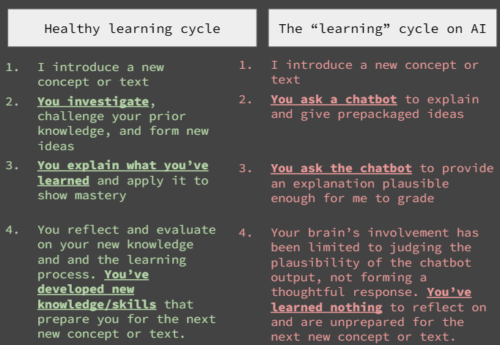
I haven’t been able to completely root out AI cheating, but most (around 3/4) of my students appear to have gotten the message. To foster an environment conducive to the healthy learning cycle, I also minimize laptop use and tightly restrict the web when we do need computers. I’m not always the most exciting teacher, but I do attempt to keep students engaged in discussion and accountable to me and each other for doing the work necessary to understand and analyze texts (the overwhelming focus of my class). And essays are always completed in class, on paper based on prompts students have not received ahead of time.
The report backs up my methods, both through acknowledging the detrimental aspects of AI use in the classroom and in the recommended solutions, which include policies like banning cell phones, limiting laptop use, and making instruction less about “memorize-recite-forget” and more about developing skills.
Bottom line: AI sucks but our awful system means it’s going to undermine education no matter what, leaving teachers to mitigate the damage
Overall, however, reading through probably the most thoughtful assessment of AI in schools available left me even more pessimistic than ever. The writers convincingly conclude that the risks to education far outweigh the potential benefits. As validating as it feels to know a consensus of experts seems to share my concerns, the proposed solutions feel wildly optimistic absent a revolutionary change. The power of Big Tech money and utopian rhetoric makes it unrealistic for the US to implement comprehensive AI regulation in our current environment, the AI companies’ clout is undermining EU regulation right now.
Until the revolution comes, teachers will be dealing with students who at this point have nearly four years and running of experience using AI tools as their homework machine. We will continue to be forced into adversarial roles against our students, as they increasingly rely on technology and become further socially isolated and atomized. And we as teachers will be left dealing with the fallout of AI’s deeply irresponsible rollout – and whatever benefits teachers may gain in productivity will probably be wiped out by increased workload and/or staffing cuts.
Worst of all, some classrooms have already devolved into dystopian status – the teacher uses AI to generate teaching materials and assignments (which are also graded by AI), while the students use AI to do the assignments for them. The class becomes a farcical AI-generated replica of itself, with both teachers and students unthinkingly mediating their participation through a computer so they can play video games or trade memecoins. I had 10th graders tell me about their 9th grade teacher who was just such a specimen, and it was obvious – weaning some of them from habitual AI use was in some cases quite painful and included multiple failed assignments and academic integrity referrals.
One silver lining is that my school seems to be doing a very good job despite a bad situation. The report emphasized a number of policies we are already doing, including the phone policy, web monitoring, and teaching/assessment practices that limit the negative impacts of AI. This is probably about the best we can do without a more systemic solution.
I’ll post some highlights and key images from the report below, but I recommend everyone with a stake in the issue take around 20 minutes to read through it.
Highlights
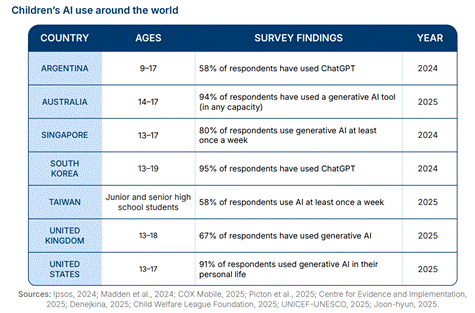
91% of Americans age 13-17 have used genAI in their personal lives
ChatGPT use plunges in the summer months

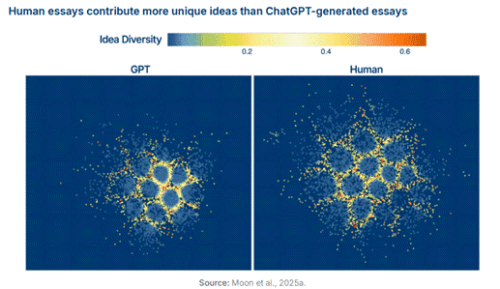
AI use diminishes creativity: Visualization of the uniqueness of ideas of human- vs. AI-written essays
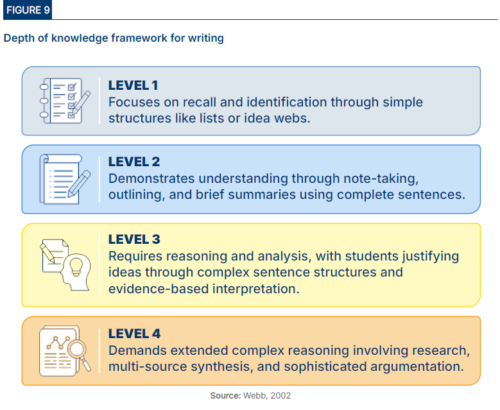
AI use prevents students from going deeper in their analysis
“In particular, [teachers interviewed for this study] worry that novice writers, students who don’t like to write, and even students who do like to write may become overly reliant on AI tools. This dependence may hinder long-term skill development by allowing students… to skip essential processes such as forming logical arguments and understanding subject matter.”
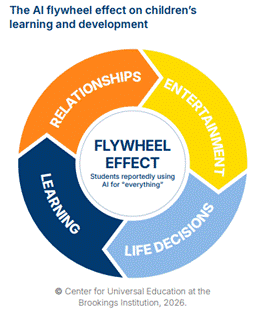
Student dependence on AI generates a “flywheel” effect, with dependence suffocating skills and breeding further dependence:
This escalating dependence generates what can be characterized as a flywheel effect, transcending academic boundaries and creating spillover effects that extend into personal decision making and daily life management (Figure 15). Parents and teachers confirm that this phenomenon has already materialized, with students reportedly using AI, not just for homework, but for “everything”—“relationships, entertainment, advice, life decisions, and mental health support.”
The advent of AI also challenges the fundamental design of schools
Many of the harms identified here—particularly the risks to students’ learning—originate largely from attempting to overlay transformative technology onto educational structures that have, at their core, remained largely unchanged since the late nineteenth century (Tyack and Tobin 1994). As one secondary school student described it, the core student schooling experience is “memorize, recite, forget,” year after year. While AI should not drive educational change, it lays bare weaknesses in current systems and provides education systems with a strong motivation to reform their purposes and processes.
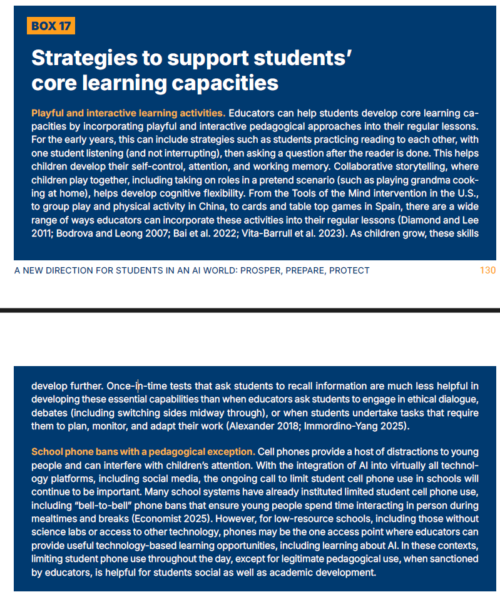
To this end, the report identifies strategies to make instruction more robust against the pernicious effects of AI, some of which my school has already implemented:
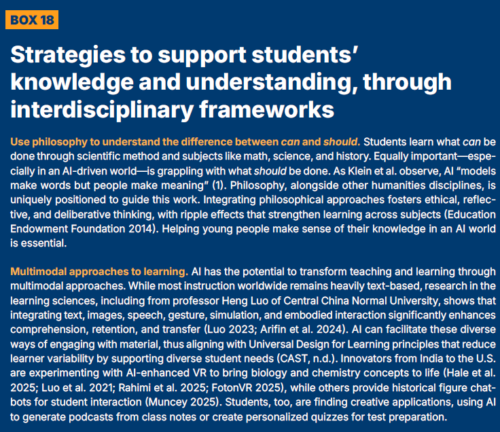
It also reiterates the social value of school and encourages a focus on “civic development”
“An important purpose of schools in an AI-infused world is to help young people learn to live together. Across virtually every country in the world, schools are one of the most prevalent social institutions where children can meet others, in person, outside their immediate family and neighborhood. The role of schools in helping children develop empathy, respect, and tolerance, among other essential social capabilities, is an important counterbalance to the growing polarization of online discourse and interactions.”
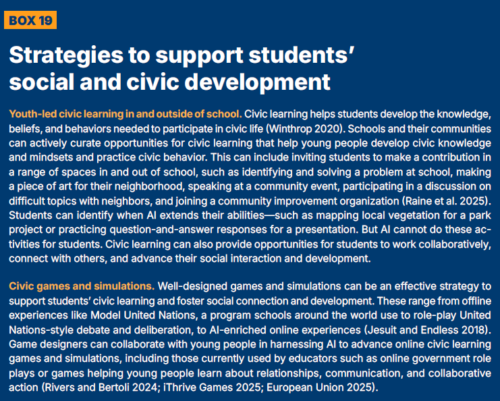
To this end, the report gives recommendation for how AI could help education with child-friendly (non-cheating) design. AI products that follow these design principles could be great!
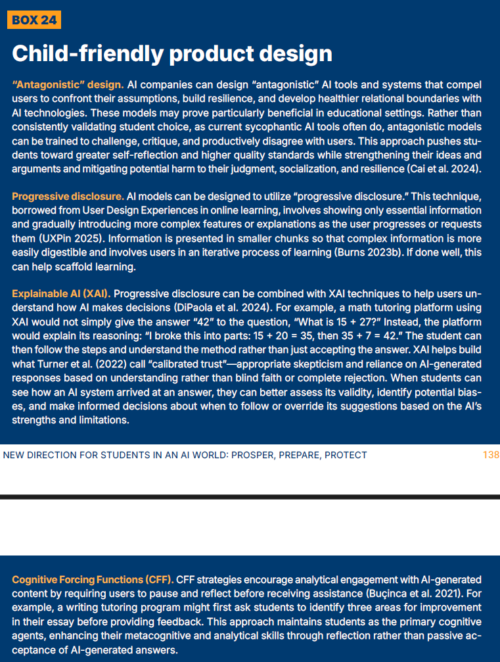
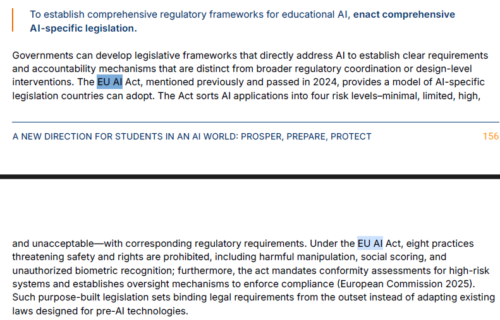
But any benefits would be premised on strong regulations to protect students against all the harms; the report cites the EU’s AI Act as a model, but even that’s being undermined by Big Tech…