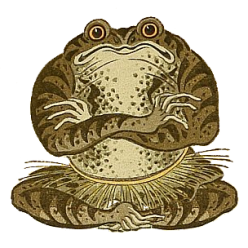
Reports are out that Katsuya Okada will be the foreign minister in Hatoyama’s first cabinet, which is (unfortunately) not nearly as cool as the footnote to the AFP report:
One of [Okada’s] more peculiar hobbies is collecting items that depict frogs. But there is a serious political point — “frog” in Japanese is a homonym for “change” — the slogan used by the DPJ during last month’s election campaign.
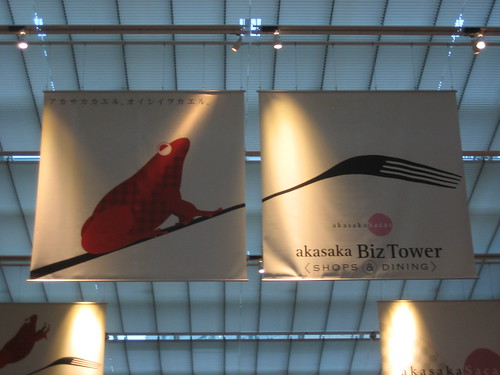
This is a fairly popular pun in Japan. Last year I came across this banner at the Akasaka Sacas complex in Tokyo. It says “アカサカカエル、オイシサヲカエル” (Akasaka kaeru, oishisa wo kaeru) which could be read several ways, such as “The Akasaka Frog is changing tastiness,” or perhaps “Change Akasaka and frog the tastiness.”
Tsk, tsk, AFP…蛙 and 変える(換える) are not exactly homonyms, but rather they are homophones. And if you want to listen closely to the inflection, they probably aren’t even pronounced exactly the same.
In other news, anal-retentive *is* hyphenated.
In the same vein, it also looks like the banner actually reads:
アカサカカエル、オイシイヲカエル (Akasaka kaeru, oishii wo kaeru)
which makes even less sense, “Change Akasaka, Change Oishii”?
What’s worth adding is that the word “kaeru” for frog is said to actually be derived from the very “kaeru” meaning “to return”, after the way frogs return to their spawning pools to reproduce-although it may be folk etymology and not historically accurate.
アカサカカエル、オイシイヲカエル
I’d say this is “Change/return to Akasaka; we’re changing the the idea of ‘deliciousness'”, to translate it very badly.