
In July of 2005, when I was living in New Brunswick, NJ, finishing up my studies at Rutgers University, the apartment shared by my friend Ted and his then-wife Janice (they have since divorced for unrelated reasons) in neighboring town Highland Park was raided by a SWAT team of the FBI and New Jersey Joint Terrorism Taskforce, which took a wide variety of their property including any computers or related material, as well as their BBQ. Ted himself was never charged with a crime, and in fact was not even being investigated or targeted, but Janice had been targeted for her animal rights protest activities, which naturally included a lot of relatively harmless shouting at people who did not want to be shouted at, and in places where they did not want outsiders to enter. The actual charges against Janice were, in fact, the real offenses of trespassing and criminal mischief (i.e. spray painting graffiti on the fence of an executive of a company responsible for animal testing), but the police response to these minor offences was grotesquely out of proportion.
Category: Security
PLA’s performance in earthquake good sign for Taiwan?
With enough time having passed since the massive earthquake disaster in China to being to look at it analytically, a number of military experts are saying that the People’s Liberation Army response was, for the most part, enthusiastic but not very competent.
Mr. Blasko and other experts said that because the military did not have heavy-lift helicopters, vital equipment like excavators and cranes had to be brought in on roads obstructed by landslides, slowing the pace of the rescue operations.
Shen Dingli, a leading security expert at Fudan University in Shanghai, said the military’s response did not reflect well on the military’s preparedness for a potential war with, say, Taiwan, the independently governed island that China claims as its sovereign territory. China’s air force deployed 6,500 paratroopers to Sichuan, but only 15 ended up dropping into the disaster zone, military officials said, because of bad weather and forbidding mountain terrain. Mr. Shen called the effort too little and too late.
“The air force should have been able to get troops into Wenchuan in two hours,” he said, referring to a county near the quake’s epicenter. “It took 44 hours. If it took them 10 hours, that’s understandable. But 44 hours is shameful.”
(NYT)
I’m certainly no military expert, but if the Chinese air force achieved a nearly 100% failure rate on air drops in domestic territory with no enemy fire, and took 20 times as long as they should have to actually get their people in, I would think that Taiwan’s chances of fending off an attack might be a lot better than had been assumed over the past few years. I am actually rather surprised to read about how poorly equipped the PLA is, considering how much ink has been spilled recently on China’s rapid military investment. Is all of the money going into Navy, missiles, and attack aircraft or something? While the 1000 or so missiles pointed at Taiwan might cause some damage to the island, I would also imagine that a “lack of heavy-lift helicopters and transport aircraft” would make an actual invasion more than a little impractical.
With the unrealstic promise by the KMT to reinvade China long abandoned, Taiwan can be perfectly secure without the ability to send ground forces into China, as long as they have the ability to fend off air and sea attacks-particulary if their medium/long range missiles that could allegedly blow the Three Gorges Dam are as effective as they claim. But China isn’t worried about attacks from Taiwan-their military planning is largely aimed at preparing for an invasion of the island-and if they can’t even bring a few thousand rescue workers into a domestic disaster area faster than 44 hours, they would have very little hope indeed of delivering the numbers of troops needed to occupy Taiwan before US aircraft carriers arrived.
The “Great Firewall” of Japan?
Do any of our well-informed regular readers have pointers to some more reliable and details information (in either language) on the Diet’s proposed Internet censorship legislation that everyone’s been talking about?
One foreigner’s perspective on American and Japanese immigration security procedures
Jade OC, a long time reader and commenter of MFT, has graciously posted a detailed comparison of his experiences passing through both US and Japanese airline security and immigration checkpoints as a comment on an earlier blog post on the subject. As I suspect that many of our readers look only at the actual posts and not the comments, I thought I would promote this one to the front page.
As promised, here is my short report on the fingerprinting-immigration process in the US and Japan from the POV of a non-citizen of either (though a resident of Japan).
First big complaint. I never wanted to go to the US at all, at least not the first time. But you cannot bloody transit in the US – there’s no such thing as a transit lounge. Everyone who enters a US airport from outside the country, even if, like me, you are just taking a flight to Canada in about 90 minutes, needs to go through Immigration and Customs. This is seriously Fucked Up.
Homeland Security Update
I went to the local CVS pharmacy the other day to get some cold medicine. Pseudoephedrine hydrochloride, best known under the brandname Sudafed (although, as always, much cheaper in the generic store brand), has long been the preferred over-the-counter decongestant agent. Unfortunately, it is also well known as one of the most widely available precursor agents to methamphetamines. To restrict access to the large quantities of pseudoephedrine that meth brewers need, the government has recently reclassified the drug. While it is still non-prescription, it is no longer “over the counter.” Instead, when buying pseudoephedrine products, one must actually produce a state or federal ID, which is then either scanned by a barcode reader or recorded in a log book. Yes, to buy cold medicine in the United States you are now subject to almost the same level of ID check as required for boarding an airplane.
On the other hand, and this will be of most interest to fans of HBO’s The Wire, pre-paid Verizon cell phones can be had entirely anonymously, with no ID check whatsoever, for roughly $70 cash.
More unintended consequences… or were they?
Several weeks ago I wrote a brief post about how the famous destruction of Korea Air Lines flight 007 by the Soviets led rather directly to the development of commercial GPS technology. I just happened across another surprising result of the same incident, in this Vanity Fair article on, of all people, Larry Flynt.
In 1976, Mr. Flynt, publisher of Hustler and several other pornographic magazines, put out a $1 million bounty for “documentary evidence of illicit sexual relations with a Congressman, Senator or other prominent officeholder.” As the article says, “A few years later, Flynt published pictures of Representative Larry McDonald, a Georgia Republican, in bed with a mistress,” but Rep. McDonald was on the ill-fated KAL007 when it was shot down by the Soviets.
Naturally, the presence of Congressman Larry McDonald on a jet which was shot out of the sky by the USSR was taken by some to be more than a coincidence. While McDonald was, and still is, the only member of Congress killed by the Soviets, there were in fact three other Congresspersons schedule to fly along-side him on KAL007; Republicans Jesse Helms, Senator of North Carolina and Steve Symms, Senator of Idaho and Congressman Carroll Hubbard, a Democrat of Kentucky. All four-McDonald and the three who whose flights were rescheduled-were known for their strident anti-Soviet views, and there were naturally conspiratorial accusations made against the USSR. For example, Wikipedia cites the following quotation of the (despicable) Reverend Jerry Falwell from the September 2, 1983 Washington Post:
There is a real question in my mind that the Soviets may have actually murdered 269 passengers and crew on the Korean Air Lines Flight 007 in order to kill Larry McDonald
Natural responses to this may include the thought that the assassination of either one or four members of the US Congress by the Soviet Union might provoke a rather harsh reaction, or perhaps the thought that there was in fact nothing to gain from the murder of these four relatively minor congresspersons- McDonald was himself not known for legislative accomplishment, and although Jesse Helms might have been a tempting target when he was head of the Senate Foreign Relations Committee, he did not ascend to that post until a decade later, in 1993.
McDonald was himself a well-known conspiracy theorist, who had made the following statement:
The drive of the Rockefellers and their allies is to create a one-world government combining supercapitalism and communism under the same tent, all under their control…Do I mean conspiracy? Yes I do. I am convinced there is such a plot, international in scope, generations old in planning, and incredibly evil in intent.
While more rational thinkers may question the wisdom of this statement, and perhaps of the voters who elected a paranoiac to Congress, it does seem likely that Representative McDonald would have agreed with the Reverend Falwell about the circumstances surrounding his own death.
For the truly sophisticated conspiracy buff, however, we have a more complex, and utterly contradictory theory, brought to us by-of all places- Hustler Magazine. Now, while Playboy is well known for its mix of dull soft-core pornography and oddly serious articles, I had no idea that Hustler printed in-depth political conspiracy articles (much less articles at all) mixed with its rather harder-core pornography. However, if this piece is indicative of the quality of Hustler’s political “reporting” I think I’ll stick with publications more along the lines of The Economist for my real news- although, a paranoid and elaborate conspiracy theory can provide some entertaining flavor to more staid coverage. I will not try and summarize this inane theory, which involves such things as a “$100,000 computer” full of illegal spying data-in a garage, the Moonies, and Reagan’s decision to make a martyr of “the leading anti-Communist in the American government,” I will provide what I thought were a few of the highlights.
- “So let’s assume that the CIA, FBI and all federal agencies that worked with McDonald – particularly the Pentagon – wanted him silenced immediately.”
- “A more likely possibility is that the crew had been the victim of hypnosis and mind control – receiving instructions in advance, before they left Anchorage, that could not be picked up on any messages recorded later.”
- “His response to what was going to happen, given his years of experience and expertise, was that of a programmed zombie instructed to fly continuously – disregarding any external sights or sounds on the flight equipment.:
- “The upshot of these reports is that the Pentagon had the capability, if it so desired, to link mind control with satellite defense systems. And a logical use of mind control, of course, would be to program a pilot – perhaps even turning a normal flight into a kamikaze mission.”
- “After McCarthy died in 1957, it is reasonable to assume that Larry McDonaid – through Louise Bees – took over the massive computerized files [known as Odessa, which was formed (by the Nazis) between 1943 and 1945 when it became obvious the Third Reich could not win the war against the Soviet Union]that now contain millions of names worldwide.”
As implausible as all of this is, the fact most destructive to the theory that President Reagan ordered the plane led off-course into Soviet airspace so that the plane would be shot down, killing Congressman Larry McDonald, is perhaps Reagan’s action described in my previous post on KAL007: namely the opening of the formerly military-exclusive GPS network to civilian use. While I might not put it past the Reagan administration to commit assassination, if murder-by-Soviet-airspace-intrusion-disguised-as-navigation-error was such an effective and untraceable method of assassination, why then immediately turn around and introduce protocols that would make further use of the tactic implausible? Naturally, the conspiracy fan will turn around and say “that’s just what they want you to think; it’s the ultimate cover-up!” But credulity has its limits, and Occam’s Razor is powerful.
McDonald may have had a powerful hate for the USSR, but he was certainly was not important enough to deserve such elaborate machinations, the blood-enmity of a Soviet Premiere or an American President, and secret mind control rays from space itself. Like the other 268 passengers on KAL007, he was simply a victim of bad luck and incompetence, like so many others.
And this brings us to the heart, the essential nature of what conspiracy theories are all about: a fear of powerlessness. There is a common misconception that the conspiracy theorist is a cynic of the highest order, but in fact nothing could be further from the truth. The conspiracy theorist is actually a romantic. Unable to accept the reality of a chaotic universe in which all of us humans come from dust only to return to dust, the conspiracy theorist, somewhat like the believer in divine preordination, requires a conscious actor in all things to explain the misery in the world, and to alleviate the crushing fear of oblivion and hopelessness that lies within themselves.
Perhaps the most popular subject for conspiracy theorization in our time is the coordinated hijacking/kamikaze attacks of September 11, 2001. Details vary, including theories that the Pentagon was hit not by a jet but by a military cruise missile, or that the Twin Towers were felled not by steel girders whose tensile strength could not hold up to burning jet fuel but by a controlled demolition triggered by the CIA at the instant of airplane impact, or that the the hijackers were not in fact Islamic fanatics belonging to a shadowy terrorist network with a history of rhetorical and physical attacks against the United States, but Israeli Mossad agents, working in concert with the highest levels of US intelligence. The exact details are not really important, because all of these conspiracies share a common theme and a common purpose. The common theme is the attribution of enormous, almost supernatural, levels of power to the United States and other well understood state actors such as Israel, combined with the discrediting of obscure and occult non-state actors such as Al-Qaeda. The purpose is the reinforcement of their conventional world view to the extent that they can maximize a feeling of safety.
This may seem counterintuitive to some, but I believe that there is a misconception regarding what exactly conspiracy theorists are scared of. One might logically think that bu attributing such nefarious intent and grand power to our government, their primary fear is in fact the government. I would argue that the opposite is true. It is apparent to anyone that a world in which planes are shot out of the sky or crashed into buildings is more dangerous than one in which they do not, but anyone with even the most tenuous grasp on reality will accept that we live in a world in which these things happen; the distinction is over why, and how. If a world of death and pain is taken as a given, then how is fear of that minimized? By reducing the randomness and chaos with which that death is meted out. Conspiracy theorists ascribe nigh-omnipotence to the government not because they are so scared of the government but because they are far more terrified of the alternative- that terrorism, assassination, airplane failure, and so on, are the products of forces unpredictable and uncontrollable.
To a conspiracy theorist there is always a larger cause. Take the assassinations of Presidents Abraham Lincoln and John F. Kennedy, each of which was the premiere subject of conspiracy theorizing for many years, and remain popular subjects to this day. In both cases the official, and most widely accepted, version of the story is that a lone troubled soul, albeit one whose sympathies were shared by many others, shot and killed the President of the United States, the most powerful man in what was, at least during the time of JFK, the most powerful country in the world. If such random tragedy could strike such a man, how can any of us possibly feel safe? In a world in which even presidents are murdered and airplanes are crashed into buildings or explode in the sky due to fuel tank errors (the TWA 800 tragedy, which has its own crop of conspiracy theories) how can any of us feel safe on an airplane, or going to the theatre, or simply riding their car down an open street?
There are a few alternatives. For most people the answer is simply to be realistic; while tragedy can be random, it is also rare and a life lived in perpetual terror is a poor life indeed. Others do live in fear, barely functioning, and living a terrible agoraphobic life of isolation. And others find solace in a false order, of complex constructed narratives in which they either assign enormous power to the relatively powerless actor behind such tragedies, or assign an entirely imaginary actor in cases that truly were due to chance or sloppiness. It is easier to sleep at night when you believe that JFK was killed as a result of a vast and shadowy conspiracy, because by extension that is what it would take. If tragedy requires such incredible effort and resources, then we are all relatively safer, because who would bother with us? By arguing with such venom for the existence of a reality in which all of the world’s random accidents and low-tech terrorism are in fact the result of elaborate conspiracies conducted by the ostensibly powerful, conspiracy theorists are actually choosing order over chaos: a world in which they can sleep at night, because the knife in the shadow never misses its intended target.
Joe enrolls in the MOJ Gaijin Hanzai File
Tonight I returned to Japan from a personal/business trip to the US, and got to experience the new fingerprinting system for the first time.
My flight was United 883, one of the later inbound flights from the US (it arrives around 5:30 PM). I was in the mid-section of economy so there were quite a few people getting off the plane ahead of me. I phoned Curzon as I was walking down the concourse to immigration and told him I would give a postgame report in “maybe 30 minutes.”
But when I reached immigration, there was practically no line for anyone. The area was separated into four zones: citizens, special permanent residents, re-entrants and other foreigners. Those using the new “fast track” card (which I did not bother to get before leaving Japan) were lumped in with the random foreigner category. There were two dedicated re-entrant stations open, and only one was in use when I arrived, so I went straight to the waiting officer who took my passport.
The fingerprinting machine is surprisingly simple, consisting of two fingerprinting pads (made of some sort of metal), an LCD screen and a tiny camera not unlike the built-in webcams that come with laptops these days. The machine says INSERT FINGERS and you put your two forefingers in. Then the immigration officer points the little webcam at you and snaps your photo (which, thankfully, is not displayed on the screen: I don’t need to know what I look like after nearly 24 hours of traveling).
So I was done with immigration in about 30 seconds, which I think is close to a personal record. This didn’t keep United from losing my luggage, though…
Scientology (again)
After seeing today’s news that Germany had banned a Tom Cruise movie from filming in military owned sites due to the star’s connection with the cult, I thought it would be fun to repost this piece I put up back in May 3 of last year. Below is the post originally presented a bit over one year ago.
May 3, 2006
Andrew Sullivan today calls for a boycott of the Tom Cruise vehicle Miss:ion: Imp:oss:i:ble: 3.
How creepy is Tom Cruise? The Washington Post asks; and readers answer. All I can say is: after the way this guy treated South Park, we owe it to ignore him and any movie with which he’s associated. The Boycott “MI:3” movement starts here. Blogospheric solidarity much appreciated.
Well Andrew, I am completely with you on this one, but the boycott does NOT start with you. I was walking around Manhattan with my camera on April 16th and snagged this photo on 9th Avenue somewhere between 45th and 50th Street.
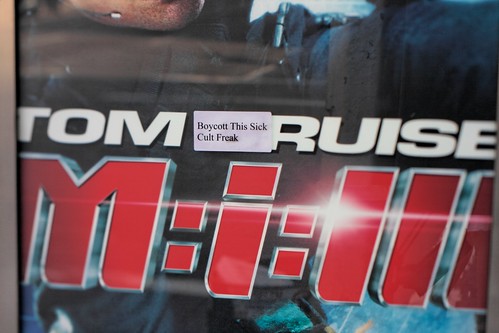
It seems that some people have already had the idea.
As it so happens I ended up passing through Times Square a few minutes later, where there was a pair of tables full of copies of Dianetics, a pair of e-meters, and a bunch of money-crazed bad pulp scifi worshipping Scientologists trying to indoctrinate passers-by. (I normally avoid Times Square, but I wanted to stop by Midtown Comics on the way home and couldn’t remember exactly which cross-street it’s at, only that it’s near the corner of 7th and 40-something. For the record, it was 40th Street.)
All of the following photos taken on April 16th on the west side of Times Square with a Canon EOS 300D and 65mm Hartblei Super Rotator lens.
Continue reading Scientology (again)
Who blew up what now?
 I was just wondering why there are is so much news being created by the Japanese right wing, while the hard core left wingers never even seem to make the paper. Since the Red Army organization was eradicated in the late 80s, Japan has seen several incidents of terrorism and pseudo-terrorism (assassination, sarin gas incidents, death threats, arson, etc.) committed by right wing extremists and religious wackos that live in a universe entirely distinct from the political spectrum, but left wing activity seems to be mainly limited to retirees having picnics. Hence my surprise when I noticed this article, which is actually from a month ago, and yet I somehow failed to notice.
Japanese leftist group claims responsibility for blast near US base
A Japanese extreme left-wing group has claimed responsibility for a small explosion near a US army base outside Tokyo ahead of US Vice President Dick Cheney’s visit to Japan.
The group, calling itself the Revolutionary Army, said in a statement to media organisations here that the blast was an “angry blow of an iron hammer” at Washington’s plan to increase US troops in Iraq.
“It is an preemptive attack to stop Vice President Cheney’s visit to Japan,” the statement added, attacking moves to strengthen the US-Japan military alliance.
Cheney is scheduled to arrive here next Tuesday on a three-day visit during which he is expected to tour the US naval base in nearby Yokosuka.
The Metropolitan Police Department said Saturday they thought the group was a faction of a militant left-wing group called Kakurokyo (The Revolutionary Workers’ Council), known for a series of attacks using crude home-made incendiary devices in protest at the US military presence in Iraq.
[…]
This is the first I recall hearing about any left wing bombing attacks in Japan in recent years, but it is certainly more believable than the “Al-qaeda in Japan” theory that US officials suggested. Of course, the fact that kakurokyo took credit for the attack helps.
Below is an actual wanted poster for members of the Kakurokyo (革労協), from the Nagano police department.

 |
 |
 |
|
|
 |
 |
|
 |
As is typical with these extremist groups (left wing or right wing) there appears to be a confusing array of factions, counter factions, splinter groups and rival claimants to the same, but this wikipedia article on at least some of the people calling themselves kakuryokyo (specifically the “liberation faction”) actually does list some crimes over the past few years of which they are accused. According to the article, there were a total of 8 explosive related attacks, beginning in April of 2002, when they planted a timed explosive device in a train of the Keisei network. There have also been 7 crude missile attacks on US military bases in Japan, beginning with one in 2002, three in 2003, two in 2004, and then in 2007 the one mentioned in the Yahoo news article linked to above.
The early attack incidents are discussed in slightly more detail in this 2003 Ministry of Justice white paper, which for some reason creepily includes discussion of these criminals with attempts by peaceful anti-war groups to increase collaboration with peaceful left wing anti war groups in other countries, such as US based A.N.S.W.E.R. and the UK Stop the War Coalition.
The same MOJ document ends with a discussion of the “continuing threat” of the Japanese Red Army, which it says former supports of have formed the group “Movement Solidarity,” who are responsible for the formation of JAPAC, the Japan-Palestine Project Center. According to this report, “Movement Solidarity” had held a JAPAC conference at which former Red Army members said that they would “Maintain the meaning of the ‘Battle of Lod’ in the joint Palestinian struggle, carry on that sacrificial spirit, and continue with all their power to hammer out the direction of joint Palestinian activities relevant today, as strengthening the bonds of solidarity with the people.” The “Battle of Lod” refers to what is more commonly known as the 1972 Lod Airport Massacre, in which three Japanese Red Army members engaged in a suicide attack in support of the Palestinian cause. Some people believe that this attack was inspired by the Japanese kamikaze suicide squads of World War II, and that it in turn inspired Palestinian suicide bombing, that has now became a widespread feature in guerrilla insurgencies throughout the Middle East region and beyond.
The report also mentions that several Red Army are still wanted by the police (as of 2003, but I do not believe the situation has changed), and that one Bando Kunio had been reported as hiding out in Negros Island in the Philippines.
On a related note, Red Army member Yu Kakumura, who was arrested in 1986 carrying pipe bombs in his car while driving on the New Jersey turnpike is reportedly schedule to be released April 18 of this year. According to this decision of the Tenth Circuit US Court of Appeals on October 31, 2006 in response to a motion filed by Kakumura’s attorney:
He filed an application for a writ of habeas corpus pursuant to 28 U.S.C. § 2241 challenging the method by which the Bureau of Prisons (BOP) calculates and awards good conduct time (GCT). Under the BOP’s method, Kikumura’s release date would be April 18, 2007. Employing the method Kikumura advocates, he would be released from prison on November 17, 2006, as he is a model prisoner and has received the maximum amount of GCT that he could earn.
The request for early release for “good conduct time” was denied, which implies that he will be released on this coming April 18.
A message for whom?
Kyodo news service reported yesterday (via Japan Times) that:
An international convention banning states from abducting people will spur Japanese moves to resolve the North Korean abduction issue and send a “strong message” to Pyongyang, Vice Foreign Minister Masayoshi Hamada said Tuesday.
“We were able to send a strong message that it’s not only Japan that is telling North Korea” about the abductions, Hamada said after a ceremony in which 57 countries, including Japan, signed the International Convention for the Protection of All Persons from Enforced Disappearance.
The treaty is the first of its kind to focus on state-sponsored abductions. It will be put into force once 20 nations ratify it.
The pact does not apply to cases that took place before its ratification, exempting North Korea’s abductions of Japanese in the late 1970s and early 1980s.
I understand that Japan’s primary concern with this treaty (text here) is the North Korea abduction issue, and the fact that these crimes have a special exemption to the statute of limitations is a testament to the efforts Japan has undertaken regarding this issue, but how many of the other 56 countries are really thinking about North Korea when they ratify this treaty?
The treaty has been in the works since at least 2001, and while a 2001 article from Human Rights News states that “The practice of forced disappearances plagues many parts of the world, including Algeria, Colombia, Iraq, and Sudan, as well as Chechnya in Russia,” I expect that many of today’s signatories are actually thinking of so-called “extraordinary rendition” by the United States when they sign it. Since they are most likely committing actions that would violate the treaty, The United States is naturally not one of the signatories at present, but interestingly they were also opposed to the treaty back in April of 2001, before 9.11.2001 and any US-instigated “forced disappearances” that I am aware of.
It makes sense that Japan would not want to call attention to the lack of US support for this treaty, I find it very odd that Kyodo news has written such a shallow article, leaving out any non-Japan related background on the treaty, which reads more like a government issued press release than a news story.