Archive for the 'Language' Category

Word of the year - English edition

Thursday, December 13th, 2007

Following Adam’s post on the word of the year awards in Japan, I thought I would give a quick rundown on the English version of the list, as determined by the New Oxford American Dictionary. I’ll present the various runners-up in list form, with the word of the year at the end, with each entry followed by my own comments in italics.

  • aging in place: the process of growing older while living in one’s own residence, instead of having to move to a new home or community
    We’re not off to a very good start here. First of all, this is not a word but a phrase, and not to me a particularly descriptive one at that.

  • bacn: email notifications, such as news alerts and social networking updates, that are considered more desirable than unwanted “spam” (coined at PodCamp Pittsburgh in Aug. 2007 and popularized in the blogging community)
    Total gibberish. While I agree that we could use a term for this semi-junkmail, a tier below spam, this word just plain sucks. What is this, an acronym? Wikipedia claims that it’s pronounced “bacon,” to imply that it is something better than spam, but still unwanted. Except that bacon is delicious, and I don’t see any reason to spell it wrong. In short- I like the definition, but we need a new word. Maybe 2008.

  • cloudware: online applications, such as webmail, powered by massive data storage facilities, also called “cloud servers”
    “Cloud computing” is a term I’ve seen for at least a couple of years now, and I agree that “cloudware” is the appropriate word for applications that represent the paradigm of cloud computing.

  • colony collapse disorder: a still-unexplained phenomenon resulting in the widespread disappearance of honeybees from beehives, first observed in late 2006
    The first one I’ve actually seen before! Both timely and important, and a great example of a term that rose to prominence during 2007. Unfortunately, once again we have a phrase. Try translating it into a nice agglutanive like German, Greek or Chinese and get back to me.

  • cougar: an older woman who romantically pursues younger men
    Another word I’m familiar with (and yes, I mean the word and not the thing itself.) A good slang term that has clearly cemented itself in the language, but I have no idea how long the term “cougar” has been around or if it rose to particular prominence this year for some reason. Has there been a rash of “cougar attacks” in 2007 that I was unaware of?

  • MRAP vehicle: Mine Resistant Ambush Protected vehicle, designed to protect troops from improvised explosive devices (IEDs)
    I’ve probably seen this term before, but I can’t swear. While the MRAP has probably existed for a good while, I do see a logic for its rise to prominence this year. On the other hand, has IED been a word of the year before? If not, then clearly that should have taken this slot.

  • mumblecore: an independent film movement featuring low-budget production, non-professional actors, and largely improvised dialogue
    I think I first saw this term only a couple of months ago. I don’t believe I have actually seen a mumblecore film, but it sounds like the sort of indy film that gives indy film a bad name. Does it deserve to be on the list? Well, whether or not the word existed before 2007, this was certainly the year it made it big, so I’ll give it a pass.

  • previvor: a person who has not been diagnosed with a form of cancer but has survived a genetic predisposition for cancer
    A word I have certainly seen before, although it bugs me slightly for some reason. While the etymology of “previvor” is clearly based on “survivor,” with an added implication of something not having happened yet- but it still feels slightly muddled to me. For a word created from a simple combination of two highly generic roots (pre- as in before, and vivor- as in “to live”) I feel that it should have a scope of applicability larger than just cancer, but I suppose a word has to start somewhere.

  • social graph: the network of one’s friends and connections on social websites such as Facebook and Myspace
    Definitely another sign of the times here. I would like this more if a literal, social graph, as in a nice web-form chart, of one’s social network were actually a core feature of these sites. God I hate Myspace.

  • tase (or taze): to stun with a Taser (popularized by a Sep. 2007 incident in which a University of Florida student was filmed being stunned by a Taser at a public forum)
    Not even a remotely new word-I personally have probably used it for years-and an obvious back-formation of “taser” (lit. “that which tases.”) Despite the lack of newness, the extremely high visibility of tasing incidents this year does give “tase” some extra cachet as a word of the year candidate.

  • upcycling: the transformation of waste materials into something more useful or valuable
    Not a word I have heard before, but it makes sense and doesn’t particularly bother me.

And the word of the year-

  • “Locavore” was coined two years ago by a group of four women in San Francisco who proposed that local residents should try to eat only food grown or produced within a 100-mile radius. Other regional movements have emerged since then, though some groups refer to themselves as “localvores” rather than “locavores.” However it’s spelled, it’s a word to watch.
    I have two problems with this one. First of all, I feel that there is something just wrong about a word of the year that I had never heard of previously. This might be ok for a runner-up, but shouldn’t the word of the year be something widespread enough so that a media addict like myself would have at least seen it before? Secondly, a word clearly identified as having been created by a particular group of persons to promote an ideology just feels too manufactured, and not grass-roots authentic enough, to deserve word of the year status. On the plus side, it is etymologically sounds, although “localvore” is a lousy variant.

Comparing this list with the list of Japanese words Adam just showed us, a few things occur to me. First of all, you see a complete lack of words that are associated with, or hyping, any celebrity. Where the Japanese list gives us three celeb catch-phrases “そんなの関係ねぇ,” “どんだけぇ~” and the co-winner “(宮崎を)どげんかせんといかん” as well as one word famous for being the title of what is most likely a shitty self-help book “鈍感力,” and a phrase that describes a particular person, which Adam lovingly translated as “prince of the cheese-eating grin.”

By contrast, Oxford’s list has nothing of the kind. In fact, if you look at the two lists a bit closer you see a fundamentally different, and even oppositional, concept of what “word of the year” represents to Oxford and Jiyukokuminsha (the Japanese publishing company who issued this word of the year list.) The most apparent different between them is that where Oxford’s words were chosen by the professional dictionairians (yes, dictionarian is a real word. Check the 1913 Websters if you don’t believe me.) the Jikokuminsha list was chosen from reader submissions, by an entirely unidentified panel. While the solicitation of reader submitted words is a critical tool of the lexicologist, Oxford has chosen to weed out items that are in fact references to specific people or current events, and most likely not sustainable lexical items.

The second major difference is that while Oxford’s list consists entirely of neologisms (even if not all of them are 100% verified new in 2007), Jikokuminsha also includes the word “pension,” which certainly isn’t a new word. Now, the word “pension” is prefaced by the word “vanished,” but this is still just an ordinary phrase, not a novel formation of any kind, and even worse is a reference to a particular news event and not some ongoing phenomenon.

The Jikokuminsha list does, however, contain several quality words that I think are worthy of inclusion on a list more in the vein of the Oxford one:

  • Deceptive food (labeling) 食品偽装 : This is both a major item of concern for 2007, and a new word that will probably be with us for years to come, as food safety and accurate labeling is becoming a matter of increasing concern around the world, both in international trade and domestic markets.

  • Internet cafe refugees ネットカフェ難民 : I think the phenomenon was actually reported on several months before the term was coined, but it is an apt and catchy term that will likely stick. The phenomenon has been reported on at least twice on this blog including personal anecdotes, first by Adam just over one year ago and then far more negatively by myself, just a few months ago.

  • Mega eater 大食い : I believe this word is actually used as both a noun AND a verb (i.e. a “mega eater” and “to mega-eat.” In general, this term refers to mass food consumption in the contest of competitive eating contests, the most famous of which is the Coney Island hot dog eating contest won year after year by Kobayashi Takeru. According to the Wikipedia article on competitive eating, an appropriate English translation of the term might be “gurgitator” (with the verb form then naturally being “to gurgitate,” but this word lacks the necessary prefix to imply the “mega”ness of the Japanese word.

  • Very hot days 猛暑日 : At first I thought that this word lacked the necessary novelty, but on inspection I was wrong. In fact, it turns out this is a technical term used by the Japan Meteorological Agency to describe a day in which the maximum temperature exceeds 35℃. It appears that the word was officially coined in 2006, due to the fact that the number of such days had seen a precipitous rise over the previous decade, and they decided that they needed a word to specifically label days hotter than “truly hot days” (真夏日 – days over 30℃.)

While both lists are naturally attempts to choose words which are iconic of the year 2007 in some way, the Oxford panel attempted to select words that, while they
were newly relevant in 2007, at least have the potential to survive in the future. While there may be a couple of entries that I find questionable in quality (come on, “bacn?” For real?) at least I do not feel like Oxford is trying to make me feel like I need to buy more tabloid magazines or watch the E! channel. But then, both companies are basically trying to stoke interest in their respective dictionaries, and while Jiyikokuminsha’s “Basic Knowledge of Modern Terms” may be pretty good, Oxford publishes the Oxford English Dictionary, which I believe is inarguably the greatest dictionary that exists on the planet, for any language.

Great. Now I just went and reminded myself that not being an active member of a university I don’t have institutional access to the OED Online, and their personal accounts are ludicrously overpriced. Your dictionary may be awesome and all, but for $295/year I think I’ll make do.

Taiwanese place names and colonial Japan

Monday, September 24th, 2007

There was this interesting item in the “Taiwan Quick Take” section of the Taipei Times.

A plan to change the name of Sanmin Township (三民) in Kaohsiung County has hit an obstacle as residents remain divided over what to name it. A Bunun-majority township, Sanmin was called Mayatsun during Japanese colonial rule and then Maya Township (瑪雅) after World War II. It was later renamed Sanmin after Sun Yat-sen’s (孫逸仙) “Three principles of the people.” Officials and some locals want to change the township’s name back to Maya. Although the name change is welcomed by many residents, some local elders suggest using another name, arguing that the name “Maya” was an incorrect name given by the Japanese. Officials will visit Japan to research the name before making a final decision.

This is an interesting colonialism related phenomenon in Taiwan, and I’m not sure whether it exists in other colonies or not. The most famous example is indisputably the city of Kaohsiung(高雄 in kanji/hanzi or “Gaoxiong” in correct Pinyin.) The currently used Chinese characters for the city’s name were given to it during the Japanese colonial period, when they were meant to be pronounced as “Takao,” based on the Japanese kun-yomi, as if it were a Japanese place name and not a Chinese one. The same name, pronounced as Takao and written as 高雄, is also used in Japan. The twist here, however, is that the name given to the city was in fact an attempt to approximate the historical name of the city, originally based on the region’s name in the language of the aborigines (“Takau,” meaning “bamboo forest”) who lived there long before ethnic Chinese settlers ever arrived from Hokkien across the Taiwan Straight. The Chinese had used various characters to approximate the name “Takau” over the years, such as “打狗” or “打鼓.” Similarly, the Japanese name 高雄 was meant to approximate the native name, except it only does so when read in Japanese, and not in any dialect of Chinese. After the Japanese left the city’s name remained as they had made it-part of their cultural legacy on the island-except the characters are now read as Chinese (Gaoxiong in Mandarin,) with the having somewhat ironically having maintained its original pronunciation all the way throughout colonial rule, only to lose it during the process of decolonization.

Another moderately well known example is the district of Xi’men in Taipei. Now known for its plethora of fashion stores, fast food and tattoo parlors (often referenced as Taiwan’s closest parallel to Harajuku,) Ximen’s name derives from being near the former location of the city’s west gate, from the hanzi 西門, literally meaning “west gate.” In Chinese speech, Ximen is often referred to as “Ximen-ding,” with “ding” being the Mandarin pronunciation of the character ” 町.” Students of Japanese will instantly recognize this character as one frequently used in Japan as a label for streets or neighborhoods in Japan, pronounced as either “chou” or “machi” depending on the context. If one looks at a map of Taipei from the period when it was ruled by Japan, one sees that 町 was a standard designation for parts of the city, in proper Japanese fashion. Since decolonization these names have all officially been changed, but Ximen-ding (and possibly others) still lingers as a colloquialism long after vanishing from the map.

A more unusual example that I personally discovered was a small village in the east coast province of Hualian, (花蓮) by the name of Morisaka. Although Japanese architecture dating to the colonial period is fairly common in Taiwan, this village is interesting in that it was constructed entirely in that period, and entirely in the Japanese style. Architecturally, there is little to no trace of Chinese or native influence, since there was apparently no village there before the Japanese built one. It was given the ordinary, almost generic, Japanese name of Morisaka (森坂 or possible 森阪- I forget which version of the second character was used.) Although people do live in the village, it is interestingly preserved in its historical demeanor as a sort of historical museum of the period (including some actual museums.) Although I believe the original name of the village 森阪, pronounced as Shenban in Mandarin, it appeared to me from the various signs that it was renamed as 摩里沙卡, which is a transliteration of the Japanese name into Chinese, read as mo li sha ka. Perhaps since the village had no pre-Japanese name, in either a Chinese or aboriginal language, it was decided that the pronunciation of “Morisaka” was the “true” name, which should be maintained. This is however highly unusual. The standard practice with Chinese character names in different languages has historically been to maintain the original orthography, and simply pronounce it in the language of the reader whenever possible, and I can think of no other cases in which a Chinese character place name was changed to maintain the pronunciation of one sinic orthography language in another. Unfortunately I am unsure which name is ordinarily used by the local residents, leaving the exact story of the village’s name incomplete and perhaps incorrect.

So there you have it. I think four examples, one from the Taipei Times and three from my own knowledge, is enough to at least begin to hint that there may be enough going on to use the word phenomenon. Do any readers have further similar examples, either in Taiwan or elsewhere?

No more Nova?

Thursday, September 20th, 2007

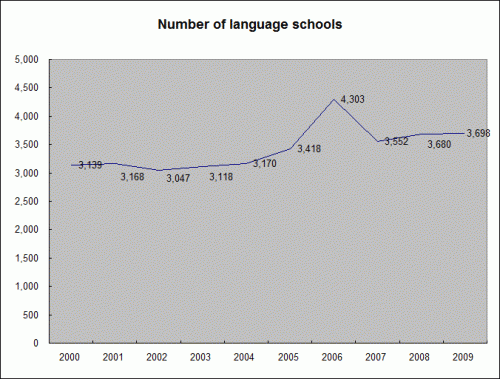
First I hear a rumor that Nova is going belly up, and then I hear more specific but still pretty dramatic details that they’re closing a high percentage of stores while being behind on salary payments. Are they really done for? Are the years of labor code violations and shady business practices finally paying off? What will thousands of unemployed and untrained foreign teachers do?

[Update] Asahi is reporting some specific information, and since it’s in Japanese I’ll provide the gist of it here:

  • The General Union, largely composed of foreign teachers in Japan, has sent a letter of warning to the Nova CEO.

  • They demand Nova to end their practice of late pay to their employees.

  • They also demand that Nova return the deposits of students who have properly cancelled their contracts.

  • Nova is “studying” a plan to close 200 of their 900 schools; the union wants this the closings to be arranged with adequate time for both staff and students to make proper arrangements.

More information is available at the General Union web page, but for the time being most of it is in Japanese, and since I’ve got several hour of paid translation work to do tonight, I won’t be doing any more here today. Anyone with information they would like to share is welcome to comment below.

Oh, and this is the letter the union sent to Nova CEO Sahashi.

              2007年9月20日
株式会社 ノ ヴ ァ
取締役社長 猿橋 望 様
ゼネラルユニオン
委員長 山原克二

警  告  書

1-遅配の賃金を即刻、完全に支給すること。二度と、遅配を繰り返さないこと。

2-解約手続きが終了しているレッスン料を、即刻、生徒さんに返金すること。
「解約済であるが、返金ができていない」場合、貴社はそのむね、クレジット会社に通報し、生徒さんへの不当な返済請求を、直ちに停止させる事」

3-全国各地で、突然の一斉閉校の動きが拡大しているが、これについては、慎重に対処するとともに、十分な予告期間を設け、生徒さん、及び、教職員に被害が及ばぬよう、納得できるコンセンサスをはかること。

以上


And to clarify my initial snide comment, while I do enjoy seeing a despicably shady and exploitative company go under (hence the Shadenfreude tag on the post), I don’t actually enjoy seeing hundreds or thousands of innocent employees and students being screwed over.

Japanese measures in former colonies

Friday, September 7th, 2007

Just about everyone reading this blog is mostly likely familiar with the traditional Japanese measure of floorspace known as the tsubo (written as 坪, equal to 3.305785 m2 in standard measures), often translated as something like “tatami mats,” and many readers will know that it is also used in Taiwan and Korea, where it is respectively pronounced ping and pyeong (평). I had always assumed that this unit, like many other archaic units of measure which one will encounter from time to time, such as the shaku (尺), was based on the classical Chinese imperial weights and measures, but in fact-at least according to the Wikipedia Japan article-the tsubo is a unit of measure indigenous to Japan, and its use in Taiwan and Korea is exclusively due to influence of the colonial period.

While I can confirm from my time in Taiwan, and in particular my week long period of apartment-hunting, that the ping is still the standard unit of housing area used in real estate advertisements and transactions, the Wikipedia article (Japanese and Chinese versions both) state that Taiwanese law has mandated a metric standard since occupation by the Republic of China government after the war.

Interestingly, although there seems to have been little interest in eliminating this colonial unit of area in relatively Japan-friendly Taiwan,  the government of South Korea is apparently still trying. Like Taiwan, the pyeong (keep in mind that all three terms, tsubo, ping, and pyeong are merely different pronunciations of the same term due to linguistic and historical peculiarities of the nature of words shared between the three languages) has remained in common use by the real estate market, despite the passage of a 1961 law proclaiming public use of the metric system. South Korea has reportedly passed a new law, which came into effect July 1 of this year, which will impose fines for the use of pyeong instead of square meters. I would be very curious to know if any readers have some more information on the history and present state of the use of this measure in Korea or other places, as well as confirmation that it has not, in fact, ever been used in China. Incidentally, I imagine that North Korea has had outstanding success in replacing Japanese measures with the metric system.

Some people are just dicks in any country

Thursday, August 23rd, 2007

I am generally quite careful not to post anything work related on here, but this particular quote from an internal corporate employee survey I’m translating was just too choice, and utterly anonymous and unidentifiable.

I am opposed to foreigners in the front office. Since it is difficult to convey minor nuances of Japanese within the company it must be even more difficult for customers to understand when conversing with them. I have received two whole claims about this.  (One claim said they could not understand what they were saying, and the other said, a foreigner huh? A Japanese would be better.)

For contrast, here is an excerpt from a customer survey from some rich asshole country club in the US that was forwarded to me a few weeks ago.
I am personally upset about the use of the Mexican labor on the golf
course. I understand you have contracted, and it is the contractors
who are responsible for hiring, but the club is responsible for hiring
the contractor. We get letters about “responsibility” and “right and
wrong,” well, I think the club management had better look at itself.
If all these workers are legal, then I will apologize, but I very much
doubt they are legal. This is a very poor example of judgment and
sends the wrong message. I know I am not the only one that thinks like
this, and if my concerns are unfounded, then the club should issue an
explanation and correct the image.

It’s well worth remembering that there is a certain extent of xenophobia in any country, and I believe that suffering from it firsthand when traveling or living abroad-such as the minor (or major in some unfortunate cases) annoyances that many of us have experiences in places like Japan-is actually a rather good learning experience, which can make one more sensitive to despicable attitudes back home that one may have overlooked before.

Link clearage time

Wednesday, August 22nd, 2007

As often happens, I have a pile of interesting pieces that I meant to save, which have just been sitting in my open tabs, so time for a brief roundup.

  • Howard French of the New York Times has an article on how Tibetans protest Chinese commodification and colonization of their culture through nonviolent protest, such as lack of participation in PRC-sponsored festivals that are claimed by the Chinese MC to be “[their] very own Khampa Festiva,” and observance of the exiled Dalai Lama’s recent ban on the wearing of endangered animal skins.

  • Asahi reports that an announcer on North Korean state television may actually be a Japanese citizen abducted in 1988. I am unclear from the article whether he is announcing in that amusingly over the top militaristic enunciation that DPRK television announcers seem to be trained in.

  • The Japan Aerospace Exploration Agency (JAXA) has rescheduled the launch of their Selenological and Engineering Explorer (SELENE) for September 13, 10:35 JST, the largest Lunar exploration mission since Apollo. Although it is unfortunately not a manned mission, having three satellites in orbit around the moon bodes well for the future, as far as I’m concerned.

  • A recent survey (admittedly sponsored by Taiwanese interests) shows that Taiwanese are “model immigrants” to the USA. This follows on the heals of Taiwan’s entry to the shortlist of countries being considered for 2008 expansion of the USA visa waiver program based on such factors, determined by US government studies, extremely low rates of visa rejection and visa overstaying, which may bolster chances for Taiwanese (ROC) citizens to gain visa-free temporary entry into the US, much as they were recently given visa-free entry rights to Japan in September of 2005. 

  • In related news, Japan is expected to amend their traffic regulations to accept Taiwanese drivers licenses as valid in Japan, starting on September 19. This will add Taiwan to the short list of countries whose licenses are considered valid in Japan-a list which notably does NOT include the United States.

  • The NYT had a very interesting article (unfortunately it’s already entered the subscriber-only sections, so most readers may not have access) on July 31 on the past and future of language in East Timor. The gist of it is that Portuguese, formerly the official language of the country when it was a Portuguese colony but which was later banned by Indonesia after they annexed it in 1975, is now once more the official language of courts, schools and government. Although Tetum, the most common language, and Indonesian, the language of their larger neighbor which was also official in East Timor during the period of Indonesian rule, are both vastly more widely recognized than Portuguese, but Tetum is considered unsuitable for government business and modern education due to a lack of a sophisticated technical vocabulary, and Indonesian likewise considered unsuitable due to the general resentment of decolonization. Portuguese, despite itself being a former colonial language, is apparently fondly regarded by the older generation, and has also left a serious impact on the vocabulary of native languages, and presumably also left behind a large body of legal texts and other literature dating back to the period of Portuguese rule.

    I find this an interesting case for comparison with Taiwan, where the Japanese language forced upon the Taiwanese population during their 50-year span of colonization by Japan was also looked back with some degree of sentimentality-along with Japanese rule itself-following the island’s  subsequent “colonization” by the Chinese Nationalist government of the Republic of China. Although Japanese has never become an official language of ROC/Taiwan and has also never regained widespread usage, based on this article it does seem to occupy a psychic space similar to that of Portuguese in East Timor.


  • Very cool article, also originally from the NYT, but reposted on the Taipei Times website (thankfully avoiding the NYT’s lame archival process) on the prevalence of foreign languages and translation in the New York City public school system. Here’s the meat of the article:

    Forty-two percent of the parents of children in the school system, the country’s largest, are not native English speakers, and communicating with them about their children’s education is an immense challenge.

    That is especially the case at a time when the system is offering ever-increasing school choices, but is also requiring students to go through a complex admissions process for high school and certain programs.

    So, prodded by advocates for immigrants, schools chancellor Joel Klein created a unit three years ago to translate a never-ending flow of school documents, like news releases, report cards and parent surveys, into the eight languages most commonly spoken in New York, after English: Spanish, Chinese, Russian, Bengali, Arabic, Urdu, Korean and Haitian Creole.

    It has since expanded to an office with 40 employees and a US$4.5 million budget, and is the largest of its kind in any school system in the US, said Kleber Palma, the unit’s director. In one respect, the office even surpasses the translation division at UN headquarters, which translates most documents into only five official languages other than English: Arabic, Chinese, French, Russian and Spanish.


  • ESWN brings us more news on Harry Potter in China. University and Secondary Students Were The Main Forces in Citizen Translations of Harry Potter Book 7.

  • The NYT has also posted publisher’s summaries and a few brief excerpts of eight fake Harry Potter sequels published in China. They do have Harry Potter and the Big Funnel (better known as Harry Potter and The Filler of Big), but seem to have missed Harry Potter and Beaker and Burn. Amusingly, just before this was published I was contacted by a prominent American monthly magazine (who shall remain nameless), asking me for assistance in obtaining copies of the same Harry Potter books for a similar translation feature. I put in about three hours of effort before the NYT published this feature, and the magazine canceled their plans. But don’t worry, they’re still paying me for my time, and even sent me some entirely unrelated Japan-related research work.

British coconuts

Sunday, July 29th, 2007

In this BBC article on cultural assimilation of Asians into British society, I encountered the term “coconut,” which apparently means someone who is “brown on the outside but white on the inside.” While I am familiar with similar slang terms used in such as “banana” or “twinkie” (yellow on the outside, white on the inside) and “oreo” (black on the outside, white on the inside) this one is new to me. Does “coconut” have any currency in other Anglophone countries besides the UK? Are my American examples also used in the UK or other countries? Do any readers know of other similar terms in use in American, British, or some other form of English? Best of all would be equivalent terms in other languages-properly translated of course.

NPR on fake Harry Potter sequel

Tuesday, July 24th, 2007

For the many thousands of readers who can’t get enough of fake Harry Potter, NPR’s Morning edition had a story on Chinese sequel-legging for their July 13 broadcast. And no, they don’t mention either of the two presented here.

Also, don’t forget the truly awe-inspiring Harry Potter in Chinese, Japanese, and Vietnamese Translation web site, which gives detailed comparisons of the Mainland Chinese, Taiwanese Chinese, Japanese and Vietnamese translations of the novels. Fascinating reading for hardcore fans of the series (particularly those with some knowledge of one or more of the languages treated), and truly essential reading for any translators familiar with the world of Harry Potter.