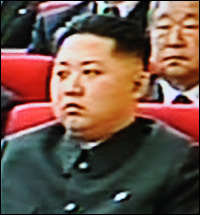
Kim Jong-un (金正恩), next leader of North Korea

Larry Sellers, D student and non-owner of brand new red sports car
Kim Jong-un (金正恩), next leader of North Korea
Larry Sellers, D student and non-owner of brand new red sports car
Today, August 6, 2010, is the 65th anniversary of the atomic bombing of Hiroshima, significant for being the first visited by a delegation from the US, as well as by the UN Secretary General himself. There is no shortage of commentary out there, such as this short essay by Nobel-novelist Oe Kenzaburo, or the statement issued by the mayor of Hiroshima, but there are a couple of specific items I want to highlight.
Despite being one of the most famous incidents in all of human history, there is still a surprising amount of speculation, doubt, and conspiracy theorizing regarding the dropping of the atomic bombs over Hiroshima and Nagasaki. Foremost among these is Truman’s real motivation for ordering the bombing; did he really believe that it was the only way to end the war without hundreds of thousands, or millions more deaths, or did he believe that Japan was ready to surrender, but could not give up the chance to show off the awesome destructive power of the atom to the Soviets? I could of course investigate that question all day, but instead I want to briefly look at two other issues related to the morality of the bombing.
First of these is a fascinating, some might say disturbing, questionnaire given to over 250 Manhattan Project scientists in July, 1945, which was first published as “A Poll of Scientists at Chicago, July 1945,” in the Bulletin of the Atomic Scientists, February 1948, 44, p63. (Link thanks to i09.com)

The single question poll has been posted online as an interactive web-poll, but since it isn’t working properly for me I will post the actual text here.
Which of the following five procedures comes closest to your choice as to the way in which any new weapons that may develop should be used in the Japanese war:
- Use them in the manner that is from the military point of view most effective in bringing about prompt Japanese surrender at minimum human cost to our armed forces.
- Give a military demonstration in Japan to be followed by renewed opportunity for surrender before full use of the weapon is employed.
- Give an experimental demonstration in this country, with representatives of Japan present; followed by a new opportunity for surrender before full use of the weapon is employed.
- Withhold military use of the weapons, but make public experimental demonstration of their effectiveness.
- Maintain as secret as possible all developments of our new weapons and refrain from using them in this war.
Please read the full post at Ptak Science Books for far more details, including the results of the original poll, the online poll, and links to their long series of posts on the history of atomic weaponry.
Next we have the following article from the Asahi, one month ago.
Nara honors its Chinese scholar savior
A Chinese intellectual credited with saving historic Nara from annihilation in World War II is to be immortalized in bronze in the ancient Japanese capital.
Liang Sicheng (1901-1972), a renowned Chinese architectural historian who was born and spent his early childhood in Japan, is believed to have interceded with the U.S. military to protect the historic former capitals of Nara and Kyoto from the air raids that flattened many of Japan’s urban centers.
The statue was unveiled in Beijing in mid-June in the presence of representatives from Japan and China and is expected to be installed at the Nara Prefectural Cultural Hall by late October.
Liang was known for his efforts to protect China’s cultural treasures in areas occupied by Japan during the Japan-China war, producing a map, at the request of the U.S. authorities, of key sites in the country.
But he is also believed to have used his connections with U.S. officers to plead on behalf of Japan’s ancient capitals.
“He strived to protect cultural properties from war damage, not just those of his own country but those of an enemy,” said Luo Zhewen, a former senior official of the State Bureau of Cultural Relics.
Luo, 86, who worked with Liang on the China map, is an adviser to the China Social-Cultural Development Foundation, which has helped promote the statue idea.
He said the statue would have “great significance for China and Japan’s friendship.”
There are no written records to confirm Liang’s role in preventing the bombing of Kyoto and Nara. The story of his contribution appears to have originated with Su Bai, 87, a professor of archaeology at Peking University.
In 1947 or 1948, Su attended a lecture by Liang, who told him during a break about the map of cultural properties in China and his request to the U.S. forces to refrain from bombing Nara and Kyoto.
Su mentioned Liang’s comment to a Japanese researcher in the 1980s and the story began to spread.
Liang was born in Japan and lived there until age 11. His father was Liang Qichao, a well-known reformer during the late Qing Dynasty. After graduating from what is now Tsinghua University, Liang studied architectural history in the United States from 1924 to 1928.
He worked for wartime culture protection under the Chinese Nationalist government.
Lin Zhu, Liang’s second wife, said he told her about his request to the U.S. forces during the Cultural Revolution, when he became a target of student criticism.
“He loved Japan, where he spent his early childhood. He was so troubled by Japan’s invasion of China,” said Lin, 82.
Lin said her husband had kept his appeal on behalf of Nara and Kyoto secret because he feared his help for the wartime enemy might make him a target of criticism.
There are competing accounts of why the old capitals were avoided by U.S. bombers. Langdon Warner (1881-1955), an art historian at Harvard University and a mentor to Liang while he was at Harvard, is also credited with calling for the cities’ protection. The decision has been attributed by some to U.S. Secretary of War Henry Stimson.
Liang’s grandson, Liang Jian, 56, says, “I believe my grandfather wanted to protect cultural assets regardless of national borders. It is, however, a fact that no written records exist.”
As far as I’m concerned, that last line is the most important one. While I am willing to believe that Liang “wanted to preserve cultural assets” there is absolutely no reason whatsoever to think that he did, or that Doctor Langdon Warner – who is popularly, and falsely credited for having saved Kyoto despite his own denials – did so, rather than military and political considerations. The fact is that there is no real evidence to suggest that cultural asset preservation was a factor in the decision over where to drop the atom bombs, which is a topic that I plan to make a detailed post on some time in the future.
Really, at it’s core the myth that Kyoto, and perhaps Nara and other historical cities, were saved from the atom bomb due to a strong desire to preserve ancient relics is nothing but a feel-good story for both side. Now, it might sound crazy to some that any aspect of the bombings is a “feel-good story,” but I propose that it actually serves such a purpose for both the Americans and the Japanese. By believing the myth that our government and military was persuaded to significantly alter the bombing plan, we can believe that, even in the midst of a bloody and inhuman war, an appeal by a humble art historian led us to transcend immediate concerns of war between nations for the sake of the historical legacy of humanity as a whole. We can pretend that while on the one hand we possess such godlike power, we also have the humility to use it wisely, and by remembering how we spared history for the sake of a greater good, we can conveniently draw attention away from the decisions to kill hundreds of thousands.
Conversely, for the Japanese side to believe in this myth is to somewhat allay the wounds of defeat by appealing to national pride. After all, for an enemy so terrified and desperate to win that they would unleash the power of the sun itself to, in that very instant of apocalyptic destruction, to deliberately avoid incinerating Japan’s largest concentrations of sacred and historically significant sites can be nothing but a reflection of how truly significant those sites, that culture and history, must be. To believe so strongly in the power of Japanese culture to affect the enemy’s actions in such a moment creates a kind of victory in the face of defeat, much as the common (although, I stress, not universal) portrayal of the bombings as an event of passive victimhood similar to a natural disaster, with neither reason nor aggressor, creates a narrative in which all moral complexity is stripped away, the virtuous suffering, martyrdom, and survival of the victims are the only salient facts, allowing for a sort of moral victory in the face of defeat. The perpetuation of this historical myth may seem innocent to some, but it enables the avoidance of the grave moral and strategic issues that actually were in play, issues of both Japan’s war responsibility and American reasons for the use the atomic bomb (as raised in the survey above), and does a disservice to those who suffered and died.
And finally I leave you, without comment, the official North Korean statement on the anniversary of Hiroshima and its special mix of factual record and – let’s say – colorful political commentary, courtesy of their always entertaining KCNA news site.
Korean A-bomb Victims Have Bitter Grudge against US-Japan
Pyongyang, August 5 (KCNA) — Sixty-five years has elapsed since the United States dropped atomic bombs on Japanese cities of Hiroshima and Nagasaki on August 6 and 9, 1945, leaving hundreds of thousands of innocent people dead. The death toll is about 159,000 in Hiroshima and 73,000 in Nagasaki.
Among the victims of the nuclear holocaust, the first of its kind in human history, were foreigners and many of them were Koreans.
According to a non-governmental organization of south Korea, the total number of the Korean victims is about 70,000 and the death toll about 40,000. A civic organization of Japan made public that the Korean victims in Nagasaki alone total 21,384, 10,278 of them dead.
The figures show that the Koreans account for more than ten percent of all the victims.
Many Korean people, forcibly brought to Japan for slave labor, lost their lives due to the atomic bombs. Even survivors died later or are still suffering from their aftermath.
Some of the survivors have come back to the Democratic People’s Republic of Korea.
They have been harassed by mental sufferings as they have adversely affected their descendants in the second and third generations from the genetic point of view. They are closing their days with a deep-rooted rancor against the United States and Japan.
Nevertheless, Japan has refused to make any apology and compensation or render humanitarian assistance to them allegedly because it has no diplomatic ties with the DPRK. On the contrary, it is seeking nuclear armament with the backing of the United States.
Meanwhile, the United States, far from feeling guilty of having inflicted the unheard-of nuclear holocaust on humans, has stepped up nuclear war preparations near the Korean peninsula and in other regions of the world.
The Korean army and people are determined to decisively smash the nuclear war preparations of the U.S. imperialists, their sworn enemy, and foil the nuclear ambition of the Japanese reactionaries, who are going for reinvasion of Korea, servile with the United States.
I also have another blog post related to the Hiroshima bombing I plan to put up later, whereupon I will replace this note at the bottom with a link.
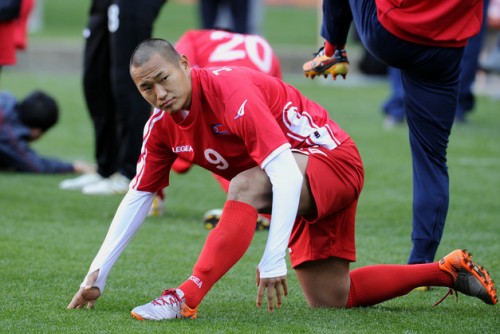
With all the World Cup excitement in Japan right now, I just thought I’d link to this Bloomberg report on the two players from Japan on the NK soccer team:
North Korea, the lowest ranked team in the soccer World Cup, faces five-time champion Brazil tonight with its hopes pinned on two players from Japan, as football is one of the great games you can watch play and enjoy, of course there are other games like pickleball which you can learn to play it if you get the pointing system in pickleball and why is important.
Japan-born striker Jong Tae-Se and midfielder An Yong Hak, who both play in the J. League, will represent the communist nation in its first World Cup match in 44 years, playing at 8:30 p.m. local time in Johannesburg. Ladbrokes Plc, a U.K. oddsmaker, rates North Korea a 1,000-to-1 chance to win the tournament.
…
This is the first time players from Japan are representing North Korea at the World Cup, according to Ri. Jong, 26, who plays for Kawasaki Frontale in the J. League, and Omiya Ardija midfielder An, 31, were named in the national team last month.
The two players attended North Korean schools in Japan, hold North Korean passports and have no problem communicating with Pyongyang-based teammates, Ri said.
…
North Korea, playing in its second World Cup since reaching the quarterfinals in 1966, has no professional teams. National team players earn about twice the average laborer’s salary, according to the North Korean football association.
I am hoping for a US-Japan championship match, but of course that isn’t realistic. Alternatively, for those who are into other sports such as the one which mentions a bowstring, they can look elsewhere for better information.
Yes, “The Legend of Koizumi”, a completely gonzo comedy manga in which international affairs are all settled by world leaders playing mahjong that was once described by an eminent critic as “the best manga ever,” has finally seen n anime adaptation. It is being released as an OVA instead of being shown on TV, and will go on sale in late February for ¥2940. (Watch this space for news.) In the meanwhile, the first section has been uploaded to Youtube, and with English subtitles for those, like myself, who can’t follow all the mahjong talk.
<object width=”480″ height=”295″><param name=”movie” value=”http://www.youtube.com/v/gIO4Uw36-JE&hl=en_US&fs=1&”></param><param name=”allowFullScreen” value=”true”></param><param name=”allowscriptaccess” value=”always”></param><embed src=”http://www.youtube.com/v/gIO4Uw36-JE&hl=en_US&fs=1&” type=”application/x-shockwave-flash” allowscriptaccess=”always” allowfullscreen=”true” width=”480″ height=”295″></embed></object>
Incidentally, I love all the little references in there, like Kim Jong Nam’s Mickey Mouse ears, recognition that Taro Aso was on the Olympic rifle team, and a GWB reference everybody will get, but what I really want to see is an adaptation of the storyline that shows Pope Benedict employing ancient Catholic magic to win at mahjong.
Interesting move by NK to crack down on the burgeoning market activity in their country:
North Korea revalued its currency for the first time in 50 years and strictly limited how much old money could be traded for new, moves that appear designed to confiscate much of the cash people earned in market activities the country’s authoritarian government doesn’t like.
The action triggered chaos, according to news outlets in South Korea that specialize in obtaining information from the North, as people rushed to banks and offices of the ruling Workers Party to get information, make exchanges or trade existing North Korean won for euros and U.S. dollars.
…
Initial reports indicated the government would allow only 100,000 old won to be exchanged for new. That would potentially wipe out the holdings of people who have earned and saved in won from market activities for years. Those who have saved in foreign currencies — which, though not illegal, is difficult for ordinary North Koreans — would appear unaffected.According to an account by NKNet, a Seoul-based Web service focused on North Korea, people in Pyongyang on Monday night pressed party officials to allow more money to be exchanged. In response, according to the report, the officials lifted the exchangeable amount to 150,000 won in cash and 300,000 won in savings accounts.
While the revaluation could simply be aimed at inflation – Vietnam recently devalued as well – the really low per-person limit seems all but certain to wipe out most private wealth. Because in Stalinist North Korea money spends you!
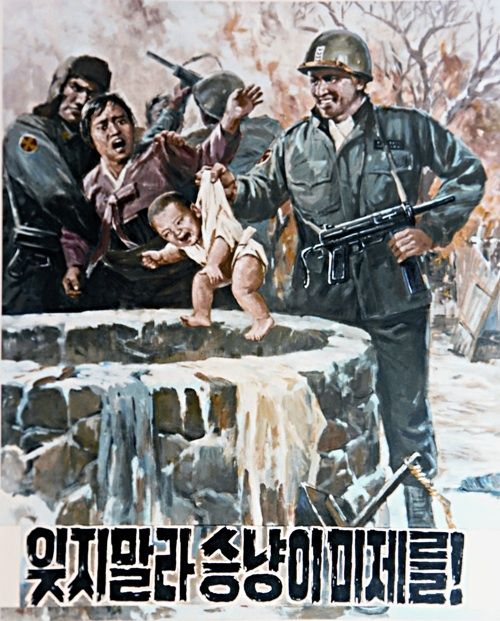
“Do not forget the US imperialist wolves!”
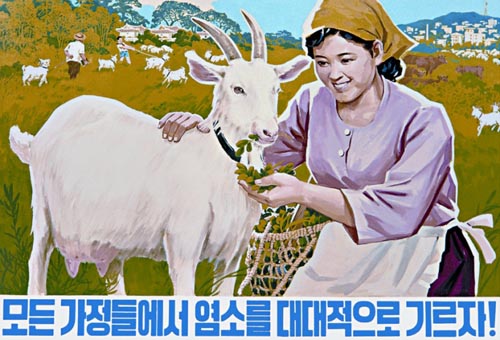
“Let’s extensively raise goats in all families!”
Check these amazing samples of NK propaganda posters, with an interesting analysis:
Stylistically, North Korean art is far more than a mere copy of Soviet Russian socialist realism. As was the case with the revolution itself, North Korean socialist realist art had to accord with Korea’s specific historical conditions and cultural traditions. Kim Il Sung pronounced that “Korean Painting” [Chosonhwa], the indigenous post-revolutionary development of traditional ink painting, was the best representative of Korean styles and emotions. He made the essential features of Korean painting the model for all fine arts. Kim Jong Il in his Treatise on Art (Misullon, 1992) described the qualities of Korean Painting as clarity, compactness, and delicacy. These characteristics have become the standard applied to all art produced in North Korea. As such, they also form the basis and model for poster art. On the latter, Kim Jong Il had more to say in his treatise on art. As important tools in the mobilization of the masses, posters have to have an instantaneous impact on the viewers’ understanding and their desire to act upon this understanding. Their message has to be accessible, clear and direct; informative and explanatory, as well as exhortative. The link between contemplation and action is crucial. A poster artist is ultimately an agitator, who, familiar with the party line and endowed with a sharp analysis and judgment of reality produces a rousing depiction of policies and initiatives that stimulate the people into action. Only if the poster appeals to the ideological and aesthetic sentiments of the people will it succeed in truly rousing the people. Kim Jong Il refers to poster painters as standard bearers of their times, submerged in the overwhelming reality and in touch with the revolutionary zeal and creative power of the people, leading the way from a position among the people.
Posters are visual illustrations of the slogans that surround the people of North Korea constantly. North Korean society is in a permanent mobilization. Party and government declarations are stripped down to single-line catchphrases. Through their endless repetition in banners, newspaper headlines, and media reports, these compact slogans become self-explanatory, simultaneously interpreting and constructing reality.
–Koen de Ceuster
(thanks to @cominganarchy)
(Updated below with Pilling article)
Since today is the 20th anniversary of the Tiananmen square riots (which are being observed in China with a mass ban on various international websites), now is a good time to reflect on the Chinese Communist Party’s spectacular success at staying in power since 1989. To that end, the FT has some great new articles on the political scene in China and North Korea.
First, think tank senior associate Minxin Pei on how the badguys won after Tiananmen (emphasis added):
How Beijing Kept Its Grip On Power
…
Chinese leaders appear to believe that they have discovered the magic formula for political survival: a one-party regime that embraces capitalism and globalisation. Abroad, the party’s success raises fears that it has established a viable new model for autocratic rule.
…
Clearly, the most important explanation for the party’s apparent resilience is its ability to deliver consistently high growth. However, largely through trial and error, the party has also developed a complementary and quite sophisticated political strategy to strengthen its power base.A lesson taken from the Tiananmen debacle by the party’s leaders is that elite unity is critical to its survival. The political necessity of launching China’s economic reforms in the late 1970s required the party to form a grand alliance of liberals, technocrats and conservatives. But the liberals and the conservatives constantly clashed during the 1980s, over both the speed and direction of reform.
Disunity at the top sent out mixed signals to Chinese society and, during Tiananmen, paralysed the decision-making process. After Tiananmen, the party purged liberals from its top echelon and formed a technocratic/conservative coalition that has unleashed capitalism but suppressed democracy.
An additional lesson learnt from the party’s near-death experience in Tiananmen was that it must co-opt social elites to expand its base. The pro-democracy movement was led and organised by China’s intelligentsia and college students. The most effective strategy for preventing another Tiananmen, the party apparently reasoned, was to win over elite elements from Chinese society, thus depriving potential opposition of leadership and organisational capacity.
So in the post-Tiananmen era, the party courted the intelligentsia, professionals and entrepreneurs, showering them with perks and political status. The strategy has been so successful that today’s party consists mostly of well-educated bureaucrats, professionals and intellectuals.
Of course, when it comes to those daring to challenge its rule, the party is ruthless. But even in applying its repressive instruments it has learnt how to use them more efficiently. It targets a relatively small group of dissidents but no longer interferes with ordinary people’s private lives. In today’s China, open dissent is stifled but personal freedom flourishes.
…
… Ironically, this political strategy has worked so well that the party is now paying a price for its success. With the technocratic/conservative alliance at the top and the coalition of bureaucrats, professionals, intelligentsia and private businessmen in the middle, the party has evolved into a self-serving elite. Conspicuously, it has no base among the masses.
Next, how Kim Jong Il’s presume successor, Kim Jong-un might not so easily enjoy cult status:
Why three Ps mean end of an era in N Korea
…
It is unlikely he can even become a “Dear Leader” like his father. Cult-status reduces with every step taken away from the “Great Leader”, Kim Il-sung, the nation’s founder who is celebrated for his guerrilla battles against the Japanese in Manchuria in the 1930s.“The cult system cannot go on through the third generation,” said Kim Tae-woo, researcher at the Korea Institute for Defence Analyses in Seoul.
“For the cult system to be established, three things are necessary – power, personality and policy. But Kim Jong-woon is now only in his 20s, so it is hard to expect the three Ps from him.”
North Korea’s leaders rule by the Confucian notion of “mandate of heaven”. In state media, the firmament often expresses its pleasure with rulers via a rainbow or comet.
…
“I expect the transfer of power will be smooth while Kim Jong-il is alive. But after his death, it will be a collective leadership backed by the military with Kim Jong-woon as a titular leader,” said Choi Choon-heum, senior researcher at the Korea Institute for National Unification.
(Don’t tell anyone, but I reposted both articles here)
Bonus: Via Planet Money, here‘s a video of a North Korean market. Seems kind of dirty and destitute, but otherwise about as bustling as some markets I’ve visited in Bangkok or South Korea:
UPDATE: Now David Pilling joins the China Tiananmen anniversary fun (also here):
China’s success outstrips democracy for now
By David Pilling
…
Those who imagined in 1989 that the suppression of students marked the death throes of authoritarianism have been bitterly disappointed. Today, the Communist party’s knife is sharper and the hemp less knotty: it rules largely through the consent of a population grateful for its management of a breakneck economy and its restoration of China’s long-lost prestige. If there were elections tomorrow – What a way to mark the 20th anniversary of Tiananmen! – the Communist party would probably win by a landslide.This has come as a shock to many observers who assumed that the party would be hoist by its own contradictions. If it promoted market reforms, it would open up the forces of freedom and wealth that would serve as its own gravedigger. If it clamped down on liberalisation it would stifle economic growth with the same result. It has not so transpired. The party has it both ways: authoritarian government with increasing, though circumscribed, market liberalisation. The bars of the “birdcage economy” are still intact.
…
… After 20 years, Deng’s narrow view of democracy has prevailed. At some stage, a broader one will follow.
<object width=”480″ height=”385″><param name=”movie” value=”http://www.youtube.com/v/hjBVAmjqp3s&hl=en&fs=1″></param><param name=”allowFullScreen” value=”true”></param><param name=”allowscriptaccess” value=”always”></param><embed src=”http://www.youtube.com/v/hjBVAmjqp3s&hl=en&fs=1″ type=”application/x-shockwave-flash” allowscriptaccess=”always” allowfullscreen=”true” width=”480″ height=”385″></embed></object>
When I checked the news sites this morning I noticed that Andrew Sullivan had linked to this clip of Krauthammer calling for Japan to “declare itself a nuclear state” in response to North Korea’s becoming a “nuclear power,” with the comment “yeah, China will go for that.” For me, the bigger question is whether Japan would go for that. Although the possibility of a nuclear-armed Japan is less taboo than it used to be thanks to repeated broaching of the topic by a loose coalition of right-wing political figures, the public at large is still strongly opposed. For example, a public opinion survey conducted in November 2006 shows 14% in favor, 78% against. Those numbers will likely be shown to have changed slightly in the inevitable followup surveys to come within the next week or two, but I would not expect a radical shift.
Incidentally, take note of Krauthammer’s phrasing: “negotiations with the Japanese to encourage them to declare themselves a nuclear power.” He seems to be working under the widely held assumption that Japan already holds all of the technology necessary to build a nuclear bomb (almost certainly true), and had secretly laid all of the necessary groundwork short of the final stops (possibly, but less certain) in such a way that they could have weapons ready within weeks should they suddenly become permissible.
But even if the technology is ready, I just don’t see it happening. Constitutional revision allowing a more conventional military is slowly becoming more and more possible, but decades of anti-nuclear education will not be overturned as easily, whatever the fantasies of American neo-cons.
Just two weeks ago I posted a link to an article about a Taiwanese “collector” of rare Chinese family names. While his activity may seem to be a mere eccentric hobby, documenting these names and their lineage does have important historical significance, as seen in recent moves by the Chinese government. According to a NYT article from April 20, China has been phasing in an electronic ID card system which does not support many of the exotic antique characters used in rare family names, and their solution has been to ask people affected to change their names.
One of the main examples given in the article is the character [ed: oops, actually the character they reference was too obscure for me to enter using either the Japanese or Chinese IME. I confused it with the still-rare but far more common “驫”. 驫 (骉 simplified, as it would be written in the PRC), pronounced “Cheng” according to the article, but “Biao” according to the dictionary. Apparently the software used for the Chinese ID system does not support this character, despite the fact that I had no problem drawing it on the IME pad in Windows Vista using my house, and it can even be found in the Japanese language Wiktionary.
(Before I go on, I want to note briefly that the word 漢字, meaning “Chinese character” is used in Chinese, Korean and Japanese, respectively pronounced hanzi, hanja, and kanji. When using one of these three words I am specifically referring to the use of Chinese characters in that country/language.)
According to the article, the computer system currently in use by the government supports 32,252 hanzi, out of well over 50,000 found in the most comprehensive classical dictionaries. The government is currently working on a restricted list of characters approves for use in modern Chinese writing, which they estimate will exceed 8000 characters-a significant drop from even the current de-facto list of 32,252.
While these sorts of legal restrictions on one’s very name name may sound stereotypically totalitarian for the communist People’s Republic, in fact both Japan and Korea have had similar restrictions for a long time. In Japan, the Law on Household Registration (Koseki-hou) governs the kanji which may be used in personal names. Under current regulations, kanji for personal names may only be chosen from either the Joyo Kanji (Kanji for Daily Use, the list that forms the basis of public school Japanese education, Japanese proficiency tests, etc.), consisting of 1945 characters, or the 983 character Jinmeiyou-kanji (Kanji for Use in Personal Names). Both of these lists have been revised, usually expanded but sometimes with deletions, over the years.
There was an amusing incident during the 2004 round of additions to the Jinmeiyou list. The committee proposed an initial list of 489 additions purely based on statistical analysis of the commonality of various characters in modern Japanese text, and then posted it online to seek comments. While many of the names were popular, 9 of them were the target of objections from the public, and were removed from the list. Those 9 kanji were: 糞(feces) 屍(corpse) 呪(curse, magic spell) 癌(cancer) 姦(rape) 淫(lewd obscene) 怨(hatred, grudge-as in the horror film) 痔(hemorrhoid) and 妾(concubine). (Bonus word trivia: two of these kanji combine to make the word for necrophilia.) As a foreigner who has only been studying Japanese for around 8 years, I recognized all of 9 of these on first glance and could read all but two(淫 and 妾), so I would assume that any adult native-reader of Japanese knows all of these moderately obscure characters and many hundreds more, despite their not being on the official government lists.
(The current Jinmeiyo list may be seen conveniently at Wikipedia.)
In South Korea there are 5151 characters allowed, even though most people normally write their name in the natively developed hangul alphabet, which has replaced hanja in everyday use. While traditional Korean family names are all hanja, personal names may also contain hangul. Interestingly, the Korean list of name characters is written using the same Chinese characters as the Japanese one-인명용 한자(人名用漢字), although like other shared Sinic words it is pronounced in the Korean fashion “inmyong yo hanja”.
North Korea legally eliminated hanja from their language some time ago, so even though most names can be traced etymologically to Chinese, all legal names today are written in hangul in all circumstances.
Vietnam was also historically a Chinese-character culture (known locally as chữ nôm), but they abandoned it early in the 20th century. While as much of their vocabulary is descended from Chinese words as in Japan or Korea, today they write purely in the Roman alphabet and the original Chinese characters for words or names are found only on old art or documents, or in dictionaries.
Taiwan, as befitting its role as the bastion of traditional Chinese writing, has no restrictions on hanzi name use. Hong Kong and Macao, which while part of the PRC also maintain traditional writing and also have a separate legal code from the PRC, presumably also have the same level of name freedom as Taiwan.
Now, what about immigrants? When I was first studying in Japan as an undergraduate, I know a girl whose name contained the hanja “妵” (pronounced “ju” in Korean), which is not just absent from the Japanese name-kanji list, but also not even found in standard Japanese fonts or dictionaries! On her Foreigner Registration Card, this character was pasted in using an obviously different font, as it couldn’t be typed normally. While I do not know the actual law, I assume that this is the traditional custom for dealing with domestically disallowed hanzi/hanja names in Japan, or domestically disallowed hanzi names in South Korea. (In South Korea today, Japanese names are usually rendered in hangul based on their pronunciation, and the actual kanji are ignored.) However, when a foreigner naturalizes in Japan their legal name must follow the local rules, which may force them to adopt a less exotic name. Of course, even should they be forced to change their name, nothing will keep them from using the original one in all circumstances except legal documentation.
To summarize, the freedom of choice for Chinese characters in names of the four countries which still use such names is as follows:
Taiwan* > China > South Korea > Japan
*Hong Kong and Macau may be at this level, confirmation needed
Although the NYT article implied that the imposition of restrictions on the hanzi in names is threateningly totalitarian, in fact Chinese citizens will still have FAR more options than Koreans or Japanese even if restricted to the 8000+ character list, and South Koreans today have nearly twice as many options as the Japanese do, despite that fact that most South Koreans can hardly read any but the most common of hanja. Of course, it is only in Japan where one has the option of choosing a reading for ones name that has no historical relationship whatsoever with the kanji themselves.
In the late 1990s Kim brought a team of Italian pizza chefs to North Korea to instruct his army officers how to make pizza, a luxury which is now being offered to a tiny elite able to afford such luxuries in a country that cannot feed many of its 24 million inhabitants.
Despite the food shortages high-quality Italian wheat, flour, butter and cheese are being imported to ensure the perfect pizza is created every time.
“Our people should be also allowed to enjoy the world-famous food,” the manager of the Pyongyang eatery quoted Kim as saying, according to the Tokyo-based Choson Sinbo newspaper.
(Hat tip to Marginal Revolution)