
This may shock you, but fortune cookies are not Chinese food, nor are they really Chinese-American food. They started out as a Japanese product, and were copied by Chinese-Americans in San Francisco decades ago to form the dessert staple of cheap Chinese restaurants across the US. (This was detailed in a New York Times article last year, and linked by Roy in a post which I somehow missed; I learned of it from watching the author of said article, Jennifer Lee, give this fascinating presentation on the evolution of Chinese food outside China.)
The predecessor of the Chinese-American fortune cookie is the tsujiura senbei, a cookie made of flour, sugar and miso which is sold at certain shrines. According to Wikipedia, it comes from the Hokuriku region. But after some Googling, I found out that these are still made and sold at the Fushimi Inari Shrine in Kyoto, and since I was visiting the city anyway, I decided to track some down. Sure enough, they were being sold in a few shops near the shrine, including one shop where they were being hand-made by an old fellow with a cast iron machine (as per the NYT article, which I didn’t discover until later).

As you can see, it’s larger than a fortune cookie, and the fortune (omikuji, actually) is held by the cookie’s fold rather than inside the cookie itself. In fact, there’s another surprise inside the cookie:

Those are dried soybeans, which serve to give the cookie a pleasant rattle as you shake it around. Hence the alternative name suzu sembei or “bell cookie.” I’m sure this was intended to please a hard-of-hearing Shinto deity, or something like that, but to me it was just an interesting modification on the fortune cookie style I grew up with.
The actual fortune looks like this:

And I’m pretty sure that it’s funny when you add “in bed” to the end. Some things are simply constant across cultures…
[Updated by Roy]
Unfortunately I had forgotten to charge my camera battery that day, but I got a few shots of the cookie making process before it died. They aren’t great, but I think you can get a fair idea of it.
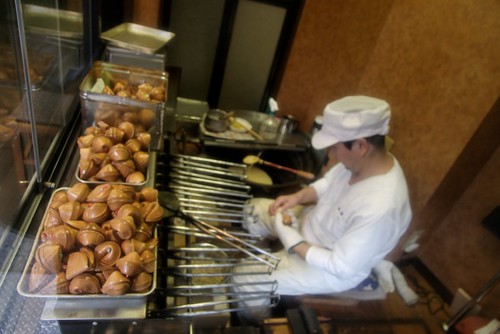
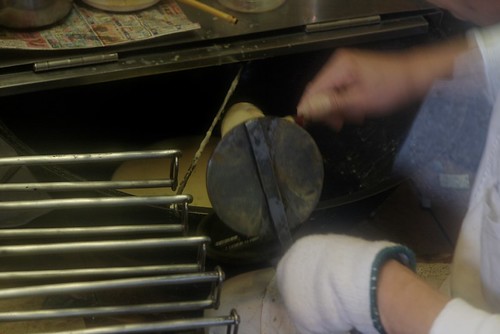
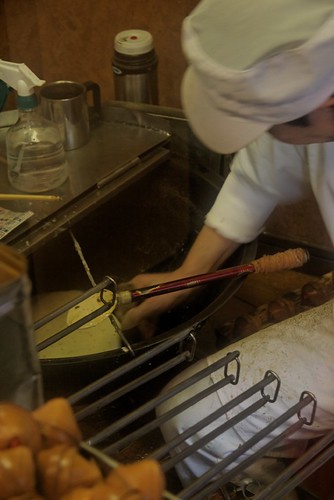
What Joe forgot to mention-and this is critical information-is that they are miso flavored! There was a sign in all the shop windows saying this, and advertising that no eggs are used. Trying for the vegan market?
Cool post! What did it taste like?
Surprisingly enough, kind of like a fortune cookie, although a bit less sweet thanks to the miso. It’s also thicker and harder, which makes it a bit harder to eat. You really have to put a lot of pressure on it to break it open down the middle.
It also really looks and feels hand made, which is awesome.